By Tom Demerly for tomdemerly.com
screen-shot-2017-02-23-at-4-52-01-pm

Disc brake road bikes, new tire sizes, new brake caliper brake placement, new models, new categories, new components.

The cycling industry has a spastic obsession with newness

The belief is that, to keep cycling compelling for consumers there must be a continuous flow of new products, exciting products.

But not necessarily better products.

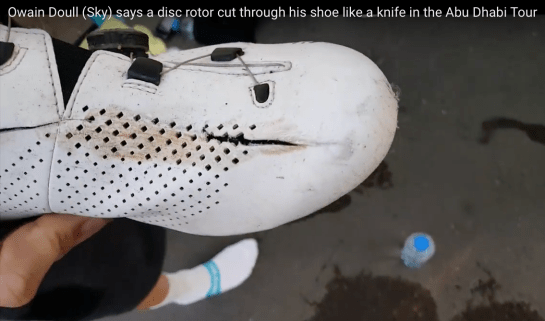
In an incident today in Stage 1 of the Abu Dhabi Tour top professional rider Owain Doull of Team Sky told reporters his left shoe was sliced clean through by a disc brake rotor in a crash. Doull sustained additional cuts he attributed to the sharp-edged disc brake rotor from the racing bicycle of sprinting sensation Marcel Kittel of the Quick-Stop Floors pro team. The two were involved in a crash near the race finish; a common occurrence in fast, bunch sprints.

Disc brakes on road bikes have been a new feature for three years. The jury is still out if they are better. This latest exhibit does not bode well for the future of disc brakes on road bikes, and it isn’t the first time.

Gregor Brown of Velo-News.com wrote this today following the Abu Dhabi incident:

“It was not the first time a rider has accused disc rotors of inflicting damage. At Paris-Roubaix in 2016, Movistar’s Fran Ventoso claimed that a large cut on his lower leg was caused by a disc rotor used by the Roompot team. That assertion has been disputed, but Ventoso stands behind the story.”

The sales pitch is often something like, “Everything is going to disc brakes!” and “Cars use disc brakes, discs work better in wet weather.” But there is a contrarian argument to be made that disc brakes are a feature without a benefit, or, at least, not a benefit commensurate to their attendant drawbacks.

In a balance sheet format, disc brakes look something like this:

Advantages:

Better wet weather stopping performance than caliper brakes. Greater tire clearance at fork and rear triangle facilitating wider tires on disc equipped bikes. More frequent use of structural thru-axle wheel design for better lateral stiffness. Removal of braking surface from wheel rim allows new rim shape designs.

Drawbacks:

Reliance on disc-brake specific wheels. Difficulty maintaining adjustment of brake calipers relative to wheel brake disc. Slower wheel changes compared to caliper brakes. Difficulty moving wheels from one bike to another due to tight tolerances. Heavier weight. More expensive. Fewer wheel options for disc brakes. New maintenance requirements, especially with hydraulic disk brakes.

So the question for consumers is, do the drawbacks outweigh the benefits? Another attendant question for consumers is, “Was there anything wrong with caliper brakes?”

In fairness, road calipers have had decades to evolve. Brake surfaces, rim profiles, brake calipers, brake levers, brake pad materials and brake cables for caliper brakes have been evolving ever since they were invented in the late 1920’s. That is a century of technological evolution in favor of calipers.

Conversely, disc brakes are new to road bikes compared to calipers, and the technology is not quite ready for prime time. If it were, the incidents with rider injuries, complexity surrounding wheel changes and maintenance wouldn’t exist.

During the past two decades when the bike industry introduced a few ideas that made it to market when they arguably were not mature we saw an increase in service and warranty related inquiries. These included, most notably, bottom brackets following the move to press-fit bottom bracket formats.

And the bike industry has a dismal record of owning its bad judgment unless compelled to do so via litigation, usually in the form of mandated recalls or personal injury lawsuits. Until those things happen the pedal is to the metal on selling new innovations with an often-subordinated regard for technical merit, let alone safety or integrity.

Solution: Do a Better Job of Selling What Already Works.

While the bike industry has done a great job of introducing “new” it has mired itself in an increasing number of sales narratives.

For every new innovation there needs to be a new sales case, new sales materials, new web assets, new sales and distribution channels and new marketing materials. It takes time and resources to develop those assets, and they cost money. It makes sales conversations longer on the floor of the bike shop on Saturday morning. It may not increase sales, but it makes it longer to complete sales. There is simply more to talk about.

An alternative solution exists in other industries where price maintenance, dealer cooperation and better marketing of existing products along with more judicious management of the supply chain has maintained product quality, profit margin and customer satisfaction.

Perhaps the best example of maintaining profit and demand for a static, non-evolving product is the diamond industry. Despite the rising supply of diamonds (there is actually a surplus) and the introduction of nearly indistinguishable synthetic diamonds, prices for diamonds have consistently risen. The diamond industry has created an emotional perception of worth although all other metrics suggest diamond prices should be falling.

The bicycle industry has not mastered any version of this perceived value equation. It is consistently undercutting price and negotiating a seasonal “surplus” of inventory that has conditioned consumers to buy previous model years at discounts. While some bike brands have reduced the emphasis on model years this has resulted in sometimes-stale offerings since the marketing narrative was not supported vigorously enough within the bike industry. They forget to sell. But they remember to invent new shiny things.

When the bike industry begins to focus on the job of selling rather than the novelty of making shiny new things then product quality will improve and profit margins will follow. And, most importantly, consumers will get a better, safer, more valid product instead of just the latest shiny thing.

By Tom Demerly for tomdemerly.com

vice-admiral

We got him because no one else would take him.

Malcom the Cat was in a crowded foster home with dogs, cats, ferrets and rabbits. Food was competitive and the population changed frequently as new foster animals came in, and older ones were (hopefully) adopted.

The lady from the animal foster home told me, “He’s a… handful.”

The arrangement seemed somewhat odd. The lady would bring Malcom to us, we would not go to the animal foster home to meet him. She asked me, “If I bring him there and it seems like it may work out, are you willing to keep him then?”

I said “Yes”.

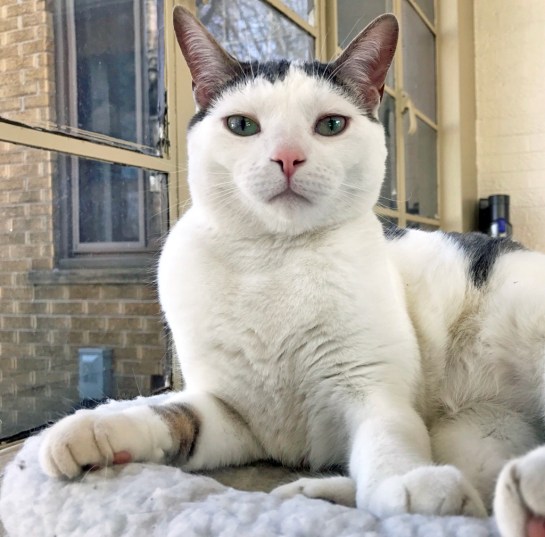
Malcom was big, even before he turned one. A large, sturdy male cat, tall and long with powerful limbs and a large head. He was bright white with unusual striped spots and a dark striped tail. And claws. Very, very big claws.

We took him.

I am the first to admit that it did not go well at first, and that I was concerned. Our other cat, MiMi, is a gentle and polite girl with soft fur, one eye (she lost the other to a snake bite in the Arizona desert next to an air force base before she was rescued) and kind disposition. She’s a lap cat.

Malcom was a competitive, territorial predator. A fighter.

One day, when the house was torn up, MiMi was hiding somewhere terrified and I was losing blood through another series of scratches on both arms, I sat down and spoke with Malcom.

“You know Sir,” I told him, “This is a cooperative home. Every cat has to get along here, do his share, and be a good cat.”

Malcom stared at me.

“I know you are a fine cat, you just need some time.”

Time went by. One day I picked Malcom up and he didn’t tear me apart. He started purring. One night I felt something heavy on my leg. He was in bed with me.

Soon after a little cat named Chester showed up outside our window. And Chester moved in. Now there were three.

viceadmiraladministers

The Vice-Admiral oversees the delivery of new equipment.

I sat them all down one morning, as well as you can do that with three cats (which isn’t very well). We laid some ground rules: every cat must get along with the other cats. Meals are in the morning and the evening. Everyone eats together, served in order, from their own bowl. Everyone gets up at the same time. Everyone is allowed to sleep where they want but no fighting over sleeping places. There were more rules.

The three cats listened, seemingly interested, likely indifferent as cats are.

Finally, I appointed Malcom as the de facto leader, largely because of his physical prominence, but also because of his experience in an animal foster home. Apparently he used his size, strength and razor-sharp talons to enforce a kind of martial law there. Hence, he became Vice-Admiral Malcom Fredrick Davis III. Named from a number of sources, the third in an honorable naval lineage of cats who rose to equal prominence and distinction from the crucible of adversity.

Today the Vice-Admiral, as he is formally known, presides over nearly every activity in the house. He is served first at breakfast and dinner, eats in the highest position and in matters of cat politics, is subordinate only in seniority to MiMi, who is several years his senior and hence the wiser.

It took time to understand Malcom. It took time for him to become comfortable with the rules and procedures of a house with three very different cat personalities and two people. But with guidance and compassion and patience he has become a very fine man, a leader of cats, and an example to all cats. That every cat can rise above a difficult past, learn to stop scratching, accept and show affection, behave in a gentlemanly manner and enjoy the many things that cats take amusement in.

It’s just matter of patience and understanding.

viceadmiralportrait


By Tom Demerly for tomdemerly.com

president-elect-donald-trump

“Thank you America! Thank you!

Thank you for being a great country, a great people, a country made up of great people.

You know, we won this election based on many things, one of them is a slogan, and it’s a fabulous slogan, “Make America Great Again.” I say “we” won this election because we all did. Every one of us. There are no losers today. There are no losers in a free country when democracy grinds its often loud, often difficult way toward what it is we all desire, even though we propose to get there in different ways.

We argued and debated, checked and rechecked our system, and we learned that it is still a great system. It’s always been great. Today proves it’s great again. Our forefathers made this system great, and you’ve made it great again today.

This election proves what I’ve believed all along, America truly is great. The fact we’re standing here together, on this day, proves how truly great America is. It’s the reason I asked you two years ago to hire me for this job, one of the most important jobs in the entire world, and by far the most important and sacred job I’ve ever had the privilege of doing.

During this last administration Americans showed why we’re great. They rallied, they demonstrated, they debated on both sides and they worked through a difficult process to be heard. And you are heard. So here we are. Thank you for speaking up, and speaking out.

And I have one thing to tell you as we start out today, America: I hear you.

I hear you calling out from the factories and the assembly lines and the check-out counters. I hear you when you tell me that half of us can’t afford the basics even though the stock market nears all time highs. I hear you call out from both sides of the aisle, no matter where you live or how you live or what you earn. I hear you. And I’m listening.

I’ve heard that government is so bloated with its own rules and forms and regulations that it can’t push away from its own dinner table to answer the knock on the door of people who want the freedom and liberty to remain great, and the ability to be even greater.

I’ve heard that things like the Affordable Care Act are anything but affordable. I’ve heard that you can’t afford to take care of your aging parents even though you work three jobs and sixty hours a week. I hear that you can’t afford college for yourself or your kids so we can continue to be great. I’ve heard that you work so hard that you have no time to retrain for a new job in a changing economy. And I’ve heard one thing that bothers me the most, one thing that ultimately got me here today, I’ve heard, both here and outside our country, that America isn’t as great as it used to be. Well I don’t agree with that. Today proves we’re right.

And America, I’m listening. And I’ll keep listening.

You’ve hired me to do a job, and I’m honored to be the candidate chosen for that job, it’s the most important one I’ve ever had, and I’m humbled that we stand here today, together, ready to get to work. And along the way to getting here you’ve told me what you want done.

You’ve told me you don’t want a hand-out, that you want a way up. You’ve told me that Washington needs to lead, to follow or to get out of the way. We’re going to do some of all three, and in different ways than we’ve seen before.

I’ve heard that we face threats to the ideals and values that we hold dear. The things that are guaranteed to all women and men. These threats originate in places far, far away. We’ll meet those challenges with strength and resolve at every corner.

I know that the creeping cancer of terrorism threatens America. That cancer will never infect our country. I’ve already picked the strongest and most experienced team of people in history to lead our continuing fight against terrorism. And I have a message for those who choose violence and oppression over unity and liberty; Your evil ways are over.

And I know that you hired me not just to listen, but to deliver on the promise of an American dream that, during this past decade seemed, to many, like only a dream while we waited in endless lines and filled out endless forms for a hand-out or a fair chance when all we wanted was to get to work.

I hear you.

Today we do get to work. We work on forging an America better than ever before, built on the foundation of the greatest country on earth. Built by people from all over this world who have always wanted three precious things; a chance, a change and the freedom to prove there are no limits in the United States of America.

This won’t be easy, and in the long American workday we all won’t get everything we want as individuals. But America isn’t only about individuals. It’s about unity, community and our great national ‘whole’ being greater than the sum. That when we reach above our differences and find our common goals, our common aspirations, we can unite in the hard work to make our shared dreams into a reality better than ever before. And as Americans working together in these United States, we can accomplish anything.

I hear you America.

And now the world will hear the sound of an America made great once more. An America that rises up again and again and again, built upon a succession of yesterdays from our foundation and principles to a future of tomorrows greater than we can imagine. An America that will reach ideals and goals not yet dreamed of.

Think of our lives 30 years ago and how different they were then. Now try to imagine our lives 30 years from now in an age when the only constant is change and change happens so fast we sometimes feel we’re lost in a succession of ever-reinventing Americas that often seem strange, out of control.

But we are not lost. Our founders drew maps called the Constitution and the Bill of Rights. Those great maps will take us to our destiny across any future, no matter how changing and unforeseeable. When we use our shared ideals as our national roadmap we can navigate any change with courage, ambition and grace.

And as we navigate this change together I pledge to always stay the course of freedom, liberty, the strength of the American people and the things that have always made us great.

America, I hear you, and it is a joyous chorus of voices rising up as one to tell of a tomorrow greater than any of us can imagine.

America, I hear you. Now join me in listening to the sound of our success! May God bless these United States of America!”


Speechwriter’s Notes: 

  1. This is written in the language and speaking patterns of President-elect Trump. It is the result of listening to his oration and creating a style that is natural and comfortable for him, using his favorite words. It also includes his penchant for repetition of themes, and restating them in different words during the same speech.
  2. His penchant for speaking in themes, “promises” and leaving specific commitments out of the delivery.
  3. There is a moderate “centering” of position in the post-election rhetoric as the President-elect transitions from a divisive election narrative to the mission of aligning a divided nation in the interest of progress and cooperation; the campaign divided us, the President-elect’s term must unite us in order to accomplish anything.
  4. The speech, as written, runs only seven minutes (07:00). Previous inauguration speeches, including Ronald Reagan’s first address, ran over 20 minutes and were more substantive. In keeping with President-elect Trump’s history of orating only on theme rather than specific substance, and the success it has brought his campaign. At the President-elect’s discretion, specific themes can be outlined into the script while care is taken to maintain the continuity of the theme.
  5. The intent is for media to colloquially refer to this as President-elect Trump’s “I Hear You” speech, a theme that will be revisited throughout his term.


By Tom Demerly for tomdemerly.com

President Obama during his speech at 2010 winter commencement held at Michigan Stadium on May 1st 2010. (SAM WOLSON/Daily)

Friday, January 20, 2017 is the final day President Barack Hussein Obama II will serve as President of the United States. He was President for 2,931 days.

Those were among the most significant days in my life.

The day President Obama was sworn in I owned a business grossing well over $1M. I earned an upper-middle class living. I owned a house in the city where I was born. I actively participated in local government, paid for a new car in cash and was on track with retirement savings for a person my age.

A year later I lost everything.

The full weight of the banking collapse, the global recession and the automotive meltdown settled on Dearborn, Michigan. The stock market plummeted to 6,000. People lost houses, businesses and livelihoods. I lost all those things and more. I had a stroke and lost part of my vision and needed heart surgery. I declared bankruptcy, packed a suitcase and moved to Tucson, Arizona in a modern day “Grapes of Wrath” migration to start a new life.

Now, 2,500 days later (give or take) I’m back. Detroit and Dearborn are back. I own part of a business again and write for four media outlets published around the world. Abandoned buildings and empty businesses on Michigan Avenue in Dearborn are gone. New ones are being built. Ford Motor Company is rebuilding its engineering center. Small businesses are going back into Dearborn. The stock market is flirting with a new record at 20,000.

Seven years later I have hope again.

It would be wrong to attribute America’s entire comeback to President Obama, and it would be equally inaccurate to blame all of America’s many remaining problems on him.

It is entirely accurate to acknowledge his steadfast adherence to his ideals. It is also accurate to credit him with a measure of unity and compassion that was much needed in America when he was elected.

When President Obama first took office our country was fractured and afraid. And while much of that feeling remains and even expanded during this last, divisive election year, President Obama presided over our national crisis with quiet strength, dignity and wisdom.

He inspired us to rise up, come out, speak up and get to work. If you believed in him, he inspired you to support his agenda. If you disagreed with him he inspired you to oppose his agenda with action and resolve. No matter your political orientation President Obama inspired us to action. He inspired us to hope we could be a part of the system, then he set an example that everyone can be a part of that system.

A consistent theme of President Obama’s time in office has been “Hope”. When he was elected he said;

Do we participate in a politics of cynicism or a politics of hope? I’m not talking about blind optimism here — the almost willful ignorance that thinks unemployment will go away if we just don’t talk about it, or the health care crisis will solve itself if we just ignore it. I’m talking about something more substantial. It’s the hope of slaves sitting around a fire singing freedom songs; the hope of immigrants setting out for distant shores; the hope of a young naval lieutenant bravely patrolling the Mekong Delta; the hope of a millworker’s son who dares to defy the odds; the hope of a skinny kid with a funny name who believes that America has a place for him, too. Hope in the face of difficulty. Hope in the face of uncertainty. The audacity of hope!”

But hope is a hollow doctrine without action, and President Obama inspired us through his own action. In every policy that he believed in, in every doctrine that he supported, he was tireless, resourceful and relentless. I did not agree with all of his initiatives, but I remain inspired by his endurance, tenacity and grace in driving them.

Understand that President Obama stood for two things: his political agenda- that you may or may not have agreed with- and most importantly, the strength of hope. Not hope only for our own agendas and politics, but hope for every single American, regardless of politics, race, religion, orientation or aspiration.

That hope has carried us, sometimes in the absence of anything else.


By Tom Demerly for tomdemerly.com

2016storeclosingsalesliquidationfinalgoingoutofbusinesssalesgettyimages-758495-571f256c5f9b58857dc11614

In a brutal week for traditional big-box U.S retailers, Sears Holding announced the closure of 108 Kmart and 42 Sears locations in 40 states. Overall 150 large department stores are being closed by the formerly popular department store brand. Additionally, department store giant Macy’s announced the closure of 68 stores across the U.S.

As with any large shift in business there is likely no single reason for the closures. They are the result of a complex amalgam of factors that have aligned to degrade the appeal of big department stores to retail customers.

What can the bicycle retail industry learn from the big-box closures?

If you insist on a singular narrative to the “big-box bust” it is failure to adapt.

Big box retail stores are essentially a time capsule of retail since the post World War II consumer boom era. They have not changed significantly since then. Items are stocked by category in displays on a large sales floor. Displays highlight featured products. Shoppers can see, feel and touch items before they buy them. And while this seems like a logical way to present and sell consumer goods it fails to acknowledge a simple theme: Most other factors in retail consumption have changed.

When Sears, JC Penney and Macy’s were founded Costco, Sam’s Club, online shopping, smart phones, Amazon.com “One-Click” and e-Bay did not exist. These new alternatives to traditional retail have exerted a kind of slow, painful “death by a thousand cuts” on traditional department store retail. Add the “reset” affect of the U.S. recession and structural changes in age demographics and you have a brutal conspiracy of factors working against traditional retail.

Retail has become increasingly polarized, with consumers gravitating toward either end of the retail spectrum. They buy from massive online and warehouse stores for commodity items like appliances, most daily apparel and food staples. They buy from small well-branded niche retailers for discretionary purchases like fashion apparel, luxury goods, specialty recreational equipment and items that help define their lifestyle.

The lesson for the bike industry is simple; sell, stock, display and market differently than old school department stores. Look at what they have done, and do the opposite.

Here are a few specifics for bike retailers: Avoid excessive program buying that makes any one brand dominant in your store making it feel like a generic “brand store”.

Bike brand takeover of independent bike dealers has been an emerging trend because of attractive pricing incentives for dealers, financing of inventory and the marketing strength that the big brands offer the small shops. These things sound great to a small specialty retailer. Bike brands have sold small independent dealers on the idea of “competing with the big boxes” by aligning with a big bike brand for marketing, financing inventory and even point of sale systems. The problem with that logic is that small specialty retailers don’t need to, and cannot, compete with the big box retailers. Instead, they need to create and maintain an entirely new identity unto themselves. They need to create their own niche, and that takes original thinking and acceptance of risk.

If there is a singular lesson it is: If the big box retailers are doing something, then the small independent bike shops should invent another approach. Small specialty bike shops should capitalize on their small size by remaining nimble with inventory, rapidly adaptive to trends and constantly changing their merchandising to reflect their position at the leading edge of the sport. They also need to be honest about the structural elements of their business. Are they located in an area where cyclists live, ride and shop? Does the local population use specialty retailers? Are they near other niche-category specialty retailers?

Finally, the small specialty bike shop needs to exploit the great equalizer of modern commerce, the Internet. This doesn’t necessarily mean having a shopping cart experience online, but it does mean presenting products that are unique and branding themselves by communicating a unique voice that reinforces expertise, candor and authority.

It’s possible for the small bicycle retailer to succeed, and some continue to, but the rules have changed and continue to change quickly enough that doing the same old thing will earn a retailer the same destiny as once-great retail giants Sears, Macy’s and JC Penney.


pharewell50

When I was a kid, about 8, a neighbor took me to an airshow. It was 1970.

There were Army Rangers there with a giant boa constrictor. You could put the snake around your neck and have a photo taken. Famous test pilot Bob Hoover, who flew with Chuck Yeager when he broke the sound barrier in 1947, flew a Rockwell Aero Commander prop plane with both engines shut off. There was a real P-51 Mustang there too.

For the finale of the airshow the U.S. Air Force Thunderbirds would fly in their supersonic Phantom jets.

After the Thunderbirds landed the father of the kid I went to the airshow with, Alan Larraza, decided we might as well wait there instead of sitting in a hot car in a big traffic jam. Al’s dad heard a rumor that the Thunderbird pilots would sign autographs after the show if you waited. Of course, a rumor like that could never be true.

We waited on the wide expanse of the open airfield. There was smoke in the air and the smell of jet fuel. A fence separated us from the important men who got to walk close to the airplanes and actually touch them. The fence also separated us from the tall, thin men with sharp chins and crisp uniforms who looked like statues and wore their hair stubble short in perfect haircuts that looked like they were done this morning. Everything about these men was perfect- how they stood, the sunglasses they wore, the places they were from, the angle of their jaw.

These men were pilots.

I waited on the other side of the fence, where the regular people had to stay. I came from a single parent home where my Mom barely made ends meet. I wasn’t a great student in any subject except English, which wasn’t really even a subject since it was so easy. I knew, even at 8 years old, that I would always have to stand on this side of the fence at an air show. Only the tall men with the perfect haircuts, patches on their crisp uniforms and polished flight boots got to go on The Other Side Of The Fence.

The Thunderbirds were the biggest, most incredible, most important, loudest thing I had seen in my life. The sound, the smell of jet fuel, the incredible speed of their planes and the giant crowd that came to see them, even at the height of the Vietnam war protests (some hippies were kept outside the gate because they were protesting the “war show”). It was boggling to me that something could be so… big, so serious, so vast, so important.

Men on the other side of the fence in uniforms handed out a free pamphlet with photos of the Thunderbird pilots on the front. The photo on the front showed six men kneeling, one knee up, the other knee down, with big smiles and thin pilot hats. Every man was positioned identically in front of a giant, red, white and blue Phantom jet. These men were the actual Thunderbirds. And I got a free picture of them.

“If ya’ll stick around son, the Thunderbirds’ll be sign’n autographs soon e’nuff”, said a tall man with a cowboy accent in an Air Force uniform from the other side of the fence. He handed out the free pamphlets. Inside the pamphlet were diagrams showing maneuvers the Thunderbirds did, the “Diamond Roll”, the “Knife Edge Pass” and the “Roll Back to Arrowhead Formation” were some of them. On the last page was a photo of a real F-4 Phantom jet with all the numbers about it; how wide its wings were, how fast it went, how far it could fly. Everything you needed to know.

The crowd got thicker at the fence. Six tall men in blue jumpsuits and thin pilot hats were standing out on the concrete near the actual Thunderbird planes. All at once the men began walking up to the fence. The crowd pushed forward. People started holding out their pamphlets as the men got closer to the fence. When they got to the fence, people started snapping photos on their Kodak Instamatics and holding up pens.

autographs

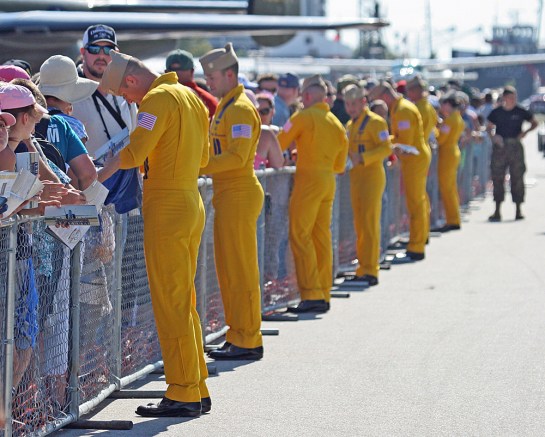
In a tradition that dates back to the first airshows, the U.S. Navy Blue Angels pilots sign autographs at the fence line after their flight demonstration at the Cleveland Airshow this summer.

The men in the blue jumpsuits shook hands, leaned over and let people take photos with them, smiling wide grins with their special sunglasses and shaking hands like they knew each other or came from the same town. The men would sign their autographs next to a photo of themselves with the number of plane they flew on the free pamphlet.

I held out my pamphlet. “You gonna be a jet pilot someday son?” One of the Thunderbirds asked me when he signed my pamphlet. He took a pen out of a special pocket on the shoulder of his jumpsuit. I was too stunned to answer. He was very tall. Every part of him seemed… sharp. Perfect. His life must be the opposite of mine, everything in order, everything decided, everything perfect. Everything sharp and perfect and clean

I wanted that. But I never got it.

I joined the Army and did minor work in a special operations unit that gathered intelligence. I wound up with the guys who had the snake at the airshow. It was good, great even. We won a war, spied on the enemy and knew secret things.

But it was never- perfect. Not like the clean, crisp tall men with the red, white and blue Phantom jets at that first airshow.

A month or so ago I found out the McDonnell-Douglas F-4 Phantom II, the “Phantom jet”, would fly its last flight with the Air Force at the Aviation Nation airshow at Nellis AFB in Nevada. My girlfriend asked me what I wanted for my 55th birthday. I told her, not entirely seriously since it was such a big thing, that I wanted to see the F-4 fly for the last time. It was 47 years after that first airshow with the Thunderbirds and their Phantom jets.

In the way she works her magic my girlfriend, Jan Mack, got us to Las Vegas just a few miles from Nellis for the airshow. I write for an aviation website called http://www.tacairnet.com and wanted to do a story on the final flight of the F-4 Phantom II.

Jan and I meet co-contributors to TACAIRNET (Tactical Air Network) Melanie Mann and Ethan Garrity, both pilots from Texas. We’re sitting up front in the VIP area with catered food, our own bathrooms and chairs on the flightline and about 50 cameras.

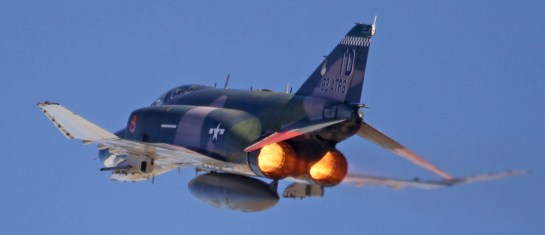
There are two McDonnell-Douglas F-4 Phantom II’s here at Nellis AFB for its last official airshow. These last surviving two of only about seven left in the U.S Air Force, are called QF-4E’s. They have been modified to be flown by remote control without a pilot or with pilots. When they are unmanned other planes can practice shooting them down. Some of the QF-4E’s will die a fiery death, shot down by live missiles fired from brand new F-35 Lightning II’s out over the open ocean in tests.

One of the QF-4E’s here today is on static display so we can touch it and see it up close, the other will be flown in the final airshow demo by Lt. Col. Ron “Elvis” King and retired Lt. Col. Jim “Wam” Harkins of Holloman AFB, New Mexico.

I get to see the last F-4, touch it, look at how it has aged and weathered. I wonder where this aircraft has flown, when it was built, about what happened to the pilots who flew it and where they are today. There are old men here wearing F-4 Phantom hats. They’ve come from around the world to see it fly and touch it one last time. Some of them flew the Phantom a long time ago. One of them may have flown in that first airshow I was at 47 years ago.

There’s a convention that a pilot always says whatever aircraft she or he is flying is the absolute best. Pilots pick careful language to describe a plane they fly, and if you listen closely enough, you get a feel for what it must really be like.

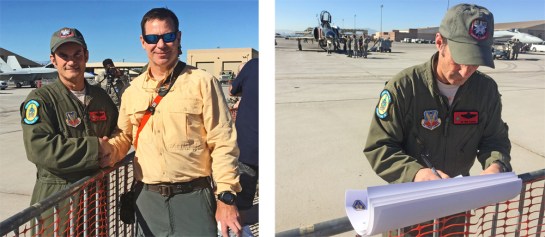
I meet Air Force Lt. Col. Jim Harkins and Lt. Col. Ron King near the QF-4E they will fly today. A bunch of maintenance guys are tending to the tired old plane. Like an old person with difficulty controlling their body, she is leaking everything- fuel, hydraulic fluid. She needs a lot of maintenance to keep her in the air now.

“She’s old, but she still flies good.” Lt. Col. Harkins tells me. “We’ll be taking her home after this, then… that’s about it…” He signs prints of these two QF-4E’s I brought to the show with me. He writes the date of the last flight on the posters. I get a few signed, including one for my friend Lance who is back in Michigan taking care of Jan and my cats while we’re gone.

pharewell100

I shake the pilots’ hands. Thank them for bringing the F-4 out one last time. “You’re welcome. It’s a pleasure”, he tells me. We pose for a photo that Jan Mack takes of us.

And that is it.

The QF-4E flies its last demo. I’m focused on getting good photos of her but during one of the passes I lower my camera and just watch. The smoke and smell and sound are exactly like 1970. It’s 47 years ago and I’m a kid at that first airshow all over again. There’s a new plane here, the F-35 Lightning II, and pretty soon we’ll get a chance to see it fly, talk to the pilot, maybe even touch it if we’re lucky…

pharewell120


By Tom Demerly for tomdemerly.com

ap_hillary_clinton_jt_151030_12x5_1600

Hillary Diane Rodham Clinton ran a credible and just campaign. It brings to a probable conclusion a long political career that included two runs at the U.S. Presidency.

Clinton has distinguished herself as a public servant for her entire career. And while no public servant, especially at the highest levels that she rapidly rose to, is without criticism, her dedication to public service never lacked vigor, drive or tenacity.

In a divisive election played out largely on the battlefield of social media, Clinton outwardly played by the old rules. That is commendable. But the new rules are, there are no rules.

Secretary Clinton is to be best remembered by her tireless efforts to preserve diplomacy in a world that lacks civility now. When the world went low, she stayed (at least outwardly) high. Her approach to politics was dignified and poised. She should be remembered for that.

Hillary Clinton will never be gone from public service or commentary, and that is good. She is an articulate and civil voice to be heard, and she will remain relevant. She is particularly relevant contrasted against a new Presidency that has swung so far to the opposite extreme.

If you voted for Hillary Clinton, I commend you. You are as fine an American as Secretary Clinton. It is now up to her supporters to vigorously continue to work, further her worthy doctrine, and be heard.

Hillary Clinton and her supporters did not lose. Regardless of Secretary Clinton’s transgressions and errors- of which all humans are susceptible and most are guilty- much of America is better from the legacy of Hillary Clinton.


Photo and Story by Tom Demerly for tomdemerly.com

f35break_edited-1


Silence fell over 200,000 people when the announcer’s voice dropped off…

A half million eyes turned up and left, looking to the west.

“And… Ladies and gentlemen, from left of show center- your- United States Air Force F-35A Lightning II..!

It is the first time I have seen a major new aircraft introduced in nearly four decades. It is history. Likely the last time in my lifetime this will happen.

So I look left and up…

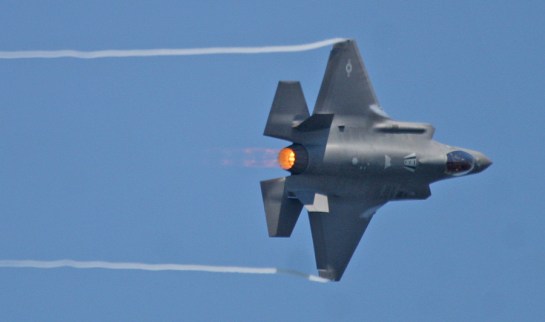
A small, grey spike, angled slightly upward, drifting silently toward us at moderate speed. Suddenly its speed gathers. The utter silence is eerie- so many people holding their breath, eyes turned upward, necks craned left. Fingers point. There it is!

It’s flight is like an arrow from a bow until- flame. A tongue of orange perforated fire leaps from the rear of the small grey spike. With unlikely acceleration it angles slightly nose downward and hurtles in front us. Still no noise. Silence. Then…

Like a roar from a movie monster there is a deep growl of fiery thrust, then a sharp, shrill whine above the deep, flaming bass. It’s unlike any sound I’ve heard.

Inside the F-35A USAF Major Will Andreotta, callsign “D-Rail”, cranks his right wrist toward his thigh and pushes his left hand forward. His F-35A Lightning II Joint Strike Fighter heels over in the gathering crush of centrifugal force as g-forces accumulate. The Lightning II turns one huge, flat, fiery circle in front of us.

Then it is gone.

There are no stunts. No rolls, loops, tail slides. There is a lingering tinge of afterburner noise as the grey spike rapidly fades into blue sky over Lake Erie.

That’s it.

I had one pass to get a decent photo, and my cameras are old and beat up. Sometimes they work, sometimes not. I get lucky. At the outer edge of my camera’s ability to catch a high resolution image I bag one good shot from a sequence of many. A little Photoshop to tweak color, shadows, light and contrast and I have what may be the most significant photo I’ve shot in four decades: the first time I’ve seen an F-35, an airplane that will still be flying and fighting when I die.

f35_250_edited-1

The next morning I get an audience with the pilot of the F-35A, “D-Rail” himself, Major Will Andreotta. Major Andreotta has a tough job flying the F-35A for airshow audiences. Not everyone is convinced the F-35A is a good aircraft. There are protesters outside the airshow holding signs that question how many schools could be built for the price of one F-35A (Quite a few schools could be built, one F-35A costs the Air Force an estimated $98 Million).

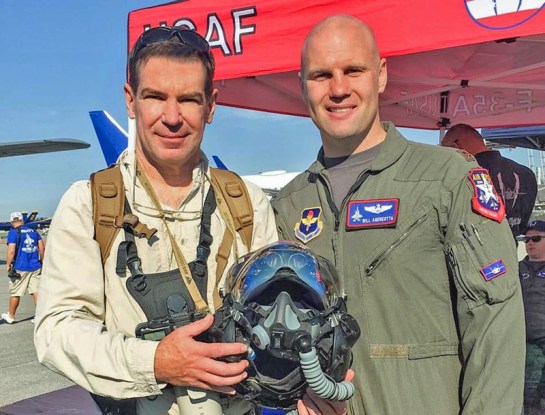
Major Andreotta has to chat with everyone from 8-year olds to F-35 protestors to aviation geeks and hybrid journalist/aviation geek/intelligence gatherers like me. But once D-Rail and I begin chatting behind the F-35 demo team tent he senses he’s in relatively safe territory. I ask him pointed questions about F-35 capabilities. My inquiries are laced with attempts to get him to reveal something the rest of the media hasn’t reported on- some new capability, some new feature to report on for the publication I write for, The Tactical Air Network (www.tacairnet.com). D-Rail throws me a bone. He hands me his flight helmet, the nearly half-million dollar helmet that has been a part of the controversy about F-35. They don’t let just anyone handle the $400,000.00 helmet.

It is absurdly light, like a bicycle helmet, and covered in beautiful carbon fiber. The visor looks like crystal and the shell is criss-crossed with communications cables and data cables. With the helmet, D-Rail can “see through” the floor of his F-35.

“It takes a little getting used to, and we don’t turn it on unless we need that capability.” He tells me.

I get no new scoop, no new nugget of previously secret intel about something amazing the F-35 can do. But I do get a series of pregnant pauses and measured responses from D-Rail that hint at many things unsaid.

I also get a handshake, autograph and an F-35 patch, just like the one on D-Rail’s flight suit. My girlfriend Jan Mack shoots a photo of me holding the helmet, standing next to D-Rail with an idiotic grin on my face like a starstruck teenager with a pop star.

But most importantly, I got that one photo when Lightning struck for the first time.


By Tom Demerly for tomdemerly.com

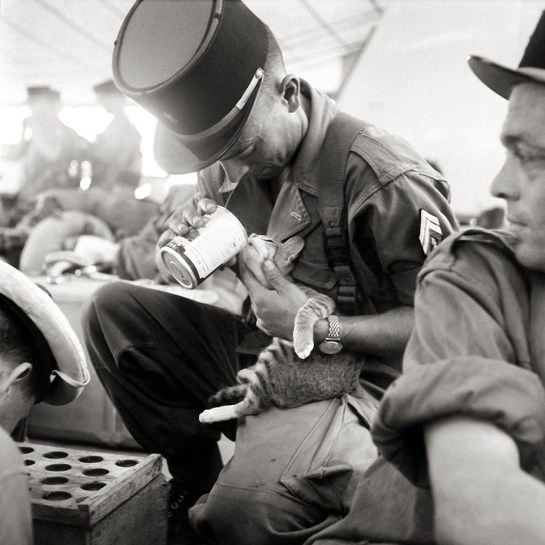
00-0b-cats-at-war-french-army-indochina-1956

My psychiatrist told me to get a cat.

I was having nightmares. For seven years. Nightmares of plane crashes. I was not in the crashes but would see them from the ground. Not all the dreams were the same, but they were similar. Detailed. Color. Graphic. Gruesome. In one dream body parts were caught in a tree where a plane went down right over my head. In another I tried to pull a burning person from a crash. His arm came off in my hand. I would wake up and stay up, and I was afraid to go back to sleep.

So my psychiatrist told me to get a cat.

I did.

We live in a big world, and most people only see a very small part of it. I have seen much of it. When you travel over continents from peace to war you bear witness to the full spectrum of human interaction, from inspiring charity to noble heroics to horrifying cruelty. And I have seen them all.

So I got a cat.

Over time I noticed that, if I was kind and patient and loving to the cat, it would act the same toward me. I learned that cats were much more intelligent than I originally thought. They have individual characters and personalities. They also have fears and anxieties and sometimes act out.

But for the most part, when you show a cat kindness, it returns kindness.

I also learned that having animals allows us a sacred privilege on a sacrilegious earth; the privilege to create our own little world.

When you have a cat you can make your own moral code of how to live: You will never abandon the cat. You will always care for the cat. You will love the cat selflessly even if it scratches you or knocks something valuable on the floor. You will elevate the cat to a place of reverence and safety. In doing so your relationship with the cat becomes an island of kindness, love and safety in a the vast ocean of the world where things are often cruel and unfair.

But in the little world that you have built between you and your cat, there are no nightmares. Only petting and purring and playing and scratching and cat toys. And until the sad day when your cat leaves this earth it will be happy and well cared for.

And in this life, no matter what else happened, you can point to one thing and say, “I made that better.”

That’s why I got a cat.

Photos and story by Tom Demerly for tomdemerly.com.

49c97dc8a5df8f84129ca29dfb962140

I didn’t move to Tucson, Arizona by choice. I was a refugee of the American Recession.

In a migration that mimicked a modern day “Grapes of Wrath” I took a job with the world’s largest triathlon retailer in Tucson and moved there after losing my own business in Detroit.

TriSports.com flew me to Tucson for an interview. Following the interview I was convinced I was finished in this business. The founder, Seton Claggett, asked some tough questions. I left with my head down.

But I got the job.

I did a little of everything at TriSports.com’s massive headquarters. Marketing, sales, promotion, writing, photography, video commentary, employee training, managing, sweeping floors, bike fitting, driving stakes in the desert and cleaning up trash by the roadside. Working there was immersive. The H.R. director counseled me that I couldn’t work as many hours as I did because it wasn’t good for me. But in reality, it was exactly what I needed: self imposed exile to the desert gulag.

Today we’re on a photo shoot.

I saw a road headed south from Mt. Lemmon, Freeman Road, that makes a lumpy black beeline toward the Mexican border. It looks like a black snake laid across washboard desert sand. It will be perfect for a photo shoot.

There are a few problems. Firstly, it is beastly hot in Tucson. Shooting in natural light with the sun overhead means working in the open desert at noon. Temperatures are well over 100 degrees. There are rattlesnakes, ill-tempered desert pig-bears called “javalina”. Every plant on the shoulder of the road is wearing knife-like thorns that pierce clothing and implant flesh with barbed needles.

Secondly, I have a clear vision of what I want the photo to look like, but without an aerial camera platform that shot is impossible. I want to show a cyclist riding south on the oddly rolling black road set against the desert backdrop. I chat with a couple local private pilots about the possibility of flying me over this road for the shoot, but the logistics and expense of getting a small aircraft over the road while coordinating with the cyclist/model on the ground make that impossible. We don’t have camera drones yet, and even if we do, getting the resolution and type of image I want would be tough from a small drone.

So, we load up the tallest stepladder from the warehouse, grab one of the big company trucks and recruit Debbie Claggett, a founder of the company, as fashion/action model for the day and head into the desert.

Debbie is a dream to work with. She is pretty, fit and knows how to ride. But it is a little awkward giving photo direction to one of the founders of the company you work for.

I describe the photo I want. We set up the stepladder on firm enough sand to keep me from falling into a prickly cholla cactus, and Debbie sets off south on her bike.

“Ride for about thirty seconds past those lumps in the road then do a U-turn and come back toward me. Keep doing those loops.”

Debbie does a few out and back circuits. I shoot a few frames. It looks pretty darn good. I’m careful to frame the photo so there is space to drop text in the upper left corner. It is a lot of work for a pretty simple photo. That said, the weird looking lumpy road is kind of cool, but it could be anywhere. Something is missing.

We need something that defines this photo as being distinctly Arizona. Distinctly Tucson.

We need a cowboy.

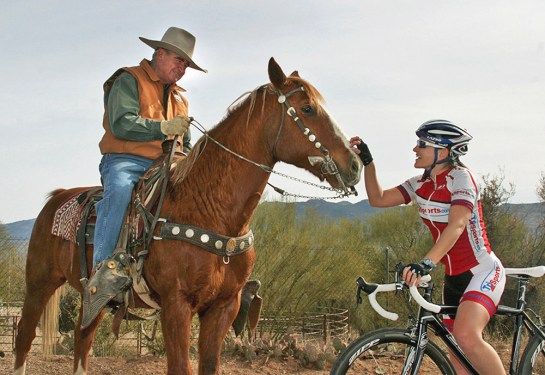
On queue a man who looks like he dropped out of a Clint Eastwood spaghetti western rides a beautiful horse onto the road. We could have spent hours in wardrobe and costume and not done as well. When you look up “Cowboy” in the dictionary, there is a photo of this guy. He is John Wayne, The Marlboro Man and Clint Eastwood all rolled into one with a dash of Boss Hoss for good measure.

Jackpot.

Debbie recognizes the opportunity instantly. Without a word she wheels around, glances over her shoulder to check if I am getting this (I am…) and she makes a few riding passes by the cowboy. Smoke is coming off my cameras this is so good.

debbie

She stops and pets the horse. More incredible images that say, without a word, “Cycling in Tucson is extraordinary, there is no place like it in the world.”

We thank the cowboy and horse, load up our gear; brush off the dust and race back to the warehouse to see the photos.

This one photo describes riding a bike in Tucson, Arizona better than any single image I’ve seen, thanks to Debbie and the mid-day rider of Freeman Road in Saguaro East.