By Tom Demerly for tomdemerly.com
My life is 70% over. Only 30% remains. WorldLifeExpectency.com says I will die when I am 73. I’m 55.

I know all the colloquialisms about “the best is yet to come”, “your best days are still ahead” and “70 is the new 40”. I’ve heard them. This is our way of establishing emotional distance from mortality with fable. We’re afraid to die, and we distance ourselves from its inevitability any way we can, so much so that we often forget to live.

Last night the arc of abundance in my life converged in a marvelous peak that reminded me of something very rewarding, very comforting, very valuable. I have friends. Good friends.

We met at my lifelong best friend’s house for a house warming party. I know it was the realization among us that our lives are finite and every rare opportunity to meet is precious that brought us together last night. It wasn’t someone’s new house. None of my friends took that for granted, and nearly all of us were there.

I could gush to you about my friends, they are incredible people. Collectively they are engineers, scientists, real estate brokers, writers, physical therapists, code writers. Those are some of their jobs. But who they are as people is friends. Friends to me, to each other, to the other people in their lives outside our circle. Friends to mankind who spread abundance and tolerance and understanding and wonder. They are a watershed of kindness and good judgement that is never ending. It has spanned decades. We met when we were teenagers. We have changed little since, and what change there has been is overwhelmingly for the better. These people made my life better, and they make the world better. I’m lucky to have them.

My reflection on last night is seen in the mirror of a textured life lived from one end of the human spectrum to another. I’ve dined with kings in the Arab desert, slept on the streets in California. I’ve been wealthy, and beyond completely broke. I’ve been the pinnacle of health and fitness, and struggled to remember my name after waking up from a stroke. And I’ve watched life pass from this earth before my eyes in ways both violent and comforting.

And through it all the consistent thing I return to for comfort, no matter where I am, delighting in abundance or comforting myself in the dark intimacy of looming death, I return to the comforting realization that friends are immensely valuable.


By Tom Demerly and Jan Mack for tomdemerly.com

An elderly man and woman driving eastbound on Hines Drive under Telegraph Road in Dearborn Heights were rescued from serious injury or worse after a crash and vehicle fire on Wednesday, June 14, at approximately 5:15 PM by passing cyclists Nate Nalder, 41, of Dearborn, Michigan and friend Dave Taylor.

Nalder, an experienced road cyclist who frequently trains along Hines Drive, told us, “Dave Taylor and I were riding down Hines, going west. Just after we passed under Telegraph we saw a white, late model Ford Fusion driving across the lawn on the other side of the walking path. It was moving fast across the grass, maybe 45-50 MPH. It came back toward Hines, we heard a loud ‘boom’ and the car rolled three times.”

An unidentified male was driving the vehicle with a female in the passenger seat. The occupants of the vehicle were described as “elderly”. According to witnesses at the scene of the accident, a medical incident may have affected the driver. The cause of the accident has not been officially determined.

When cyclist Nate Nalder saw the accident happen he turned back toward the place where the vehicle came to rest. “I hurried and checked the traffic real quick and rode back to the car and dropped my bike and ran there to the driver’s side and pounded on the window.”

Nalder was attempting rescue from the driver’s side door, but heard a voice from the passenger side shout, “Help me, I’m trapped, get me out of here.”

The airbags in the vehicle had deployed and the interior filling with smoke. The vehicle began burning shortly after it came to rest.

“I said, ‘We got to get them out of here!’ said Nalder, directing rescue efforts of bystanders.  “I did not know the extent of his injuries so I asked him to undo his own seatbelt to kind of assess his condition. Myself and two others guys helped him out and walked him over and set him down.”

As the fire spread, and without regard for his personal safety, Nalder returned to the burning vehicle to recover the female passenger and move her to a safe distance. Another cyclist had arrived on the scene to assist Nate Nalder and Dave Taylor in the rescue. A passing motorist had stopped on the scene and phoned 911 for assistance.

It is possible that, because of the age of the vehicle occupants and the possible medical condition of the driver, the swift selfless actions of Nate Nalder and Dave Taylor at the scene prevented more serious injury from the fire or fatalities as a result of the crash and fire.

According to the account Nalder heard from the passenger of the vehicle, who was transported from the scene by emergency personnel, the driver lost the ability to control the vehicle, possibly due to a medical incident. The passenger was able to grab the steering wheel but could not control the pedals because the driver’s legs were in the way. The passenger steered the vehicle off the road away from other cars but could not control the speed of the vehicle. It struck a pole and rolled several times.

Cyclist Nate Nalder, 41, of Dearborn, Michigan and friend Dave Taylor rescued motorists from a burning vehicle on Hines Drive on Wednesday.

When we asked cyclist Nate Nalder what made him decide to respond by pulling the victims from the burning car and how he had learned to respond to an accident situation he told us:

“When I was younger in high school I was riding in the back seat of a Jeep and came over a hill and accidentally hit a friend who was walking across the street. I just jumped out and helped. It was the automatic thing to do I guess. I grew up being a Boy Scout, doing a lot of lifeguarding classes and learning CPR. Just learning how to take care of a person when they are hurt. Something just said, ‘Get over there and do what you can to help because no one else was’ I was the first person to that car I guess.”

The quick, selfless actions of Nate Nalder and Dave Taylor at the accident scene almost certainly prevented further injury to the two vehicle occupants once the car began burning.

By Tom Demerly for tomdemerly.com


 It was like the beginning of a favorite new song. It began quietly, and you could barely hear it. The soft cooing of a distant sound, a trilling that seemed reassuring and comforting. The world was safe. Everything was all right. It was home and warm and nature surrounded our little neighborhood. I listened to it in bed, shushing my girlfriend with our heads on the pillows, “Listen!” I whispered. There was silence in the dark. Then the gentle spring breeze carried the rising song. “It’s an owl! Can you hear it?” She did. “That’s a good sign. They trap mice and are good for the environment and the neighborhood. He probably lives at the end of the block down by the park.”

We drifted off to sleep to his quiet, lilting song. It made for an easy transition to dreams of rolling, wooded hills filled with friendly owls building nests, cooing their gentle songs while sitting on tree branches as wise, powerful sentinels maintaining the delicate balance of nature.

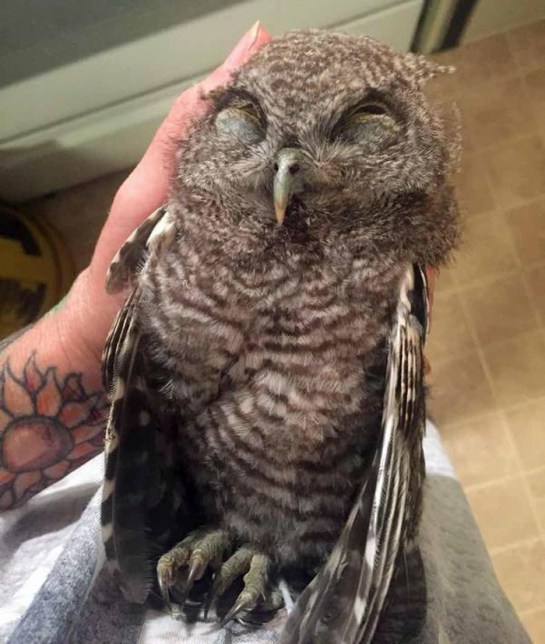
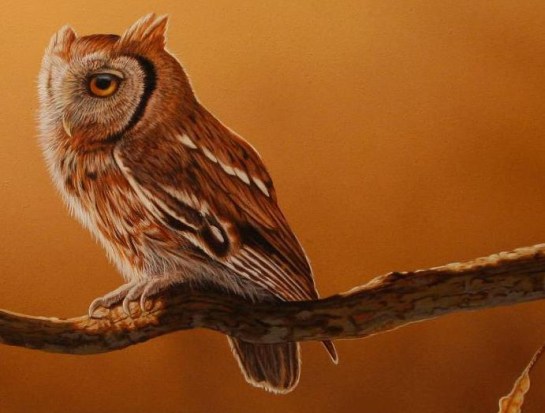
The Eastern Screech Owl (Megascops asio) is a relatively common small owl species found throughout the Midwest and into Canada. It eats mice, rodents, and has adapted well to a suburban environment.

Owls are oddly social and friendly birds to humans. One very early morning a few years ago in Mission Viejo, California I saw an owl swoop down, glance off the windshield of an SUV driving in the early morning darkness, then drop into the street. I walked over to him, he appeared stunned in the middle of the street but otherwise, hopefully, OK. I spoke to him for a moment, asked him if he was OK. His feathery owl head pivoted to my voice. He looked confused, stunned. I scooped him up carefully in my arms, his soft feathers delicate to the feel.

I don’t know how to take care of an owl. I figured I would bring him home, get him a drink and make a little nest for him and take it from there. He was large, the size of a small cat, and very beautiful. He was also exceptionally well mannered, riding in my arms comfortably as if he knew I was trying to help.

In only a block of walking he had composed himself from the brush with calamity. He spread his wide wings carefully even as I held him, then gently lifted off with a downward flap and flew out of my arms. He did one circle over my head, as if to demonstrate he was fine and say thank you for the help, then he flew east up toward the mountains on the outskirts of town. Helping the owl felt like religion. It was like being visited, and blessed, from another world. A kinder, fairer world.

When I heard the owl outside our window here in Dearborn, Michigan I was elated. This is a great omen, a sign that our neighborhood is blessed and safe and well looked after. That things are in balance and that nature and mankind have arrived at a reasonable détente.

But then reality smashed home.

The quiet song disappeared. The owl was found in the street, his eyes barely open, standing on the ground. Confused, sick, in deep trouble.

A Good Samaritan named Jamie found the owl in the street a few days later around 10 PM. She said he was half dead. She picked him up, called the University of Michigan Emergency Veterinary Hospital. She was on the phone with them, getting instructions for how to save the owl as she held him in her arms. He opened his eyes once and she spoke to him as she held him. Then he closed his eyes.

They never opened again.

The owl in our neighborhood died because someone put out rat poison to try to control mice. But the problem with poison is it doesn’t know to only kill mice. It kills everything. The mouse eats the poison, the owl eats the mouse. The owl dies too. And we are left in a world without the owl’s song. It’s a world different than intended. A world that is ruled by our poison, literal and moral.

Using poison to control animals is wrong and immoral. We learned that in the 1950’s and ’60’s with DDT poisoning, and countless times since. It’s also ineffective and short-sighted. The owl was in charge of controlling rodent populations and did an effective job. He maintained a manageable balance of nature. When that is disrupted the results are always different than we imagine, and never better. But our human, insatiable need to control things drive these short-sighted and selfish decisions like using poison to kill a mouse.

You can buy things and you can build things. A fancy house, a yard that looks like a golf course. It proves you are rich and fancy. But you are driving a wedge into the world that pries things apart and ruins what was here before us and will hopefully return when we are gone. We are not better or smarter or stronger or more important. We’re temporary participants in a complex process. When we upset the process we spread suffering, not only to animals around us but to our own lives, often without even know it.

When I think of the most important events in my life, the most extraordinary, the most valuable and lasting they are not the day I bought a car or a house. I actually don’t remember much about those things. But I remember the owl in the street in California. I remember the song of the owl down the block. These things had value. They reminded me that I am part of something bigger and that, if I care for it, it will care for me.

But when the owl down the street went silent I suddenly felt very alone.

SaveSave

SaveSave

SaveSave

SaveSave

By Tom Demerly for tomdemerly.com

This past Presidential election was one of the most divisive and closely contested in the past three decades. We’re still arguing about the outcome. It was set against a backdrop of new participant media. Everybody with social media has a voice of equal visual size, if not reach.

Because of this our closely contested and highly divisive election played out over the stage of social media. And now it feels like we’ve entered an era of rising hysteria.

Why?

From the printing press, the Manhattan Project, the Internet, stem cell research, and social media, we develop technology before we develop the ethics and conventions to employ it with moderation and reason. We just turn it loose, and hope for the best. We’re experiencing that now with social media and in politics.

We’ve entered an era of more polarized and less moderate opinion shared at louder volume than I’ve known in my 55-year lifetime, and maybe in the history of mankind. Author/philosopher Alan Watts once recounted a tour of the MIT campus where the vast and numerous science and engineering facilities were showcased with pride and grandeur, but when someone asked where the philosophy department was, the response was, “Oh, I think it is somewhere over by the library.”

Some of that may be good. But a lot of it isn’t. At least not yet.

There is an axiom that if you redistribute the collective monetary wealth of the planet equally between all people it will, over time, wind up right back with the people who originally had it, and away from those who didn’t.

But what if you equally distributed access to publishing media? To having a public voice? The same outcome might happen in contributory/social media, and for the same reasons. People may not use it responsibly and with reason. So, just as those who would not be good at managing monetary resources would fall victim to those who are, those who do not use communicational resources responsibly will stop getting listened to and lose their voice to those with more judicious use of media. But before they do lose their voice they raise the volume and frequency in one last, desperate attention grab.

We are at the leading edge of that redistribution of voice right now. Everyone has a voice now, and most people love using it, but aren’t quite sure what to say except that they should say something. And, in a new global room full of rising voices we continue to shout louder and louder to be heard above the rising din. And few people take the time to listen. I’m constantly reminded of that great axiom, “Seek first to understand, then to be understood.”

The formerly mainstream news media is included in the rising number and volume of voices and opinions. In order to compete with Twitter feeds, Facebook posts, Snapchat, and Instagram attention grabbing, the formerly mainstream media has had to change to also grab attention. Much of that change isn’t for the better. That has influenced our own behavior, but mostly it has influenced theirs. For mainstream media now, it looks and reads like, the rules are, there are no rules.

So the shouting gets louder and louder, more and more frequent. And as the frequency increases the depth of insight seems to become shallower, more superficial. Sound bytes, YouTubes, hotlinks and infographics are batted back and forth in some new form of cyber argument that mimics a fast and loose version of the Greek forums, where debate raged between scholars in a public forum.

We’ve seen two examples of this in the ongoing, divisive political narrative. Some time ago an expired rock star, Ted Nugent, ignited rancor with radical right commentary that included inciting violence as a political tool. That’s wrong, no matter the political agenda. Every despot has proved that. More recently, an equally less relevant celebrity, Kathy Griffin, depicted the President’s decapitated head in a sensational lampoon that also suggested inciting violent response as a political tool, at least as commentary. That is also wrong.

Both are wrong. Both went too far. Both are a sensational attention grab for a waning career. And both sides argue some justification for each one’s bizarre and extreme political commentary. Both also illustrate our use- or misuse- of new access to media and our rising consumption of it.

One positive outcome has been the impetus to do more investigation into the media we see. That has been fascinating. It’s also helps shape opinions, hopefully to the more informed. And I’ll suggest a more informed opinion is likely to be more structurally sound.

Before the last presidential election I took an online survey that queries you on a long list of issues and, depending on your responses, prescribes who you should vote for. I got Bernie Sanders. I liked that, so I dug a little deeper into the ramifications of having Bernie Sanders as our President.

Voting for President is a little like going shopping without knowing any of the prices. The system tells you, “Pick out something nice, whatever you want.” But there are no prices and you may not even know how much you have to spend. You don’t get the bill until after you made it to the register. If you can’t afford what’s in your political shopping cart you either throw it on a charge card that has been maxed out since Nixon was President or you say, “The person in line behind me is paying.” Then they do that for the next person, and so on…

Increasingly, being in the middle seems to feel oddly isolated as the rising din to “pick a side” on social media gets louder and louder. It seems like the social media doctrine is to pick a side lock, stock and barrel- a political “Happy Meal” that includes a somewhat superficial acceptance of all or nothing from one side or the other. We only get a second to read, to decide, to respond. We may have learned something a long time ago in school, and we do remember part of that, so we quickly compare what we see to what we know and then we hit “post”. God forbid we should actually question, criticize, and inquire. And when we disagree, we need to be ready for the attempts to be shouted down.

I’m satisfied looking at the political and social landscape ala Carte though, and I’d like to know what it is I’m reading and where it came from- to the extent I can.

The outcome of this last election was about as wild a swing from one extreme to the other as you can get. The only way we could be farther from who we had as a former President would be to have elected an albino Margaret Thatcher with male reproductive organs. So things are pretty crazy right now.

The choice we have now is to make use of social media as a shield to paint our existing beliefs on and protect our entrenched views from the swords of new thinking, or as a mirror to reflect our own beliefs in the concern that we may have a big political booger hanging out of our nose.

I’m checking my own nose now. I suggest you do the same.


SaveSave

SaveSave

SaveSave

By Tom Demerly for tomdemerly.com

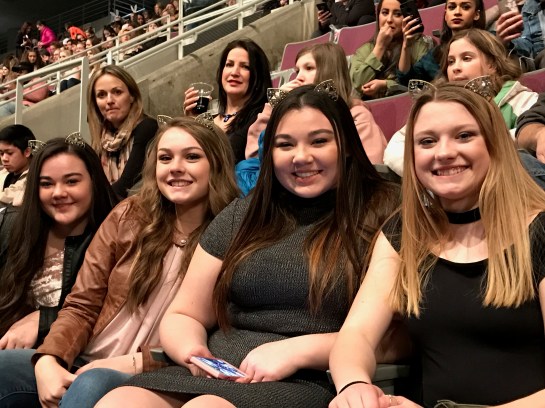
We’re Surrounded by thousands of preteen girls wearing cat ears trying their best to figure out who to be. How they are supposed to look, what boys they like, what their parents will let them get away with and something about this hazy and ominous thing called their future. Most of their faces are buried in a smart phone. Some press together for selfies, striking leaned-in poses with practiced smiles for social media posts tagged with “Dangerous Woman Tour, Ariana Grande, The Palace of Auburn Hills.”

It’s Sunday, March 12, 2017 and we’re outside Detroit, Michigan in the United States. This is America. Ask any of these girls where Syria, Afghanistan, Somalia or Iraq is on a map and, unless they are one of the growing number of immigrants in this community who moved here for a better future, they will likely give you that sideways head lean and go back to their Instagram or Snapchat. It’s just after Spring Break, and there are waaaaaayyy more important things to worry about.

Chinese military philosopher Wu Ch’i, wrote:

“Now suppose there is a desperate bandit lurking in the fields and one thousand men set out in pursuit of him. The reason all look for him as they would a wolf is that each one fears that he will arise and harm him. This is the reason one man willing to throw away his life is enough to terrorize a thousand.”

Terrorism is the desperate and effective strategy of striking terror (hence the name) into a civilian population by transcending the conventions of warfare. Everyone is fair game, and the rules are, there are no rules.

Until 9/11 the United States was blissfully and ignorantly insulated by geography from international terrorism. It didn’t happen here unless it was homegrown. We had Timothy McVeigh and the Oklahoma City Federal Building bombing in April, 1995. That was about it.

And then there was 9/11.

Many of the girls at the Arianna Grande concert in Manchester were not born before the terrorist attack on the United States on 9/11/2001. If they are under 15, it is simply a page on a history website. They wonder if their cat ears are on straight or if that boy they’re following on Snapchat will see the selfie they just posted.

This is how terrorism works. Take the fight to the most vulnerable.

I am told there are two kinds of wars; Wars that are started over territory and commerce. Oil, borders, political rule. These wars resolve quickly as their costs, both human and financial, spiral. And then there are grating and unending wars of demented hatred. These are often linked to an ideology that has nothing to do with hatred at its basis, but some perverse distortion of an ideology- any ideology will do- is bent to justify a demented agenda.

Terrorism only grows in soil where nothing else will. There is no opportunity, no room for dreams beyond martyrdom. Poverty, oppression, fear. That is life, and death is promised as better. It’s a set of beliefs that expresses the unknown as evil and threatening. It condemns education and liberty, and reinforces rigid belief and blind acceptance with the threat of rough “justice”. It is a doctrine of fear, ignorance and limitation.

In the fertile soil of freedom and liberty terrorism cannot maintain its roots. The growth of hope and opportunity cast a shadow over it that chokes out its sunlight.

Hope and opportunity are the greatest weapons in the war on terror. They offer a better alternative. They offer abundance and tolerance, growth and safety.

As we absorb the intimate enormity of our daughters and nieces being drawn into a global war on terror we need to consider a future when we are free from these fears. And we need to plot the course to get there. The Global War on Terror has fractured off fragments of malignant hatred that take root elsewhere. The fragments get smaller and smaller, but spread farther and farther. Eventually they may be gone altogether, but it is a laborious and tedious process of finding them and eliminating them.

And what will we provide in their absence? If terrorism only grows from places where there is no alternative what will the alternative we offer be? I know that the leader of the 9/11 attacks attended Hamburg University, but his personal doctrine was already set when he got there, and it emanated from poverty, hatred and prejudice.

Ultimately we will find the greatest weapon in the Global War on Terror is the enormous might of inclusion and understanding, new opportunity and alternative. Until then we will continue to fight smaller and smaller fragments of this hateful doctrine into deeper and deeper corners of our lives.


By Tom Demerly for tomdemerly.com


He appeared like night smoke. Silent and sudden.

And like smoke he disappeared without a sound.

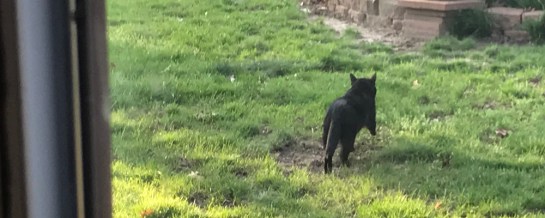
Someone’s black cat walked through our yard. It sometimes jumps on the windowsills. Nothing unusual, just a pet cat on his rounds when its owner let it outside.

Or so I thought.

After seeing the same black cat every day, whom we began calling “The Mysterious Cat”, I started paying attention to him. I had no idea I would discover an incredible, mysterious wilderness right outside my window. It’s a complex hierarchy of alpha predators, finite territories, deadly stalking and a ruthless food chain. It’s no different than the plains of Africa where majestic lions hunt in prides or the jungles of the Suriname Forest in India where Bengal tigers stalk their prey like solitary snipers. In fact, it may be even more complex because, whether we realize it or not, we are part of the food chain.

Five things helped me understand The Mysterious Cat. I watched a BBC documentary called “The Secret Life of the Cat”. It followed the hidden behavior of indoor/outdoor pet cats and revealed details about their range, territorial activity and habits. I recently saw the award-winning film, “Kedi”, about feral cats living in Istanbul, Turkey and the local populations’ reverent relationship with them since ancient times. I was reading author(s) Erin Hunter’s entertaining fiction book series, The Warriors. Erin Hunter, who is actually a group of six different authors, creates fictional feline characters divided into different categories of cats. Some are pet cats, called “kittypets”, others are solitary outdoor cats called “loners” and “rogues”. They have complex fictional societies and elaborate adventures. I was also casually keeping track of local pet cats’ behavior in the neighborhood. I would see the same cats on someone’s porch, notice their schedules and territorial behavior. And then finally, the fifth thing that got my attention:

One night The Mysterious Cat made an extraordinary visit. It stalked into our run-down outdoor back porch. A very large, solid black cat with a thick coat and sturdy legs. He skirted the crumbling brick planter wall, checked over his shoulder twice, then silently climbed in one stride up to where my girlfriend had planted catnip plants. He munched catnip for a second, and then it got weird…
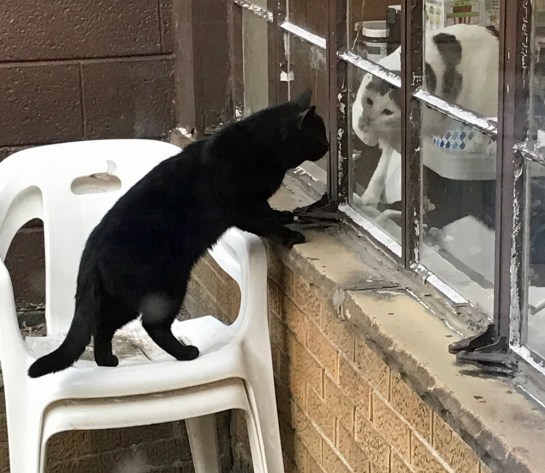
Our indoor cat, Vice-Admiral Malcom Fredrick Davis III (Vice-Admiral for short), stepped up on the indoor porch windowsill. The Mysterious Cat left the catnip plant and slowly walked over to the outdoor window where the Vice-Admiral was. Glass separated the two cats. I anticipated hissing and raised fur, and then one cat would make a hasty retreat. But I was wrong.

The Vice-Admiral, a domesticated indoor “kittypet”, was intensely interested in the Mysterious Cat. He was not afraid of the Mysterious Cat, not aggressive toward him. It was as though he was fascinated, as a person might be seeing an exotic new species. The Vice-Admiral leaned forward toward the glass. The Mysterious cat climbed onto the windowsill outside. Only a thin windowpane separated the two cats. In a gesture that could only be interpreted as a form of inter-species détente, the Vice-Admiral assumed the exact same posture as the Mysterious Cat, mimicking him, side turned to him, pressing against the inside of the glass as the Mysterious Cat leaned against the outside in mirror image. It’s possible the cats could feel the warmth of each others’ bodies through the glass, the vibration from their nervous purring. It made no sense. I expected territorial behavior, meowing, hissing, arched backs. What I saw was bizarre behavior I had never seen between two domestic cats.

Because I wasn’t watching two domestic cats.


The Vice-Admiral maintains surveillance.

I wanted to know who owned the Mysterious Cat, who cared for it, where it lived and what its name is- whether it is a boy or a girl. I posted a photo of the Mysterious Cat from my smartphone on the local neighborhood web forum NextdoorNeighborhood.com. “Does Anyone Know This Awesome Black Cat?” What I learned was stunning.

The Mysterious Cat is not a domestic cat. It is a feral cat.

Feral cats are behaviorally hyper-evolved cats  that appear identical to domestic cats. They live in a vast grey area between wild cats like bobcats, lynxes, panthers and cougars and stray domestic cats. They are very distant from an indoor domestic cat in behavior. They are also different than a stray domestic cat as I learned without realizing it a year earlier.

Feral cats are the alpha predators of suburbia. They are highly adapted and exhibit incredible intelligence, reasoning, and a remarkable ability to learn complex concepts quickly. They stalk, kill and enforce a ruthless command over a clearly defined territory. They sit at the top of a natural suburban food chain few people even know exists. Most of what they eat is prey they kill in their nightly hunting trips. These suburban wildcats help reduce rodent populations and control pests. They are, in a very real sense, the panthers on our porches. Feral cats seldom “convert” from being feral to becoming domestic, although this does happen occasionally. Particularly in the ruins of outer Detroit where vast areas of abandoned houses and overgrown lawns turned mini-forests are the perfect environment for a growing population of feral cats, these remarkable semi-wild cats are on the rise.

One night, after dark, I spotted the Mysterious Cat outside. The wind was east to west and the cat was headed east. My sound and scent would be masked. I followed him to wherever he was going. At first he appeared remarkably casual, walking in shadow near the center of the sidewalk at a businesslike pace. I did not know it, but I was being drawn into an ambush. At each corner he would stop and listen, look, before crossing the street. How did a cat learn to use sidewalks and crosswalks, and obey stop signs? I followed carefully, moving from concealed position to concealed position nearly a block behind him. Remarkably he did something I had learned as a member of an elite special operations unit in the military. He changed direction, circled back and checked behind him to be sure he was not being followed. And he saw me. This cat had just used tactics taught in the most sophisticated combat schools in the military. And he just used them to perform counter-surveillance on me. If Osama bin Laden had behaved like this cat, we’d still be looking for him. I was stunned. This was no one’s pet. This was a sophisticated predator.

A woman on the NextDoorNeighborhood.com forum replied to my inquiry about the Mysterious Cat. Cyndi Parrely lives on the corner two city blocks east of our house. Her garage door is always slightly open, about a foot. There is a stone statue of a cat in her garden. Visible just under her door is a small cat enclosure. The lair of the Mysterious Cat.

“I do not know if it’s a boy or girl. Can’t really get close enough. I began feeding her/him about a year ago. Very gentle but keeps her distance. Never makes a sound.”

Cyndi has defaulted to referring to the Mysterious Cat as “her”. No one knows its true gender or age. Or where it came from. But Cyndi is a kind and generous person who has made a home in her garage for the Mysterious Cat. She has entered the behavioral and food chain of the feral cat, and performs a vital function to its survival.

The Mysterious Cat would only accept food and some limited outdoor shelter from her. No petting sessions, little physical contact. “I touch her when she comes up to eat and she is fine with that. Doesn’t run away.”

Suddenly a number of mysterious puzzle pieces about local cat behavior revealed themselves. Two cats who live at the south end of the block near the entrance to the park never leave their yard. The Mysterious Cat does not permit it. He limits their territory to their own yard, chasing them back to their house if they venture outside their clearly defined territory. He allows them their yard, but no more. And his policing of the boundaries is vigilant and rough.
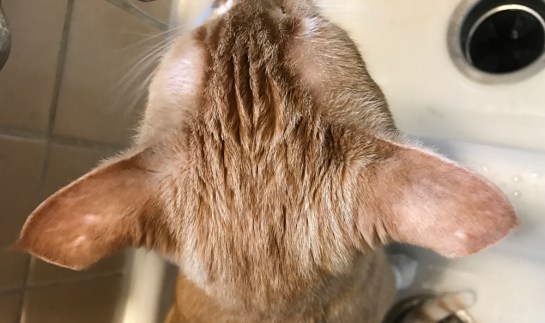
Young Chester, our adopted stray who lived outside much of the time before we adopted him, had three deep puncture wounds on his left ear when we got him a year or so ago. When Chester first appeared in the neighborhood right before we adopted him the Mysterious Cat had savagely enforced his territorial rule on young Chester. Even though he was no more than a kitten, Chester was a threat, a competitor for food in the Mysterious Cat’s domain. There was no room for Chester. The Mysterious Cat tried to kill him. Luckily, young Chester escaped with only minor wounds and we adopted him permanently as an indoor cat. Now he is safe.

For months Chester would sit in the window and meow a longing, urgent meow in the early morning, the time when the Mysterious Cat was most frequently seen returning to his lair. The week after the Vice-Admiral held his meeting on the back porch with the Mysterious Cat, Chester stopped meowing. He has not done it since. It’s been a week. It is as though some silent communication was passed on that Chester is off the “kill” list; the Vice-Admiral has brokered a peace treaty. Call me a crazy cat person, but this behavior is real.

Cyndi told me, “She [or he] stares at my cat through the glass door. They are both outside together at times and get along. No fights.” Cyndi told me about the Mysterious Cat’s behavior in her yard. “I try and coax her but to no avail.”

Perhaps the most remarkable part of this story is the role we humans play in the Mysterious Cat’s life. Something in us, some desire to spread kindness and safety, is leveraged by the Mysterious Cat. It is arguable who ultimately commands the neighborhood, the humans who live in the houses here, or the Mysterious Cat that can bend us to its will without making a sound.
By Tom Demerly for Tom Demerly.com

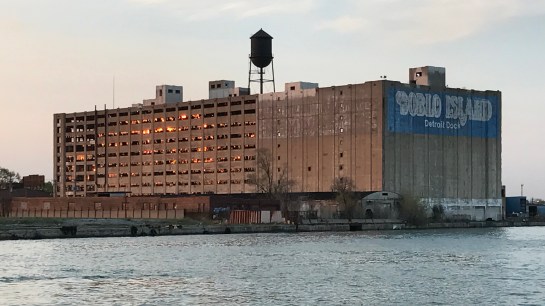
Only a mile and half at its widest, The Detroit River has been a geographical barrier between opposing tribes, rum runners and nations. Few rivers hold this much history. Globally, the Detroit River shares its historical relevance with the Mississippi in the United States, the Bosphorus in Turkey, the Rhine in Germany, the Ganges in India, the Volga in Russia, Paris’ Seine River, Egypt’s Nile, China’s Yangtze and other globally significant waterways like Iraq’s Tigris and Vietnam’s Mekong.

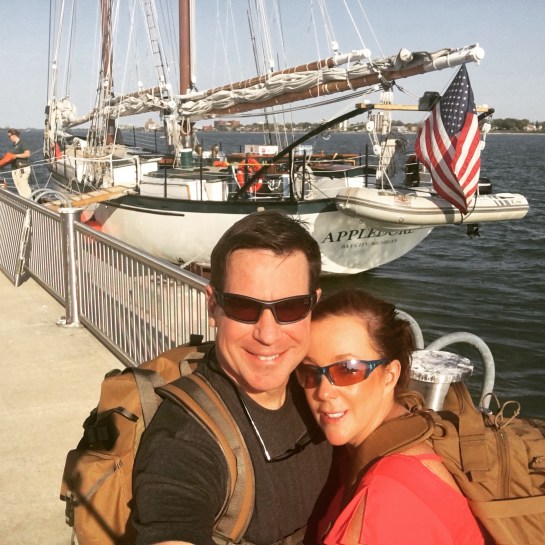
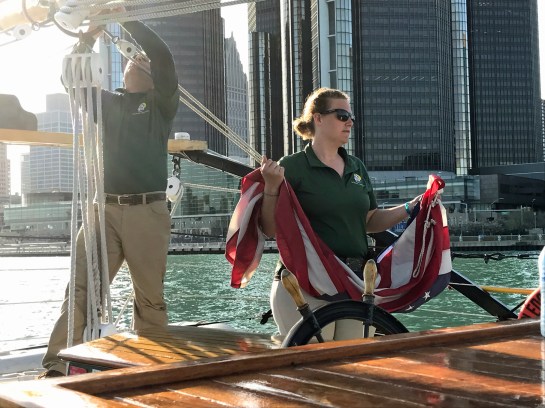
Last Wednesday, as members of the Detroit History Club, my girlfriend Jan Mack and I sailed the historic Detroit River on the 85-foot long Appledore IV two-masted schooner. Appledore IV transports its crew and passengers back in time as soon as they step on board. It is a fitting vessel for a trip back into the remarkable history of Detroit and its unique river.

Our guide on board Appledore IV was Miss Bailey of the Detroit Historical Club. Her encyclopedic knowledge of Detroit history was matched only by her wit and talent. She delivered a fascinating running narration of Detroit’s sensational history from Native conflicts to daring rum-runners driving modified Ford Model-T’s across the frozen river in an occasionally unsuccessful attempt at defying prohibition.

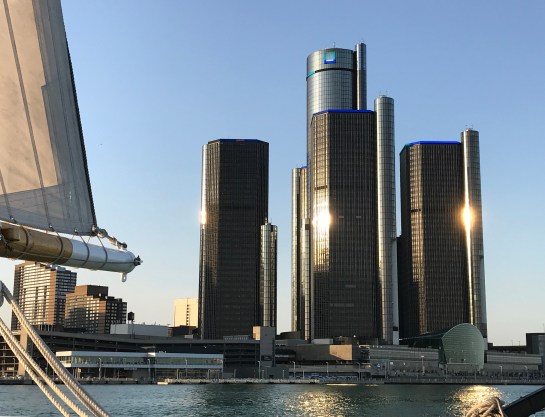
After casting off from the dock in front of Detroit’s Renaissance Center and General Motors headquarters we set sail on moderate winds and calm waters north and east toward Belle Isle and the Hiram Walker distillery. As we sailed across the Detroit River the strong and delicious scent of baking bread drifts off the Windsor shore from the Hiram Walker complex. The yeast processing for spirits production at the distillery produces the delightful aroma, lost on powerboats to their exhaust smell but blissfully preserved onboard the sail-driven Appledore IV.

Once at the top of the river we reversed course under jibbing canvas sails, ducking under swinging booms and picking up winds that brought us downriver toward the majestic Ambassador Bridge. We sailed under, marveling at the incredible volume of truck traffic engaging in the free exchange of goods between Canada and the U.S. that typifies the relationship between the two countries.

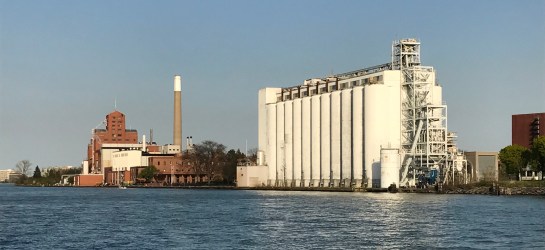
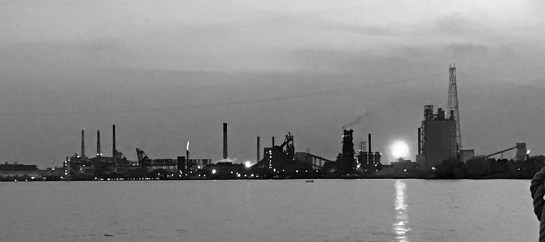
To the south we saw the dark silhouette of the industrial monolith of Zug Island, formerly one of the most polluted places on earth, now in the midst of reform into at least a slightly less toxic habitat. Today foxes, peregrine falcons, feral cats and other unusual species share the island with its heavy industrial tenants like steel mills and coke ovens. A rare species of sturgeon lives on one side of the island because of the deposits of coal cinders that collect on the bottom of the river from the industrial activity.

Mystery surrounds much of Zug Island, a private, manmade industrial otherworld that has produced an undefined loud humming sound to the distress of residents as far as ten miles away. Some say it is the sound of wind through industrial structures on the island. Over a million dollars has been spent on studies to find the source of the bizarre sound but the maker of the mechanical music remains a mystery.

Shipping traffic is a huge part of the Detroit River. During our cruise we saw two passages, one a massive ore freighter and the other a smaller cargo vessel, our radios crackling to life with instructions from the river traffic control as Customs and Border Patrol vessels zipped back and forth. The Detroit River is one of the busiest commercial rivers on earth, and ship spotting along its banks is a popular pastime.

This cruise aboard Appledore IV with the Detroit History Club is a rare and intrinsic perspective on Detroit, and one all Detroiters ought imbibe in. People who live in Detroit and its suburbs often have a deep affection for something undefinable about the city that makes it unique. An intrinsic authenticity and resilience belonging to a place that survived riots, wars, fires and economic collapse. Detroit has produced iron and steel, innovation and art. But few people own the deep historical context of Detroit’s remarkable and repetitive penchant for survival and prosperity.

To join the Detroit History Club and enjoy their many fascinating and varied events follow this link:


http://www.detroithistoryclub.com

By Tom Demerly for tomdemerly.com

You won’t find a bad review about the beautiful film-meditation “Kedi” and rightfully so. Director Ceyda Torun built a dream-like soft documentary stitched together from several storylines, and it fits and flows with elegance and mirth.

This is a kind, gentle and soothing meditation about our relationship with cats and, by proxy, with each other as humans. It identifies something good and meaningful in every person, and every animal, and celebrates it through the reverent monologues of the human supporting cast of the film as they pay homage to the roaming cat population of Istanbul, Turkey.

Kedi is a long time coming, a movie that will likely enjoy decent commercial success with the rise of cat prominence via social media. In an era of increasing social divisiveness posting a photo of a cat to your social media is the modern equivalent of talking about the weather. Everyone can relate, no one is alienated. And that is where Kedi begins, with the universal and oftentimes unspoken confession that we are more connected to our animals than we will sometimes openly admit.

Whether you are a “cat person” or not, Kedi is visually luxurious, a transparent travelogue through Istanbul and an examination of the reality that good is to be found in nearly everyone. Kedi reveals an intimacy in our relationship with animals I’ve never seen in film before, and that is uniting. It is something we need to hear.

A worrisome plot boils under the glowing surface of Kedi, the brief mention of expansion and modernization that threatens both the indigenous stray cat population supported by the citizenry, and also threatens this entire gentle culture, both human and animal. It’s ominous but not obnoxious, and mostly this film is charming, but this inference is unsettling. But that is a story for another documentary. As for this one, you may relax and enjoy this beautiful meditation.

Cat lover or not, Kedi is intrinsic and well made. It is worth seeking out. If you are a cat lover, then this film is an anthem and an ode to why we worship and cherish these perfect, gentle, beautiful animal-lords of our world who are so generous to include us in their lives.

By Tom Demerly for tomdemerly.com

Terry Lacroix (left), the driver who killed Karen McKeachie, during a court hearing Monday, March 6, 2017. (Photo Credit: John Counts Photo for The Ann Arbor News)

Terry Lee Lacroix is responsible for the death of Karen McKeachie.

That is a fact.

Had it not been for his willful actions on August 26, 2016 at approximately 10:45 AM, McKeachie would be alive today.

There is no question about the responsibility of Terry Lee Lacroix. He caused her death. That is known.

But what is mysterious is what should be done with Terry Lee Lacroix in the aftermath of Karen McKeachie’s killing? And it is a killing. It is not an accident. Lacroix’s willful decisions directly caused McKeachie’s death.

Emotionally some may want to exact a type of “revenge”, a willful infliction of loss or suffering upon the perpetrator Terry Lee Lacroix for the killing of Karen McKeachie. There may be a circumstance when this is appropriate. If Lacroix were in a position to willfully kill again. Then his capability to do so must be neutralized in the interest of public safety.

How our courts decide to punish Terry Lee Lacroix for the killing of Karen McKeachie will say a great deal about our society. It will place a value on a life. It will demonstrate what we are willing to do to prevent further loss of life, and it will reveal structural insights about our character and intellect.

What was Karen McKeachie’s life “worth”? What is the value of the life of the next victim of a similar killing? And, there will be more willful killings of cyclists by motorists.

To decide you must look in the mirror. Put a price on your life. What would you exchange for it? What is the correct toll for your life’s forfeiture?

I’ll suggest no such comparison; no such valuation can be assessed. The value of your life, and the loss of McKeachie’s, is incalculable.

But what about the next life lost to willfully deadly driving? And there will be more.

As a culture have we learned anything from losing Karen McKeachie? Will we change anything? Will the existing laws be applied as a template, and then reused on the next willful killing of a cyclist?

On Monday MLive.com reported that Terry Lee Lacroix pleaded “no contest” to a “misdemeanor charge of a moving violation causing death”. The maximum penalty is one year in jail. We are, in effect, stating clearly that, “If you choose to kill a cyclist with your car, you may go to prison for a year.” That is the value we place on a bicycle rider’s life. One year of confinement. Three hundred sixty five days confinement and the remaining legal record and expenses. That’s it.

A one-year jail term is not a substantial enough penalty for willfully killing a cyclist with a motor vehicle.

And because it is not substantial enough, because the penalty is not commensurate with the loss, the deterrent value, the compelling reason to drive more carefully, does not exist. Until the penalty fits the crime, cyclists are little more than collateral damage that may cost a reckless driver a year in jail, a prison record and legal fees.

But one year is all. And that is wrong. Your life, the life of Karen McKeachie and the lives of every cyclist are worth a greater penalty to compel drivers to behave more cautiously around cyclists.


By Tom Demerly for tomdemerly.com

racermate_computrainer_booth

According to an e-mail sent to sponsored athletes last night and reports on social media, Computrainer, the innovator of the computerized indoor ride simulator, is closing.

Reports indicate an e-mail was sent to sponsored athletes late last night. Phone calls to the company, Racermate, and its sister company, Floscan, were not returned as of this hour. In a phone call with a representative from sister company Floscan, who asked not to be named, early Tuesday, February 28, this reporter was told “I don’t know what is going on over there [at Computrainer].”

A copy of the e-mail received by tomdemerly.com via social media reads:

“It is with a heavy heart that those of us here at RacerMate must tell you that we are closing the doors on CompuTrainer. Technology and competition from larger companies have both eaten into the marketplace. As a small company with the premier indoor trainer in terms of performance and durability, we have found ourselves in a place where we cannot continue. It has been a marvelous 40+ years and we have enjoyed sharing in the victories and friendships we have made along the way.” [signed]

Chuck Wurster, Vice President

RacerMate Inc.

Seattle, WA

Voice mails left at Computrainer’s extension contained the message, “Please don’t be surprised if it takes several days to return your message.”

Computrainer is related to Floscan, a company that provides aviation and maritime fuel flow monitoring equipment.

The Computrainer indoor ride simulator revolutionized bicycle training by projecting performance telemetry on a screen in front of riders while a load generator varied resistance creating a realistic ride simulation indoors. The system also enabled riders to “compete” with each other in a virtual environment and to ride against themselves from previous performances saved on a computer that controlled the Computrainer.

If reports are accurate, contributing factors may include an unusual, non-retail sales model, low profit margins, service intensive products and the introduction of other computer controlled ride-simulation “smart” trainers into the competitive space from companies like Tacx and Wahoo Fitness who have a dealer network and existing distribution at the consumer level from brick and mortar retailers.

While this report remains unconfirmed from Computrainer as of this hour, the inability to receive or return sales and service inquiries throughout the first half of Tuesday, and reports of the e-mail announcement sent to sponsored athletes have surfaced on social media.