By Tom Demerly for tomdemerly.com

littoralcombatship2000

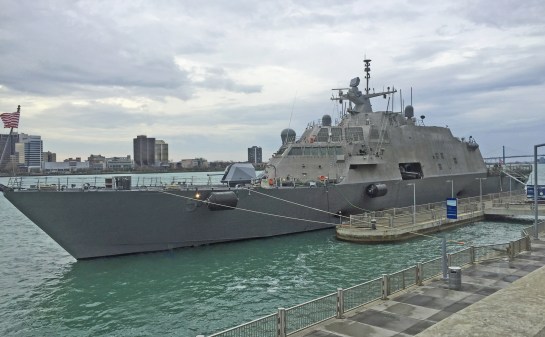
The brand new U.S. Navy Littoral Combat Ship USS Milwaukee (LCS-5) visited Detroit on November 25, 2015 for a brief stay en route to shake-down cruise and operational patrols in the South China Sea.

The USS Milwaukee is sister ship to the upcoming USS Detroit, which is under contstruction now and will be commissioned here in Detroit in 2016.

The USS Milwaukee was commissioned Saturday in Milwaukee, Wisconsin. After leaving Detroit this week the Milwaukee will sail through the St. Lawrence Seaway to the Eastern seaboard and then set course to transit the Panama Canal on the way to a stop at its home port of San Diego before deploying to the South China Sea.

LCS10

On her bow standard the USS Milwaukee flew the traditional Navy Jack flag. This unique flag with its rattlesnake on stripped field, reminiscent to but different from the Gadsden Flag, is flown from the jackstaff of commissioned vessels of the U.S. Navy while moored at a dock.

A primary mission of the Littoral Combat Ship is the anti-piracy role in areas such as the Straits of Malacca, a dangerous, 500-mile wide passage between the Malay Peninsula (Peninsular Malaysia) and the Indonesian island of Sumatra. Small indigenous craft are frequently used by pirates to board merchant vessels, terrorize the crew and hold them for ransom. The USS Milwaukee will engage in counter piracy operations in these waters along with other missions.

LCS30

The ship showed her BAE Systems Mark 110 57mm auto cannon on the fore deck, an advanced, precision, automatic naval cannon capable of firing over 200 rounds per minute with an effective range of nearly 5 miles. The gun is fully gyro-stabilized for precision fire in rough sea conditions.

LCS20

The superstructure of the ship is coated with a low-radar reflective material to enhance stealth capability and reduce radar reflectivity. A wide variety of sensor and fire control antennae and scanners are visible on the superstructure including upgraded 3-dimensional radar masts, electronic warfare systems and countermeasures. The large black cylinders on the hull appear to be bumpers for mooring. A rigid inflatable boat, the type used by VBSS (Visit, Board, Search and Seizure) and Naval Special Warfare teams was visible in the elevated port launch deck.

When we saw the ship she was secured in preparation to get underway. Unlike some versions of the LCS the USS Milwaukee wears a standard grey paint scheme now. Some of the LCS’s wear a spectacular maritime camouflage scheme reminiscent of German raider ships from WWII.

130222-N-DR144-367 PACIFIC OCEAN (Feb. 22, 2013) The littoral combat ship USS Freedom (LCS 1) is underway conducting sea trials off the coast of Southern California. Freedom, the lead ship of the Freedom variant of LCS, is expected to deploy to Southeast Asia this spring. (U.S. Navy photo by Mass Communication Specialist 1st Class James R. Evans/Released)

The USS Freedom (above, U.S. Navy photo) wears the distinctive camouflage scheme of some of the LCS’s.

The Littoral Combat Ships have a rear bay and landing deck for operating Seahawk helicopters and Navy MQ-8 UAV’s rotary wing surveillance “drones”. The ship can also launch all types of small tactical boats used by Special Weapons Combatant Craft Crewman (SWCC) teams and U.S. Navy SEALs.

The USS Milwaukee was built in Marinette, Wisconsin, where the USS Detroit also is being built. This LCS class vessel is 378-feet long and displaces 3,900 tons with a combat load. Her draft of only 13-feet means she is ideally suited for the shallow water, littoral combat environment for which she was designed, close-in, tactical, coastal combat within 200 miles of a coastline. The Milwaukee is extremely fast, with a top speed of over 50 MPH or 45 knots, more than fast enough to tow water skiers and faster than many civilian speed boats. She has a crew of 50 sailors to operate her, with an additional compliment of 25 other special operations Naval personnel depending on the mission.

By Tom Demerly for tomdemerly.com

IMblog40

It’s been another big year for Ironman; new races and more athletes earning finishers’ medals. It’s worth asking: why is Ironman so popular?

Consider the downside of Ironman:

Ironman is hard, beastly, grindingly hard. If you haven’t done an Ironman think about this: when was the last time you exercised non-stop for 10-17 hours, and paid to do it?

Ironman is a “dry pain”. An abrasive, gnawing bone-on-bone scream to just stop and give up. It’s combined with a wearing fatigue that doesn’t end until you reach the finish line. People have the ominous sensation that they’re actually doing harm to themselves, permanent, medical harm. Yet they continue. You find a lot of things on an Ironman course; common sense usually isn’t one of them.

You won’t feel right for weeks after Ironman. After the glow has faded you may sink into a mild depression, a depression that attempts to moderate the realization that hitting that finish line may have been the single biggest day in your life.

And so, inevitably, like an addict to the needle, you go back. Just one more hit…

Second, Ironman is expensive. Racecar engineer Carroll Shelby said, “Speed costs money, how fast do want to go?” That realism applies to Ironman. Entry fees, equipment, travel. It would be tough to complete an Ironman for less than a few thousand dollars and it’s easy to spend over ten thousand. Racing anything is expensive; racing three sports is three times as expensive. Traveling to do Ironman costs even more. Divorce attorneys add to the cost. And eventually, so do therapists- for your bones and your brain.

IMblog110

Ironman hammers your life. You spend endless time training and worrying that you aren’t training enough. You never realize how little time you have until you have to squeeze long rides, runs and swims into a normal life. And speaking of that fleeting thing you used to have called “A Life”, well, you can forget about that when you are training for Ironman. You become an “Ironmonk” somehow sworn to an oath of servitude to distance, diet and determination so deep your old friends who don’t share your goals become distant friends.

You may do Ironman to bolster your confidence, but the journey to the start line and the crushing enormity of the distance stacked next to the puny sum of your training is enough to dash any ego. At the start line you are small and weak. At some point in the race you become broken. But at the finish you grow to ten feet tall.

But there are compelling reasons to love Ironman:

  1. Welcome to your whole life, condensed into one day.                             

Ironman is the physical metaphor for every obstacle we’ve faced in life packaged into one long day. But unlike the other struggles in our life, there is a defined finish line. And we get a medal.

Your education, job, and relationships are all undefined. There are no mile markers, no finish lines. They become a grind with a generally anti-climactic ending, a finish line that keeps moving. At Ironman, they announce your name, give you a medal and take your picture. The finish line does not keep getting farther away. Every stroke, turn of the pedals and step brings it closer on race day. The finish at Ironman isn’t a moving target. It’s clearly defined. That is tough to find these days. At Ironman, you actually do get the carrot on the string.

IMblog10

  1. It’s us against life.

More than anything else in life we race against time. We try to get things done faster, try to live longer, and try to end hardship sooner. We never win that race. Ironman is one of the only places you can win that race. You get to the finish line before midnight, you won. Ironman gives you the chance to win life in one day.


  1. Ironman is cooperative, not competitive.

At Ironman every participant is united against two common adversaries: time and distance. Almost no one except the top ten athletes actually “race”. Most of us are competing against the terrible distance and relentless procession of the clock. Separate from the politically correct notion that “everyone is a winner”, every person who makes it to the finish at Ironman actually is a winner. They slayed the dragon. They beat the distance and the cut-off. Sharing that win with like-minded people creates a sense of community. Normal sports create winners and losers. They create divisions. Ironman creates bonds against a common adversary. No one who makes it to the finish line loses.

IMblog20

  1. Instant Gratification. (Almost).

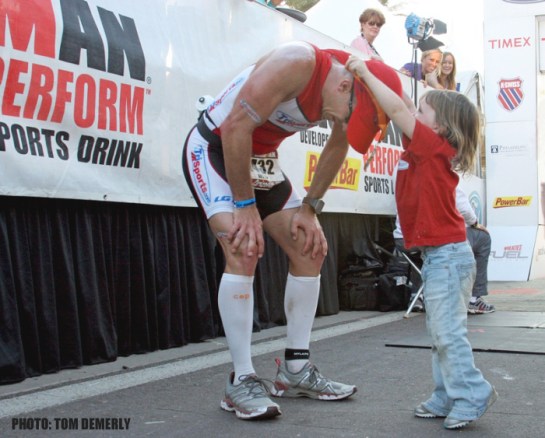
They hang your medal around your neck when you cross the finish. It’s instantaneous. Ironman has gotten more clever by erecting trendy photo backgrounds to pose in front of for social media snapshots. You look like a Hollywood celeb at a premier, only you’re covered in your own urine.

  1. It’s Good for the Ego.

If only for a little while, Ironman gives us the chance to be somebody. It makes us feel strong, capable, invincible. It validates something that exists in every person; our incredible ability to overcome an obstacle greater than we think we can. In a way, Ironman athletes may be weak of confidence since they seem to gravitate toward a store-bought, conspicuous brand of self-confidence: the finisher shirt, the medal, the sticker, and the tattoo. But judgments aside, it feels darn good to cross that finish line, sit down and drink something cold. For at least a fleeting few moments we can wrap the thin foil blanket of accomplishment around us.

IMblog50

  1. We’re Doers, not Spectators.

You can broadly divide people into two categories: spectators and competitors. But like any division between a group as vast as all mankind there exists grey. We are that grey area. A culture of people who may not be eligible for Olympic Gold or Superbowl fame but who are as uncomfortable on the couch as they would be running a 4:40 marathon pace. We land in between. We want to participate, we don’t want to just watch, and we will likely never win. That’s us. We just want a piece of the action.

Social media is another reason Ironman has exploded. We now have a vast space where we can talk about ourselves. And we do. Ironman weekend is a litany of selfies with our bike, race number, shoes, porta-johns and barf. This perfect storm of Ironman and social media has created a legion of everyday Geraldos, Diana Nyad’s, John Krakauers and even a few Ernest Hemingways. Even if no one is looking we still love to post, tweet, strava and share.

  1. If We Can Do This…

Our lives are increasingly convenient and safe. From airbags to instant communications and weather warnings, we are exposed to very little real risk. So, we have to manufacture synthetic risk. Ironman does that. It interjects much needed doubt into our lives. Ironman makes us feel like we are on some kind of edge, even if the edge is the synthetic manifestation of distance and time.

There are as many motives for doing Ironman as there are competitors, and the thing that pulls us to the start line then drags us to the finish line is usually personal, often difficult to articulate. We likely don’t understand all of our motives. And there may be no necessity to understand entirely. One thing that is certain is the choice to do Ironman is an ephemeral one that can- and will- be revoked at any time, usually without warning. An injury, illness, the rigors of age or disease will someday take away the choice. That alone may be the best reason to try to make it to the finish line- because we still can.
IMblog100

By Tom Demerly for tomdemerly.com

Ironmanbike_edited-1

As Ironman participant numbers continue to swell and average speeds come down the pro athlete marketing methodology is less relevant.

Age grouper Dan Stubleski of Washington, Michigan has won the overall race at the 2015 Ironman Florida in a time of 8:36:06.

Stubleski’s time would have won the Ironman World Championships in Kona as recently as 1985 and beat Ironman legend Dave Scott for the overall World Championship. Perhaps more impressive is that, if Stubleski had done this time at Kona in 1997, he would have been second overall to German sensation Thomas Hellriegel.

Dan Stubleski’s incredible performance is made more remarkable by the fact that Stubleski is not a pro athlete. He’s “just a guy”, an everyman. Given, Stubleski’s training and dedication are anything but average. But what Dan Stubleski has accomplished demonstrates something significant about triathlons: Pros don’t matter as much in triathlon anymore. The sport is changing. Dramatically.

The age group performance of Dan Stubleski at Ironman Florida, a non-pro Ironman, is an outlier, an exceptional effort that recalibrates our perception of what age-group “hobbyist” athletes are capable of.

Without realizing it Stubleski brought to life the fictional plot of one of endurance sports most enduring classic tales, The Purple Runner by Paul Christman, in which an amateur wins the London Marathon and breaks the two-hour barrier. It’s an enduring fable, a Cinderella story, and Dan Stubleski made it real. Ask any triathlete in Michigan with a social media account who won the Ironman in Kona and they probably can’t tell you. Ask them who won Florida, and they’ll tell you it was Dan Stubleski.

Another thing Stubleski’s performance reinforces is the notion that the triathlon industry is increasingly out of touch with their consumership. Bike companies still focus their promotional campaigns on sponsored “pros” paid six-figure amounts.

That approach isn’t relevant to the average triathlete- the middle 80%- anymore. In fact, one could argue a personality like everyman-hero Dan Stubleski is significantly more marketable than a six-figure pro. And, if I were a big bike brand paying performance bonuses to my pro triathletes, I would do well to ask these pros, “Have you sold anything lately? This age group guy just stole your headlines.”

danstu

Michigan age group triathlete Dan Stubleski at the Ironman Triathlon World Championship in Kona, Hawaii.

Triathlon has evolved into a participant sport, not a spectator sport, analogous to softball and bowling leagues. People want to do the sport, not watch the sport. As a result there is widespread demand for less expensive, more comfortable bikes- not more $10,000 superbikes hawked by paid professional athletes.

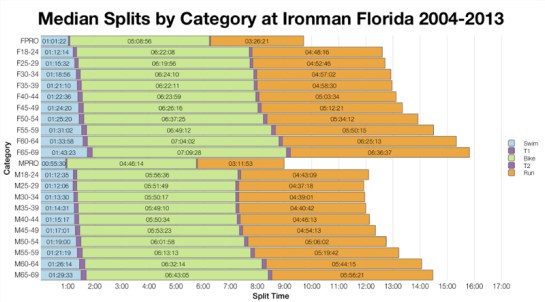
Consider this: British triathlon coach Russell Cox published a pragmatic insight into how fast triathletes are really riding at Ironman. His website, www.coachcox.co.uk, displays the data.

Cox discovered the median bike speed for the Men’s 40-44 age category at Ironman Florida, one of the fastest courses in the U.S., was only 17.5 MPH.

Major bike brands generally test and develop their marquee “superbike” in wind tunnels at speeds that are over 30 MPH, nearly twice the real world speed of the average age group triathlete. Giant Bicycles showed wind tunnel comparisons for a bike speed of 50 kilometers per hour or 31 MPH on the webpage for their new Trinity Advanced Pro.

splittimes

And while numerous bike brands continue to argue, “aero is everything”, and aerodynamics are a compelling performance component, they are a tired sales component that consumers have become increasingly cynical of. Witness any triathlon Internet forum thread that debates wind tunnel white paper claims. These discussions are cyclical and never ending. There are no clear winners.

The middle 70% triathlon bike buyer is not asking, “Which bike is the most aerodynamic?” They are asking, “What is the most versatile, comfortable and the best value?” The industry has done a dismal job of addressing those questions.

Part of the reason why triathlon bike marketing has been so monotone is a lack of willingness to market triathlon bikes in any other way than the tired “Ours is best in the wind tunnel, here’s the white paper to prove it” approach. The problem is, when every bike manufacturer claims their bike is the fastest, all of them except one are wrong. Consumers can’t tell who is telling the truth, and for the most part, the data isn’t relevant to the 17.5 MPH athlete anyway.

In a room full of bike brands shouting about aero speadsheets and wind tunnel “data” someone needs to whisper about comfort, value, convenience and ease of use.

The triathlon industry hasn’t learned much from contrarian marketing successes like REI’s recent “Closed on Christmas” or Apple’s iconic PC-killing campaigns. Every ad reads the same, claims to be the fastest. Until someone breaks the mold of sameness in triathlon marketing the way Dan Stubleski broke the tape at Ironman Florida then it all just sounds the same, and increasingly, triathlon buyers have stopped listening to the same old pitch.

By Tom Demerly for tomdemerly.com

SPECTRE10

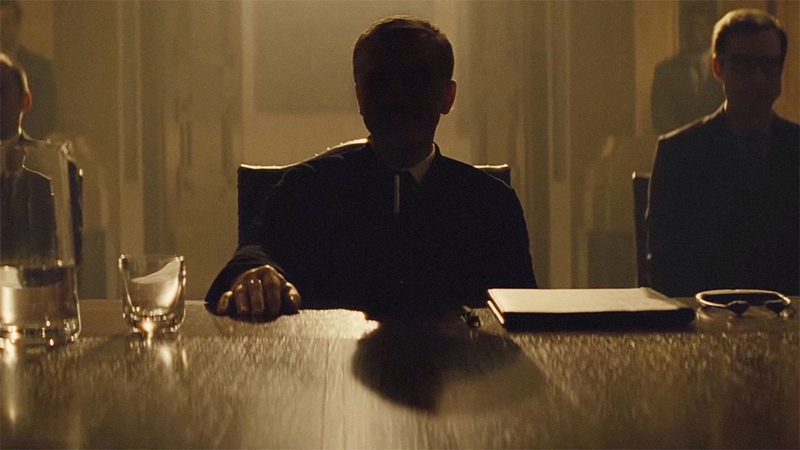
The 24th film in Ian Fleming’s landmark James Bond series, SPECTRE, is a different Bond movie influenced heavily by recent success in comic book story lines. The theme turns internal, a struggle between characters from previous Bond films. In doing so, it is interesting for lifelong Bond fans, but a let-down overall.

SPECTRE is not a typical Bond film; James Bond does not save the world from anything. He merely saves his job from a bad boss, and in deviating from the sweeping, template-style plot of James Bond saving the world from some type of annihilation the enormity of the Bond franchise is lost. Everyone has had to save a job from the influence of a rotten boss. Few of us have saved the world from annihilation. SPECTRE could have been a remake of Office Space, but with guns and sports cars.

SPECTRE20

Director Sam Mendes is only the second director to oversee two Bond films, but his understanding and reverence for the franchise are clear in the visuals, authentic feeling stunts and pacing. Mendes understands the true Bond character as Ian Fleming envisioned him; dark at times, understated, capable but vulnerable. It is a decent characterization of the fabled super-spy personality ever man aspires to. But SPECTRE breaks down because of this. Bond is just a guy with job problems in SPECTRE.

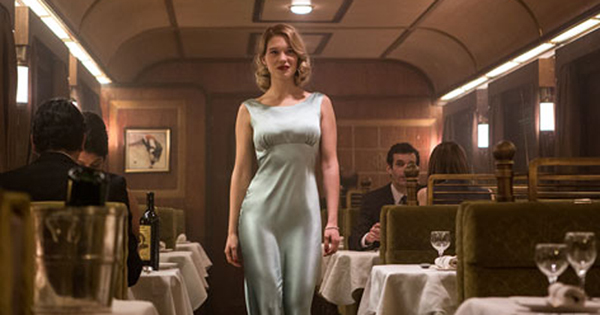
SPECTRE is a visually flawless film with masterfully executed scenes; beautiful cuts and soundtrack integration that make it flow at a pace that seems impossible. The lighting, coloration and mise en scene, that ephemeral and difficult to achieve visual quality that makes a movie seem like a dream, are all utter perfection. You can enjoy it as a travelogue. And hold your breath- you’ll need it- for the train scene when Dr. Madeleine Swan emerges for dinner in a long, ivory gown that defies the laws of physics. It’s the best part of the movie.

SPECTRE30

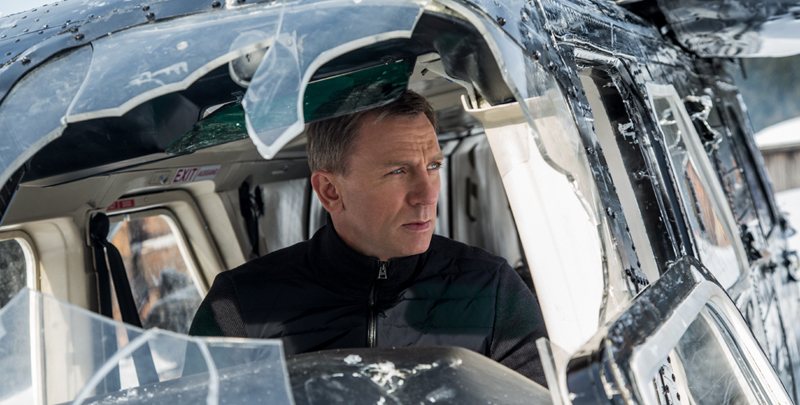
For lifelong Bond fans there is plenty to dig your teeth into though. The opening scene is an ode to several Bond films, the Junkanoo scene from the 1965 Bond high-mark, Thunderball. The helicopter fight is a tribute to Bond fighting outside a helicopter in the 1981 For Your Eyes Only. The beautiful cross-country train trip and incendiary make-out scene with Dr. Madeleine Swann takes us straight back to From Russia With Love.

So, SPECTRE is a reunion of sorts, a James Bond old-home week. It doesn’t stand alone well on its own, and the plot is underwhelming. I left the theatre hoping that the current production staff might have the courage to remake Thunderball rather than try to involve us in office politics with guns.

By Tom Demerly for tomdemerly.com

twohoursbook

Running a marathon under 2 hours is the most sensational human endurance barrier left. Is it possible?

Ed Caesar’s new Two Hours (Simon & Schuster) explores the plausibility of breaking the two-hour marathon barrier with narrative and research that will convert a fitness runner to a marathon fan. Romantic and reverent, Caesar develops the characters and brings us inside the story with documentary storytelling and well-researched technical insight.

Two Hours Grips you like a leg cramp at mile 23, holding on and not letting go. From an opening sprint that takes you inside the closed world of elite marathon running and on into the long, slow distance of endurance sports research Ed Caesar sheds new light on a old sport than has been eclipsed in recent years by the drama of Ironman triathlons and the sensation of made-for-TV novelty events. Two Hours reignites the romance and mysticism of the marathon.

Author Ed Caesar returns the reverence to marathon running and puts a face on the athletes who contest the sport at the highest level. He provides fascinating insights into their staggering training mileage and gossamer physical and mental fragility. His accounting is journalistic but his treatment of the subject matter is laced with meaty passion. The combination of the two makes for a tingling read. I had starting line goose bumps nearly the entire time.

Here’s an excerpt:

“As the gun sounded the lead pack was briefly surprised by an unknown competitor. A white athlete, who was not part of the elite field, sprinted the first few hundred meters ahead of the race favorites, if only to say he had- for a time- led the London Marathon. He must have been a decent runner, otherwise he would not have started so close behind the elite, but his challenge only lasted a minute or so. As the lead men swerved to either side of a set of traffic lights, like a stream around a boulder, the phantom sprinter stopped, stooped and caught his breath.

It was an odd moment. From the truck that drove in front of the race, where the managers and coaches of the elite runners watched the race, the reaction to this man’s quest for fleeting glory was a chuckle, or a dismissive hand gesture. These men were in town for business, not japes. But the stunt was also a reminder of the otherworldly accomplishment of the elite runners. After years of witnessing the Kenyans and Ethiopians race mile after mile at a sub 5-minute pace, it was easy to become blasé about their industry and talent. The amateur’s sprint briefly connected everyday runners to the elite and set their wondrous achievements in context. Somehow, the sport at large had forgotten how to communicate that sense of awe. But for those few seconds, it returned.”

The entire narrative of elite marathon racing rings with awe in Two Hours.

Caesar’s accounting isn’t all romance though. He digs into the dirty world of doping in marathon and the secretive deals made between super-runners to maximize winnings through inauspicious and subtle manipulation of the results.

Running literature is filled with classics from writers like Bill Rodgers and George Sheehan. But there hasn’t been a fresh voice in running books since the now-defunct Born to Run that fueled the spurious barefoot craze and saved running from the recession. Ed Caesar’s Two Hours returns credibility and reverence to distance running literature and opens the conversation about the next sensational chapter in human endurance.

If you pick up Two Hours make sure you have an aid station within reach since, once the gun goes off in chapter 1 you won’t want to drop out of the action until the finish line.

By Tom Demerly.

coldwar10

“Our greatest calling as soldiers is to create a world that is secure for all mankind. Free of war, tyranny and oppression. Equitable and tolerant. If we do our jobs we render ourselves obsolete, so we are remembered in museums and quiet parks by regal memorials.”

I wrote that for the graduating class of the U.S. Army Infantry School, Fort Benning, Georgia, Cycle C-6-1 in 1982. I was the honor graduate of my first military school, a combined course of instruction for new soldiers called “OSUT” or “One Station Unit Training”. It was an efficient factory that turned out good soldiers. We were supposed to stem the tide of the red menace we feared would blow through the Iron Curtain like a steel hurricane and storm across Europe to push liberty and democracy into the Atlantic under the crushing torrent of Communism.

We were ready to fight. We just never knew what war we would be fighting. “A war with no battles, no monuments… only casualties” as Tom Clancy wrote in The Hunt for Red October.

This week two incredible monuments of this Cold War were consigned to museums and displays. And their internment is symbolic of the end of this terrible era.

coldwar50

The last flying Avro Vulcan, XH558, at an airshow appearance earlier this year.

The only flyable Avro Vulcan Bomber, aircraft number XH558 made her final flight this week. The four jet engines that power the massive, bat-like bomber have been declared too old to fly safely so she returns to the surly bonds of earth as a relic.

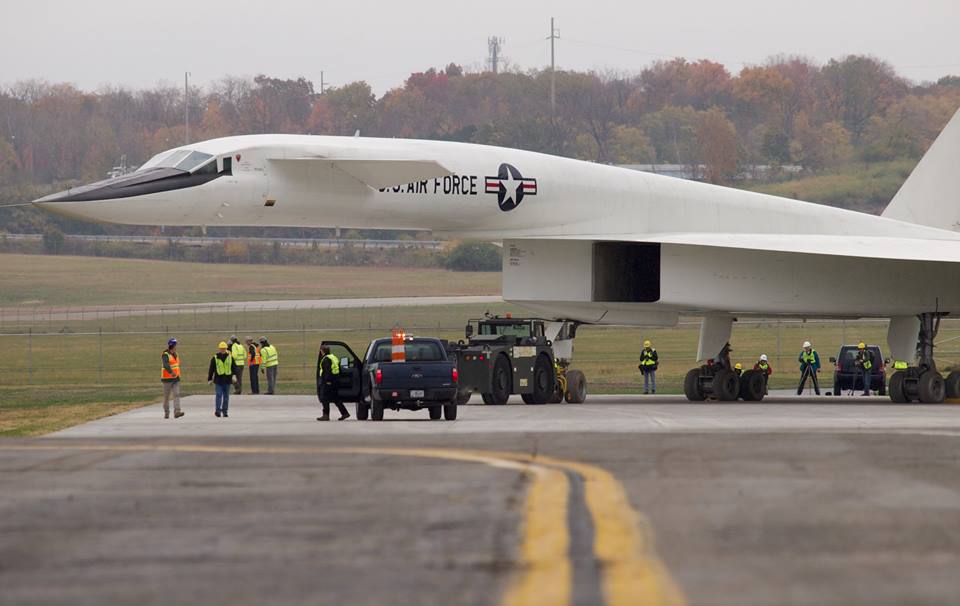
The day before the only surviving North American XB-70 Valkyrie was wheeled to a new and permanent indoor display facility at the National Museum of the United States Air Force in Dayton, Ohio near Wright-Patterson Air Force Base.

1948176_10153777466714309_4764320602961335253_n

The only remaining North American XB-70 Valkyrie being towed to its final exhibition building at the National Museum of the Air Force in Dayton, Ohio.

These two giant bombers were designed to deliver nuclear mega-death in an atomic slugfest that thankfully never came. Some strategists who espouse the deterrent theory suggest that it is because these bombers flew that the Cold War never got hot.

The two aircraft are quite different. The Avro Vulcan was an operational jet bomber used by Britain’s Royal Air Force. She wore a huge cloak of camouflage and the red/blue roundels of The Empire. The Vulcan saw combat in the 1982 Falklands war when she launched long-range bombing raids on Argentinean positions in Port Stanley in support of a British invasion. Vulcans flew a complex 3,914-mile transit one-way to their targets after leaving an airbase on Ascension Island. They relied on a relay system of aerial tankers to refuel them. The Vulcan was also a star of the 1965 James Bond film Thunderball in which a nuclear-armed Vulcan is hijacked to the Caribbean and its atomic bombs ransomed by an evil network.

The Rockwell XB-70 Valkyrie’s lineage is less illustrious but no less sensational. The XB-70 was a massive, six-engine supersonic jet bomber intended to penetrate Soviet airspace over the arctic at three times the speed of sound. Then it would level Russian cities with nuclear megadeath. The Valkyrie wasn’t a total disaster, but very close to it. One of the two prototypes crashed in an ill-fated publicity photo shoot in the California desert, killing two test pilots. The single remaining Valkyrie was subsequently grounded. The program cancelled. It became an elephant as white as its gleaming, heat resistant paint. An impossible fist of an airplane for a conflict decided in whispers.

And so the big cold war bombers are consigned to the ground. To the museums. Their stories will be told and retold. They will be cleaned and preserved and shined and photographed. Boy Scouts and school children and old men will visit them.

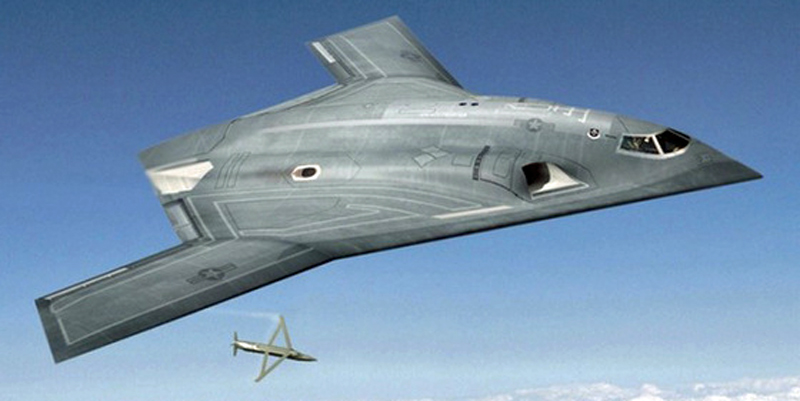
While the internment of these two massive Cold War relics signals the passage of a dangerous era it is an irony that a new mega-bomber project, the “LRS-B” or Long Range Strike Bomber was awarded to Northrup Grumman this same week.

On Wednesday Defense Secretary Ash Carter and the U.S. Air Force announced that Northrop Grumman won the development contract over competitors Boeing and Lockheed Martin. The program is expected to generate $55 billion in revenue for Northrup Grumman over its life making it one of the largest defense acquisition programs in history.

coldwar30

Artist’s concept of the LRS-B bomber project awarded this week to Northrup Grumman.

Some believe the next secret stealth bomber has already been seen, and photographed, over the American southwest when photographers got long range photos of a mysterious flying triangle.

One member of the mega-bomber club absent from the party due to work obligations is the venerable Boeing B-52. The B-52 still flies operationally. It is 52 years old this year. The aircraft is much older than the crews who fly it, and there is no end in sight for the giant, eight-engine “BUFF”. In fact one B-52 stored at the Aviation Maintenance and Restoration Group facility at Davis-Monthan Air Force Base in Tucson, Arizona for eight years was actually returned to service after being refurbished.

While the consignment of the Vulcan and the XB-70 to static displays signify the end of the Cold War they don’t signal the end of conflict I hoped for back at Fort Benning. The conflict between ideologies continues, in some ways more like ancient war than modern conflict. While it is solemn and peaceful to say goodbye to these graceful leviathans it is also worth reflecting on the fact that their replacements have likely long been in the air, veiled in secrecy and flying from remote desert runways. For, as the often misattributed but entirely accurate quote goes, and contrary to my flowery and hopeful speech as a young soldier, “Only the dead have seen the end of war”.

By Tom Demerly.

LiamMcMahon

Years ago when I had a bike shop on Mason street in West Dearborn a young lad of about twelve came in with his BMX bike. He was a tall, thin, quiet kid. He wheeled the bike in the small store and waited patiently while we finished up with other customers and our important conversations. Then we got to him.

“My bike makes a noise.”

I rode his BMX bike a few pedal strokes outside, it indeed made a noise. We tightened something. It stopped.

“Thank you.”

He left.

The next day he was back.

“My bike makes another noise.”

I rode it again but could hear no noise. I went over the various components of the bike that could make noise and demonstrated they were in good adjustment. He said, “Thank you” and left.

This process repeated every day for about two weeks. Finally I said, “Hey, would you have any interest in working here at the bike shop after school or on the weekends sometimes? I’d have to talk to your Mom but if it is OK with her it would be fine with us. You seem to like to hang out here.”

He said, “Thank you” and left.

The next day he came up to the shop with his Mom, a delightful woman whom June Cleaver could have taken tips from. She was the archetypical perfect mother.

Colin McMahon, then a young lad, started working for us that week. He was good. Quiet and focused, his shyness hid an analytical brilliance and wry wit that exceeded his young age. He was a problem solver, and he had a moral compass that locked unswervingly onto true north. He also seemed to have special reverence for our tight community of cyclists.

A man named Michael R. Rabe was working with us then, and if you don’t recognize that name I’m afraid I don’t have space here to tell you what a remarkable person he was. He is the subject of many other stories. Michael R. Rabe, or just “Rabe” for short, sort of adopted Colin as his cause in life. Rabe was a habitual bachelor and an eccentric. He was also a coach and genius having served on nuclear submarines and then writing code for a computer company. The two were perfect friends for each other. They hit it off, mentor and student, master and prodigy.

We had something rare. A community of like-minded people. People who rode bikes for fun and sport and people who shared life and friendship off the bike.

We honored the same values of friendship, sportsmanship, work and a reverence for an undefined code that goes something like, “I will always watch out for you, you will always watch out for me, we will remain friends during sunny afternoon rides and late night personal crisis. We shall always remain friends, no matter what the rigors of time may bring us.” That was our unspoken code.

Rabe was killed by a drunk driver on his bike riding home from my bike shop on the night of May 2nd, 2003.

I don’t remember much about the immediate aftermath. Zoloft does that. But I do know nothing was ever the same. Or so I thought.

Fast forward 12 years. It’s today. The wounds have scared over. They never heal. It’s been more than a decade. The worst recession in history, two wars, more people lost to the ether of time, moves across the country (twice) and around the world. I never wanted the changes thrust on us during the last 12 years. Never wanted to lose my best friend, my house, my business, my health, every cent, my belongings and even more. When people tell me they “lost everything” in the recession I silently nod. They lost their job for a while and their house in Lake of the Woods, from the $170’s, in Northville. They didn’t lose the people they loved most. They don’t have a hole in their heart closed with wire and plastic by a surgeon from Baghdad. When they look in the mirror they see about the same guy they did 12 years ago. I see his ghost.

And then I get the photo you see at the top of the page here in my Facebook feed. He is Liam Mitchell McMahon, and he was born yesterday to Colin McMahon and Bridgett McMahon. They were married a little more than a year ago. They live five blocks from me. And then I realize that after all this time, all this strife, all this distance, that I have finally found home again. Community again. Family again. This is where I started. The wound has closed. The scar is fading. Life is, as they say, going on.

Now, I am not all gushy about babies. I’ve never had kids, never yearned for them myself. But the continuation of the things that make this city, this culture, this circle of friends complete lives on, and that I am gushy about.

Liam McMahon will grow up with good parents, good grandparents, in a good neighborhood with good friends. He will continue this. It goes on.

And when I saw his photo on Facebook this morning It suddenly occurred to me, maybe everything I thought I lost isn’t really gone. It’s just reborn.


By Tom Demerly.

Malcomathome10800

Meet Vice-Admiral Malcom Frederick Davis III.

Call him Vice-Admiral Davis, “Sir” or, on a first-name basis, Malcom.

Vice-Admiral Davis is a survivor of Detroit’s collapse, and a product of its renewal. Local animal welfare organization Providing for Paws rescued Vice-Admiral Davis when he was only 5 months old living in the ruins of Detroit. He survived in a dangerous neighborhood filled with stray dogs. Winter was coming. He lived in abandoned houses.

Once The Vice-Admiral was rescued he established a basecamp at a volunteer rescue house for cats, dogs and raccoons. A born leader, young Malcom liaised between the animals to create a peaceful and cooperative society. He is a feline Sir Lawrence of Arabia.

For his exceptional survival skills, outstanding humanitarian efforts, valor in the face of adversity and his infectious positive outlook, then-Lieutenant Davis was advanced to the honorary rank of Vice-Admiral. He owns the name of Malcom and takes the given name Frederick from the late, great Frederick the Cat, who was also a white Prince of a cat. His Surname, “Davis”, emanates from a secret origin that cannot be disclosed, and he is the third in line of male cats, hence “III”.

Vice-Admiral Davis is, as you can see, skilled in appearing as two cats at once: a striped tiger cat and a pure white cat. This belies his background in espionage and subterfuge, tradecraft he learned well in the rough and tumble survival world of the Detroit ruins. Despite his martial skills Vice-Admiral Malcom Frederick Davis III is primarily a bon vivant and man of peace. He enjoys good food, exercise, friends and sleep. His character was forged in the cauldron of economic collapse but his intellect is sharp and his disposition as warm as a benevolent Sultan.

The Vice-Admiral has agreed to take up permanent residence at our home along with MiMi the Cat, who is 2 years and 4 months his senior.

By Tom Demerly.

MiMimourns

MiMi the Cat looks out the window at Mia’s grave in our backyard.


My friends know my cat named Mia died last week from a 2-year battle with heart disease. She was only 7. I wrote about her loss here. 

During the ordeal with Mia being sick my girlfriend Jan and my friend Sue shuttled Mia from one specialist doctor to another in an attempt to save her life. 

Losing Mia hurt. That’s an understatement. Her gentle presence, kind personality and soft, graceful beauty made her a wonderful companion. She was a stray rescued from a dumpster who grew into a beautiful cat despite a rough beginning and a difficult feline cardiac condition.  

Loss leaves a hollowness, a dark void that produces physical pain in your chest. A vacuum. And in that vacuum hope and light seems to disappear into the deep shadow of fear and uncertainty. And there is that familiar dread of never being able to get back what you have lost and the choking sense that you lost it too soon.

Then something quite remarkable happened.

People sent MiMi, my surviving cat and my girlfriend Jan Mack and I cards. My friend Mark from Arizona sent a card. My friends Glenn and Rasa from here in Michigan sent one. The hospital staff where Mia went when she was sick all signed a card and mailed it to us. People sent cards to my work. My friends Yanti and Kingsley sent a card all the way from Indonesia. More people sent cards. My good friend Mary, whom I’ve known since we were kids and whose dad ran a local bookstore for years, made a donation to our local animal shelter in Mia’s name and so did my friend from Ann Arbor, Wen N. My buddy Ira, who also knows cats well, stopped by to say he was sorry about Mia. My friends Paul, Sue, Lance and Connor came to my house and helped dig Mia’s resting place in my back yard while a man in Pennsylvania made a beautiful casket for her by hand from wood harvested from the forest near there.

And in all these cards and messages and help one thing emerged; we do not not suffer loss alone. Everyone around us bears the weight of our despair. Author Sylvia Boorstein wrote, in the book In The Face of Fear, “We take pain very personally. As if it is happening to us as individuals. The Buddha’s foremost teaching says that life is difficult and each of share the losses of others. That we do not despair and suffer alone.” And in that company of compassion and care, there is an uplifting sense of warmth that chases the shivering chill of loss away. It is replaced by a sense of support and community. Of kindness and empathy. And even in loss, loss that we will never recover, something good and warm is born.

We learn that we are not alone.


By Tom Demerly.

burger10

Brome Burgers & Shakes opened this week at 22064 Michigan Ave. in Downtown West Dearborn in the former jewelry store building that sat vacant for over a decade. It is near the corner of Mason and Michigan Ave. next to the BP Gas Station at the corner. The opening follows a major refurbishment of the building and continues the growth of new businesses along Michigan Ave. between Oakwood and Military.

The entire Oakwood/Military stretch of Michigan Ave. was hit hard by the automotive recession five years ago and by a poorly timed move to paid parking in the area The paid parking has since been removed and returned to free public parking in lots north and south of Michigan Ave. in this now thriving restaurant district.

burger20

Brome Burgers & Shakes brings the East and West coast gourmet hamburger trend to West Dearborn. The execution of this popular theme, from menu to decor to service and most importantly, food, is truly exceptional.

A menu of at least ten sandwiches including vegan, candied turkey, brisket sliders and a nicely varied specialty hamburger list also includes Hot dogs, salads, gourmet sides including delightful fries and truly remarkable shakes. Ever had a cornflake shake?

burger60

The open, airy and bright decor give the restaurant a fresh, modern feeling while the wall of natural foliage softens the feel and freshens the room, also serving to make the noise level in the restaurant pleasant for conversation even when packed. The owners get high marks for providing a perfect setting marvelously themed to go with the menu.

Staff is bright-eyed and bushy-tailed as they check in on guests to be sure burgers are cooked to order. An impressive feature of the restaurant we noted while visiting during the first few days it was open is that the operation ran flawlessly, with ordering done at the counter, the short line moving quickly, the menu placed far enough away from the ordering counter to facilitate good flow. This will become a hotspot for Ford Motor Company lunches, especially for out of town vendors looking for an afternoon gem. It is a well engineered lay-out that feeds smoothly through the experience.

burger50

A beautiful outdoor dining patio accompanies the dining room.

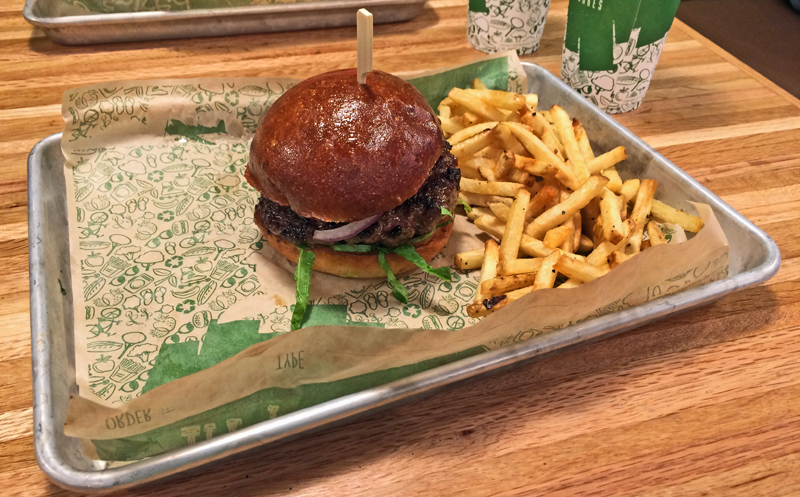
We sampled the Original Burger, the top item on the menu at $10.50 ordered in a combination with Kennebec fries and a drink, standard burger joint fare interpreted at Brome Burgers & Shakes with meticulous attention to detail. The meat is excellent, grilled to medium-well per their recommendation, juicy and lightly seasoned for a memorable smokey finish that hints at sweetness. Red onion, fresh tomato, mcclure pickles, fresh romaine lettuce and a respectfully mild Brome sauce finishes the standard topping. The bun is brown-crusted and flavorful, perfectly fitted to the patty so the hamburgers even handle well. Fries are perhaps the best ever, with the ones we sampled wearing a sea salt and cracked pepper accent.

All meat is Halal and organically grown along with a natural theme of incredible quality that runs through the entire menu. Even the soft drink selection is massive and dispensed from the most advanced mixing machines.

burger40

Brome Burgers & Shakes helps recalibrate the Downtown West Dearborn dining experience with a fresh flavor and experience common to the big cities now but new to Dearborn. It’s a mother sign of the strong comeback the Downtown West Dearborn Business District is making and a truly gem-like surprise for Downtown Dearborn. Don’t miss it.

Brome Burgers & Shakes is at 22064 Michigan Ave, on the north side of Michigan next to Om! Spa. Parking is free and open in the back of the restaurant. Hours are 11:00 AM to 10:00 PM. Phone number is (313) 996-5050. Dine-in and carry out available.

www.bromeburger.com

burger30