By Tom Demerly.

Get ready for an ordeal with a pay-off at the end in “Life of Pi”.

There are very few movies I am tempted to walk out of, but Life of Pi was one of them. The movie and the story are both an ordeal. I’m glad I stayed though.To appreciate Life of Pi you must have lived some personal version of the fable. If you have it’s worth the trip.

Life of Pi is a classic transitional and survival tale that follows a lad named Pi through his intellectual and spiritual coming of age then a dreadful shipwreck as the main story develops. You know the end at the beginning, some of it at least, so I’m not spoiling anything for you. The movie relies heavily on symbolism to the point of tedium, until the plot pays off in the final few minutes with a truly amazing sleight of storytelling. And that is why I’m glad I stayed.

Based on a book of the same name released in 2001 and shopped around from director to director Life of Pi wound up in Ang Lee’s hands after being considered by the eccentric M. Night Shyamalan. I’ll suggest a version under Shyamalan’s quirky direction would have been the final nail in the coffin for this story. Lee’s interpretation was its best chance short of Steven Spielberg or perhaps Richard Zemeckis who directed the well done Tom Hanks film Castaway of similar plot but different ending. Hollywood reviewers haven’t given Life of Pi much of a chance but audience reviews may prove them wrong. In hard times a movie like this will resonate. Viewer reviews have trended to four star territory even in the crowded holiday movie market.

There are three distinct visual styles in the film. The first is a beautiful and lilting mise-en-scene rich in pastel sepia that provides a gentle and reverent basis.  It has a travelogue quality I liked.  As the story shifts to adulthood it becomes more journalistic then back to stylistic during a tender first love.

Then it gets weird.

A 3D version of Life of Pi was showing at the same time as the normal one I saw. Thinking back after the non-3D version I can see how 3D may have added to the visuals in the bulk of the movie. Critics who saw the 3D version were positive about the effect saying it was used tastefully. I didn’t miss it since good camera work and lavish special effects carry the conventional version well along with the wild twist at the end.

The main body of the film charts Pi’s ordeal on a lifeboat with some unlikely companions. It becomes tense and stressful. Then it becomes downright painful. During one scene I had to convince myself to stay it was so difficult to watch. The only reason I did was in the hopes of some pay-off, some redemption.

An unlikely feature of Life of Pi is its addition to the body of survival literature. The movie teaches textbook survival lessons both technical and behavioral. It harkens to a few epic survival tales such as the book Survive the Savage Sea and a favorite of mine, Kon Tiki. There are lessons in how to survive, cope and go beyond mere survival in Life of Pi. For anyone who may rely on survival skills the film delivers on two levels, technically and with the strange twist at the end that teaches a valuable lesson.

The degree to which this movie works will depend on your own life experience. If you are a survivor, it will resonate and the ending will deliver. If not, it is just a tedious fable until a long-winded pay-off that may not be worth the wait.When you sit down in the theater you’re risking the two hours to see if that pay-off is worth it. For me it was, but I’m an easy sell for survival stories and its metaphors were a gut punch to someone who loves animals. After being pummeled by the harrowing scenes in the middle of the story I really wanted something in return. I came away entirely satisfied, both glad I stayed and glad I didn’t miss Life of Pi.

By Tom Demerly.

While some of the digital effects and scenes in “Red Dawn” are cumbersome the movie does have merit in the recessionary and post 9/11 era.

Remakes usually bomb. They almost always bomb when they’re a remake of a film that was quirky or marginal to begin with. They may have a chance if there is a relevant cultural change that reframes the plot between the original and the remake. That is the case with the new Red Dawn. Things have changed that make this film work oddly well. Red Dawn is a remake of the 1984 movie of the same name with Patrick Swayze and Lea Thompson, both credible actors even before Swayze started dancing.

I have a unique relationship with the original Red Dawn since it was released when I was in U.S. Army Airborne School at Fort Benning, Georgia. Fort Benning had three movie theaters then. All three were playing Red Dawn, and only Red Dawn. Every showing was sold out.  We were soldiers then, and young, new to the military and hot off the successful invasion of Grenada. The fictional prospect of being able to fight the Russians (and Mexicans, oddly enough in the first film) made us feel like we were “ministers of death, praying for war” (Full Metal Jacket).  We saw it over and over, debating the tactics, the weapons, the plausibility.

Patrick Swayze and Charlie Sheen in the original “Red Dawn” from 1984.

On 9/11 we got our war.

The original Red Dawn was written with technical insights from the insurgent war in Afghanistan. Not the one we’re in now, the one before that. It seems we had found a hero of sorts in that war, a courageous and charismatic tall sheik who fought the Russians in the high mountains of Afghanistan. Patrick Swayze’s character in Red Dawn 1984 was inspired by him. His name was Osama bin Laden. Osama eventually fell from U.S. favor in about the biggest way possible and another movie about his inevitable appointment with a red-haired CIA lass and some Navy SEALs is due out next month. You already know how that ends.

Red Dawn 1984 didn’t resonate much beyond the military and right-wing NRA audience since there wasn’t much to hold it up then. The Berlin wall came down in 1989 and Reagan was taking care of those pesky Soviets who would fall altogether in 1991. The entire prospect of an attack on U.S. soil was too farfetched to prop up a story. Until 9/11.

The new Red Dawn leverages not only a post-9/11 realization that the world is indeed, very small, we’re only a short plane ride away from the Global War on Terror.  It also leverages something Adolf Hitler did maniacally in Germany in 1936.  A terrible economy.  Red Dawn 2012 demonizes the North Koreans, the primary villains of the film and depicts them offering respite from a bad economy after they invade. Like Hitler did when he invaded France and Poland. In a sinister way the plot works if you understand the historical context.

I shot this photo on my cell phone on the set of the “Red Dawn” remake in downtown Detroit. The recessionary downtown auto capital was mostly abandoned. After the GM bankruptcy Chinese banners gave the city an eerie feel.

What is even more haunting about the film is that the original villain in Red Dawn 2012 was not the North Koreans, it was the Chinese. The plot would have worked even better with the Chinese invading. Apparently, a little too good for Chinese political sensitivities. Most of the Chinese stuff had to be digitally replaced with North Korean stuff when the Chinese media got a hold of the plot for Red Dawn 2012 and had a fit. Since the film is intended for international release and a big part of the audience is in Asia the idea of having the Chinese invade the U.S. was a little too prickly for the Asian market and for the studio execs who sweated over threats of boycott.

Red Dawn 2012 itself is not a bad action movie. It gets going quickly and the pace remains spritely.  Some of the opening special effects are unconvincing as is a lot of the plot. How did the Chinese, I mean, North Koreans, get all those transports and paratroopers into U.S. airspace without a big fight? What happened to our military? Those are pesky details that get in the way of wrapping your mind around the prospect of the Chinese… sorry, North Koreans getting in a bunch of airplanes and flying over here to parachute into Anytown, USA. That part is a big stretch. The depictions of urban combat, an insurgent war, the doctrine of guerilla warfare and even most of the technical details aren’t bad. In fact, they are a little haunting. There are a couple of scenes in Red Dawn where the kids who form the U.S. guerilla insurgency begin to question the wisdom of what they are doing. To understand the bad guys in the Global War on Terror simply insert a scene here where they are reminded of their religious conviction and now you understand much of the Middle East insurgency. Spooky. There is even a weird little vignette when a free American radio broadcast transmits “…the chair is against the wall”. It’s the same code Free French partisans broadcast in a scene from the D-Day invasion film, The Longest Day.

A connection I share with the new Red Dawn is that, while the movie is set on the U.S. West coast it was mostly shot in Detroit, Michigan. I lived in Detroit then. My friends and I rode our bikes to downtown Detroit where the movie was being shot and took cell phone photos of the giant Chinese Communist Party banners hanging from downtown buildings, sandbag bunkers and TOW missile launchers. It was weird to see that, especially when GM had just filed bankruptcy and most of Detroit was abandoned. In a way the film’s plot became… oddly relevant.

The fact that the Chinese wielded so much influence over Red Dawn and what it showed may suggest we need the Wolverines, the American good guys in the movie, in Hollywood a little sooner than we thought.

Red Dawn 2012 has enough going for it that it’s worth a look if you’ve already seen the new Bond blockbuster Skyfall  and have some interest in the historical influences and controversy about the Chinese in Red Dawn. Those things and a good, “B” grade action shoot-’em-up may make the movie worthwhile despite some weaknesses.

By Tom Demerly.

Slow checkouts and invasive information gathering keep customers from their most important activity; buying.

“No, I don’t want a membership card, I don’t want to be in your buying club, I’m not giving you my name, you can’t have my e-mail, I’m not interested in earning points. I just want to buy something. And I don’t want to stand at the register more than 120 seconds. “

During  the last three decades buying at stores has become a hassle. Checkout takes longer. Retailers collect personal information with invasive questions. Add marginal Point of Sale software with frequent errors creating more delays and the “service” in customer service is largely forgotten.  It’s a missed opportunity for retailers.

To understand the problem I timed my checkouts at retailers for over a year. The better retailers, usually grocers, chains and small specialties, had me out in under two minutes regardless of how many items. The bad ones took up to eight minutes to process a straightforward sale.

Interaction at the point of purchase is often the only interface a retailer has with a customer. The customers’ opinion relies on that experience. It’s an opportunity to win fans but more often a reason for people to use Amazon 1-Click. It’s also why Walmart is experimenting with iPhone based “Scan & Go” in Rogers, Arkansas. This is a movement to the opposite extreme at Point of Purchase; from too much to too little. The best experience is somewhere in the middle.

How valuable is quick check out? Amazon has a patent on their “1-Click” checkout technology and there is a $10,000 bounty to contest it. No one has.

We develop systems before we create the social conventions for using them. Gadgets before manners. Point of Purchase routines are rarely tested with live customers. Few retailers take the time to adequately train their staff before they have contact with a customer. It shows in the number of “excuse me’s” and “I’m sorry, this will just take a second” at the register.

There are retailers who get it right. Summit Hut in Tucson, Arizona is a specialty outdoor retailer with an online sales component. Checking out in their stores is quick and dignified.  More importantly for the retailer, Summit Hut staff frequently add to the sale during checkout. It’s good, old fashioned customer service; respectful of the customer’s time and attendant to the sales motive without being too invasive. Key components to Summit Hut’s efficiency are a large, uncluttered cash wrap area, employees who know what they sell and sensitivity to the customer’s time and buying behavior. The store isn’t reliant on cookie-cutter systems for good customer service. They use good employees instead. The challenge for retailers is reproducing this behavior.

Summit Hut competes directly with the largest chain of outdoor retailers in the U.S. in Tucson. That chain sells memberships that return a dividend and provide member pricing. Summit Hut still competes because not every consumer wants a membership shopping experience. A component of membership shopping is non-members are penalized and even alienated at the register when the sales associate asks, “Are you a member?” and tells them, “You would have saved $XX today if you were a member.” Data suggests strongly that customer memberships do foster repeat purchases, but they also alienate non-members when skilled customer service can achieve the same loyalty without the negative reinforcement to non-members and the costs and delays associated with membership buying.

The principles of great customer service were born with the earliest retailers and haven’t changed even with new technology.

Key components to a great customer experience at checkout include streamlined, proven POS software, absolute proficiency of the checkout person, respect for private information, the ability to interact sincerely with the customer, expert product knowledge, strong sales motive, separate return and exchange facilities and a well designed check out area. One at a time:

1. Point of Sale software needs to work perfectly. Customers should not be penalized with longer waits if it fails. There is only one remedy for a defect during checkout. Give whatever the customer is buying to them free or cheap and quickly move on with a sincere apology. After a store gives away enough stuff they’ll get this right. There are laws governing errors at checkout with bar-coding. One set of widely drafted state statutes “requires sellers using UPC’s [barcodes] to mark each item with its price” (CGS § 21a-79(b)(4)) as a back-up to software. If a retailer’s  price scanning doesn’t work instantly at checkout it isn’t the customer’s problem.

2. Checkout staff should be highly proficient in the process. Checkout is often the only live contact a customer has with a brand. A few retailers respect this enough to train and test their employees up to six months before they service a live customer. Some retailers separate customer service staff with checkout specialists. The key things with the checkout are expedience, respect, gratitude and service through sales. Retailers should respect the customer’s time by getting it right and moving quickly.

3. No inquiries for contact info. Retailers have confused checkout with an opportunity to gather marketing data. It isn’t. It takes additional time and has no place at the cash wrap. Collecting personal information at the checkout is awkward because of privacy concerns and delays. Customers are sensitive about revealing e-mails and phone numbers or showing ID’s with other customers close by and to a store employee they don’t know. It isn’t appropriate to ask for personal information at the checkout. An alternative is providing customers with a kiosk separate from the cash wrap where they can share that marketing data if they desire in exchange for a one-time gift certificate (but not a percentage discount).

4. People at checkout should have a personality. This requires judgment since not every customer wants to chat. A good customer service person can sense what level of interaction is right. The best customer service people use their proficiency in the sales systems to move quickly and make the customer feel good about their choices. This is an opportunity for add-on sales if the interaction feels right. It requires training, experience and judgment.  It is difficult to quickly process a sale and assess the right kind of interaction with the customer but this talent is what keeps people coming back- and buying.

5. Expert product knowledge keeps customers. At the checkout it can avoid mistakes and add to the sale. It’s takes time and genuine interest to develop, but it’s a strong asset when combined with good judgment. The axiom “shut up and sell” applies as does the motive to move quickly, but a good catch from a checkout person on a sizing issue, product compatibility or other technical point reinforces why a customer should come back and can add to the sale.

6. The best reason to move quickly at checkout is to sell more. The longer it takes to process a customer at the cash wrap the less time is available to sell on the floor. Staff that are incentivized with attainable sales bonuses learn this quickly. They use their time wisely, respect the customers’ time and focus on sales and service.

7. Separate return area. You don’t want buying customers interacting with returning customers. They need to be separated for logistical and sales reasons. A buying customer should never be delayed by anything, worst of all a potentially unhappy customer with a return. Customer service staff should be proficient and expedient in returns processing, remembering it is another opportunity to win or retain customers and even to provide sales ideas. People working in the returns area should have the authority to grant refunds and adjustments without delays or assistance.

By Tom Demerly.

Over the last three decades a new set of business clichés has surfaced. They’re used by small companies trying to act big and big companies on the way to bureaucratic gridlock and subsequent meltdown. Never use these terms. They make you look like an idiotic lamb on the way to the recessionary slaughter of unoriginal thought.

One of my favorite business writers, Seth Godin, said it best: “Clichés make it easy to talk without really saying anything. Clichés make it easy to hide and to lie.”

People resort to clichés for three reasons: They don’t know what to say and clichés are convenient, fashionable and convincing to the dim-witted, everybody else is using them so they must be relevant and cool and they make you sound associated with the codified language of business insiders- but only to the uninitiated. As Godin mentions you can burn hours in meetings by just using these clichés and some Power Point as your business does ever shrinking laps around the drain. Throw in some Excel and you have most of what is big trouble with business both large and small.

Here are the most common business terms and trends to avoid:

1. Best Practice:

The most obnoxious business colloquialism. A best practice is neither. Best practices are what someone talks about when they have no original thought and steal obsolete ideas from other companies, often as not, bankrupt ones. They aren’t the “best” of anything and usually don’t stay in “practice” since hashed over old ideas don’t work. Except in pointed sarcasm or abject mockery, never use this term. If people above you in your company use it, update your resume. If people below you use it, replace them.

2. Spreadsheet:

Spreadsheets are more commonly collections of irrelevant statistics than meaningful tabulations. They are compiled in a manner that feigns logic to support some innocuous conclusion by someone with an agenda.  While the Microsoft Excel application used to craft most of these interpretive works of fiction does have useful applications, like finding Saddam Hussein (they did it with a spreadsheet) it is a lot like a paintbrush and an easel: just because you know how to use them doesn’t mean what you produce is useful. Spreadsheets support the useful business axiom: G.I.G.O., Garbage In, Garbage Out. In fact, the spreadsheet is every bit as interpretive as the brush and canvas but more dangerous since so many people accept a sort of “spread sheet truth”. Beware of people who boast about proficiency with spreadsheets. They wield a mighty ability to manipulate reality and bend it into some statistically supportable fable, generally to their favor. The spreadsheet disproves a time-honored axiom; sometimes numbers do lie.

“Yeah…. I’m gonna need you to go ahead and get those best practices into a PowerPoint along with our latest metrics in a spreadsheet by tomorrow.”

3. Metric:

Metrics come from and go into spreadsheets. That itself makes them evil. They usually wind up in a Power Point presentation from there. Even worse. The people using this term usually have no idea what it means. They are office Mina birds regurgitating some important sounding dribble their ineffectual boss or webinar dweeb spouted. Metrics are supposed to be a measure of something relevant. They’re usually the trees that keep you from seeing the forest, and produce a kind of entrepreneurial nearsightedness  that precedes things like GM’s bankruptcy and the Apple trouncing of Microsoft. The problem with the term “metric” is there are any number of better synonyms for the same thing. It is a term that is more fashion than function. Its adoption by the “Office Space” demographic has doomed it. Unless your goal is to look purposely unoriginal or suggest you lack insight, don’t use the term “metric” to describe any relevant set of business statistics. Pick another word, or better yet, take a tip from fast advancing middle managers everywhere; don’t say anything.

4. Webinar:

Definition; waste of time. The webinar is roughly traceable to the first espousing of calibrated ignorance under the guise of information by the Ancient Greeks and Romans. They called it satire. As with the Greeks, the audience often doesn’t realize they are being played. Webinars usually espouse best practices using metrics from spreadsheets. The perfect storm of commercial cretinism. In general you will know less after a webinar than before. They are sort of a virtual lobotomy. Enough of them and you may actually believe the company you work for has a chance of lasting another year. It doesn’t though, because instead of working, you’re wasting time making some buzzword huckster rich over the Internet listening to their webinar instead of selling anything.

The President was not entertained by another delay in the PowerPoint presentation.

5. “A/B” Testing:

When companies find themselves flummoxed on the edge of a fiscal precipice they will often announce an “A,B Test” to generate “metrics” to put in a spread sheet so they can determine their “best practices” and display them in a Power Point.  They learned this during a webinar last week. These are the death throes of the decreasingly competent. It’s like animals on the plains in Africa walking in ever tightening circles until they die of a brain worm or something bigger with more teeth eats them. Businesses that attempt this don’t know what or how to test. Usually they try to learn from a webinar. We all know the result of that. The danger with this term is it suggests some orderly and sentient analysis. There is seldom a correlation between the use of this term and execution of an orderly and empirical investigation. It’s just another thing companies do before they file.

Here’s a PowerPoint slide about bad PowerPoints.

6. PowerPoint:

The PowerPoint application would have been a useful presentation tool prior to the 1930’s when people were still amazed by anything big on a screen. Prior to PowerPoint there was the overhead projector.  PowerPoint is somehow worse than the overhead because it seems so easy to use. People rely on it too much and it has compromised the art and practice of delivering convincing and skilled presentations. Just throw up a PowerPoint, after all, when people are sleeping they can’t tell how stupid you really are. Putting any content into a Power Point slide lowers its “punch” by a massive factor. People have simply seen too much Power Point, and too much of it is bad Power Point. When the slides go up, people tune out. It is the crutch of the weak presenter. The bane of Power Point is it rarely works on the first attempt. Power Point would be better software if it electrocuted the presenter with increasing voltage for every second their stupid slide show doesn’t work before a live audience. Then the problem would fix itself, and be more entertaining.

7. Reach Out:

This is another truly awful one. My skin crawls when I hear this. It smacks of desperation. No one wants to be “reached out” to. Drowning people and zombies “reach out”. Worst of all, there is a better word for this concept. It’s called: “Ask”. Don’t make yourself look foolish and trendy by using two ambiguous, trendy words when one will do. Just ask. Don’t reach. It’s not polite.

8. Mission Statement:

If your company has mission statements plastered on walls it’s likely they are so far away from their original area of competence they need written reminders of why they are there. Businesses write mission statements for one reason: No one knows what the company is really supposed to be doing. The irony is most businesses need a two-word mission statement: “Sell something”. That sums up the purpose of most commercial enterprise. When businesses get so distracted from that central purpose they need constant reminders of what they actually do a sign on a wall won’t pull them back.

By Tom Demerly.

Poorly administered sponsorships are like showing too much cleavage at a dinner party. They attract plenty of attention, but not the right kind of attention.

Earning a net profit in the bicycle industry is extremely hard.  Poorly managed  sponsorships, mostly at the dealer level, contribute to making it harder.  They create a damaging subculture of “sponsored consumers” who expect to pay less than retail,  are trained to resist MSRP’s, set an example for others to expect discounts and return almost nothing measurable – except red ink. Worse yet, through unprofessional use of social media some amateur sponsored athletes have created the impression that if you are paying full price, you are somebody’s fool, and you’re not one of the cool kids.

It’s a tough thesis, but one the specialty bike retailer needs to own. Low level “sponsorship” discounting isn’t all that is wrong with bicycle retail, but it is one of the many small wounds that has bled the dealer network dry in a sort of financial “death by a thousand cuts”.

The National Bicycle Retailer Association, the NBDA, reports a significant contraction in the number of independent bicycle dealers over the previous two decades.

The NBDA, National Bicycle Dealer’s Association, reports that the “number of bicycle retailers is dropping” from a high of about 8,000 independent bike shops in the early 1980’s to about 5,000 in early 2004. In 2011 the NBDA reported 4,100 independent bicycle retailers, a loss of nearly 50% since the 1980’s. This is contrasted by significant growth in the number of USA Triathlon licenses sold, the number of triathlon events and the growth in popularity of cycling during the Armstrong era prior to the loss of his titles. It doesn’t make sense that there are less bicycle retailers today than there were before the triathlon boom and the Armstrong era. If we had seen similar expansion in any other specialty consumer population we would have seen growth in the number of retailers servicing them. We haven’t. In fact it has been the opposite.

Business owners driven by personal involvement in the sport and not  focused on the bottom line have created a subculture of amateur “sponsored athletes” that don’t generate additional net profits at all. These “sponsored athletes” have full-time jobs outside of endurance sports, earn middle class or greater incomes in their full-time careers and don’t devote a significant amount of hours returning anything to their so-called sponsors. They are hobbyists. Worse yet, if they weren’t “sponsored” most of them would still be buying at full retail. Retailers have, in many cases, “sponsored away” their best customers.  Many of these customers are very good athletes but they aren’t in the business of sports marketing to return a profit to their sponsors. They are consumers turned bad, ruined by a bike retail industry not focused on the bottom line and looking for quick popularity from customers looking for a quick deal. It’s like buying votes rather than earning them, or showing a little too much cleavage too early and risking a bad reputation.

Sponsorships work to drive full margin sales in professional sports through top level media exposure. That promotional loop seldom succeeds with lower level sponsorships.

Consumer level athletes aren’t the ones to blame for the sponsorship dilemma. Undisciplined retailers are. I should know, I’ve been one, and the last four years have been a cathartic process of trying to learn something from my own mistakes and teach others as well. Teaching bike dealers anything is tough since, like most entrepreneurs, they believe they know everything. I did. Before I failed. Many dealers are impervious to business education. Before their nearly inevitable failure though, they are unrepentant champions of knowing everything about how to run a small retail business. Right into the ground.

Another obstacle is that once local bike dealers launch their sponsored athletes and teams they do almost nothing to broadcast the message about it. There are proven axioms in professional sponsorship that, for every one dollar a sponsor spends on sponsorship they need to spend eight to ten dollars talking about it. Big brands can afford this. Bike dealers can’t. As a result the effectiveness of local club and individual sponsorship programs erodes to nothing with no real return at full margin for the dealer. Once the discounts and schwag are given out the dealer sees little in return, except more sponsorship requests as savvy consumers learn to “never pay retail” when they can easily negotiate a sponsorship discount instead. It begins a death spiral of increasing expectation for discounts that the retailer has a difficult time reversing.

The quandary of this phenomenon is that, if bicycle dealers offering sponsorships had a higher degree of attentiveness to the bottom line they would realize a series of elegant solutions to the dilemma. Realizing that giving the local hot shots a discount hasn’t sold much (or anything) at full margin is step one. Secondly, working with brand-level suppliers to leverage their sponsorship efforts is a better plan than trying to run a local sponsorship/discount program and it preserves the integrity of the local market. Big brands can afford to sponsor big names and pay for the media to talk about it. That is one factor that drives full-price consumers to a brand in an independent bicycle retailer. Thirdly, discounting product to retail consumers through sponsorship sends a bad message; the better you are, the more visible you are in social media, the less you pay. Instead of regular participants becoming better consumers, they are trained by retailers to become discounted/”sponsored” consumers.

An argument the local bike retailer has made for their consumer discount “sponsorship” programs has been that it supports their local market. That’s a good argument, for something else. If the local dealer wants to support the sport locally, build relationships and create additional demand they wouldn’t sponsor local athletes, they would sponsor local events. The difference between sponsoring events and sponsoring athletes locally  is significant. Firstly, price and margin are not eroded and demand is increased. Supporting local events creates more full price consumers on a broader level. Done correctly it can leverage a shop’s brand identity to full price consumers every weekend. Event promoters shoulder the burden of continuing the message on Monday morning with their own website when they report results. The branding message reaches everybody in the event. It reaches them before the event date through promotions to enter the event, during the event and then after the event with results. It also gives local retailers an easy “out” when the inevitable neighborhood hotshots come calling for sponsorship discounts. The retailer simply says, “We support the sport locally through our sponsorship of local triathlons, bike tours, mountain bike series and cyclocross races. If it weren’t for our support, those events couldn’t continue to grow and provide cyclists with events to enjoy.” Everybody wins.

A better use of sponsorship resources by the local dealer is events instead of individual athletes or teams. Sponsoring events benefits every athlete in the community and does not compromise dealer margins.

Like all arguments there are a few exceptions, but only a few. One good example is Fraser Bicycle and Fitness in Fraser, Michigan. Their “Club Fraser” initiative to involve athletes in the sport has created community rather that eroded it. It has benefitted charities and encouraged athletes to participate. It is built on involvement and development rather than discounting and schwag deals. It creates good customers rather than converting them to discount customers. It’s also hard work for Fraser to administer. The program has raised the visibility of Fraser at regional and national events and been recognized in national publications like the USA Triathlon newsletter. Best of all, the program hasn’t eroded the strong business model of Fraser Bicycle. Fraser Bicycle and Fitness is the exception rather than the rule, and few independent dealers have the focus and business discipline the Fraser management team has demonstrated in innovating and administering a sponsorship program.

Poorly conceived and administered sponsorships at the dealer level aren’t the only obstacle to earning a net profit in bicycle retail. There is no single factor to the contraction in specialty bicycle retail over the last two decades. It is an awful conspiracy of recession, changes is how consumers access products and information and ineptitude on the dealers’ part among other factors. The first step to facing the challenges to improving profitability is owning the problems, something independent dealers have had a difficult time with.  Seeing each contributing factor for what it is from the perspective of objective business will help the independent bike dealer mount a comeback. Starting with one problem at a time, like poorly administered shop sponsorships, is part of the solution.

The twenty-third installment in the James Bond film franchise, Skyfall, debuted last week in the U.S. to strong reviews and packed houses. It’s worthy of the praise as one of the best Bond films ever.

Skyfall is a long-awaited oasis for Bond fans, with numerous references to previous Bond films, beautiful visuals, and all the clichés James Bond movies are known for- but better. Skyfall reenergizes the Bond franchise with great plot, fantastic cinematography and opulent visual style. What is noteworthy about Skyfall is that, unlike some Bond films, it actually does elevate the Bond film franchise to a much-needed new level while paying homage to the existing films in a subtle and dignified way. Add incredible visuals and you have a holiday blockbuster and one of the best Bond films ever, a delight following the dingy and depressing Quantum of Solice.

The imagery in Skyfall is captivating, no small feat in the age of advanced computer generated imagery that often looks phony. What sets Skyfall apart is photography, composition and creativity, not just lavish computer generated imagery, which is applied sparingly and convincingly with perhaps one exception, a slightly clunky if typically “Bond” scene when monitor lizards attack Bond and an assailant.

The Bond film franchise is about clichés, some of them Fleming and Bond originated, others quite openly borrowed from other films and other series. Director Sam Mendes and Barbara Broccoli of Bond film fame were obviously influenced by the “Bourne” film series as some of the scenes are a bit  close to beach scenes in Goa, India from The Bourne Supremacy. Nonetheless, those scenes were good for Bourne, and they are good for Bond too. Apparently another cliché of disenfranchised film spies is a temporary respite in the beatnik beach communities of India.

Opening scene stunts, titles and the theme song are a staple of Bond films and this one returns faithfully to the first five-minute formula of previous bond films. The opening stunts are masterful, if borrowed, and refreshingly free of any clunky effects. They wrecked a lot of cars and broke things to film the opening sequence. Opening titles are a treat with Adele’s theme song as a fitting soundtrack, among the very best from previous Bond theme songs. It’s been in the top five songs of the British charts for five weeks. The graphics revisit previous Bond movies and make the avid Bond fan feel at home.

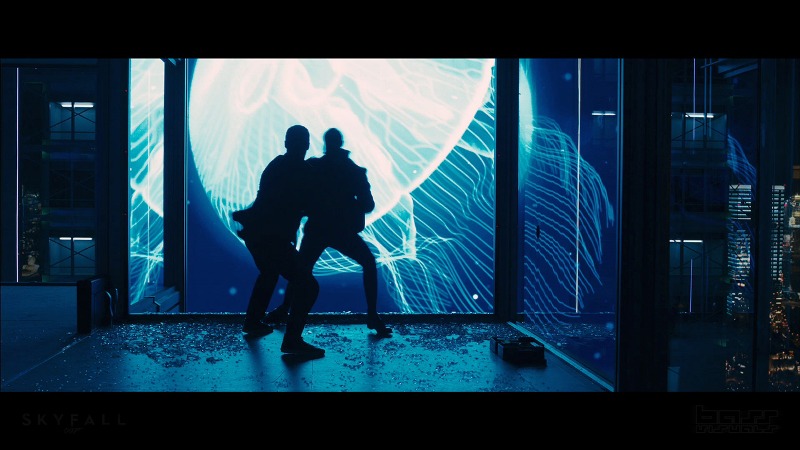
Visuals like this fight scene in front of a giant, deadly jellyfish projected onto a skyscraper in Shanghai make Skyfall a breathtaking treat.

One masterful scene is the brutal fight that unfolds against a massive Portuguese man-of-war laser graphic being projected on a skyscraper in Shanghai. It’s beautiful Bond style. Add to that the sweeping landscapes that are visually opulent in style and composition, such as the arrival scene in Macau, and you have one of the best Bond travelogues ever. Lighting is used in many scenes in place of overblown digital effects to achieve a more elegant and authentic appearance. All of it is done in the stylized visuals Ian Fleming was known for in his writing. Fleming would approve of Skyfall.

The pace of Skyfall is snappy with the typical Bond globetrotting locations shot on location in the United Kingdom, India (where the production crew ran into trouble with the state government early on), China and Turkey.

While nearly all of Skyfall is masterful, Berenice Marlohe misses the mark as a captivating Bond girl in here role as “Severine”.

What is missing from Skyfall is a developed and captivating Bond girl character. While Berenice Marlohe as Severine makes a stab at the mandatory Bond girl cliché role, her character in the movie is minor, somewhat mercifully so, as Marlohe lacks allure and personality as a Bond girl. She is, like some Bond girls, merely a victim.

A character who shares the spotlight with Bond to the greatest degree ever is the previously underused Dame Judy Dench as “M”. Dench is the best “M” in the modern Bond era and interprets the character masterfully across her seven appearances in Bond films as “M”. She takes a more active role in Skyfall and provides a new conduit to the next generation of Bond films.

If you are a Bond fan you will love Skyfall. In the two public screenings I attended the theatre was packed. It was obvious who the Bond fans were from their reaction to scenes with reference to previous films. This Bond has won Bond fans over. The local Hollywood Reporter projected $80M in ticket sales for the opening weekend. For moviegoers who aren’t rampant Bond fans it is an elegant and visual action film that provides a delightful escape and a visual vacation from lesser films. Skyfall adds momentum back to the Bond film series after losing steam with Quantum of Solace and the four-year hiatus from MGM’s financial problems during the recession.

Skyfall is the perfect extension of the Bond series, a worthy celebration of its 50th anniversary and a  must see holiday film. It’s a strong assertion that Bond is, indeed, back.

Craig Bellmann shot this photo of me at the entrance to the Lower Tanque Verde Falls. We went there on an expedition to climb up the falls and swim in the pools that form there during the monsoon season. Flash floods from the sudden thunderstorms are a constant threat during the monsoon season.

Craig, my guide for the day, is an expert on the flora of the desert Southwest. We spent considerable time examining specimens of unusual local plants that survive in the fragile desert canyon environment because of the flow of water through the canyon after rainfall. Many of the plant and animal species are very rare and only survive briefly after rainfall and uniquely in this region. (Left) A seed pod of the Proboscidea altheaefolia or “Devil’s Claw”. (Right) The Arizona Desert Cotton or Gossypium thurberi after blooming.

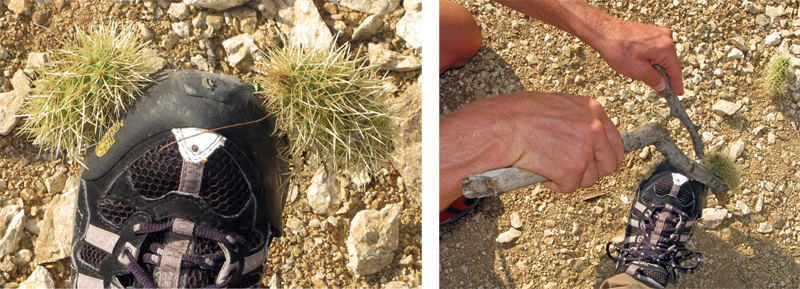
The “Teddy Bear” or “Jumping Cholla Cactus”, Cylindropuntia fulgida, is an annoying and dangerous plant. If you touch it the miniature barbs embed in your skin making removal difficult. Serious injuries for mountain bike riders falling on jumping cholla and hikers being impaled are common in the Southwest. Needles can be painfully lodged in the skin for weeks before they are expelled. These were imbedded in my shoe and had to be removed using two sticks.

Lush green desert grass grows quickly during the monsoon and disappears just as fast when the water dries up. Few environments on earth transform as quickly as these desert canyons, entirely dependent on the fleeting monsoon rainfall.

This was the seventh consecutive day of high temperatures above 105 degrees in the Tucson, Arizona area so our primary objective was exploring the cool canyon pools that fill after rainfall in the upper canyon. We discovered these pools were teeming with life including unusual transparent fish species.

A small frog or toad species joined us at a rest break. Some of the species in the region use a biological process called “cryptobiosis” whereby they lie entirely dormant until the water arrives, then spring to life until the drought of the desert returns.

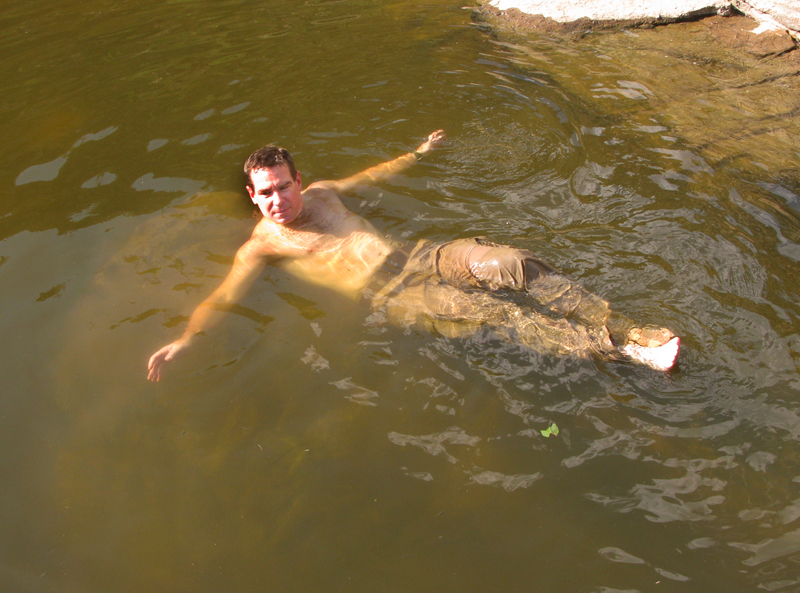
Cooling off in the canyon pools fed by the numerous waterfalls. I wore RailRiders’ VersaTac-light pants made of lightweight, durable 3-ounce Duralite Nylon fabric with Railtex reinforced knees and seat. These pants dry within minutes of leaving the water making them a perfect choice for adventures where you are in and out of the water.

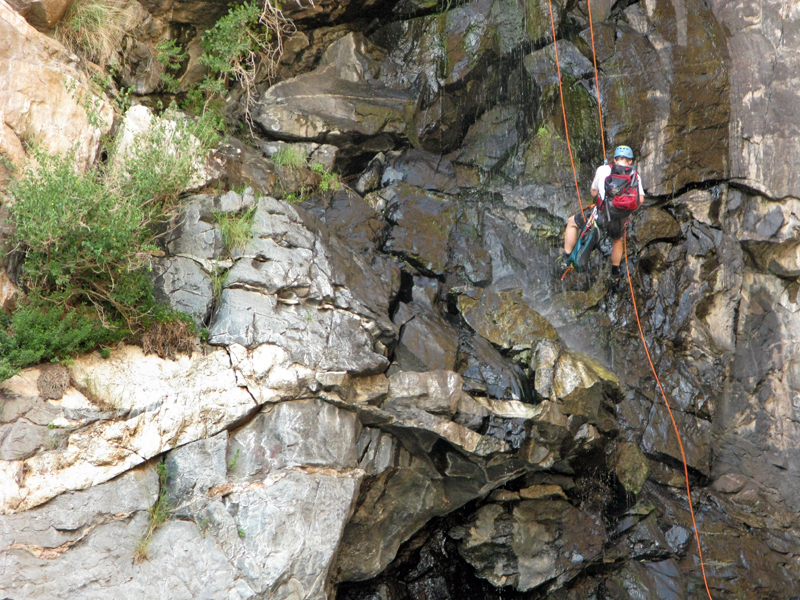
Canyoneering is the sport of descending the flooded canyons using climbing equipment, then swimming across the descending pools from waterfall to waterfall. Here a canyoneer rappels down a dwindling waterfall.

Once he has rappelled down the dwindling waterfall the canyoneer uses his inflated dry bag for bouyancy as he swims across the deep canyon pool.

The canyoneer uses an unusual mix of equipment and skills from rock climbing, mountaineering, spelunking and even white water rafting.

Craig Bellmann is a local expert on the flora, fauna, history, weather and topography of the Desert Southwest. His keen sense for the rapidly changing desert weather, especially in the monsoon, are important in avoiding the deadly flash floods that claim victims every year.

RailRiders’ VersaTac-light reinforced, quick drying pants and their classic Eco-Mesh shirt are perfectly suited for adventures where I’m in and out of water and need protection from the sun in extreme heat. I’ve worn this same RailRiders Eco Mesh Shirt on all seven continents and in the Marathon des Sables, a 152-mile running race across the Sahara in Morocco and in the Jordan Telecom Desert Cup, a 105 mile running race near the Jordanian/Iraqi border.

In the crush of social media brands only have seconds to be heard. Don’t waste it on hollow engagement. Shut Up and Sell.

Notice to companies using social media for marketing: Stop trying to engage me. I’m not interested. Instead, take a tip from author and super salesman Don Sheehan, “Shut Up and Sell”.

With the advent of social media there has emerged a demi-industry of “teaching” people how to market using social media. It’s bunk. The truth is social media is so new and dynamic no one knows how to wield it most effectively for marketing and if they did, they wouldn’t sell that knowledge in a hundred dollar webinar. 

What we do know are the basics of what works in sales, and those basics work across all media. Media has changed. People haven’t. Most marketers forget their end goal is as simple as selling to people. Whether that is putting your tomatoes on a vegetable stand in downtown Beirut or posting a photo of your products on Facebook, the rules are the same. Shut Up and Sell. Focus on your brand. Show your products. Ask for the sale. 

The mistaken idea that brands and companies ought to “engage” on Facebook comes from a common quark of human character transferred to brand management: Ego-centricity. Many Facebook “marketers” view their Facebook contributions in a vacuum. They think their post is the only one “friends” and potential “Likes” will see. They think the people who “Like” them will be so thrilled with an attempt to “engage” them they will surrender a fragment of their precious (and fleeting) attention span. Wrong. The time-tested principles of sales show that neither works nor contributes on the bottom line. It does waste a lot of time though, time you could be selling.

Picture this: A man is seated in the middle of Grand Central Station. The normally packed station is abandoned. He sits in solitude. Suddenly, you walk in and “engage” him. He devotes his full attention to you. That’s not reality. Grand Central Station is never empty. It is a chaotic throng of people, lost and looking, busy and on task- just like social media. They do not want to engage. They want a quick peek and to be on their way. Now, walk up to that same person in the crowded, real world setting and try to “engage” them. They are annoyed by you.

According to a range of results the average Facebook user has between 120 and 300 “Friends”. With that number of inputs commercial users need to be concise and focused with their message.

The high discretionary income Facebook users most marketers crave are sophisticated enough to know they are talking into a hole if they respond to hollow “engagement”. The brands and companies posting open-ended Facebook posts like, “Dave Morgan won Olympic Gold today, what do YOU think of Dave Morgan’s victory?” are getting responses from people who have little better to do than post on Facebook. The real consumers are busy earning discretionary income and spending it, hopefully as fast as they can. They don’t waste time “engaging”. They see something. They want to know about it. They either buy it or they don’t.

How do the most profitable (key word there; profitable) Facebook users look? Here are two:

Dan Whitsett’s “Secrets in Lace” retro apparel brand wields social media effectively to drive measurable results in sales. Their Facebook page is all product, no empty content. Fans respond by exercising their only option: Buying.

 Secrets in Lace is a niche lingerie brand that sells retro-themed women’s apparel. Dan Whitsett started the company in 1984. Whitsett had a singular and focused market vision. His company faultlessly executed that laser-beam focus in their social media. They have 22,000+ fans and the only thing they post about is their products. All their photography is professional and original, no “copy and paste” images on their Facebook page. Their Facebook pages have the same look and feel as their website and print catalog. The message is consistent. They only show their product. They only promote their product.

Patrick Ma of Triple Aught Design is a master of selling with social media. His weekly product “teasers” create a rush on new introductions that drive sell-through. His focus is on brand, product and sales.

Bay area entrepreneur Patrick Ma didn’t just found a company, he founded a category. His company, Triple Aught Design, designs tactical/military inspired outdoor gear. Ma is widely attributed with the invention of the “tactical softshell” jacket, a category now embraced by mega-brands like The North Face and Arcteryx. His 15,000 Facebook fans are served a weeky menu of product “teasers” that provide hints to what new products will be released every Friday. They usually sell out in less than three hours. In a strange quirk of social media some Triple Aught Design customers rant about short supply of new product. Ma lets the rants run, understanding this is the best “call to action” for brand fans there is. It is the advertising you can’t buy.

 There are many other good brands wielding social media effectively and their key link is narrow brand focus, product focus and asking for the sale. Facebook and social media “marketers” need to remember the metrics that count on the bottom line. They aren’t “Likes” or number of fans, they are sales results. A bank deposit slip doesn’t have a box on it for “Likes”.

By Tom Demerly.

This slideshow requires JavaScript.
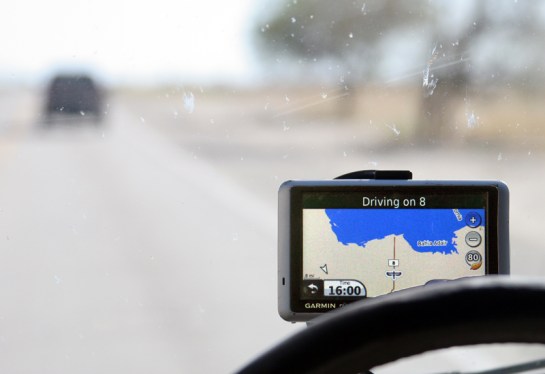
Puerto Penasco is a sleepy coastal town at the northern edge of the Sea of Cortez in Mexico. The warm, placid waters are havens for whale calving and dolphins. Once a year the city of Puerto Penasco, known in the U.S. as “Rocky Point”, hosts the Red Rock Las Palomas Triathlon at the Las Palomas Resort in Rocky Point. Here is our first sighting of the Sea of Cortez on our GPS as we make the scenic drive south through Mexico to Puerto Penasco.

The beach at Puerto Penasco is idyllic light sand extending out into calm, shallow water. It is perfect for first time open water swimmers since it’s calm and shallow with good visibility the entire way out. Shallow depths allow athletes to stand up almost everywhere along the 1000 meter swim course.

Part of our group conducts a beach reconnaissance before the race. They discover swim conditions are excellent with no currents, comfortable water temperatures and a calm surface. Many of the athletes at the Red Rock Las Palomas/Rocky Point Triathlon are first timers attracted to the perfect swim conditions and beautiful resort in a safe coastal town. This course suits them perfectly.

The sleepy beach community is safe for tourists with excellent local police and security. Crime in Las Palomas is actually lower than in Phoenix, Arizona. Many U.S. citizens own vacation property and retirement homes in the quiet little city known for its excellent local restaurants and colorful markets. Law enforcement in the area are helpful and friendly, anxious to spread the word about how pleasant and safe Puerto Penasco really is.

The storybook setting is an ideal destination for beach weddings like this one, just make sure the incoming tide doesn’t strand the bride and groom on a sand bar!

Athletes from Arizona, Texas, California, New Mexico and as far away as Idaho and Ohio made the trip to the Rocky Point Triathlon. Despite the perfect setting, great accomodations and excellent course only 134 athletes completed the Olympic distance triathlon with another 188 finishers in the results for the sprint distance event. Red Rock also hosted a nice 5K and 10K run during the event for non-triathletes. The event is clearly a “best kept secret”.

The Las Palomas Beach and Golf Resort hosts the Red Rock Las Palomas/Rocky Point Triathlon. The resort features incredible views of the ocean and spectacular balconies worthy of any exotic coast around the world. It is a spectacular host hotel for the event.

Our entourage discusses the swim course and conditions on the balcony the night before the race during another picturesque sunset on the Sea of Cortez.

Athletes on balconies watch for feeding dolphins the night before the event as jet skiers return their craft before sunset. The golden light of the northern coast of the Sea of Cortez is spectacular in the evening.

The pool area is quiet the night before race day as a few lingering athletes get race briefings and pick up their packets. The heated pools and hot tubs are popular for warming up after a night swim in the ocean.

Crews from the Red Rock Company, event producers for the Las Palomas/Rocky Point Triathlon, use jet skis to pull swim buoys out onto the course on race morning. The course marking is excellent making the event a great first time open water swim experience.
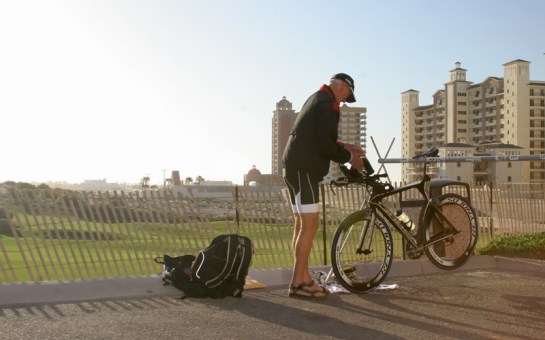
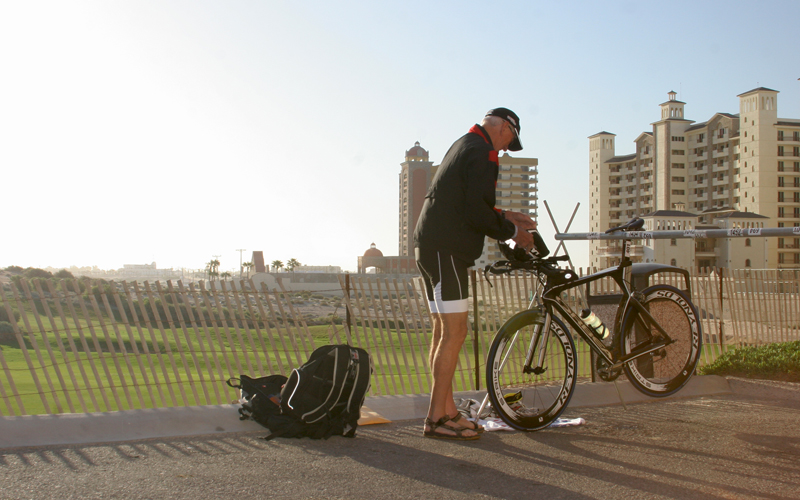
An early athlete sets up his transition area next to the hotel at the top of the beach. There is a short run up a sand berm to the first transition after the swim finish. The run uses the golf course across from the transition area. It’s a scenic, sunny but rolling and exposed venue that can be challenging.

If you designed the perfect triathlon swim venue, this would be it: A shallow beach with firm sand, clear, warm water, calm conditions and excellent course marking with plenty of lifeguards. Course sighting was easy in clear, calm waters.

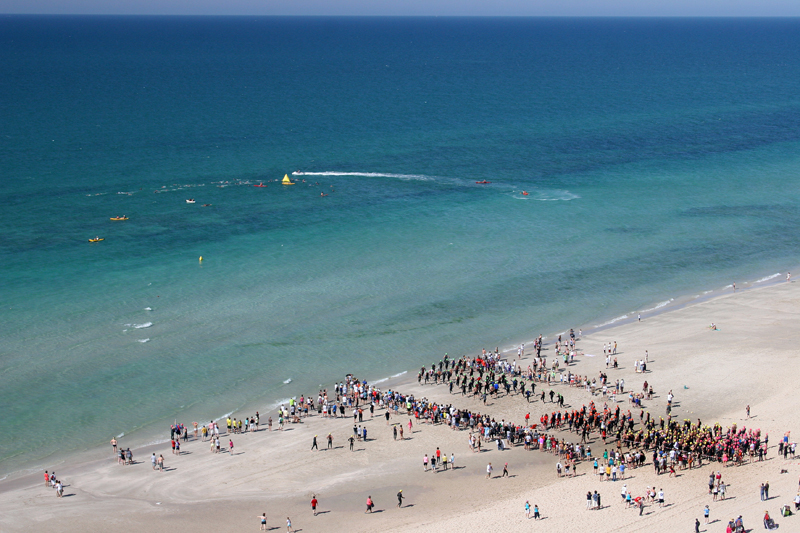
One of the first age category waves hits the swim course as the next wave waits for their start horn. Notice the athlete at the far right cutting the tangent to the fist buoy to save time and distance, a good strategy.

Mexican Coast Guard Units used rigid inflatable boats to patrol the swim course along with race volunteers and staff on jet skis, kayaks and paddle boards. Swim safety was excellent and the large, rectangular swim course meant crowding was not an issue.
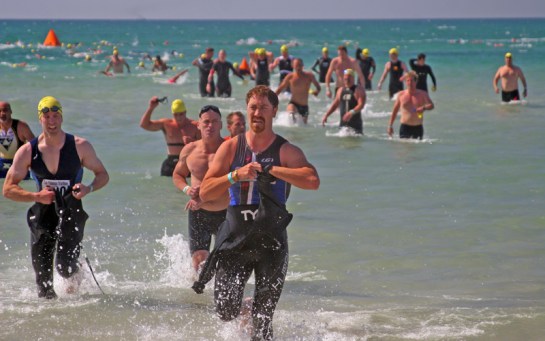
The swim “bubble” as wave starts converge near the swim finish where athletes stand in the shallow water to remove the top of their wetsuit in preparation for the run up the beach to T1.

Terra McCreight (left) hits the beach with another group of athletes from her wave start. This was Terra’s first open water, ocean Olympic distance swim.
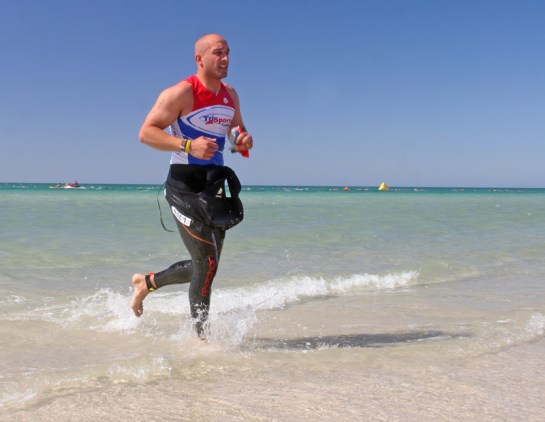
Adam McCreight beaches after his wave arrives on shore. Adam and Terra organized a large group of athletes to travel from Tucson to Rocky Point for the Red Rock Rocky Point Triathlon.  
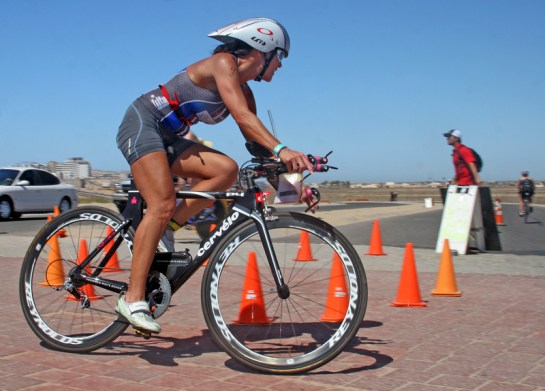
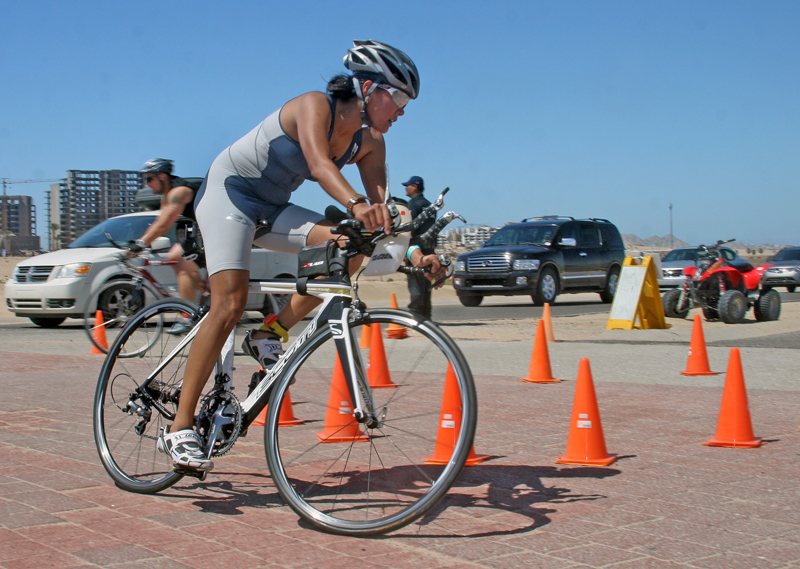
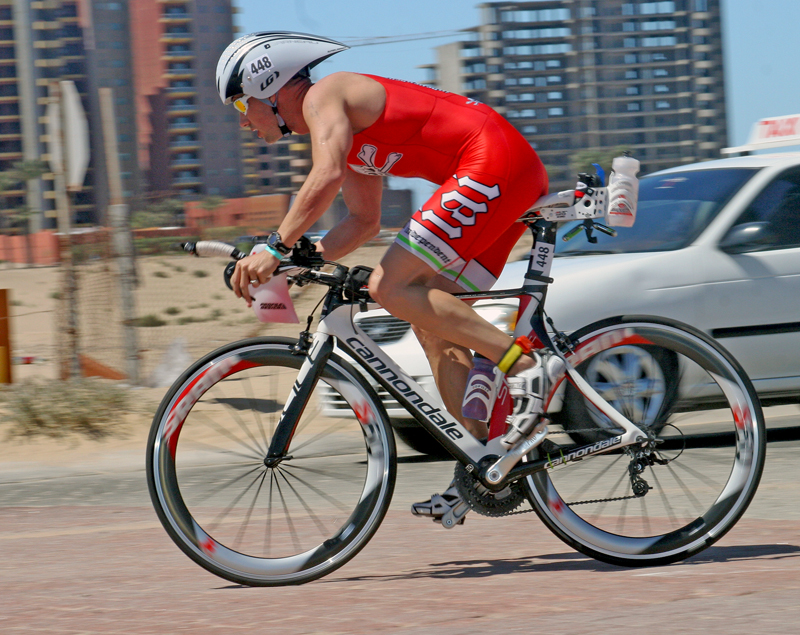
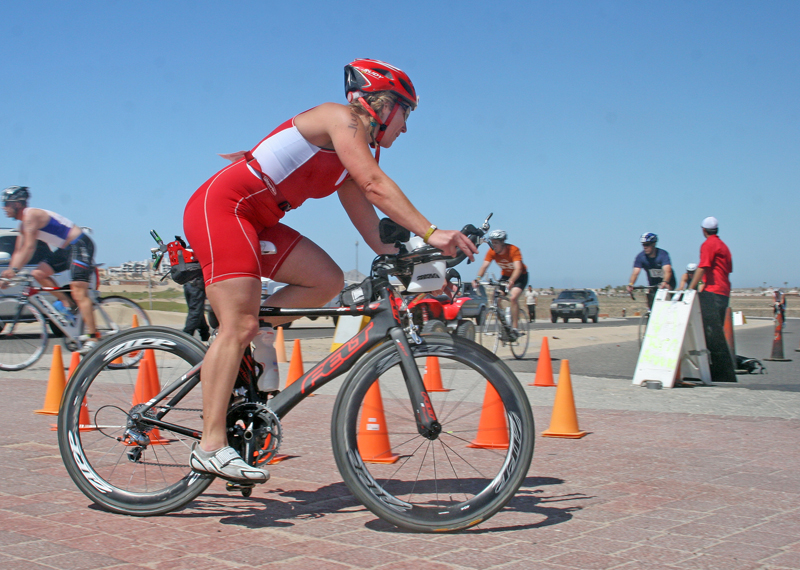
The Olympic distance athletes did three laps of an out and back bike course with sprint distance athletes doing two. Winds picked up late in the day challenging athletes who were on the course late. Here an athlete negotiates the turnaround before heading back out on her second of three loops.

Dr. Cheri Ong, a surgeon originally from Kuala Lumpur, Malaysia now living in Tucson, Arizona, negotiates the turnaround to head out for another loop of the bike course as the winds gather.

The open expanse of the Sonora Desert butts right into the north coast of the Sea of Cortez making for a barren bike course exposed to wind and heat. It is challenging but the multi-loop format makes the distance more digestible.
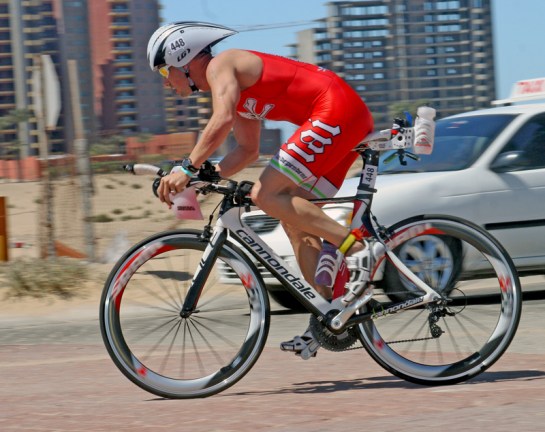
One of the race leaders storms into the second transition after completing three loops of the bike course for the Olympic distance, 24.8 mile ride. Athletes who got out of the water and off the bike course early had less wind to contend with.
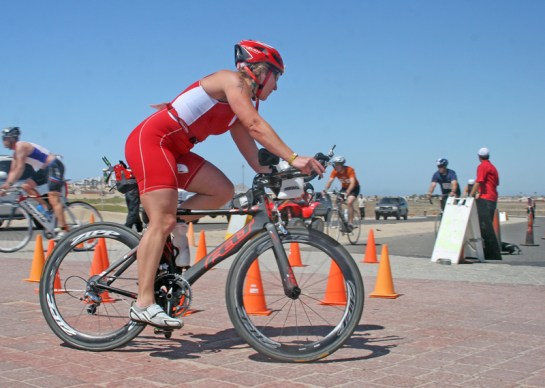
Terra McCreight begins her third lap under rising winds. McCreight’s preparation for the race season was interrupted by a serious auto accident that she recovered from quickly to return to training.
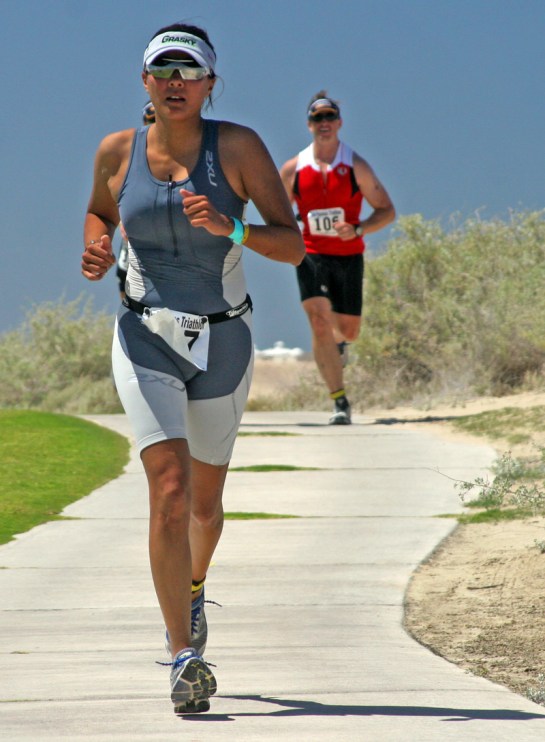
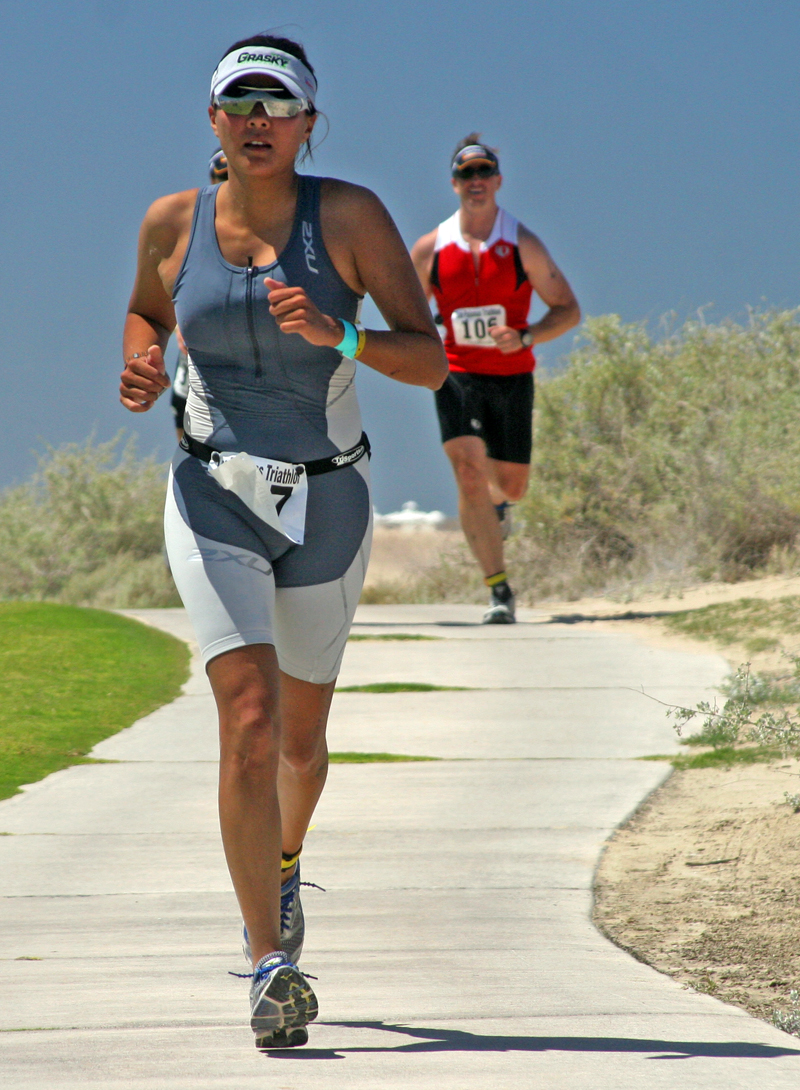
Cheri Ong attacks the run. This was a pivotal race for Ong as she began to plan a number of events throughout the season. The surgeon balances the demands of a difficult profession against the training required for events like the Rocky Point Triathlon.

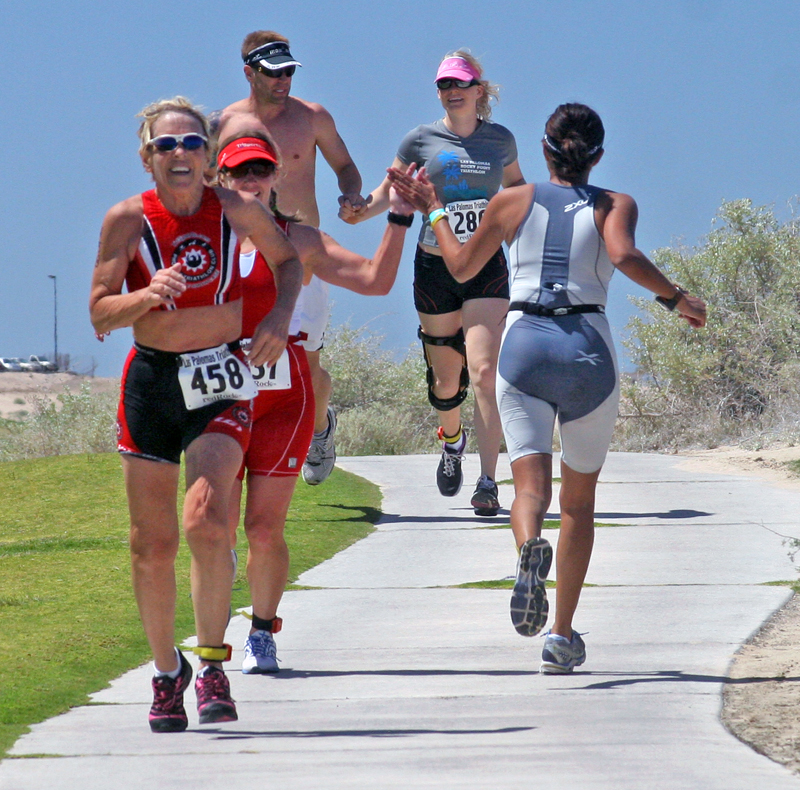
Terra McCreight and Cheri Ong exchange a high five as they pass on the run course late in the Olympic distance race.
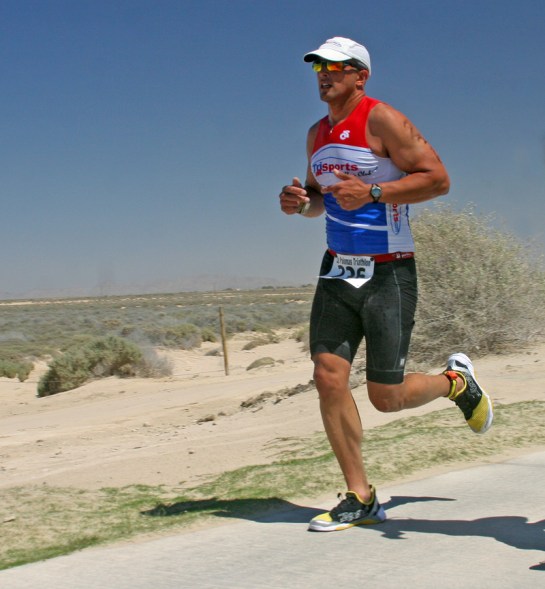
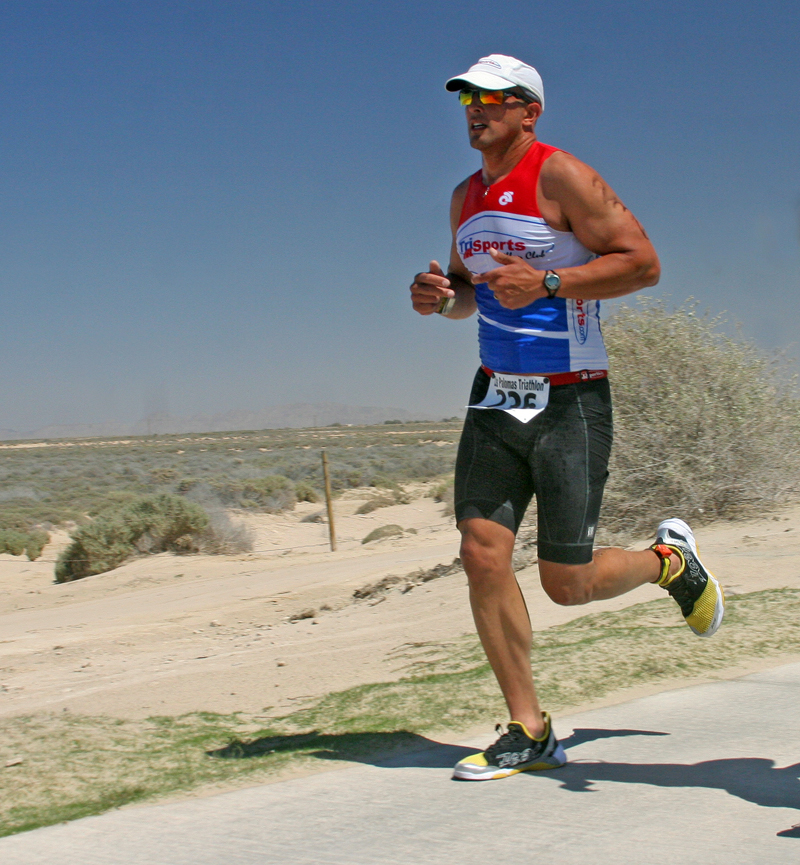
Adam McCreight on the run. The rolling hills in the golf course took their toll on legs tired from battling the rising winds on the bike.

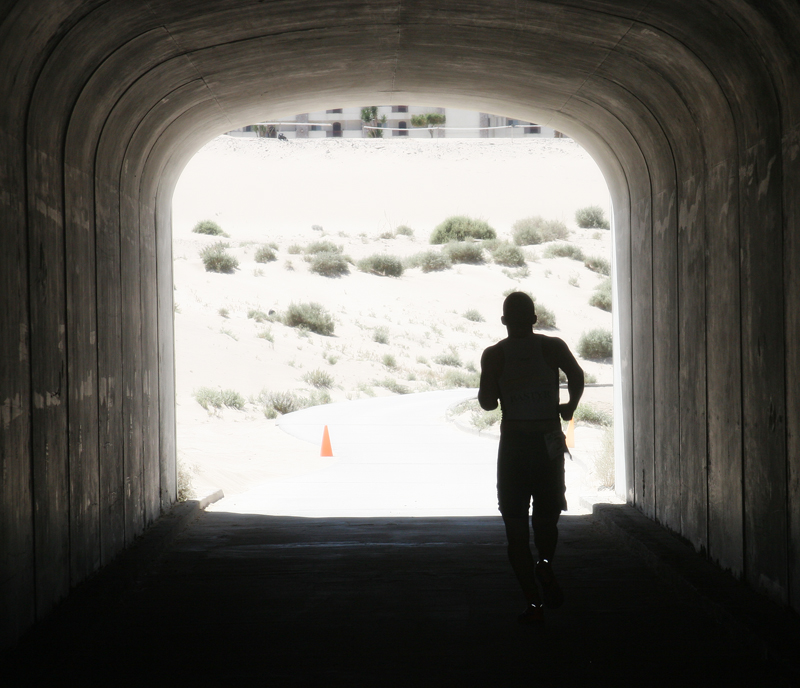
A tunnel for golf carts gave runners respite from the sun on the Olympic run course as they went to the bottom of the course for the run turnaround.

Water and sand were the theme of the entire course at Las Palomas. Nearly half the field at the Red Rock Las Palomas/Rocky Point Triathlon was doing their first triathlon here. It is a perfect event for first timers.

Crossing the golf course athletes got a moment of respite from the heat on the cool grass. This section headed to the top of the course where they turned left to finish the outer loop of the run. Athletes had frequent opportunities to see each other on the course with the multiple out and backs.

Terra McCreight covers the final few meters on the beach finish. The loose sand feels like wet cement on tired legs after the tough run of the Olympic distance event but the slip n’ slide at the finish makes it worth the effort.

Cheri Ong of Tucson makes the final trip across the beach to the finish in the Olympic distance event.

The Slip n’ Slide in the finish chute was popular after the warm conditions on the exposed run course.

Cheri Ong and Terra McCreight enjoy the beach after finishing the Red Rock Las Palomas/Rocky Point Triathlon.

The less PC attitude south of the border was apparent in the Tecate Beer tent as the Tecate girls were always ready to pose for fans.
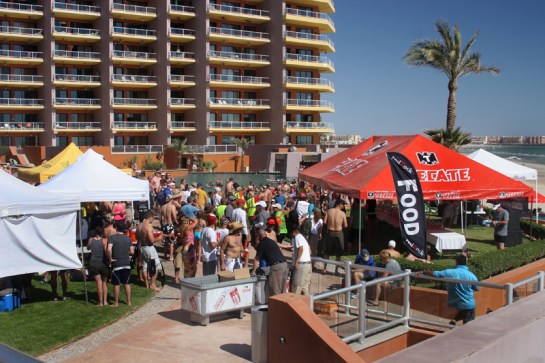
The Red Rock/Las Palomas Triathlon is the spring break of triathlons. With a festive award ceremony and a perfect party setting the event is poised to grow as the word spreads about the great race organization, excellent course and fantastic venue. The Red Rock crew deserves credit for a job very well done at Las Palomas.

This slideshow requires JavaScript.

The Heritage Flight Conference provided an opportunity to meet air crews one on one and get a glimpse of flight demonstration operations up close. This A-10 pilot enjoys a cup of coffee before his morning flight demonstration.

Senior Airmen Dean (left) and Staff Sergeant Stacy (right) prepare data logs for an A-10 flight demonstration at Davis-Monthan, Arizona in Tucson, Arizona during the Heritage Flight Conference on March 4th, 2012. Both men wear the Oakley tactical specific sunglasses, a must in the Arizona sun.

Davis-Monthan AFB is a hub of A-10 operations and training for the entire USAF. This view of the A-10 close air support and forward air control aircraft shows it’s imposing GAU-8 Avenger 30mm cannon capable of firing the PRU-13B high explosive and -14B armor piercing projectiles up to 4,200 rounds per minute.

A-10 pilots may be the last generation of low-level ground attack combat pilots. These pilots fight with their “nose in the mud” at low altitudes where they are vulnerable to air defense weapons. They are superb stick and throttle men, constantly pulling high G loads and ringing their aircraft through every corner of its flight envelope.
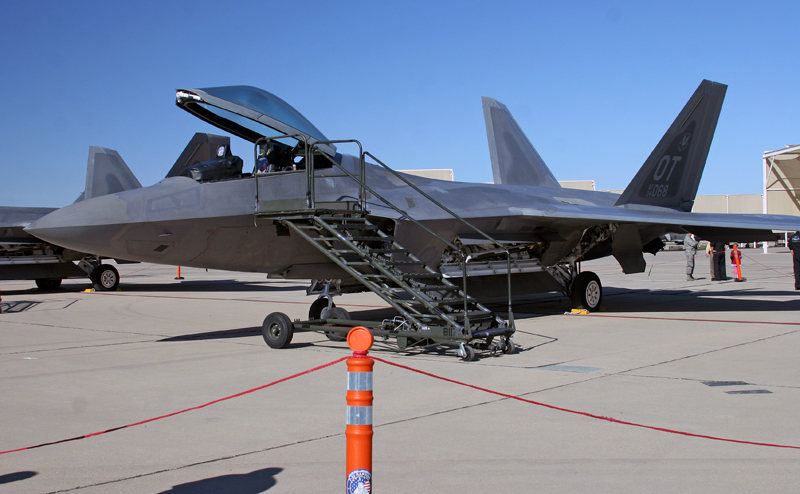
Heritage Flight Conference provided a rare close up look at the incredible F-22 Raptor, the consummate air superiority aircraft. It’s net-centric, low observable capabilities enable it to dominate the battle space in the first 24 hours of a conflict.


Heritage Flight Conference gave us a chance to chat with the flight crews up close and get the insider’s perspective on their busy flight demonstration season. Here I fire questions at a flight crew member about his beautiful F-22 Raptor.

The F-16 Fighting Falcon or “Viper” as its pilots call it may be the single most successful fighter aircraft in the history of aviation. It takes its place alongside the P-51 Mustang as a truly great combat aircraft. Tucson is a hub of flight training operations for international F-16 pilots.

Another view of a pretty F-16 Viper ready to fly in the Heritage Flight formation. Notice the aircraft shelters in the background to protect the A-10’s and other aircraft at Davis-Monthan AFB from the sun.

Heritage Flight is about the history and legacy of aviation. This resplendent P-51D Mustang is a part of the Heritage flight. Its gleaming bare metal finish, invasion stripes, unit markings and even enemy victory tally below the canopy is a living record of aviation history.

The P-51 Mustang was a consummate multi role,  air superiority/escort fighter in WWII and after. It flew combat missions in every theater of the war and went on to fly in Korea. There was even as a special twin fuselage night fighter version. As recently as 30 years ago some third world air forces still operated old Mustangs. It first flew in 1940.

One of the Heritage Flight P-51D Mustangs parked on the flightline at Davis-Monthan AFB in Tucson, Arizona for 2012 Heritage Flight Conference.

This Mustang was a treat, an early P-51C version from before the development of the later bubble-canopy P-51D. Notice the older three-bladed propeller. This aircraft also had guns that fired through the propeller like older WWI era aircraft.

This could be a photo from Davis-Monthan AFB in the 1950’s. A beautiful pair of F-86 Sabres on the flight line at Heritage Flight. The F-86 was the first widely used US air superiority aircraft. It saw combat in Korea against MiG 15’s in jet-on-jet engagements and was used by international air forces as recently as 1994. They are beautiful, classic aircraft. A true fighter plane in every sense.

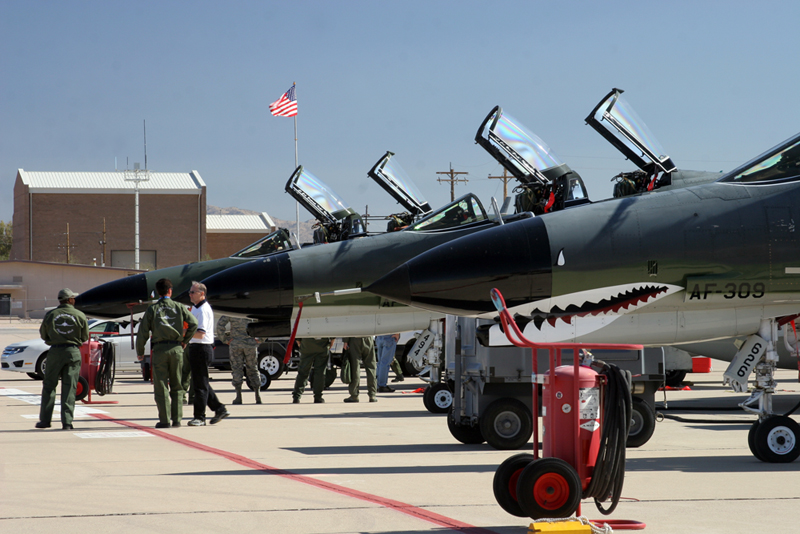
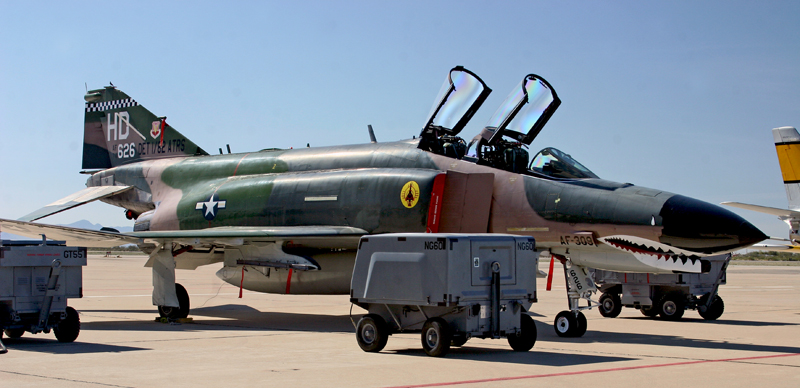
Phantoms Phorever. A rare sight in the U.S. today: A flight line of F-4s. The venerable F-4 Phantom in its many versions was an enormously successful multi-role aircraft used by many free world nations. These are QF-4E aircraft still in Air Force service with the 82nd Aerial Targets Squadron at Tyndall AFB, Florida.

These two F-22 Raptors wear the tail codes for the 53rd Test and Evaluation Group at Eglin AFB in Valparaiso, Florida. This unit has operated the Global Hawk and Predator RPV’s as well as nearly every frontline combat aircraft in the USAF arsenal.

A QF-4E Phantom of the 82nd Aerial Targets Squadron assigned to the 53rd Weapons Evaluation Group at Tyndall AFB in Florida. These aircraft provide the unusual role of being flying targets for weapons in areas like the White Sands Missile Range and the open areas of the Gulf of Mexico. They operate with unmanned aerial targets for testing. One of the aircraft in the squadron was actually flown by the famous Col. Robin Olds who lead the raid on the Thai Nguyen Steel Mill outside Hanoi in the Vietnam conflict.

There are about 150 remaining P-51 Mustangs flying. Some have been converted to TF-51 versions with two seats and sets of flight controls. After WWII surplus Mustangs sold for $2000. Now a restored P-51/F-51TF-51 is over a million dollars. This pretty two-seater is getting pre-flighted for Heritage Flight.

A Mustang stampede! It’s rare to see so many nice P-51’s together. Note the older “C” version closest to the camera with the three bladed propeller.

Every time I get to see one of these old F-4’s I wonder if it could be the last time. The F-4 holds a special place for most US aviation enthusiasts and seeing these beautiful examples was a real treat.  This QF-4E taxis to participate in Heritage Flight.

Major Henry Schantz (left), call sign “Shadow”, walks to his F-22 Raptor in preparation for another scintillating flight demonstration of the F-22.

A head-on view of Major Schantz returning from his flight demonstration in the F-22 Raptor.

A Heritage Flight formation with an F-22 Raptor, QF-4E Phantom and two P-51 Mustangs. It is challenging for pilots in dissimilar aircraft to fly in formation, especially for the QF-4E pilot who approaches the lower end of the aircraft’s speed envelope.

Heritage Flight pilots flew their entire demonstration routine at Heritage Flight Conference. This flyover was a spectacular opportunity to see these three unique types and gain perspective on the history of military aviation since the 1940’s.