By Tom Demerly.

MrX hit team

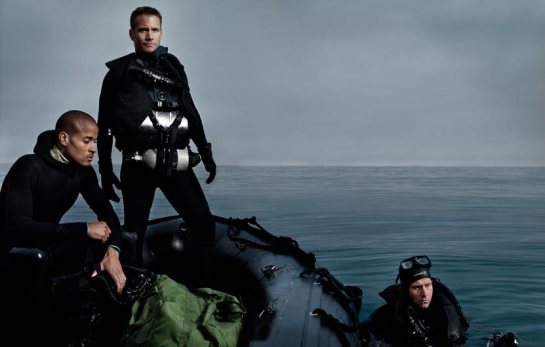
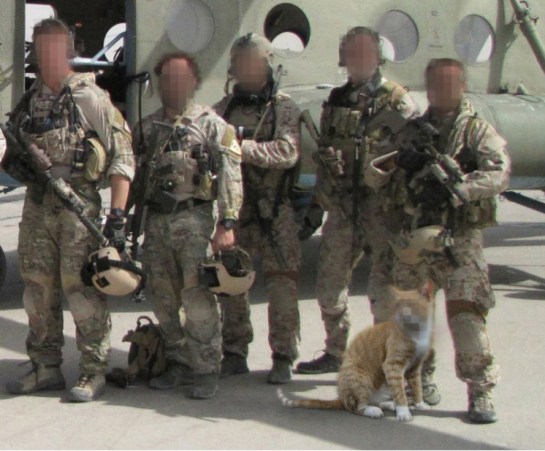
This top secret photo, obtained under the Freedom of Information Act, depicts a U.S. rescue team just after liberating Mr. X and a helicopter load of kittens from Damascus, Syria. Mr. X safeguarded the abandoned kittens until U.S. forces could mount a lightening raid using Russian helicopters operated by the CIA to rescue them. His whereabouts following the operation were unknown, until he showed up in our back yard a month ago.

Across four continents with too many aliases to count, rescuing hostage cats and fending off the advances of top-secret “honey pot” queen cats, smuggling catnip to refugee cats and establishing remote, clandestine scratching posts deep in denied territory- these are just a few of the fur-raising exploits in the secret life of the cat who came in from the cold.

They told us his name was “Chester”, but when the vet read his microchip he told us, “I think there is something you should see here…”

That something is a tale of danger and adventure more incredible than any fiction.

Based on the shadowy details we could piece together Mr. X’s adventure started in the Canary Islands off the coast of West Africa. How he got there is a mystery but documents revealed that Mr. X had been issued a U.S. military I.D. posing as a feline member of an elite Air Force unit in charge of chasing birds.

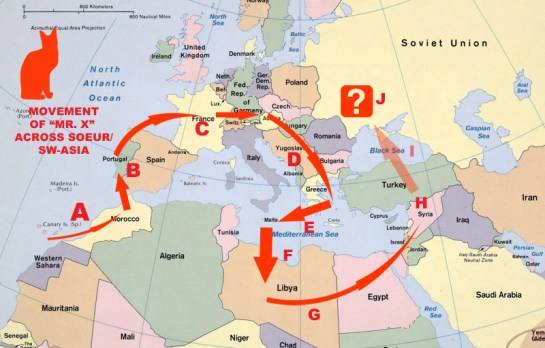
Mr X map

A. Mr. X arrives in the Canary Islands from a secret U.S. base in Lajes, Portugal. B. He crosses into Morocco, through Casablanca and Meknes, then across the Straits of Gibraltar on a fishing boat while eating tuna and then into Portugal. C. In Paris Mr. X encounters “honey pot” cat Choupette Lagerfeld. D. Crossing eastern Europe to the Greek Isles Mr. X enjoys the spoils of smuggling and espionage on a tuna fish magnate’s yacht. E. He crosses to Malta on a mouse-hunting expedition and then infiltrates Libya to rescue kittens trapped in Libya. F. In Benghazi he rescues a litter of Russian kittens and (G) smuggles them across the desert to Egypt. H. A secret, joint U.S./Russian rescue team airlift Mr. X and his rescued kittens to Turkey. J. Mr. X receives a massive welcome in Russia where he is awarded the “Cat of the Russian Federation” award.

Likely attracted to the Canary Islands because of his fascination with birds, Mr. X, (his alias at the time was “Chester”) was recruited into an experimental U.S. Air Force program that trained cats to conduct audible surveillance with their sensitive hearing. From Lajes, Portugal Mr. X moved by small surface vessel to establish ears-on a bird rookery on Tenerife.

Mr X ID card

False Air Force identity card issued to Mr. X under the alias “Airman David S. Silva” for his clandestine activities off the African coast.

It is off the coast of West Africa that Mr. X’s activities become increasingly difficult to follow. He has now fully adopted a new identity under the name “Airman David Silva”. Airman-cat Silva apparently learns of a massive catnip plantation high in the Atlas Mountains of Morocco near the Algerian/Moroccan border. The catnip is grown in the damp, rain catching mountains before the vast sprawl of the Sahara major in Africa’s north-central expanse. Being a clever businessman Mr. X brokers a deal to move substantial quantities of catnip from the Atlas Mountains overland and north to cross the Straits of Gibraltar. He hopes to resell his secretly obtained catnip on the open market in Paris, France where fashionable cats pay a premium for Moroccan catnip.

In Portugal Mr. X is approached by shadowy members of a secret cat society called “Le Chat Noir” (“The Black Cat”)  who attempt to extort a tax for the safe passage of his vast catnip shipments in exchange for distracting customs officials from seizing the material.

While partying at a late night laser-pointer rave in Lisbon David Silva meets the captivating celebrity cat Choupette Lagerfeld, cat to the famous fashion designer Karl Lagerfeld. In a passion-driven all night purring and licking orgy Choupette and David Silva form an unbreakable bond, waking up at sunrise on the breathtaking Praia da Marinha beach.

chopet_edited-1

Choupette Lagerfeld, the queen-cat who seduced (alias) David Silva during an all-night catnip and laser-show rave in Portugal.

Once in Paris David Silva begins to make contacts through Choupette Lagerfeld for the distribution of his catnip shipments now moving freely from Morocco. Problems surface almost immediately as David Silva suspects that Choupette is working for the French Direction Générale de la Sécurité Intérieure or the “DGSI”, the French equivalent of our FBI. The French agency hopes to stop the flow of Moroccan catnip into Paris in the hopes of driving up catnip prices and collecting a French excise tax on the feline confection.

David Silva feels betrayed by Choupette, urinates on the carpeting in one of Karl Lagerfeld’s estates and shreds designer toilet paper in one of its bathrooms before leaving in a rage. Claws still out from his perceived betrayal he crosses Eastern Europe until he reaches the Greek Isles, where partying aristocats take a liking to Silva and invite him for a month of partying on their yacht docked at the island of Lesbos.

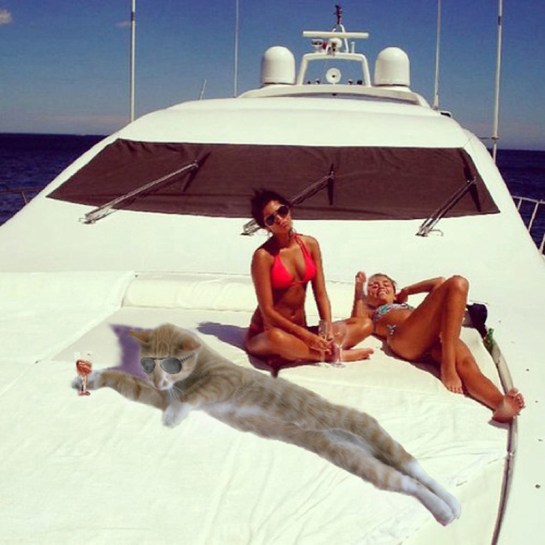
yachtgirls

Still heartbroken from the Paris Affair, Mr. X attempts to recover on a billionaire cat’s yacht in the Greek isles.

Having profited modestly from his catnip venture in Paris before betrayal by Lagerfeld, Mr. X used his resources to travel to the Greek Isles where he hoped for a much needed holiday. There he met a cartel of cats who controlled tuna fishing in the area. These cats had amassed a considerable fortune from their fishing industry that supplied a lucrative canned cat food market across Europe. Mr. X immediately befriended them and boarded their yacht, the M.V. Silent Purr, on the Greek Island of Lesbos.

Mr. X. remained the guest of the Greek tuna cartel cats until one of the cats told him of a rumor of abandoned Russian Blue kittens inside Libya. X immediately made plans to infiltrate Libya, then torn by revolution, to rescue the kittens and repatriate them to Russia. In exchange Greek Cats agreed to pay, through their syndicate, a massive stipend to Mr. X.

Details of Mr. X’s operation to rescue the Russian Blue kittens in Tripoli, Libya remain classified, but the operation was a resounding success. This is especially impressive since his escape route passed through conflict-torn Syria where X actually rescued more cats, repatriating them to Russia. Back in Moscow, a massive reception was held in honor of Mr. X.

MrXPutinfinal

Mr X. at his reception in Moscow.

After Mr. X returned to Moscow with the rescued kittens his path became a mystery. There is no doubt he accumulated substantial financial resources as a result of his activities, and these resources likely enabled him to travel back to the United States.

Another theory, and some recent information that surfaced also as a result of a FOI Act inquiry, was this CIA identity card with a recent photo of Mr. X, who may have returned to his orginal alias, “Chester”.

cia alias


By Tom Demerly.

MrX10

He just appeared.

Out the back window in a pool of light at 12:34 AM. He was interested in what was inside our window. When he looked inside our house he saw two happy, healthy, well-fed cats with rooms full of toys and cat trees and water fountains and beds. He had a sad look of longing on his face.

And then he was gone.

MrX20

It was March 13 that first time we saw him. Since then he has come back many times. Sometimes he just shows up. He comes running when he sees us. Now he answers to our voice when he is around or meows outside the window to come in.

We started calling him “Mr. X”, a man with no name, no obvious place of belonging.

When Mr. X arrived the first time I was concerned. Animals show emotion on their face. After decades of living with cats I could tell Mr. X was not happy outside our house that night. He wanted a warm blanket, a cat tree, something to eat and a friend.

MrX30

We kept an eye out for him and over time he would make his way back for another visit. Then another. Finally, one day, we invited him into the back porch. It’s segregated from our two cats (inside only cats with clean health records). He was incredibly affectionate, loved to be petted, then held, then brushed. He smiled a big cat smile and purred when we gave him his own blanket. Then we bought him a water dish, a food bowl, his own litter box, a heated bed, all on his own glassed-in patio.

MrX40

We wondered where he was from. Was he someone else’s cat? Did a family move away and abandon him? There were five houses for sale on our block- he could have been from one of them- a family moved out and left him behind.

We had a special collar with our phone number made and we planned to put the bright red collar with our contact number on him so if anyone owned him they could call us when he got home. Domestic cats have relatively small territories, males larger than females, but finite territories nonetheless.

MrX50

Mr. X happily accepted the collar and went on his way. We hoped we’d find an answer to the mystery of Mr. X soon.

On April 1st at 10:57 AM I got a text message, “My cat came home with a collar that had this number on it. Did you put it on?”

Success. Mr. X had a home, and a name. His name is “Chester”. We don’t know his last name.

MrX60

As it turns out Mr. Chester lives next door. He comes and goes as he pleases. The people who own him have children who love him and take good care of him. His excellent disposition speaks to their kind treatment of him. But the person who texted me told us her husband is allergic to cats and they were looking to relocate him.

Of course, Mr. Chester has a vote in all this.

Over the next few days Chester made it clear he loves us and enjoys good food, a heated bed and a wide open back porch to lay in while the sun spills through the window during the day.

MrX70

But Mr. Chester also loves his freedom. He wakes up from his daytime naps and wanders out of the back porch at night. He plays in the yard, running around me, playing fetch, getting petted and stalking imaginary things.

Then he disappears.

MrX90

We’ll see him in the window next door. Then outside. Then back in our porch. Our cats haven’t met him except through the window and screen and by sharing scents on the back porch after he leaves. Mr. Chester needs a clean veterinarian exam before he integrates with our cats because of disease that can be transmitted from cat to cat.

But there is more: As it turns out the man next door isn’t the only one allergic to cats though. Jan Mack is also allergic, and she takes a coal shovel full of prescriptions every day to moderate her allergies to our two cats, MiMi and Vice-Admiral Malcom Fredrick Davis III. So the full integration of Mr. Chester into our home may never be possible for three reasons; Jan is allergic, and a third cat may add to the symptoms, Mr. Chester may not want to live inside permanently, and outside cats can put inside cats at risk for transmitted disease. Lastly, MiMi and the Vice-Admiral may not want a new cat. They are curious about Mr. Chester’s visits, but reserved about him being a permanent resident.

MrX100

So, as it turns out, Mr. Chester is the decider in this matter. If he decides he wants to move from next door to our house, he is welcome as long as we can moderate the issues of Jan’s allergies and integrate him with MiMi and the Vice-Admiral. But those factors also weigh heavily on the matter.

For now, Mr. Chester is enjoying the benefits of two households and seems quite pleased about it. A veterinarian visit is in his future, and we worry about his exposure to traffic and other animals outside, but he appears to be a clever man who has made his way so far.

MrX110


By Tom Demerly.

CerveloR3d200

On Wednesday, April 13, 2016 online publication Cyclingweekly.com reported that the Union Cycliste Internationale or UCI, the international governing body for the sport of cycling, has “issued a suspension” on the use of disc brakes for professional road racing events.

The new sanction against disc brakes on road bikes follows a trial period of disc brake use by pro cyclists before their permanent approval for competition.

According to Cyclingnews.com this “second testing phase [would have permitted] every rider in a team to use disc brakes in 2016 and in every major race. This is expected to spark widespread use of disc brakes during the 2016 season.”

But today’s suspension of disc brake use in the pro peloton raises a few questions about disc brakes on road bikes specifically, and about cycling technology and its role in the consumer market more broadly.

The cycling industry is a consumer industry. It relies on interest in new products to drive bike sales. Every season new features need to be released to keep customers interested.

But not every new feature has an attendant benefit.

Some features are just… new.

To a degree disc brakes fall in this category, but only to a degree.

Let’s consider a balance sheet of disk brakes on road bikes:

Pros:

  1. Disc brakes remove the braking surface from the rim, allowing new flexibility in rim shape design.
  1. Disc brakes usually have better stopping performance in wet and dirty conditions than a rim brake.
  1. Because a bike frame designed specifically for disc brakes does not need caliper brake mounts frame designers have new latitude with frame design not available with traditional caliper brakes.

IMG_2552Cons:

  1. Disc brakes are heavier than caliper brakes.
  1. Disc brakes are more expensive than most caliper brakes.
  1. Disc brake equipped wheels take longer to change in a race-service setting.
  1. Disc brake equipped bikes are less tolerant of interchanging wheels from bike to bike; the brake disc spacing on the wheel must be exact for it to work on a given bike and this often varies from bike to bike. Caliper brake equipped bikes are easier to change wheels on.
  1. Disc brakes have different stopping power than caliper brakes. This can create different braking performance on group rides where some riders have caliper brakes and some riders have disc brakes, potentially creating a hazard.
  1. There are not as many wheel options available aftermarket for disc brake equipped bikes as there are for caliper-equipped bikes.

If you weigh both sides of the balance sheet you see that disc brakes offer some advantages, but not necessarily advantages in a professional road race setting.

packvssolo

As with aerobars, disc brakes are not well suited for riding in a group, especially if some riders are also using caliper brakes.

Aerodynamic handlebars are similar; in an individual, time trial and triathlon setting they offer proven performance benefits, but they aren’t optimal for use in mass-start bicycle racing.

The bike industry may not have ever intended disc brakes to be a replacement for caliper brake racing bikes. Instead, the disc-equipped road bike may have been targeted for an emerging demographic of recreational cyclist who rides in all-weather.

I use the word “may” because the cycling industry seldom plans such things, but rather throws new ideas against the consumer wall to see what sticks. The impetus is to constantly release something new, if not necessarily better.

Because consumers seem to want “new”.

Disc brakes aren’t bad. They stop a bike adequately in all conditions and better than caliper brakes in wet and dirty conditions. On mountain bikes, cyclocross bikes, dirt road bikes and randonee’/touring bikes ridden in bad weather they are better than caliper brakes.

Recall the time when suspension forks were installed on road bikes used for the cobblestones in Paris-Roubaix. The trend didn’t last, and riders quickly returned to mostly conventional road bikes with rigid forks and caliper brakes at Paris-Roubaix and in the other Spring Classic races.

Suspension forks didn’t go away. They found their own best application on mountain bikes and some recreational hybrid bikes. And there they remain, because they are a feature that provides a tangible benefit on those bikes.

Do disc brakes belong on road bikes? On some road bikes they do. Not all, and they are not a replacement for caliper brakes. If you ride by yourself on dirt roads and in wet conditions, disc brakes offer a benefit. But disc brake bikes aren’t a replacement for the caliper brake equipped road racing bike. They were never intended to be.


By Tom Demerly.

democracy-spring-twitter

The people were angry. Quietly angry.

Oppressed by despotic rule, subterranean anger and frustration simmered. Until it boiled over.

The virus of discontent spread through the Typhoid Mary of technology; cell phones, YouTube, Facebook, Twitter, Instagram. The people were empowered now. The rulers shut down the Internet. Turned off the cell towers. But the world was too connected to be dragged back into isolation now.

The people knew not to trust “official” media. These were controlled by “The Man” and meant to bend feeble minds. To keep them in line.

Tunisia, Egypt, Libya, Syria then Yemen, Bahrain and even the “moderate” countries like Jordan and Saudi Arabia. The people were angry with the leadership, their lives, their countries. They rose up and overthrew them.

The Arab Spring was a geopolitical reset button that toppled deeply ensconced governments across the Middle East and sent shockwaves into the Mediterranean and Europe.

154848-004-75C2C324

A version of the Arab Spring is here in the United States: the 2016 election face-off between Democratic and Republican extremes.

This is the American Spring.

A two-term President who leaned decidedly left makes his exit. He was, in many ways, a “perfect storm” leader for the U.S. The first to preside during the age of user-generated media, the first to challenge a host of right-wing values, policies and prejudices, the first African-American.

If his agendas are congruent with yours, you will remember him as one of the greatest Presidents in history.

During his two terms the Dow Jones Industrial Average increased a staggering 156.75%, an economic surge not seen since the recovery from the Great Depression. Agree or disagree with the policies of this administration, it was very effective in prosecuting it’s agenda. People who were able to participate in the recovery from the recession got wealthy(ier).

map800

“The Economist” published an accounting of the result of the Arab Spring to date. Their analysis shows a lot of strife, a little reform and a long way to go.

And for eight years the contrarian view simmered to a rolling boil. The country began easing left as the right yearned to jerk the steering wheel back to the other side of the road. As the stock market rocketed upward, turning modest holdings into fortunes, small portfolios into millionaires, the middle class was gutted.

The middle 60% entered the U.S. recession dangling from a precipice by their fingertips. When the weight of the economic collapse settled on them, most lost their tentative grip on middle class and slid down to a subsistence living. Few have clawed their way back up the ladder. With the weight of this economic burden released from the new upper class they rocketed ahead, collecting revenue on the massive new industry of the nouveau broke.

When you talk to some members of the nouveau broke, the new lower class, you hear typically sweeping generalizations. “They’re trying to take my guns and force me to buy health insurance that doesn’t work, but keeps the drug company executives rich.” Similar banter was heard on the streets of Cairo, Benghazi, Amman, and Damascus.

Forecasting political outcomes seems like voodoo but is truthfully as banal as algebra. Equations must be balanced. The terms must cancel. When one factor is thrown out of balance in the delicate equation, it must be corrected by like terms.

And that brings us to now.

The perfect storm of accelerated media change, polarized political environment and massive social evolution have concentrated five decades of change into eight years.

Now the forces of math and physics that preside over everything want to swing it back the other way with increasing speed and amplitude. Like a car beginning to swerve off an icy road the driver’s corrections become increasingly large, increasingly desperate, increasingly dangerous. And then the car careens into a ditch.

“Of the countries involved in the Arab Spring most are still roiling in chaos, some destroyed by war. Almost none are better off.”

Of the countries involved in the Arab Spring most are still roiling in chaos and unrest. Some are destroyed by war. Almost none are better off. That ephemeral, enticing tempest called “freedom” was like smoke in a sandstorm- extremely difficult to contain as long as massive, abrasive forces swirled around it.

When you talk to some Egyptians, Libyans, Syrians and even Iraqis they may quietly suggest an unpopular belief; things were actually better before the Arab Spring. The markets were full, the economy was functional, the streets were some version of safe. Now there is rampant unemployment, a refugee crisis, widespread insurgency and the creeping cancer of ISIL and religious extremism. They tried to grab the golden ring of freedom and spun off the merry go ‘round.

A new government represented an alternative, not necessarily a well-conceived alternative, but just something different. For most countries involved the Arab Spring was a reaction, not a well-conceived set of reforms. And they have suffered ever since.

For more moderate countries like Jordan there was an orderly process of reforms- not an uprising. Al Jaezeera journalist Nermeen Murad wrote that Jordan was spared the destruction of the Arab Spring because of “The ‘maturity’ of the Jordanian public, Western financial support, the UN’s management of the influx of Syrian refugees and last but certainly not least, the kingdom’s official ‘web masters’.”

Another example of orderly and expedient reform contrasted against angry revolution is Iceland’s recent “coup”. In early April this year Prime Minister Sigmundur Gunnlaugsson voluntarily resigned after leaked documents from Panama-based law firm Mossack Fonseca reveal that he failed to declare ownership of an offshore company when he entered Icelandic parliament in 2009. It was oddly tantamount to the U.S. Watergate scandal.

This weekend protesters descended on Washington D.C. in what was termed a “Freedom Spring”. There were a reported “more than 200 arrests”. Evoking the genie of an Arab Spring style reform in the U.S. is reckless political voodoo.

Americans can be stupid. They were on September 10, 2001. They may be again, believing they can segregate themselves from a world more integrated than ever. Believing they can return to doctrine that social and technical evolution has left long behind. Believing they can somehow exist and prosper as an island selectively disconnected from the rest of humanity.

Almost no country that participated in the Arab Spring is more stable than prior to it. Some are devastated. All have relied heavily on the international community. And while some do enjoy a tentative version of liberty now it teeters on a fragile fulcrum above the abyss of even worse extremism. It could go either way.

As we head into an election year the United States would do well to learn from the Arab Spring. Wild swings from one political direction to another seldom leave a culture intact. They most commonly result in turmoil and loss.

No government appeases every political agenda on an individual basis. That is not the job of government. Instead, an effective government moderates conflicting agendas toward a mutually beneficial middle ground. As we go to the polls this November that is a reality worth remembering while the ominous potential of an American Spring is worth avoiding.

demerlyjordan


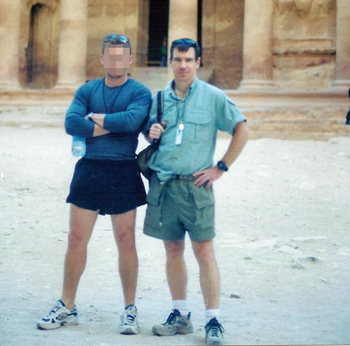
On all seven continents including East and West Africa and The Middle East, author Tom Demerly never let not knowing about a topic stand in the way of having an opinion. Here he tries to tuck his shirt in at the Petra ruins in Jordan after the 9/11 terror attacks.

By Tom Demerly.

bikefit70BEST

Bike fitting is big business. Having some version of “professional” bike fitting is the new standard for any bike sold above $1000.

How do you tell if your bike fitter knows what they’re doing? Are they a credible, trained, experienced fitter or just repeating buzzwords in a kind of bike fit “theater” learned in a weeklong clinic under the guise of years of experience fitting athletes during the evolution of bike fitting?

Here are ten checkpoints to assess the credibility of your bike fitter:

  1. Do They Ride? The Way You Do?

If a bike fitter knows what it’s like to be a beginner triathlete filled with anxiety and not even know what questions to ask they can help the newest beginner with solid recommendations. A good fitter knows the “beginner’s mind”.

At the opposite end of the experience scale, if your fitter knows what it’s like to sit on an uncomfortable saddle for six hours at Ironman- and can fix it– it’s easier for them to understand what you’re experiencing. If they have done it themselves, you’ve found a fitter you can relate to.
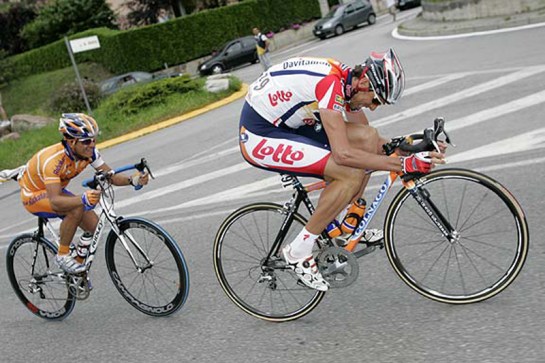
bikefit90

“After their bike fits Dave and Enrique couldn’t help but wonder if there had been some confusion between their two appointments…”

When a bike fitter combines the “beginner’s mind” with elite level competitive experience balanced with formal training and tempered against learned judgment from doing thousands of bike fits, you have a master. And the less a new rider knows, the more the fitter must.

There are a few credible fitters who are not triathletes or bike racers but do know bike fit well. But they are the exception.

Having the practical experience of riding the way you do (beginner or expert) makes communication more effective. It also means your fitter had to apply what they’ve learned about bike fit to themselves. It teaches them critical thinking and hones their analytical skills. That makes them a better fitter.

There is a dark side to the super-athlete bike fitter though, see #10 below.


  1. Have They Been Trained in Multiple Methods? 

Beware of any shop or fitter than espouses a single fit methodology. If a shop tells you “We do Retül (or Guru, or FitKit, or Body Geometry, or FIST)” but uses no other system and is not familiar with any others, it’s worth learning how deep their understanding of bike fitting and positioning really is.

How long have they been fitting? Have you spoken to any other fit clients of theirs? What are their reviews?

Bike fit systems are only tools to make the fitting process easier, more theatric, and in some cases, to sell bikes.

Dan Empfield, inventor of the triathlon bike and of the Stack and Reach sizing convention teaches a F.I.S.T. bike fitting class in England.

Dan Empfield, inventor of the triathlon bike and of the Stack and Reach sizing convention teaches a F.I.S.T. bike fitting class in England.

The quality of the end product depends on the fitter, not the system. A fitter with experience across a number of systems has a more balanced understanding of the bike fit landscape and assesses your fit from a broader perspective. That likely means you’ll get a better bike fit. Beware of the one-trick pony and the Johnny-come-lately with the shiny new fit bike and laser levels.


  1. Do They Espouse One “Fit System” Over Another?

If a fitter uses only the cookie-cutter fitting system associated with the bike brand they sell, you may still get a good fit on that brand, but the fitter’s capabilities may be limited.

As with point #2 above, bike fitting systems are merely tools. All of them will produce a favorable result in the hands of a skilled fitter- but all of them rely on an experienced fitter.

Nice tools, but do they know their stuff?

Nice tools, but do they know their stuff?

When was the last time you asked your bike mechanic, “What kind of wrenches do you use?” As bike fitters become more experienced and capable the system they use becomes less relevant.

It’s the experience and skill of your fitter that matters, not the system they use.


  1. Do They Only Suggest New Saddles for Saddle Discomfort?

Saddle discomfort is a leading motive for bike fit, but if the only thing your fitter does to make you more comfortable is bolt different saddles on your bike or try to measure your “sit bones” to sell you the right saddle, then they are a good salesperson, but a poor bike fitter.

bikefit110

A good fitter will take a holistic approach to saddle discomfort, addressing fit, position, saddle comfort habits, rider fitness and posture and the rider’s clothing to improve saddle comfort.

Bolting on new saddles is a great way to drive sales and usually the most logical approach to the customer, but it is a myopic view of what makes a person comfortable on a bike seat. Your fitter owes you more than a sales pitch on another magic saddle.


  1. Do They Claim To Be Able To Make You “More Aero”?

A great way to tell if a fitter is a hack is if they claim to be able to make you more aero without using wind tunnel testing or computational fluid dynamics.

A bike fitter can use empirical, data-driven checks to verify joint angles. They can take specific measurements of frame dimensions and geometry. They can take quantifiable measurements of your body and make mathematical comparisons to determine relevant ratios for bike fit.

A bike fitter cannot do this for aerodynamics. If your bike fitter claims to be able to make you more aerodynamic on your bike they are guessing, and lying.
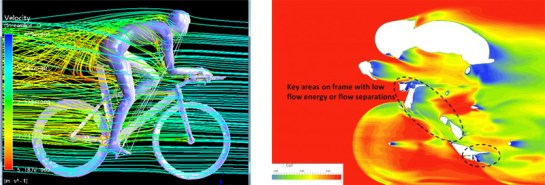
bikefit120

Air is 784 times less dense than water, and it is nearly impossible to predict the behavior of water swirling around your finger. Guessing how air will swirl around a pedaling rider at speed in different wind conditions is impossible without empirical analysis.

I know- I’ve been that guy. I spent over ten years telling clients I would get them “more aero” by lowering their handlebars and making them “more aggressive” until a wise man who happened to have a PhD in aerodynamics told me to “stop embarrassing yourself” by trying to guess at aerodynamics.

I’ve been privileged to wind tunnel test with two bike brands and one independent engineering laboratory in three different wind tunnels over 25 years, on the bike and in the control room. I’ve learned that no one can guess what small changes will make a rider faster over the entire length of a triathlon bike leg. And remember, the goal is to get faster, not just “more aero”, and while those two things are closely related, they are not entirely the same– especially for new riders with comfort issues.

bikefit70

“Jim wondered about riding 112 miles at Lake Placid like this after his bike fit was over.”

Firstly, no bike fitter without a wind tunnel or computational fluid dynamic analytics can guess at the behavior of the boundary layer of air surrounding your body across the entire performance envelope.

Secondly, even if they could, the constantly changing variables of speed, terrain, wind yaw angle and rider posture would make that snapshot in time a very fleeting case study.

Thirdly, while rider aerodynamic drag is the most significant force to overcome in cycling even at moderate speeds, wind tunnel positioning concepts were developed in testing at very high speeds, usually over 25 MPH. British professional triathlon coach Russell Cox discovered the median bike speed for the Men’s 40-44 age category at Ironman Florida, one of the fastest courses in the U.S., was only 17.5 MPH. At these sub-25 MPH speeds there are more opportunities for your fitter to improve your bike split through things that they can actually test for, as opposed to things they are guessing at for speeds you don’t even ride at.

The narrative “Let’s lower your bars to get you more aggressive…” is a valid way to tell if a bike fitter is regurgitating empty rhetoric from YouTube, a triathlon forum, or a three-day fit clinic.

bikefit80

Faster Bike Shop in Scottsdale, Arizona was the first and is likely the only bike retailer in the U.S. with actual wind tunnel test facilities.

If a fitter tries to critique your aerodynamics challenge them by asking, “Can we measure my drag coefficient before and after any changes?” You’ll likely get the sideways puppy stare or a litany of qualifying excuses. Don’t fall for it. There is only one bike retailer in the United States with a wind tunnel, Faster in Tempe, Arizona. If you aren’t there, then your fitter is guessing.


  1. Are They Trying to make you “Straight”?

There is a sub-segment of bike fitting and positioning that tries to enforce symmetry on the human form. The only symmetrical human is Mona Lisa. The rest of us are crooked.

It’s simple to use lasers and shims to try to make a person “straight”, but it may create further skeletal misalignment since our skeletons are usually not straight and symmetrical, especially as we age and accumulate injuries.

The craft of the experienced fitter is to find a functional balance between moderating asymmetries that could contribute to discomfort, or even an injury, and facilitating them. There is likely a “sweet spot” between facilitation and adaptation that provides the optimal benefit to each unique rider. This sweet spot is different for a new triathlete than a person doing their 10th Ironman.

If a bike fitter’s singular goal is to “get you straight” you should tell them to get bent.


  1. Do They Acknowledge Their Limitations?

Many bike fitters try to- or claim to be able to- do too much.

A retail bike fitter should be able to recommend a new bike model, frame size name and geometry that fits you optimally for the type of cycling you want to do. They can then adjust that bike for an optimal basic position, often using different handlebar stems, aerobars and other size-specific components to achieve the best result. Then, they can use any number of analytical tools to verify the results against commonly known bike fit standards.

That’s all.

Bike fitters can’t make you comfortable or “fix” you. They can’t add additional fitness or make you less overweight. They can’t produce the perfect saddle that feels right to you. You still have to train, lose weight if you are overweight and get acclimated to sitting on a bike seat. Those things don’t happen in a two-hour bike fit.

Unless the bike fitter in your store has a formal University level credential in anatomy, physical therapy, medicine or exercise physiology that should be their boundary, and they should respect their customers by working within their boundaries.

Beware of the bike fitter who tries to do too much without the degree to back it up. If a bike fitter learns a customer is suffering from a sports injury they are correct to refer them to a qualified physical therapist. Some licensed physical therapists now have formal instruction in bike fitting too, and you (or your health insurance) will pay extra for that, but it is worth it.

If your bike shop bike fitter tries to play physical therapist, limp out of there.


  1. How Long Have They Been Doing Bike Fits? 

Ten years ago it was still easy to sell a bike with a quick test ride. Now customers are smart enough to demand a more empirical, data supported process to selecting and adjusting the right bike. As a result there has been an explosion in the number of new “bike fitters” in the last ten years.

Not all of the new bike fitters are good.

Many new bike fitters are adequate and recognize their capabilities- and limitations- but many are also quick-talking hucksters who can sling the lingo and the laser beams to appear credible.

Ask your bike fitter questions about their training, their experience, their own cycling background and their limitations. A fitter who claims to be able to do everything has big shoes to fill.


  1. Are They Willing to Recommend Equipment They Don’t Sell?

It’s a good sign if a bike fitter occasionally “walks” a customer by telling them he has nothing in his store to fit them. That suggests their first motive is to get the customer on the right bike, not just get a bike out the door.

A specialty bike shop will stock a well-planned assortment of bikes that have subtly different fit characteristics. Some work well for larger, heavier riders, some for smaller riders, some for long torso cyclists, others for short torso cyclists.

When Triathlon Hall of Famer and inventor of the triathlon bike, Dan Empfield, invented the “Stack and Reach” table for comparing bike dimensions he created a kind of Rosetta Stone for bike fitters to make meaningful comparisons of different bikes and their dimensions. This leveled the playing field and decoded cryptic bike brand size names that have little to do with actual bike dimensions. Empfield’s accounting of bike dimensions gave bike fitters one of their most valuable tools since the tape measure, and also held fitters accountable for being honest.


  1. Are They Good Listeners? 

A good bike fitter conducts an interview with his customers, listening to their experiences, their goals and what they are thinking very carefully. This leads to more questions from the bike fitter. In fact, a good bike fitter often asks the customer more questions than the customer asks them when selecting a new bike.

The best bike fitters listen carefully to position their clients optimally on a continuum between facilitation and adaptation. Facilitating a client means the fitter exclusively listens to the client and does what they say makes them comfortable. Adapting a client means the fitter applies known principles of bike fitting without input from the rider and says, “This is right, get used to it.” The best bike fitters know how to listen to their clients to find the optimal balance between these extremes.

Some bike fitters try to be know-it-alls or local heroes. They try to mold each client into a specific posture or fit model, and they have little space left in their effusive knowledge of all things bike fit, cycling and triathlon related to learn anything from a lowly client. If you can’t get your bike fitter to listen to you, let them talk to the hand.

Craig Turner, founder of Nytro, one of the first triathlon shops in the world, is also one of the best listeners and bike fitters in the industry.

Craig Turner, founder of Nytro, one of the first triathlon shops in the world, is also one of the best listeners and bike fitters in the industry.

I once listened to Craig Turner, founder of Nytro in Encinitas, California, work with a bike customer. I was surprised by how little Craig said, how much he listened, and how he restated the key points the customer made back to them. It was clear that Turner was a careful and analytical interviewer, asking the right questions and leaving space for complete answers. When he was done with the interview he had the expertise to make learned and supportable recommendations. It was like listening to an expert attorney advise a client.


About The Author:

theauthor


While Tom Demerly can be full of shit he has been fitting bicycles since 1984 and performed well over 5,000 bike fittings including Olympic athletes Sheila Taormina and Olympian, National Champion and Tour de France rider Frankie Andreu. More importantly, Demerly has fit thousands of first time triathletes and only a few of them still have numb crotches.


By Tom Demerly.

Power_Of_Three_Book_Banner

I was in a small gift shop on an island when I first saw one of Erin Hunter’s The Warriors series books. I opened it and read one page.

And my trip began.

warriors 10

Warriors is an opulent, luxurious fantasy novel series featuring fictional cats who are empowered with mythical abilities. Their mystical powers have roots in ancient lore attributed to Native American, African and Asian cats- including Egyptian mythology. The result is a dream-like journey with loveable characters overlaid on a detailed examination of cat zoology and animal behavior science. Plot lines and morals threaded through the series feel like an amalgam of sacred texts, from Buddhist writing to the Bible and many others.

The Warriors series is immensely complex, featuring a dizzying number of cat-characters. On the Wiki page for the book series one reviewer is cited as saying the series is “confusing due to its large number of characters”.
But the incredible dream-like quality of the scenes, characters and the fairy-tale, Aesop’s-like moral themes unfold at a brisk pace that is incredibly readable and engaging.

“The incredible dream-like quality of the scenes, characters and the fairy-tale, Aesop’s-like moral themes unfold at a brisk pace that is incredibly readable and engaging.”

Author Erin Hunter is actually three writers and an editor/plot director; Kate Cary, Cherith Baldry, Tui Sutherland write the The Warriors series with Victoria Holms editing.

authors

“Warriors” writing team includes (Left to right) Victoria Holmes, Kate Cary, Tai Sutherland and Cherith Baldry.

This writing team may have created The Next Big Thing. Before you dismiss this idea, let me propose the following:

According to the A.S.P.C.A. there are 96 million pet cats in the United States. Nearly 37% of American households, more than one-third, have a cat. One celebrity cat, Tara the Hero Cat, earns an estimated “$55,000-$463,000 per year” according to the New York Times. Add in other celebrity cats and the total take for the top earning celebrity cats is well over $10 million- probably much more. Now, consider the “Hobbit” film trilogy grossed over $3 billion for three movies, and no one has a Hobbit for a pet. You get the idea; combine cats with a Star Wars style plot line and some convincing computer generated cat characters with celebrity voices and… The commercial potential for The Warriors series is titanic (pun intended), with licensing possibilities for plush toys of each of the cat characters, lines of every pet accessory attributed to the series and about every other standard movie merchandising theme imaginable. The earnings potential is boggling. Why the big movie studios haven’t grabbed this series already is a mystery.

Business potential aside, The Warriors series is why we read. It is escapist, descriptive, creative and pulls you in. Your imagination wanders the mystical forests in the moonlight with the cats. You learn about real cat behaviors and you see your own cats differently after reading these.

I’m a Tom Clancy, Robert Ludlum, Robert F. Dorr fan- technotrhillers, not flowery fantasy stories. But The Warriors series spans genres and speaks across topics to the animal lover and storyteller in me. This series is a gem waiting for mainstream discovery. I’m looking forward to seeing this series explode in popularity and I’m thrilled I discovered it early.

nine_lives_ceremony_by_climbtothestars-d9ld0tw


By Jan Mack and Tom Demerly.

finalopenwaterswimphoto

Today is Trish Morgan’s first triathlon.

It’s a beginner triathlon with a ¼-mile swim, 10-mile bike and a 3-mile run.

Trish has run a few 10K’s, a half marathon (she has a “13.1” sticker on her Honda), did a three-day charity bike ride and swam on the intra-mural swim team in junior high school. She followed a “Ten Weeks To Your First Triathlon” program on line.

So Trish is ready.

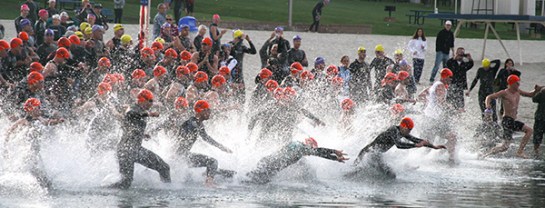
She’s at the swim start. The loudspeaker says something important. She catches every third word. Her swim cap feels too tight. It’s her first time swimming in this new wetsuit. It feels too tight. She can barely take a full breath. The salesman said that was OK. Her goggles feel so tight they are making her eyes pop out. They keep fogging up. She won’t be able to see where she’s swimming. In the middle of Mud Lake, with foggy goggles and a new wetsuit choking you, what are you supposed to do?

She can’t see where the lifeguard kids on the paddleboards are. How is a kid on a paddleboard supposed to save you anyway? She can’t see the swim buoys that mark course. The loudspeaker keeps saying something. The wetsuit is too tight. They said this was the right size…

It’s too late to worry. Like a herd of lemmings her group with pink swim caps is moving… into the lake. The dark, weed-filled lake. They are like people trying to escape a fire. Trish moves with them, swept along in the crowd. A rising voice inside her begs attention. It begins as a whisper but gathers volume and urgency.

The rush of cold thickness in the water at her thighs makes it hard to move forward. When do you start swimming? It gets deeper. Quickly. The bottom is giving way- sandy and mucky. She feels something touch her foot… A weed? It grabs at her toes, sending a spike of panic. The water is too deep to stand now. Everyone is still moving forward. She has to swim. There is no choice now.

Her first few strokes are desperate churns of the water that now feels too thin to grab or support her weight. At least the wetsuit floats, and her legs seem to bob uncontrollably behind her while she tries to manage some kind of swim stroke other than a panicky dog paddle. But the wetsuit feels like a straightjacket now, binding her arms and squeezing her chest.

swimfear100

“Put your face in the water and swim,” she tells herself. But the cold bite of the water on her face sends shock through her body, seeming to steal her breath. A jet of icy water shoots down her wetsuit. And through the grey water another swimmer’s heel emerges- she sees it just before it cracks into her left goggle lens. Something touches her foot, a person next to her where she can’t see bumps into her. She cannot see land behind her, she cannot see the first swim buoy, she cannot see a lifeguard. She cannot see in the murky water as the fog in her goggles begins to thicken. Sun glare bounces off the surface blinding her. She can’t see. The buoyancy of her wetsuit is replaced by a rising sensation that she can’t breathe. The voice in her head shouts one word: drowning.

Her chest tightens. She flails against the ever-thinning water. The wetsuit is her enemy now; squeezing what little breath she has out of her lungs. Another swimmer collides with her from behind. And another…

Drowning.

Trish Morgan ends her first race in tears clinging to a lifeguard’s rowboat as he slowly paddles her toward shore.

Trish is a fictional character, but her terrifying ordeal is typical of first time triathletes with no open water swim experience. This horror story is the combination of every swim disaster story I’ve heard during my 30 years in triathlons.

Ask twenty triathletes what the hardest part of a triathlon is, eighteen will tell you the swim.

This contradicts the reality of swimming. Swimming is the easiest part of a triathlon. The swim leg comes at the start when athletes are freshest. It is not weight bearing. There is no foot strike or saddle discomfort. Your body is horizontal so your blood pressure is the lowest of all three sports. It is the only part of a triathlon that is monitored every few yards by safety personnel. You are moving the slowest so risk of impact injury is lower than the bike or run. And unless the water is really rough, there are no hills on the swim course.

But despite the cognitive realities that open water swimming is safe it is consistently perceived as the most difficult and dangerous leg of triathlons, especially for new athletes.

Why do people have swim anxiety and how can they moderate it?

Like any single problem, there is no single solution. Swim anxiety emanates from many origins, some founded in rational fears of drowning, others founded in irrational fears of being attacked by sea life, entangled by weeds or sucked underwater by invisible forces.

Two common triggers are present in open water swim anxiety:

  1. Lack of experience in the open water swim environment. 
  2. Absence of a purposeful, step-by-step approach to building proficiency and competence in the open water.

You can’t just jump in the open water and expect to feel comfortable, especially in a crowded mass swim start. People often have unreasonable expectations when they enter their first triathlons. They have not adequately prepared for open water swimming, both mentally and physically.

How to Overcome Fear: A Meeting with the Sensei.

I went to California to find out how the best open water swimmers in the world, the Navy SEALs, overcome terrifying swim conditions, often at night, usually with a very real enemy trying to find- and kill them.

I’m sitting on a log at the Phil H. Bucklew Naval Special Warfare Center in Coronado, California. The man sitting at the beach with me is SO1 (SEAL Operator 1st Class) David Goggins.

432f62a9-a1a1-413d-853e-ad5a2b2aa431_20140621182541280

Naval Special Warfare Operator (SEAL) Dave Goggins (Left). Photo Credit: Outside Magazine.

Goggins is a legend in the Navy SEAL community, a title that most of these naval special warfare operators don’t care for with the recent flood of Navy SEAL books, movies and media attention. They prefer “Naval Special Warfare Operator”.

David Goggins is a graduate of the U.S. Navy Basic Underwater Demolition School (BUDS), SEAL Qualification Training (SQT), the U.S. Army Ranger School, The U.S. Army Airborne School, and The U.S. Air Force Special Tactics “P” School. Because of challenges he faced during his Basic Underwater Demolition School Goggins had to go through the most difficult phase of BUDs, Hell Week, almost three times. He may be the only person in history to have done so. Goggins’ Hell Week became Hell Month.

Goggins is an African-American, a demographic not populous in competitive swimming. Black Americans do not widely integrate swimming into their adolescent development. According to USA Swimming, “70% of Black-Americans cannot swim”.

Goggins also came from a broken home, has battled obesity and has a heart defect, a hole in his heart, for which he underwent surgery to correct. None of it has stopped him from being a Navy SEAL, Ironman finisher and ultra distance runner.

“How did you overcome physical and mental barriers to swim for hours in the dark?” I asked Goggins.

“You can push yourself past physical limits.” He told me. “You simply have to focus.”

“Really? It’s as simple as one word; ‘focus’?”

Goggins is right. The singular problem new triathletes have with open water swimming and the single largest cause of open water swim anxiety is the failure of athletes to systematically prepare for the specific task of swimming in the open water environment.

New swimmers practice avoidance, not focus, with learning survival in the open water.

They don’t use a step-by-step approach to open water swimming. They literally jump in all at once.

Jan Mack is a corporate executive and an Ironman finisher. She also has swim anxiety. Or, more correctly, had swim anxiety.

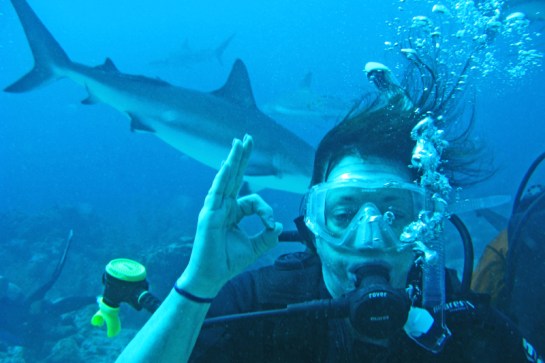
In only eight weeks Mack went from terrified of open water swimming to being a competent open water competitor and SCUBA diver. Previously she stood on the beach crying in fear at the start of a race, her friend pulling her by the arm into the water. Now she is a certified PADI Expert Open Water SCUBA diver who swam through underwater caves at 60-feet depth, explored sunken shipwrecks, swam in the open ocean in 5-foot waves three miles offshore and dove in a school of 6-9 foot sharks without an anti-shark cage.

How?

“Crawl, walk, run.” “Slow is smooth, and smooth is fast”.

Learning any new skill is best done in a systematic process broken into steps.

SEALchallenge300

This is especially true of skills that require confronting fear. The most common reason for open water swim anxiety is the failure of the athlete to engage in a step-by-step process for acclimating to the open water.

It’s a Sunday morning, eight weeks ago and I am at the Ford Community and Performing Arts Center pool in Dearborn, Michigan with Jan Mack.

We are in three-feet of water, about knee-deep, and she is learning to flood her snorkeling mask of water and then clear it underwater without panic.

She’s having trouble.

When Jan’s swim mask is flooded she must continue to breath through her snorkel underwater, but only through her mouth, and she cannot see clearly since her mask is now filled with pool water. When she tries to inhale through the snorkel some of the water inside her flooded mask goes up her nose, producing a drowning sensation. It is terrifying, the same sensation suspected terrorist detainees at Guantanamo Bay experienced when they were waterboarded. According to most international watchdog organizations, what Jan is subjecting herself to in preparation for open water swimming could be considered “torture”.

In repeated evolutions I explain and demonstrate the process to Jan. Slowly, smoothly, repeatedly. Slow is smooth. Explanation, demonstration. Then Jan tries a practical application by ducking underwater on her knees, flooding her mask, panicking and surfacing. And we start over. Slow is smooth, smooth is fast. Explanation, demonstration, practical application. Crawl, walk, run.

There is no time limit, no starting gun, no dark water, no pressure.

Jan tries her fifth or sixth time. It works. There is coughing and sputtering and spitting, but it works. She did it. In three feet of clear, warm pool water Jan Mack has become a “Go” at task number 1, clear your mask of water in a pool without showing undue signs of panic and continue breathing through your snorkel underwater.

Jan dives

Jan Mack advances to the next phase of basic open water training. And the next. And the next.

At each step Jan receives an explanation, demonstration and then performs a practical application of her assigned new skill; using swim fins, wearing a SCUBA tank, maintaining neutral buoyancy… The skills build upon one another. And so does her confidence.

At the same time she is assigned bookwork on open water diving and must take graded tests. Her knowledge about ocean conditions, the sea, her equipment and open water physiology increase. She learns a checklist mentality. She is focused. The new knowledge combined with the skills she practiced beginning in the kiddy pool and advancing to the deep end has built on each other.

Crawl, walk, run. Slow is smooth, smooth is fast.

She has learned through deliberate progression. Jan Mack focused- exactly like Navy SEAL David Goggins, on specific intermediate goals on the way to a bigger goal.

It’s seven weeks later, Friday, February 19, 2016. Jan Mack and I are in a small boat bouncing through big waves three miles off the coast of Roatan Island, Honduras. 70-feet below us a school of sharks, big sharks, circles. I’m fighting seasickness and Jan is fighting fear. But we have our dive instructor, Russ Nicholson, with us and we have our training and experience up until this moment.

shark70

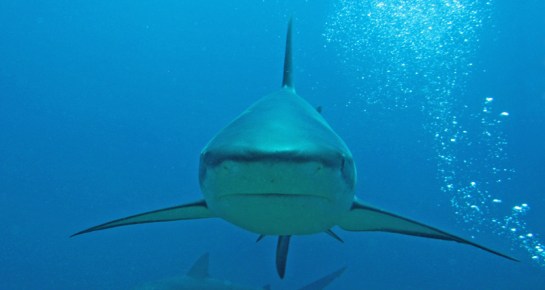
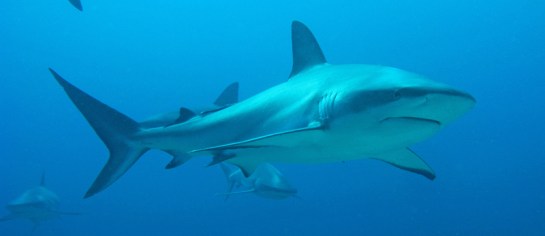
There are 20 big Caribbean reef sharks (Carcharhinus perezii) swimming below us.

For the next hour Jan swims with the sharks, no shark cage, no protection. She learns the sharks are like any animal in wild; commanding of respect but not aggressive toward people if unprovoked.

“I don’t know why I was ever afraid” she says after her dive training and open water experience.

Jan Mack has systematically ascended the open water swimming learning curve. She knows the open water environment, from top to bottom. She’s experienced every corner of it, from the shallow end of the local kiddy pool to the open ocean with a school of sharks. Whatever frightened her before, known and unknown, has been systematically broken down into smaller tasks, defeated, and resolved.

The open water environment still commands respect, and being three miles off shore, 70-feet down rough water in a school of large sharks only reinforces the need for that respect. But the process of Jan Mack’s indoctrination into the open water environment has also taught familiarity. And competence.

Unlike the fictional Trish Morgan who panicked in her triathlon swim, Jan Mack prepared in a step-by-step process to get acclimated to the open water environment. Now her fear of the water is converted to a learned respect of the objective risks and a significant level of competence in moderating them.


By Tom Demerly.

roatanjet

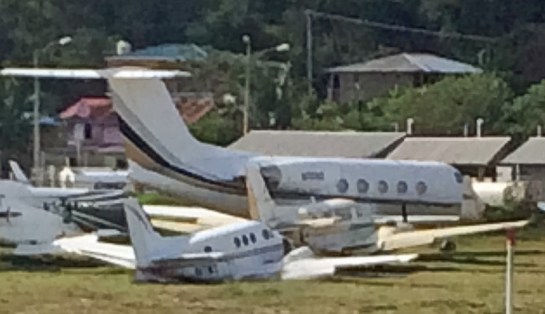
The mysterious, abandoned Gulfstream II business jet with registration number N707KD at Roatan Airport. Photo shot on Saturday, 20 February, 2016 by the author.


Tuesday, April 1, 2014, approximately 1540 HRs Local, North of Roatan, Honduras in the Southern Caribbean.

Eric Emanuel Mejia Montes is sweating.

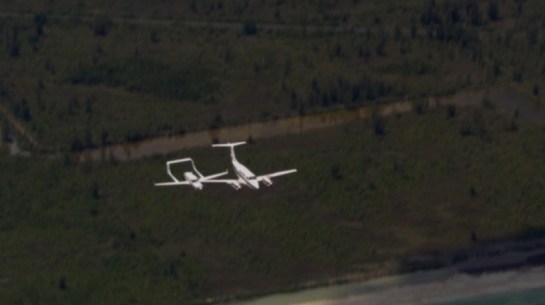
Montes is sitting in the right, co-pilot’s seat of a Gulfstream II private jet wearing registration N707KD. Only 40-feet below, and slightly behind him is a Cessna 182 single engine, prop-driven civil aviation light plane.

Flying in tight formation the two planes are on final approach to Aeropuerto Internacional Juan Manuel Gálvez, the only airport on Roatan Island, 30 miles off the Honduran coast in the southwestern Caribbean.

The Cessna’s maximum speed is 173 MPH. The Gulfstream II’s minimum stall speed is 121 MPH. Any slower and it falls out of the sky. The Cessna can’t fly any faster to keep up with the jet, now flying so slow it is a wind gust away from falling out of the sky.

The two very different aircraft, one a private executive jet designed for intercontinental travel, the other a light general aviation plane, were never intended to fly close formation with each other, let alone in bumpy tropical air near sunset on short-final approach to a small island runway with no air traffic control facilities.

On radar the two aircraft look like one because they are so close, and despite the stress of trying to hold a close formation (Montes isn’t much of a pilot, barely qualified to fly the Gulfstream) it is more important they risk a midair collision than be detected by the radar-carrying AWACS planes of the U.S. and Mexican security forces.

Planes90909

The Michael Mann fictional movie “Miami Vice” depicted two drug smuggling aircraft flying in close proximity to appear as one on radar for the purpose of concealing one of the planes.

Co-Pilot Montes and his “captain” have the easier job. The man, or men, in the Cessna beneath them must wait until the last second before they steer away from the jet above them, avoid a midair collision and quickly land on the same runway behind the jet. Then Montes and Ríos will taxi the jet to a parking area, abandon it and run to the still-running Cessna light plane for a hasty take-off from Roatan. All without official clearance and mostly without detection.

The two planes and their crews followed a mysterious, untraceable path south toward Roatan. No one knows where they took off from, and there was no flight plan filed for their destination. The authorities at Juan Manuel Gálvez Airport, what authorities there are, knew nothing of the arrival of this unusual formation of aircraft.

No one knows exactly what Gulfstream II N707KD and the Cessna 182 are doing. No one knows where they came from.

Three years later what I learned poking around Roatan’s little airport, its island shops and restaurants, from taxi drivers on the island and local SCUBA divers, is that the next day the Cessna 182 that left Roatan with both flight crews- was shot down. All of the crew members were killed according to reports- what reports there are- and no accessible record of who the original Cessna pilots were, where they came from or what they were doing exists.

flanker

A Russian-built Venezuelan Air Force Sukhoi SU-30MKK.

From other sources I learned the Cessna 182 was intercepted that next day over the jungle by a Russian-built Venezuelan Air Force Sukhoi SU-30MKV Flanker-G. The big Venezuelan fighter shot the Cessna down with a burst from its GSh-30-1 30 millimeter cannon. The charred bodies of Darimel Guerrero Ríos and Eric Emanuel Mejia Montes- the flight crew of Gulfstream II N707KD- were found inside.

But no one else was.

Reports revealed the Gulfstream II that landed without clearance the day before on Roatan and was quickly abandoned without explanation “tested positive for having carried narcotics”. It didn’t take an expert intelligence analyst to figure that out.

But what happened afterwards- the disappearance of the Cessna flight crew, the shoot-down by the Venezuelan fighter, the lack of documentation of most of the incidents and the almost complete lack of reporting on the entire incident- is perhaps the most fascinating part of the story.

Or maybe not.

In a search of the Drug Enforcement Agency’s database for fugitives the name of one, “’Mike’, Mohammed Mouied, alias EL KHATEEB and/or Mike KHATEEB” is revealed in a search for the names of Darimel Guerrero Ríos and Eric Emanuel Mejia Montes.

Mouied or El Khateeb, or Mike Khateeb- whichever alias you prefer (they’re likely all fake) is a Jordanian. There is a moderately serious criminal record for meth-amphetamine attached to his name and the directive “Do not attempt to apprehend this individual.” His activities appear unrelated to the incident of abandoning the aircraft on Roatan and the shooting-down of the Cessna the next day by the Venezuelans. But he is still somehow linked to the incident- at least in the DEA database.

The abandoned Gulfstream II, registration N707KD, remains at Juan Manuel Gálvez Airport in Roatan. If you fly onto the island for a holiday, look to your left as your plane lands. That’s it sitting north of the runway across from the small terminal. No one has claimed the half-million dollar jet. Curiously, it has not been seized and sold by authorities. It just sits.

And in the mystery of Gulfstream II N707KD there remain many more questions than there are answers.


All Photos and Story By Tom Demerly and Jan Mack.

shark20_700size_wcredit

What is left of our oceans? Is it too late to “save” our planet? Does sustainable tourism exist?

Roatan, Honduras is an island 40 miles off the coast of mainland Honduras in the western Caribbean. It is home to the largest barrier reef in the western hemisphere, the Mesoamerican Reef, second largest in the world.

My girlfriend Jan and I went to Roatan to find a place that is quiet and safe, untrampled by tourists and free from the industrial harvest of its resources. We wanted to see if there is anything left.

We found interesting- and disturbing- contrasts.

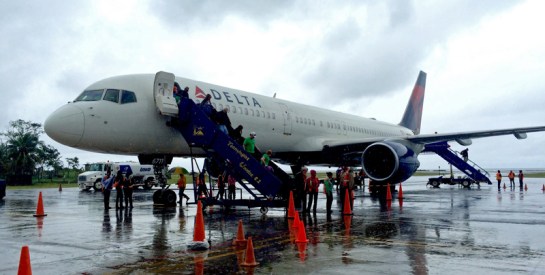
One 7,858-foot concrete airport runway serves Roatan. It’s large enough to land a Boeing 757 on- barely, and according to some sources, not quite long enough to take it off from. But Delta Airlines operates 757 service to Roatan once a week if weather permits.

plane

The Saturday we flew into Juan Manuel Gálvez International Airport was iffy. Low cloud and driving rain raked the island. It was February 13, 2016.

There is no modern landing approach system for Roatan’s only runway- no runway lights either. If the weather is too bad to land when you get there, you fly back home. The landing is even sketchier since your aircraft has to carry at least enough fuel to fly back to the mainland if it can’t land because of bad weather. During the fifth circle above the airport at 3,000 feet over a barely broken- and thickening- cloud layer our pilot’s announcements became increasingly tense.

“We’re going to try for it.” The pilot announced. Airline passengers are uneasy with terms like “try for it” when it comes to landing a big plane loaded with fuel on a short island runway.

Our huge Boeing caromed onto the end of runway 07/25 right on the ocean’s edge like a fighter onto an aircraft carrier. Brakes screeched hard as the thrust reversers on our twin jet engines shot an eight-foot diameter plume of spray forward of our plane. With only yards of runway left we stopped. We didn’t know when we landed we would need every inch of it for take-off a week later if it were a hot day, which is almost every day in Honduras.

Minutes later a United 737 twin-engine airliner made a similar attempt at getting into Roatan- and failed. He flew back to the mainland. We were the only flight to get onto the island that day. When we left the immigration checks, the airport closed.

They fingerprint you coming into Roatan and take your picture. There have been problems. Problems with people coming to commit fraud, sexual crimes, drug use and trafficking. It isn’t an epidemic though. The island is, based on our experience, safe and friendly. The islanders have built this line of defense against the things that make mainland Honduras, one of the most dangerous places in Central America, unsafe for tourism.

bird

Every islander told us that mainland Honduras milks Roatan tourism as its cash cow but returns little back to the island. Both holiday tourism from the few cruise ships that visit for day trips and slightly more adventurous “eco-tourism” for the SCUBA diver crowd. Jan and I were the later. We imagined ourselves as somehow… “better” or more authentic than the cruisers.

Our base would be Blue Island Divers, a rustic, beautiful dive center on the north coast of Sandy Bay with two cottages on the beach. Eric and Carly White run Blue Island Divers. They’re Texans, with the attendant drawl and pleasant manner. But their easy attitude belies a work ethic that is tireless. Filling SCUBA tanks, fixing plumbing, scheduling dives, maintaining boats, serving drinks, teaching new divers and improving existing ones- all done quietly behind the scenes against a backdrop of relaxed island paradise.

house

What Carly and Eric have created at Blue Island Divers is a sparkling gem in a vast sea of lesser experiences. Authentic and welcoming, small and quant, this is exactly what we had hoped for- a quiet cabin on a remote beach with tropical birds and roosters for alarm clocks, sunset views and hammocks swaying under jungle palms. It looks like a movie set. Exotic reef fish swim in shallow, crystal water forty steps from where our heads hit the pillow in our cottage. You can walk the beach for kilometers in either direction. The reef sits yards off the beach, creating a calm estuary ideal for swimming, snorkeling, sunning and teaching new divers. In our front yard lies some of the best diving anywhere on earth- a two-minute small boat ride away. Some dives sites you can swim to.

hut

Our beach cabin at Blue Island Divers in Roatan.

My girlfriend Jan is a new SCUBA diver and I am an old one who hasn’t been underwater in years. We took basic and refresher dive training in Michigan then went to Roatan for her open water certification dives and to explore one of the most renowned dive sites in the world.

Jan is a triathlete who had open water swim anxiety. She ‘s an Ironman finisher. It may seem odd that she was uncomfortable swimming in open water but fears of the unseen live in our minds that way. SCUBA diving is a way to understand what is really below the surface to moderate those fears.

jan surface

Our dive instructor and dive master at Blue Island Divers is Russell Nicholson, 26, originally from Newmarket, United Kingdom. Nicholson looks the part; short, Errol Flynn beard, curled hair and relaxed eyes that never waver, never suggest alarm or urgency. His voice is a laconic monotone of British accent, always spoken at a volume that politely requests attention rather than loudly demands it. His remarks about a dive site, sea conditions, dangerous sea life and submarine lesson plans are precisely spoken and trimmed of any sensation. There is the slightest hint of Ian Fleming’s James Bond when he suggests we “Just go inside, and have a nice swim-through” at an underwater cavern in 65-feet of ocean that opens over a submarine cliff dropping into a black abyss. No other dive master could have made us confident in such an expedition. Nicholson made it seem almost… pastoral. “We’ll just kip down and have a look, then we’ll decide.”

Russ Nicholson got here after finishing college, sciences and exercise physiology, in England at the height of the recession. With poor job prospects he did what any self-respecting English adventurer does, he traveled the world as a SCUBA instructor.

Russ

Dive Instructor Russ Nicholson.

“Egypt was incredible, but the Muslim Brotherhood and the unstable government made things a bit dodgy at times…” From there to Asia, Thailand, Indonesia across the Pacific to Australia where he worked construction for a couple years. Then back on the road of undersea adventure as an expert dive instructor. Nicholson certified over 500 divers and built a reputation as one of the finest dive instructors across that part of the world. Now he sat across from us, our own private instructor and underwater guide.

Drenching rains and ocean gales pummeled the island washing rivulets of thick jungle mud through swollen rivers dumping into the ocean when we arrived. The island wore a dense, brown belt between its beaches and the reefs. Diving was nearly impossible in the salt-water muck upon our arrival.

rain

A short day later as the weather broke we boarded one of Blue Island Divers’ small dive skiffs from their dock and motored over peeling tubes of big waves that looked like the opening of “Hawaii Five-O”. Our boat Captain, Elden, is an islander. To him the sea has road signs on it. To us it was a dangerous tempest. He navigates the waves and reef like a commuter on a cloverleaf with a Garmin.

Elden found passage between a small island and the reef, ducking behind it then out to sea between waves. Once past the reef our dive boat rose and fell with nauseating amplitude. Combined with a grey sky, dark water and threatening rain it was a good day to lose your lunch over the rail. I dry-heaved five times in the attempt.

After Russ administered our pre-dive checklists and Jan and I did a buddy check we did a back roll entry, swam the five-foot rollers on the surface to the reef marker and deflated our buoyancy compensators for the descent.

Everything changed. A vast landscape, varied and perfect, spanned below us as we fell like underwater skydivers to the white sand sea floor. It was calm underwater. Swarms of colorful fish swam easily in relaxed processions over white sugar sand between coral arrangements the size of buildings. Instantly ten or fifteen species were in front of us. As if queued by our entry a peaceful sea turtle flew over the bottom. What was chaotic and stormy on the surface gave way to Roatan’s main paradise- the paradise beneath the waves.

shark90

Nothing prepared us for the enormity and splendor of underwater Roatan. It’s shocking. Otherworldly. Only feet below the surface the world changes entirely. No other transition in human experience is as abrupt and dramatic. It takes billions of dollars and decades of technology to fly into outer space. It only takes a few SCUBA lessons to fly into the inner space of underwater Roatan as weightless aquanauts.

We dove on reefs and shipwrecks, to 100-foot depths and searched for fish species, cataloguing them on an underwater slate. Russell planned underwater navigation exercises for us on land, briefed and rehearsed us, then lead our dives and administered tests in underwater compass reading, distance measurement and every aspect of open-water recreational sport diving. We did two and three dives a day.

Roatan skies yielded to sun and calm seas. The surface conditions improved. We became more relaxed and at home in the ocean. Bobbing on the calm surface before and after a dive under warm sun was relaxing. When we surfaced we ate orange slices picked from trees the day before.

lizard

The only contrasts came when we were back on land. Roatan is a poor island. People lead a subsistence life working in service industries. When we walked on some of the beaches toward the small tourist area visited by the cruise ships the amount of trash on the beach was disheartening. During some of our dives we collected bits of plastic bags from the reef at depths of 60-feet, deadly plastic bags that could choke a sea turtle or strangle coral.

In a strange irony the deadliest things in the ocean were plastic bags from cruise ship gift shops. The jellyfish, stingrays and sharks posed no threat. The tourist trash was killing things in front of us.

Among its dive attractions Roatan has a population of large Caribbean reef sharks (Carcharhinus perezii). One dive site, “Cara a Cara”, rests on the bottom in 70 feet of water about two miles off the south coast. Cara a Cara is the farthest from shore of hundreds of popular dive sites on Roatan. The sharks gather there. And so do the adventure tourists.

shark30

I’ve been a diver on and off almost since I was a teenager. Sharks, big sharks, have only been a rare, distant shadow in the sea that fades into the abyss after we entered the water. I learned sharks didn’t like people. Sharks ran from us. But at Cara a Cara the sharks will return each day if the divers do. The divers descend with a white plastic bucket with a few fish heads in it- not nearly enough for a meal if you’re a nine-foot shark, but enough to tempt them close enough for photography.

We rode a typical open-skiff dive boat packed with divers about two miles out to the dive site. It was rough, waves broke over the bow, we were soaked. One of the other divers, a Frenchman, joked that we looked like the opening scene from “Saving Private Ryan”. He was right.

shark40

At the moment I back-rolled off our dive boat I had become a part of the problem. I had become a tourist hoping to grab some snapshots of something that should be regular and natural in the ocean, but is increasingly fleeting, exploited and rare.

Descending the mooring line to Cara a Cara I saw the plan form of a big reef shark below me. Gliding on his pectoral fins, he steered a patient course over the white sand 60 feet down. Circling, weaving, looking, waiting. Then there were two, then six, then twelve- then too many to count. Some were massive, the size of a kayak. None were small. Most were pristine and perfect. One trailed a length of fishing line from a hook gouged into the right corner of his mouth. All of the sharks were, curiously, female. Five of them were pregnant. A hopeful sign.

shark80

We landed on the white sand bottom in a natural coral amphitheater at 70 feet. Two rows of divers, me on the end. Russ Nicholson dove with Jan and I on the dive. We brought our own SCUBA tanks and equipment since the shark dive operation’s compressor was broken and they had a reputation for allowing their SCUBA tanks to drain too completely for safe operation. Russ looked after us and the other divers. Only minutes after reaching the bottom Russ had to ascend with two divers whose tanks had become dangerously low on air way too quickly.

One diver ran a large video camera, the dive master on the dive administered the bait bucket and the sharks obliged with a display that reached a crescendo when they spun into a whirling feeding frenzy, sending sand flying into the water and reducing visibility. I was in the middle of a shark feeding frenzy 70-feet under heavy seas two miles off shore.

shark70

We swam amongst the sharks. They shared their ocean with us for a few minutes. We took their picture. After about 25 minutes on the bottom the sharks began to slowly drift back to the depths and we began to slowly ascend our buoy line, each party returning to its respective worlds.

I don’t know if what we did at the shark dive was good. Am I part of the problem? Did we somehow alter the sharks’ behavior? Does our diving with them threaten them? My rationalization included a promise that I would tell the story of the Sharks of Roatan Island, and now I have.

If you are a diver, you can see them too for $100 if you think that is a good thing. The dive boat is too crowded and the sea can be rough, but the sharks are nothing short of a miracle. A miracle that I am afraid may last only slightly longer than a perfect sunset on Roatan.

tom

Tom Demerly has written for “Outside” magazine along with a host of others and traveled on all seven continents. He isn’t any good at catching fish though.


By Tom Demerly originally for MILTECHREV.com

BF-5 flight #91, piloted by SQLDR. Jim Schofield, performs STOVL operations aboard the USS WASP DT-II.

An F-35B Joint Strike Fighter of the U.S. Marines takes off from the USS Wasp aircraft carrier without the use of a catapult.

You’ve seen posts on Facebook about the new F-35 Lightening II Joint Strike Fighter suggesting it’s a “failure”, “a waste”, “damaging to the environment” and even that “F-35 basing is a racial injustice: new Americans and people of color are disproportionately harmed.” The public vitriol surrounding the F-35 program eclipses any previous defense program.

It begs the question, is the F-35:

A. A costly boondoggle spun as a super plane by the Pentagon “old boy network”?

B. The next ultra-weapons system that will render nation-users invincible?

C. A combat aircraft at the beginning of a typically difficult development program?

The reality is, of course,  “C”.

Another reality is the F-35 is the first major weapons system to do combat on the battlefield of social media. Social media is a great equalizer among combatants. All you need is a laptop and “friends” to fight a battle with the biggest defense contractors on earth. Whether you are Lockheed or Larry Smith the anti-F-35 activist, every opinion on social media is 800 x 600.
If you add some historical context to the development of military aircraft you see daunting realities. Firstly, the F-35 is actually doing quite well for such an ambitious project. In fact, some of the criticism for what has been described as “delays” may actually be the F-35 program’s primary drawback: too much caution. Partially because the magnifying glass of public opinion has focused so much heat on the F-35 the program has ground slowly ahead with more than the typical degree of caution.

Let’s look at some previous military aircraft development programs and think about how they would fare under “trial by Facebook”.

b17_wing_shot_away

An early model B-17 Flying Fortress breaks up over Germany in WWII. More airmen died in the first versions of the celebrated bomber than any combat aircraft in WWII. Today the B-17 is revered as a great aircraft.

In WWII my father was a draftsmen for Boeing Aircraft in Seattle, Washington at “Plant 2” near the Duwamish River. His first project was drawing a quickly conceived update to the B-17 Flying Fortress: a chin turret with two forward facing .50 caliber guns. The first eight versions of the B-17 lacked adequate guns to defend themselves from a frontal attack. German pilots quickly learned to attack the B-17 from high and head-on, or “Twelve O’clock High”. The results were catastrophic. Early B-17 crews attacking Germany had better odds of dying than surviving before completing their required 25 missions. In fact, more aircrews from the Allied 8th Air Force died over Europe than all of the Marines killed in the Pacific in WWII. Today the B-17 is remembered as a “great aircraft”. How would Facebook pundits have treated the first eight versions of the B-17 with a record like that?

b29_crash_feb_18_1943

A early model B-29 Superfortress crashed into a meat packing plant in Seattle during its secret testing phase. The program was so classified that firefighters and first responders were initially prohibited from entering the crash scene contributing to mass casualties not getting emergency treatment at the crash site.

My dad was transferred to a top secret project working on a super bomber that would fly too high to shoot down and carry a larger bomb load than the B-17. It was the B-29 Superfortress, a project so secret he wasn’t allowed to tell my mom what he was working on. The B-29 delivered the only nuclear weapons used in combat. It is largely credited with ending the war in the Pacific. But the B-29 was a difficult and dangerous aircraft to operate. It used four Wright R-3350 engines that were prone to overheating, and catching fire. With a full bomb load while straining to get to altitude it was common for the B-29 to have engine fires.

The B-29 killed a lot of U.S. flight crews. The engine problem, combined with navigation and bombing accuracy problems encountered from an undiscovered high altitude wind phenomenon called the “jet stream” forced Maj. General Curtis LeMay to order B-29’s to attack Japan from low altitude, well within range of Japanese anti-aircraft guns. To carry more bombs LeMay told his bomber crews to remove their defensive guns and leave their gunners behind, a request some crews ignored according to the definitive account of B-29 operations, Mission to Tokyo by author Robert F. Dorr. What would people have said about the B-29 program on Facebook?

f-111b_cva-43_approach_july1968

The General Dynamics F-111 was originally intended as a multi-role, do everything aircraft for both the Navy and the Air Force. The Navy dropped it in early development, opting for the Grumman F-14 Tomcat. It ended its largely undistinguished career in service with the Australian Air Force.

More recently, and in an oddly similar program to the F-35 Joint Strike Fighter, in 1961 former Defense Secretary Robert MacNamara asked for a feasibility study on the development of one aircraft that could perform low-level, supersonic penetration bombing missions into the former Soviet Union and also serve as a fleet defense interceptor launching from aircraft carriers for the U.S. Navy. The result was the General Dynamics F-111. The F-111 was never adopted by the navy and served with mixed results in the Air Force. Initial F-111 operations in Vietnam were a catastrophe, with 50% of the aircraft being lost and the Vietnam deployment being halted. The one shining moment for the F-111 came during Operation El Dorado Canyon under the Reagan administration, when F-111’s attacked Libyan airfields in retaliation for Libyan sponsored terrorist attacks on U.S. servicemen. A version of the F-111 never initially envisioned, the EF-111 Raven electronic warfare aircraft, did serve successfully in the early Gulf war but, in general, the entire F-111 program fell well short of its original multi-role, multi-service concept.

These are three examples of aircraft that had major problems eclipsing anything the F-35 faces. But that was a long time ago. We’re not in a major air war with a similarly equipped air force. Technology has come a long way. Engineering tools exist today that were unheard of even in the 1970’s when the current generation of operational combat aircraft were first conceived. And those are some of the reasons the F-35 has been treated unfairly.

10640

The development and production costs of the F-35 are to be shared between a host of nation-users, but the Eurozone crisis and global recession has placed more economic pressure on the program.

When cost estimates for the F-35 were originally drafted much of the development program included the new generation of virtual prototyping and testing. Computational Fluid Dynamics replaced early prototype flight-testing. Finite Elemental Analysis replaced actual strain gauge developmental analysis. The business model for the F-35 included development in the virtual space spread over international economies of many user-nations. Each of these factors left opportunities for a host of variables to act on the program and drive costs up. Some of those variables, such as the European economic crisis, have become a reality.

Another reality is the need for all combat aircraft to evolve significantly over their life span. The F-16, FA-18, AH-1 Cobra and AH-64 Apache are just a few legacy aircraft flying today that have undergone such sweeping updates they only vaguely resemble their original versions. The F-16 now has conformal fuel pallets, different control surfaces and improved sensors installed. One version of the FA-18 has gotten larger wings, new intakes, improved avionics and become an entirely new aircraft called the EF-18 Growler. And then there is the B-52 bomber, the plane that just won’t die. The B-52’s in operation now are older than their flight crews. They were based on lessons Boeing learned from- you guessed it- the B-17 and B-29 development programs my dad worked on in WWII. And the B-52 is still flying. People post photos of them on Facebook now, talking about how amazing an aircraft it is. Social media wasn’t around for the bumpy development years.

f-35b-vertical-landing_1

U.S. Marine Corps test pilot Lt. Col. Russ Clift performed the first F-35B night-time vertical landing aboard the USS Wasp off the Maryland coast last Tuesday, August 13, 2013. The F-35B replaces the aging AV-8B Harrier for the U.S. Marines and the Royal Navy.

The F-35 wasn’t developed in the middle of a world war, but it is being fielded in one of the most volatile periods in history, when enemies use airliners as attack aircraft and superpowers are fielding a new generation of combat aircraft like the Russian T-50 and the Chinese J-20. While it’s unlikely Al Qaeda, Islamic Jihad, ISIL and their radical splinter organizations will field a new- or any- combat aircraft the ability to command the airspace over insurgent controlled territory has kept their doctrine near the Stone Age and their controlled territory isolated from U.S. shores. It may have also helped prevent another 9/11.

The F-35 won’t bring peace to the world. It isn’t the final answer- no single combat aircraft is. It’s likely not even the best combat aircraft ever. But it is a viable next generation multi-role combat aircraft with a degree of information sharing and mission flexibility that can’t be retrofitted to aging current aircraft systems. It is also designed to fight a war we don’t know everything about yet: the next one. And while uncertainty, at a minimum, swirls around the F-35 on the vaunted spaces of social media the one thing that is certain is, that next war will come.