Archive

Uncategorized

By Tom Demerly.

Malcomathome10800

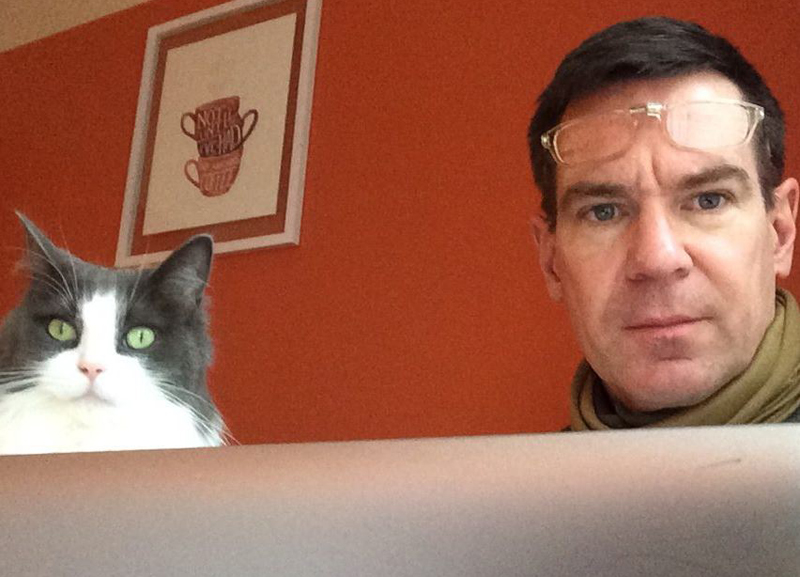
Meet Vice-Admiral Malcom Frederick Davis III.

Call him Vice-Admiral Davis, “Sir” or, on a first-name basis, Malcom.

Vice-Admiral Davis is a survivor of Detroit’s collapse, and a product of its renewal. Local animal welfare organization Providing for Paws rescued Vice-Admiral Davis when he was only 5 months old living in the ruins of Detroit. He survived in a dangerous neighborhood filled with stray dogs. Winter was coming. He lived in abandoned houses.

Once The Vice-Admiral was rescued he established a basecamp at a volunteer rescue house for cats, dogs and raccoons. A born leader, young Malcom liaised between the animals to create a peaceful and cooperative society. He is a feline Sir Lawrence of Arabia.

For his exceptional survival skills, outstanding humanitarian efforts, valor in the face of adversity and his infectious positive outlook, then-Lieutenant Davis was advanced to the honorary rank of Vice-Admiral. He owns the name of Malcom and takes the given name Frederick from the late, great Frederick the Cat, who was also a white Prince of a cat. His Surname, “Davis”, emanates from a secret origin that cannot be disclosed, and he is the third in line of male cats, hence “III”.

Vice-Admiral Davis is, as you can see, skilled in appearing as two cats at once: a striped tiger cat and a pure white cat. This belies his background in espionage and subterfuge, tradecraft he learned well in the rough and tumble survival world of the Detroit ruins. Despite his martial skills Vice-Admiral Malcom Frederick Davis III is primarily a bon vivant and man of peace. He enjoys good food, exercise, friends and sleep. His character was forged in the cauldron of economic collapse but his intellect is sharp and his disposition as warm as a benevolent Sultan.

The Vice-Admiral has agreed to take up permanent residence at our home along with MiMi the Cat, who is 2 years and 4 months his senior.

MiaObituary20

Mia Demerly died on Sunday morning, October 11, at 4:27 AM after a three-year battle with Feline Hypertrophic Cardiomyopathy. Mia was a ragdoll mix found as an abandoned stray in a litter of cats inside a dumpster near Wyandotte, Michigan in 2007. She was 7 years old.

Feline Hypertrophic Cardiomyopathy is a chronic heart condition inherited from parents and present especially in the ragdoll breed. She died peacefully at home early Sunday morning from complications related to her cardiac condition after being seen by feline cardiac specialists and emergency veterinarians on Friday and Saturday.

MiaObituary10

During her life Mia was junior to the late Fred the Cat and senior to MiMi the Cat, whom she leaves behind. Mia was a clever, calm and industrious cat who enjoyed food, bird watching, collecting cat furniture, beds and cardboard boxes. Mia also had an extensive collection of toy mice. Her favorite pastime was chasing a length of bright orange .550 parachute cord. Mia also enjoy being brushed and read to and kept a regular night/day schedule, sleeping with her human guardian (me) and most recently in her life, Ms. Jan Mack, whom she particularly loved.

Mia Demerly was native to Wyandotte, Michigan but also lived in Tucson, Arizona and Mission Viejo, California until she returned to Michigan three years ago. Her current home was in Dearborn.

Funeral for Mia will be in Dearborn, Michigan later this week. In memory of Mia you may want to make a donation to The Hermitage No-Kill Cat Shelter in Tucson, Arizona, Emerson and the Gang at Miller’s Safe Haven or the Dearborn Animal Shelter.


MiaObituary30

By Tom Demerly.

thegatesofheaven_imfinish-oct1982-finallr-_0

I don’t care who owns Ironman. Here’s why.

Years ago I saw the race on TV. It was 1982. A woman stumbled to the finish and fell. A blonde man from California won. He was a lifeguard and drank smoothies. Another man from Brazil was the fastest swimmer. The day after the race he rescued a woman from drowning in the Pacific.

I watched them on TV, in the race. Their faces. The clothes they were wearing. The bikes they rode. And I realized something; this is really cool. This is special.

I grew up fat. So fat they put me in a special education phys ed. class in junior high. I was lucky enough to have a great teacher in that class. He taught me to believe in myself. He taught me to never give up. He taught me that with work come results.

Later, in the Army, I learned he was right. I also learned that its what you do that counts, not what you wear or what you look like. Your actions define you. Not uniforms or special hats or patches or medals. Or tattoos or T-shirts or finisher medals.

The only thing that matters is what you do. Not your tattoo, your medal, your T-shirt.

Our sport has changed. People ask, “How little can I do and still reach the finish line?” They want the medal, the shirt, the tattoo. It’s important to them, and those icons help define them. That’s not wrong. It just is.

But I don’t care. I don’t care who owns Ironman. It’s still long, hard, hot and difficult. Every mile has 5,280 feet. It isn’t shorter, easier, cheaper (that’s for sure) or somehow “less”.

You can do an Ironman any day of the week. Swim 2.4 miles, ride 112 then run 26.2. When you’re done, you’ve done it. You finished. You don’t need a T-shirt, a medal, a tattoo.

You do need courage, determination, confidence, endurance and strength. You can’t buy those things anywhere. No one else owns those. No one needs to see proof. Just you. Only you really own it.

By Tom Demerly.

D5N934

I view Facebook as a place to socialize, connect, share similarities and expand understanding. Not a place to draw lines or open wounds.

It’s rare for me to “unfriend” someone, but last week I did that and it made me sad.

I was sad because I sense that I actually like the person, even though there are some things I disagree with them about. That is fine.

But at which point a person begins to use a public and social platform to spread more than just their beliefs- to spread hurt and ridicule and even hate, then I must exclude them from the stream of consciousness that is my Facebook feed.

Here’s why:

Social media isn’t reality. We portray ourselves the way we want other people to see (and not see) us. We paint a picture, based more or less, on some version of who we really are. That is good because it is, well, “social” and it gives us a very controllable 600 X 800 persona. It is bad because what we envision in the virtual does have a tendency to manifest itself in reality.

I subscribe to a few axioms of life; one of them is that “We each create our own reality”. The reality I wish to create is one of friendship, unity, understanding, tolerance and kindness. I am not about drawing lines or about cruelty or ridicule.

You may disagree with me if you’d like, and I may disagree with you, but we can still find common interests on social media. And I welcome your ideas.

I am interested in making new connections, especially with people in places I either have never been or do not understand. In the words of great author Steven Covey I try, as best I can, to “seek first to understand, then to be understood”.

tomfacebook10

Over 4,000 people tolerate my incessant and tedious litany of Facebook posts about my cats, strange animals real and imagined, airplanes, triathlons, bicycles, scantily clad girls and videos of strange happenings. Every once in a while a few people get fed up with it and “unfriend” me, and every few days I pick up a few new “friends”, almost always people I have never have never met, nor will I ever meet.

A big part of my involvement in Facebook is commercial- to promote the work I do for a few different outlets in three different and unrelated industries. People get understandably bored with that too. Fair enough. There’s an “unfriend” button for that.

But the quickest and really the only way to get “unfriend-ed” by me is for someone to threaten violence, or advocate ridicule or insult in what should be a peaceful space. This is a gray area, and I support some institutions that do violence; the military is an example. But I am judicious (at least I think so) in my advocacy of these causes and interests, and I acknowledge you may have no interest in them. I respect that. You may even take exception to them. I accept that.

There are vast areas of gray in social media use; what is obscene or profane to some of my friends is acceptable, desirable even, to others. There is a point where gray becomes black and that isn’t always the same all the time, with every topic and every person, but I know when I see it. And I won’t let it in my Facebook feed.

By Tom Demerly.

787_40

The beautiful new Boeing 787-8 arriving at Detroit Metro for the first time ever on December 1, 2014 as Royal Jordanian flight 267.

The first ever Boeing 787 Dreamliner to land at Detroit Metropolitan Airport arrived this morning, December 1, 2014, Monday. Catching a rare first arrival is a big trophy for aircraft spotters.

A month before the arrival of the aircraft, a beautiful, brand new Royal Jordanian Airlines Boeing 787-8 Dreamliner, the Facebook page Detroit Metro Airport Spotting posted an announcement of the first-ever arrival and invited people who “Like” their page to the event. Aircraft spotting is a worldwide hobby among aircraft enthusiasts and bagging a first-ever flight is a rare trophy.

Trying to be in the right place at the right time to catch an arriving flight is a little tricky, but much easier now with the help of flight tracking websites like FlightAware.com and networks of people with like interests on social media.

787_90

The Dreamliner’s route from Amman, Jordan over the Atlantic to Montreal, Quebec, Canada before flying here to Detroit.

The Dreamliner arrival originated in Amman, Jordan almost two days earlier and flew in a northern arc across the Atlantic, descending down over northern Canada and into Toronto. It originated as Royal Jordanian Flight 267 out of Amman, continuing from Toronto to Detroit with the same flight number.

The Boeing 787 Dreamliner is a milestone in aviation because of its incredible fuel efficiency, over 20% more fuel efficient than similarly sized passenger aircraft. The 787 competes directly with the mostly French-built Airbus A350, and the A350 is said to be even more fuel efficient. From the start the Dreamliner was meant to be revolutionary. Most of the aircraft’s wings are made of carbon fiber, not aluminum. This makes them lighter and stronger, contributing to fuel efficiency. It also gives the Dreamliner its unique upward bowing of the wings in flight, like a giant, gliding bird.

787_60

The carbon fiber wings of the Boeing 787 Dreamliner form a graceful curve in flight. Here is the Royal Jordanian flight on final into Detroit on its first-ever arrival here.

The windows on the Dreamliner use a unique passenger controlled auto-tint feature as opposed to conventional pull-down blinds. Early Dreamliner prototypes had unusual, triangular shaped windows, reminiscent of the DeHavilland Comet. The production versions settled on a squarish, advanced passenger window that is about 30 percent larger than other aircraft in its class. Probably better that Boeing went to the more conventional square windows since the triangular windows that originated with the Comet airliner in 1949 were blamed for several crashes and later changed.

1024px-Boeing_787-8_N787BA_cockpit

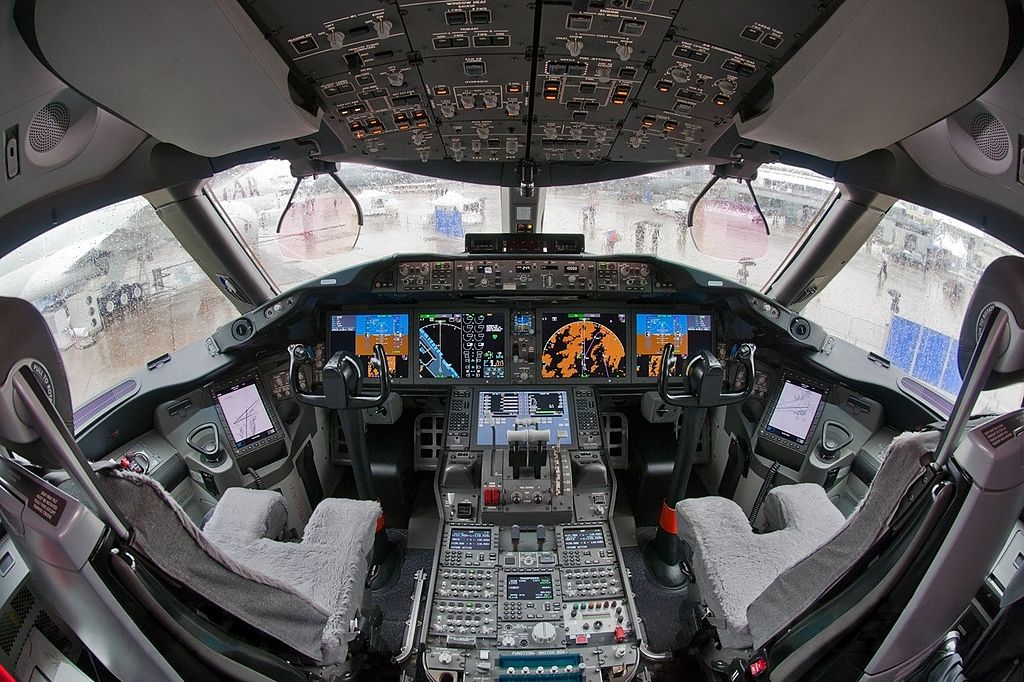
The Dreamliner’s advanced cockpit features full glass display integration, conventional wheel-style flight control column, Heads Up Displays in front of the windscreen unique communications system interfaces.

To get photos of the Dreamliner’s arrival I went to the south end of Metro Airport. After driving around the airport and watching flight arrival and departure patterns it was easy to predict which runway the aircraft would likely be arriving on. Early traffic of “heavies”, Bowing 747’s, were arriving on the western runway at Metro, runway 4L as approached from the south. The Dreamliner arrived on runway 3L. Usually the very large aircraft like 747’s are routed onto their own runway while the smaller aircraft use a different runway on busy arrival days.

787_80

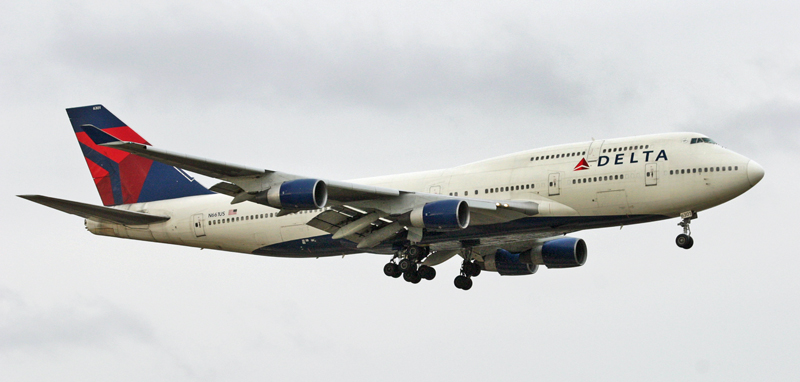
A big Delta Boeing 747 arrives at Metro before the Dreamliner. This aircraft used the farthest west runway, runway 4L as approached from the south.

Security around all airports has to be tight. One Tom Clancy novel featured an attack on an airliner using a shoulder-fired surface to air missile at Tucson International airport. In Clancy’s story, the weapon was smuggled across the Mexican border by Middle Eastern terrorists. When I showed up to the south end of Metro Airport wearing a backpack and walking toward the airport fence, three security vehicles and one Wayne County Sheriff converged to stop me. After a quick and courteous ID check by these excellent security officers they let me wait a few moments for the aircraft’s arrival while they stayed with me.

787_120

A. Where I was located to shoot photos between the approaches for runways 4L and 4R. B. The arrival path of the Dreamliner.

The ideal location to shoot photos of the Dreamliner would have been with the sun behind me. It was an overcast day so the lighting would be marginal. As luck had it, the aircraft was between the sun and me, backlit. Combined with the overcast skies conditions for photography were poor. But plane spotting is a lot like fishing. Sometimes you hit the jackpot, sometimes conditions are just OK. Today was a “just OK” day for photography.

787_20

The Dreamliner on final with flaps in the landing position and gear down. The crummy light conditions didn’t do the nice paint scheme any favors.

About three hours later the Dreamliner was set for departure and I went back hoping for better light. At the north end of Metro Airport I waited in the hotel/rental car parking lot across I-94 for it to take off. About an hour later than we had thought the aircraft was back in the air, this time with a little better lighting.

787_145


Photos and Story by Tom Demerly. (Feel free to share these photos and mention Baltia Thunder Over Michigan)
AA50

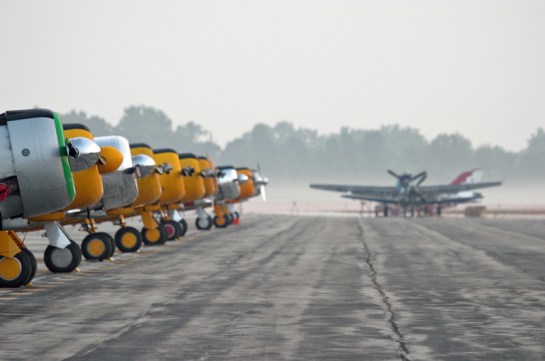
The Baltia Thunder Over Michigan Airshow at Willow Run Airport in Ypsilanti, Michigan on Saturday and Sunday, August 9 and 10, 2014 was one of the largest displays of historic and modern aircraft this year. Most of the aircraft displayed are privately owned, including one of the largest gatherings of T-6 Texan and Harvard trainers anywhere. Thunder Over Michigan also featured the U.S. Air Force Flight Demonstration Team, The Thunderbirds, along with the U.S. Army’s Golden Knights Parachute Team and other airshow acts.

This is my home town airshow, one of the shows I grew up with, so it was a special event to me. Airshow organizers provided photographers with taxiway passes for special access to the aircraft and crews along with a great hospitality tent with food, drinks, bathrooms and detailed information on every aircraft in the show. Tom Walsh, the coordinator of the photo area, did an incredible job hosting aviation photographers from around the world.

AA240

The early morning light provided a unique opportunity for photos on both Friday before the show opened and on Saturday, the first show day.

This crew (above) prepares the famous B-17G, “Yankee Lady”, that lives at Willow Run Airport as part of the Yankee Air Museum. It is a flying piece of history that is beautifully maintained. Several years ago I got a chance to fly in Yankee Lady out of Willow Run as a guest.

Yankee Lady was built in 1945 and once flew as a Coast Guard PB-1G before being sold at auction for only $5,997 to a smelting company and then to an aerial survey company. It later had a career as an aerial fire bomber and also flew in the filming of the movie Tora Tora Tora about the attack on Pearl Harbor. In it’s current condition the aircraft has been completely restored, including the replacement of all fuel and electrical systems. It is seen flying frequently around Willow Run airport.

AA130

Thunder Over Michigan attracted veterans who were pleased to share stories about the planes and people who built the history celebrated here. The show crossed aviation eras from before WWII to the modern era. Here a veteran and one of the airshow pilots chat before the arrival of show crowds.

AA60

A unique perspective on the “Fork Tailed Devil”, the P-38J Lightening “Ruff Stuff”, belonging to Mr. Ron Fagen of Granite Falls, Minnesota. There are only seven P-38 Lightenings left flying and this is the second one I’ve been lucky enough to see. Ruff Stuff was built in 1945 and never saw active service. It has changed ownership several times but its most recent restoration and the stewardship of Ron Fagen in his Fagen Fighters Museum insure its future as a national treasure.

AA40

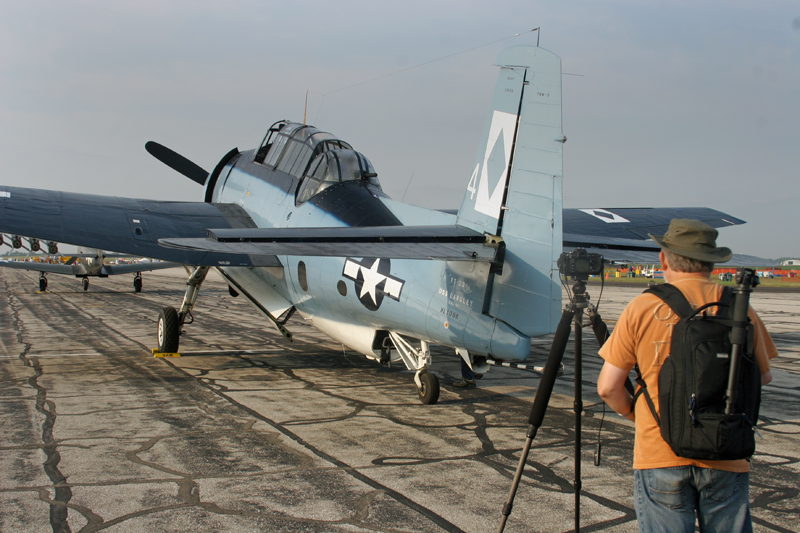
We each shot unobstructed photos of the incredible airplanes out on the flight line, an area restricted from the general public on show day during flight demonstrations. Here we set up his shots of a TBM Avenger torpedo and dive bomber.

AA20

Photographers brought an impressive array of photo equipment to capture the action. We used aviation band scanners to listen in on aircraft communications and air traffic control radio from the show Air Boss.  Shooting aircraft requires big telephoto and zoom lenses to capture the action. Canon equipment outnumbered Nikon significantly. Monitoring the show and airport air traffic control enabled us to set up shots before aircraft arrived, especially helpful with fast jets.
AA110

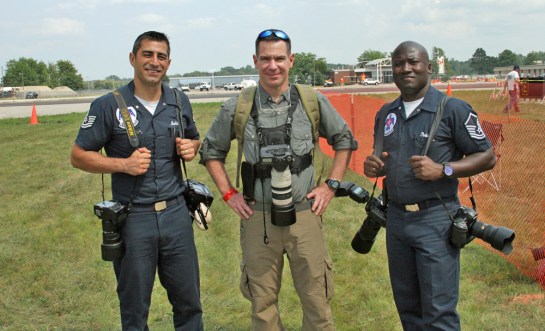
All the photographers enjoyed the same access to the field as the official Air Force Thunderbird photographers Manuel Martinez (left) and Stan Parker (right). I got a chance to grab a photo with these guys as they worked and even got a few tips on aviation photography from two of the best guys in the business.

AA480

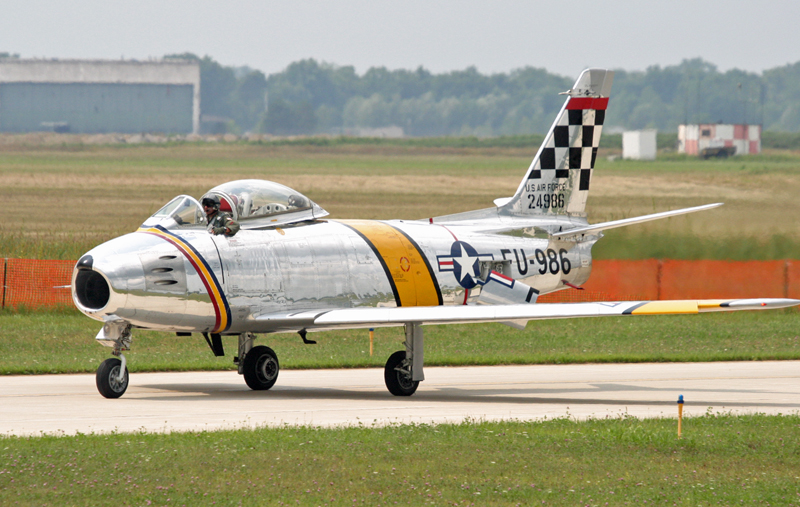
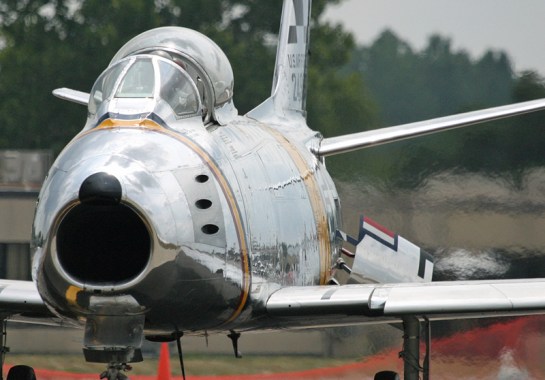
Friday, August 8, was arrival day for many of the aircraft in the show, with planes flying in from all over the U.S.. A highlight was this F-86F Sabre, “Smoky”, owned by Paul Wood from Waukegan, Illinois. The restoration and maintenance of this Korean War era jet is impeccable and it is a favorite of photographers. The aircraft was first owned by the U.S. Air Force then sold to the Fuerza Aerea Argentina or the Argentinian Air Force in 1960. It was later acquired privately in the U.S.
AA30

Paul Wood taxis his F-86F Sabre into the parking area. Notice the open speed brakes and the three holes for the .50 caliber machine guns.
AA90

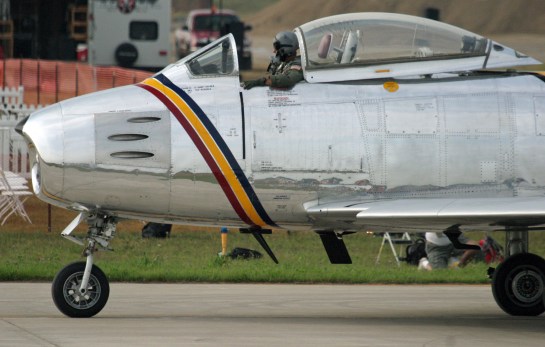
The F-86F has a natural metal finish that is difficult to maintain but brilliant to see on a sunny day. The bubble canopy of the F-86F provided pilots with excellent visibility and inspired the design of the canopy on the most recent fighters including the F-22 Raptor. Pilots like to taxi with the canopy open for ventilation but must duck down to close the canopy fully.
AA100

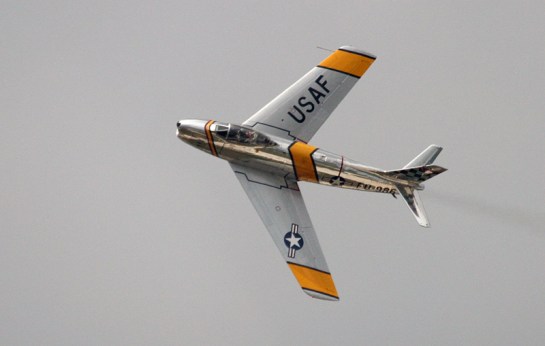
Paul Wood cranks his F-86F through a flight demonstration that showed the maneuverability and thrust to weight ratio of the F-86F. Considering this jet was built in the late 1940’s it remains an impressive performer. The F-86 was the first fully operational U.S. jet fighter with swept wings.

AA570

A few minutes later the U.S. Army Parachute Team’s C-31A Troopship flew into the pattern at Willow Run for a landing. The pilots obliged photographers with a low pass before final approach. This is a nice sounding, Rolls-Royce powered aircraft built by Fokker. It can carry up to 25 jump equipped soldiers for demonstrations.
AA370

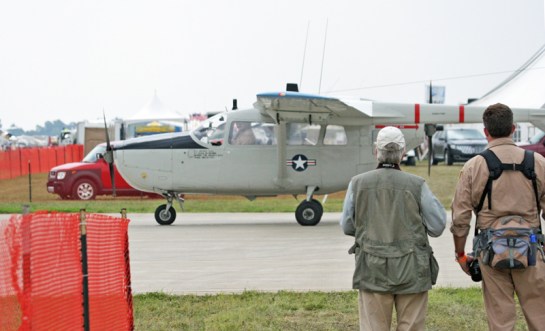
We had excellent access to active taxiways throughout Friday and were accompanied by helpful “safeties” who kept us from getting run over by aircraft when we were looking through a camera viewfinder. It was a remarkable experience to be so close to the aircraft as they came and went during arrival and show rehearsal.

AA360

This unusual aircraft is the de Havilland DH-115 Vampire formerly of the Royal Navy and now belonging to Marty Tibbits of Detroit. It is a pretty, unusual aircraft that operated from Royal Navy aircraft carriers after 1945 and also served, in a different version, with the Royal Air Force. The Vampire, in its many versions, was a successful aircraft that was flown by several countries through the 1990’s, including, oddly enough, Rhodesia.
AA350

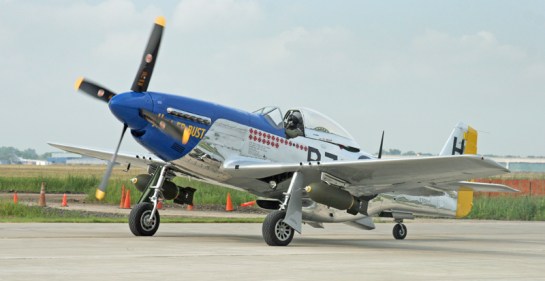
If there was one perfect P-51D Mustang at the show it was Mark Peterson’s “Hell-er Bust” from Boise, Idaho. The aircraft is painted in a photogenic livery and carries a pair of simulated 500 lb. general purpose bombs. Here Mark taxis in after his arrival on Friday. Hell-er Bust has an impressive history since being built in 1945 at the North American Aircraft plant in Inglewood, California. She first joined the legendary 8th Air Force in 1945 but was transferred to the Swedish Air Force in 1948 and the to the Dominican Republc from 1952 to 1984, making it one of the last remaining truly operational Mustangs while in service with the Dominican Republic. Hell-er Bust uses the classic Packard Merlin V-1650-7 engine that produces that goose bump-inducing Mustang sound.

AA300

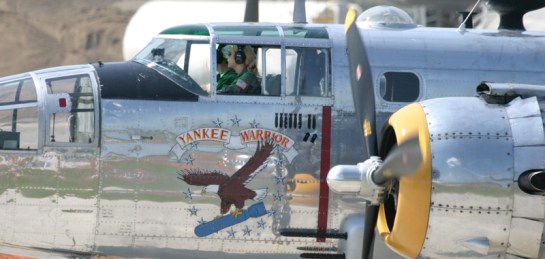
The B-25D “Yankee Warrior” is one of the planes that lives at Willow Run as part of the Yankee Air Museum. We are lucky enough to see it fly around the airport occasionally and got a good look at it on reception day. Five of its .50 caliber machine guns are visible in this view. Yankee Warrior is a combat veteran of WWII, having flown eight bombing missions over Italy before it was retired, then restored.
AA510

Yankee Warrior had a rather attractive pilot flying on arrival day and was meticulously turned out in its natural metal finish. This B-25 is a frequent visitor to air shows around the U.S. but I never found out who the pilot pictured here is.
AA290

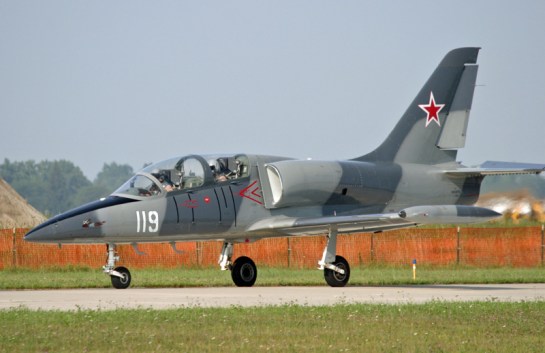
A number of exciting private jets flew in on Friday including this Aero Vodochody L-39C belonging to Tim Brutsche of Battle Creek, Michigan. Brutsche owns Brutsche Concrete in Battle Creek and is a licensed Air Transport Pilot (ATP) who has been an active promoter of youth in aviation for years.

AA280

Here is Tom and his co-pilot, perhaps his wife Beth Franklin-Brutsche who frequently flies with him, taxiing their L-39C to its parking ramp.

AA520

Aircraft owners spent time on Friday chatting with photographers and polishing their airplanes for the show opening on Saturday. This TBM-3E Avenger gets a shine in the morning.
AA500

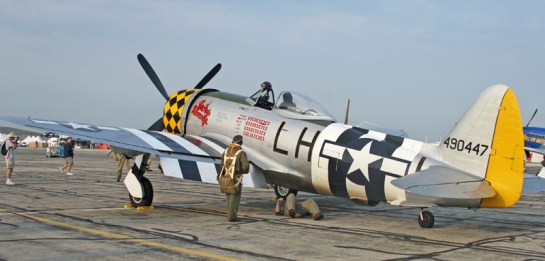
The P-47D Thunderbolt “Jacky’s Revenge” was restored from former Peruvian Air Force service in 1966 and painted in U.S. livery with D-Day invasion stripes on the wings and fuselage.
AA530

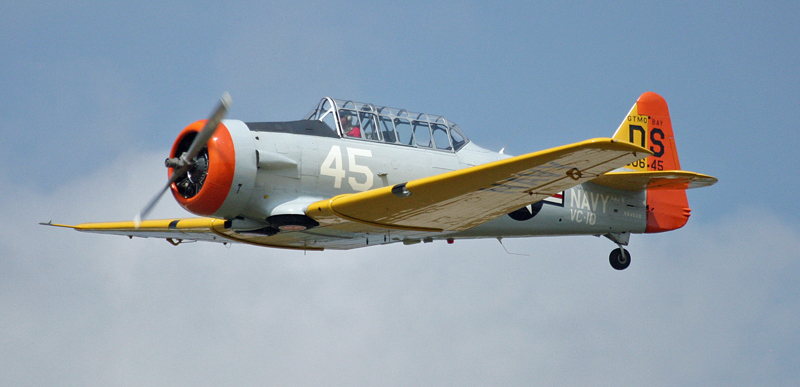
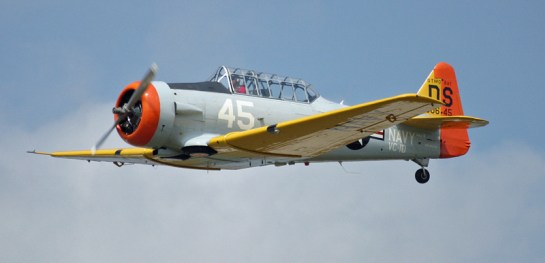
There were so many T-6 Texans, Harvards and this AT-16 Texan from Blanchester, Ohio it was hard to pick just one to photograph, but this bright orange and yellow paint scheme stood out from the other aircraft.
AA220

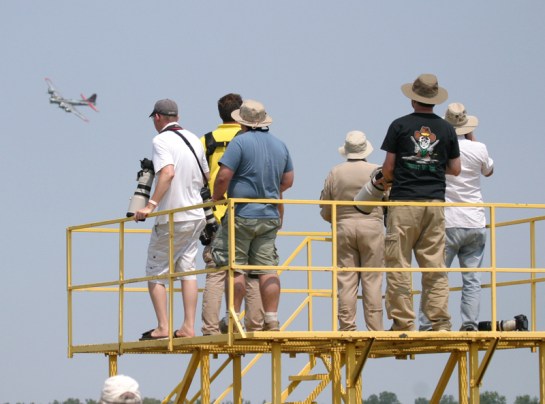
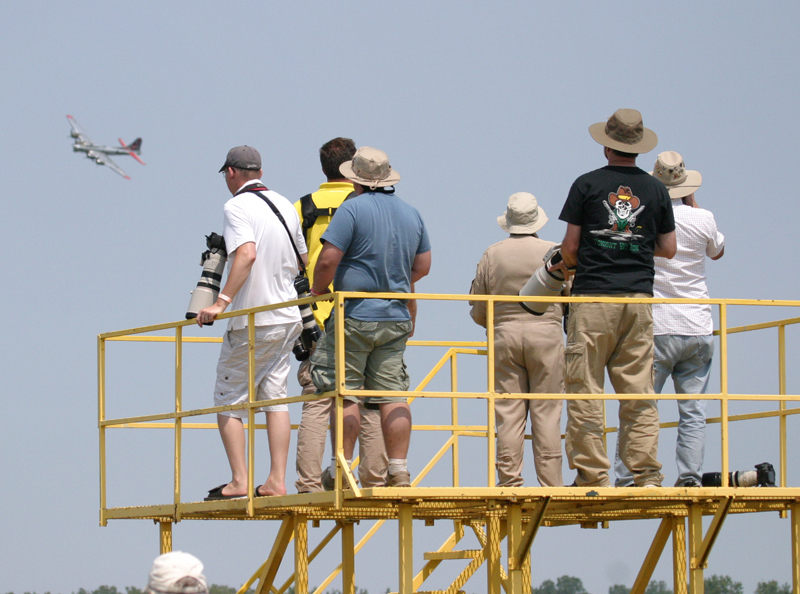
We got a raised maintenance platform to shoot photos from each day, making it easy to get great shots of aircraft taxiing and of the flight demonstrations. Each of the photographers took turns in a corner. We used a pilot band radio receiver to help locate inbound aircraft. When one photographer would see an aircraft inbound to the demonstration field they would shout out, “Aircraft, inbound, from the east…” for the other photographers to get their shot.
AA320

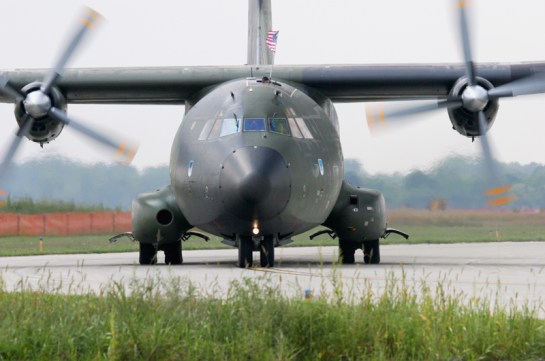
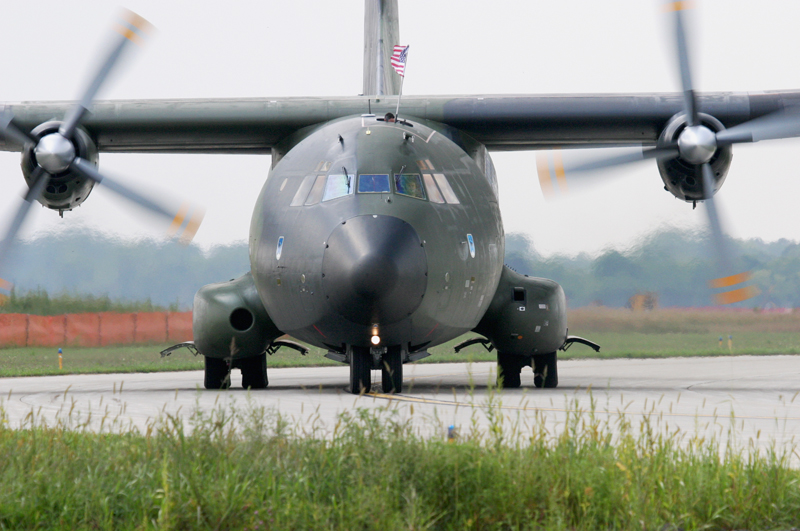
An operational German Luftwaffe Transall C-160D from Air Transport Wing 61at Penzing AB, Germany made a special visit to the show. The Transall is a workhorse twin-engine tactical transport that serves air force around the world and is especially prolific in Europe and Africa. It makes a pretty “whirring” noise like a mini-C-130.

AA120

The flight crew of our visiting German Transall were happy to be at the air show and brought a big tent filled with their squadron mugs, T-shirts, patches and other memorabilia. They enjoyed chatting with the crowd in English and in German and also had fun shooting photos of the other flight demonstrations while they earned some cash selling souvenirs.
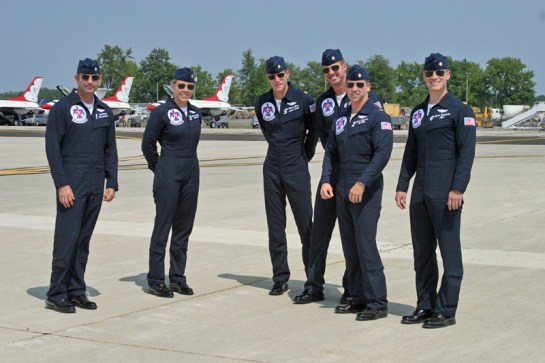
AA80

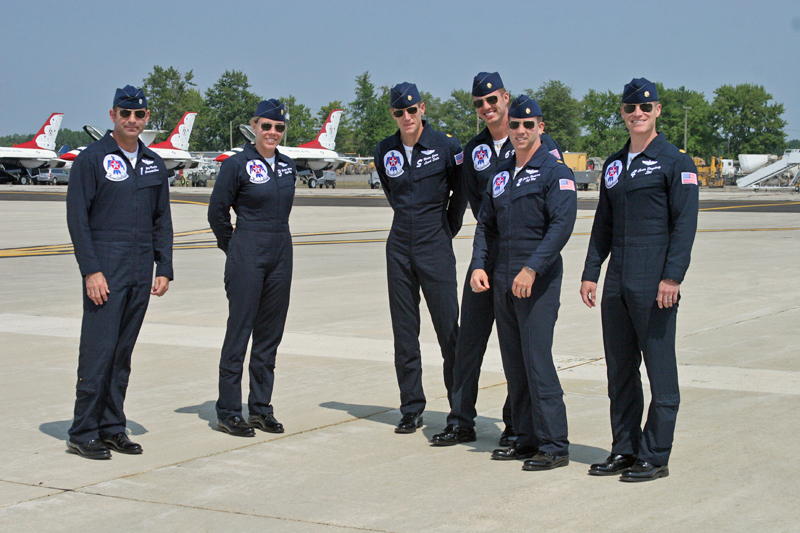
Friday was a relaxed day and a chance to meet the Thunderbird pilots in person without any fences. I caught the entire flight demonstration team here for a candid group shot here.
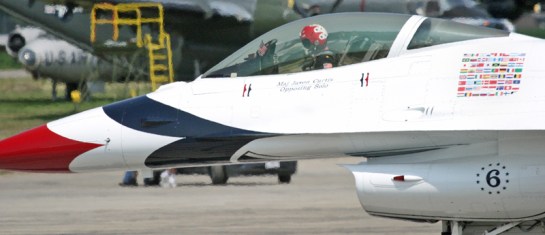
AA140

Thunderbird #6 Opposing Solo, Major Jason Curtis of Kalispell, Montana, taxis out for Friday practice. He is a drummer and competitive snowboarder and graduated from the U.S. Air Force Academy in 2004.
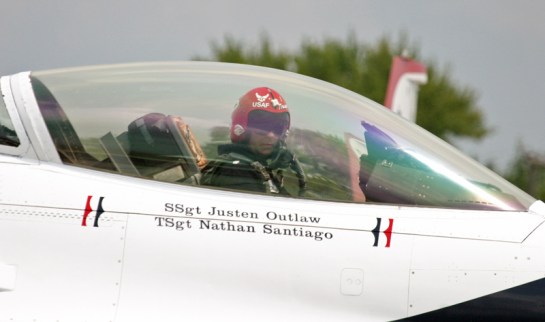
AA340

Thunderbird #1, Lt. Col. Bob Moseley taxis out for flight demonstration practice on Friday. The names of the enlisted flight maintenance crew for this aircraft are painted on the right side of the cockpit with Lt. Col. Moseley’s name on the left side of the aircraft. Moseley is a graduate of Virginia Military Institute and has flown both the F-15 and F-22.

AA470

We had an interesting incident on Friday, practice day, when Thunderbird #3, Maj. Caroline Jensen, had a “bird strike”, sucking a bird into the intake of her F-16. The bird damaged the engine and caused her to safely circle the field and make an expedient landing.

AA490

Major Jensen taxied past the photo stand on her way back to the flight line to switch to the reserve aircraft that was already preflighted by the Thunderbird ground crew and ready for engine run-up.

AA560

She quickly climbed down from the damaged #3 aircraft and ran to the waiting reserve aircraft while the ground crew began to survey the damage to her F-16.

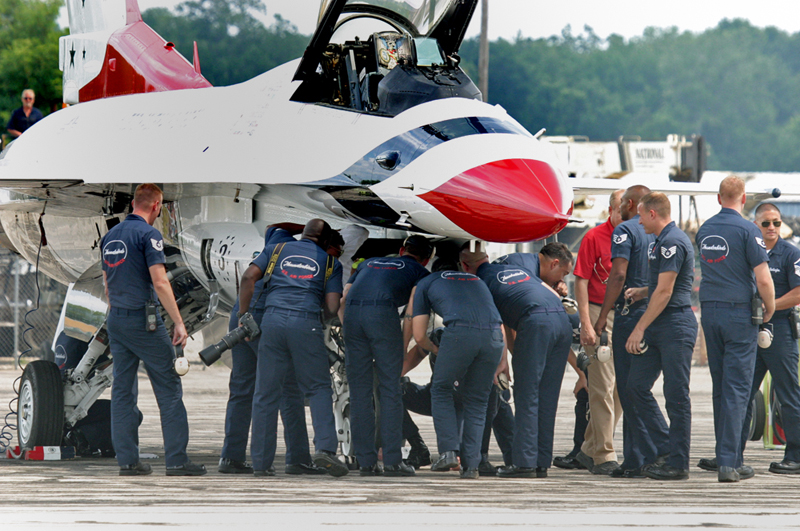
AA10

All of the Thunderbird ground crew wanted to see the damage to the inside of the F-16 intake from the bird strike. The man in the red shirt is likely the aircraft engine manufacturer’s technical rep who travels with the Thunderbirds, Mr. Tom Eshelman from Pratt & Whitney aircraft engines. That a jet engine can withstand a high speed bird induction through its turbine fans and continue to fly safely is an impressive accomplishment by Pratt & Whitney.
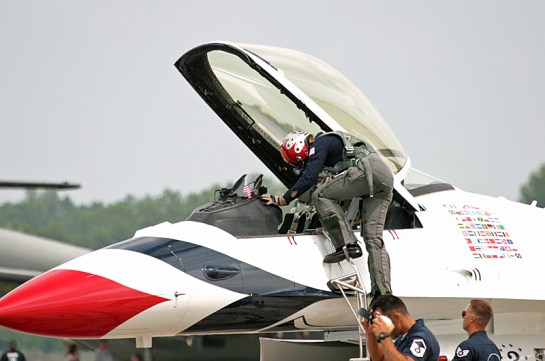
AA540

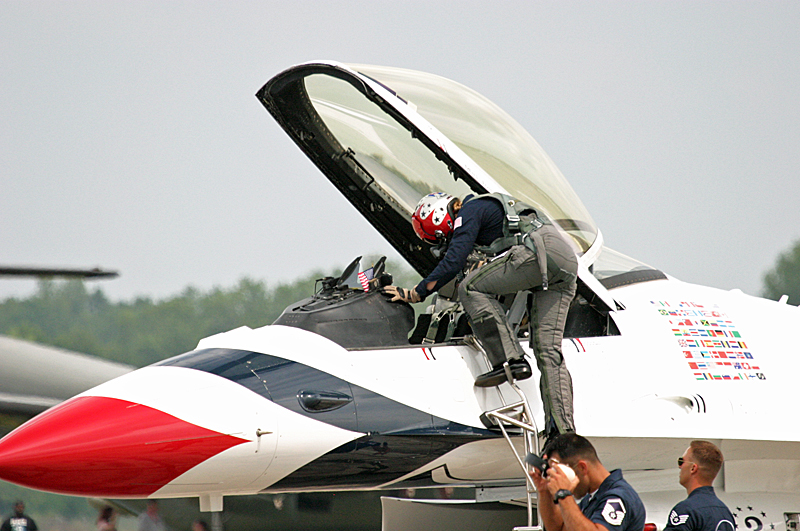
Major Jensen climbs up to the reserve F-16 to rejoin the demonstration formation after running to the alternate jet that was already preflighted by the Thunderbird ground crew.

AA550

Lighting conditions on Friday practice for the flight demonstration were poor with flat and overcast skies. It was less than ideal for good photos. We enjoyed the practice after shooting a few photos and checked the weather for Saturday, hoping for better lighting conditions for aerial photography.

AA170

The weather on Saturday started misty but the fog burned off quickly as crews got their aircraft ready for the first day of the show. I liked this shot of the B-17G Yankee Lady with the U.S. flag in the sky overhead.
AA310

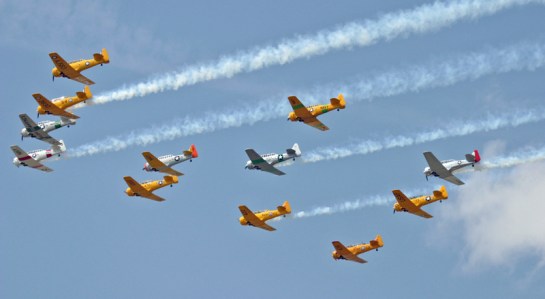
The first big flight demonstration was an giant formations of T-6 Texans and Mk IV Harvards. This is only half of the total formation. The  combined sound of their radial engines was an amazing recollection of what it was like to be near one of the big WWII fighter training bases.
AA260

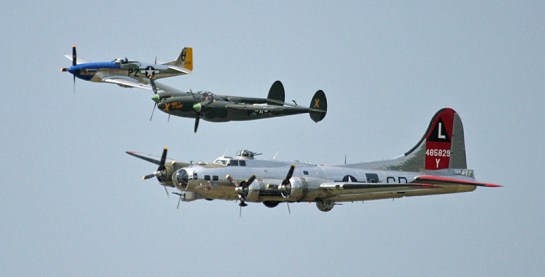
The formation flying continued throughout the morning with an intricately coordinated double-racetrack pattern of aircraft flying over Willow Run. This tight formation of a P-38, P-51 and the B-17 G Yankee Lady is a living display of air power over the Pacific and the European theaters during WWII. I can’t help but wonder what the view from inside the cockpit must be like.

AA230

Ruff Stuff, the Lockheed P-38, did a few photo-pass fly-bys for photographers, giving us the opportunity to shoot photos from different angles.

AA580

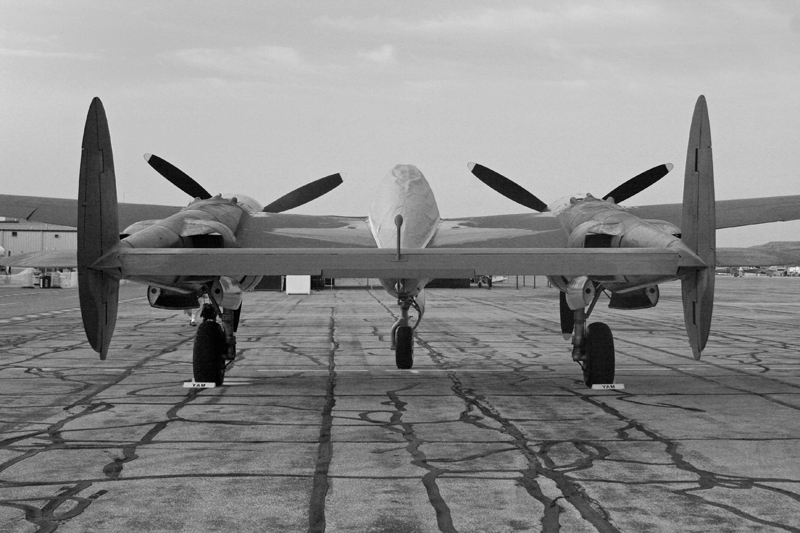
P-38 Lightening Ruff Stuff as viewed from the rear quarter. Notice the superchargers on top of each of the engine booms.

AA590

The chunky looking P-47D Thunderbolt, predecessor to the modern A-10 Thunderbolt II, becomes more graceful in the air. The P-47D was used extensively in the ground attack role. The black and white stripes on the fuselage and wings are called “invasion stripes”. These helped other allied aircraft identify each other following the D-Day invasion to prevent them from shooting at each other and prevented ground crews from shooting at them.
AA600

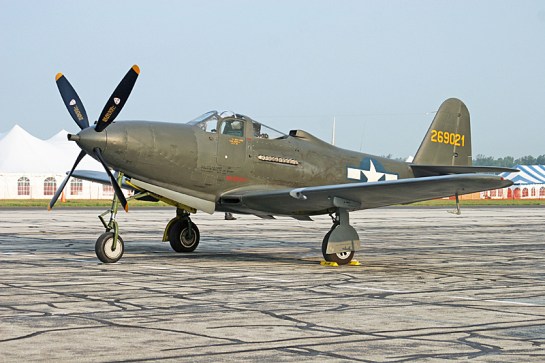
This P-63 King Cobra has a number of unique features including a centrally mounted M-37 30 mm cannon that fired through the propeller hub and an engine located directly behind the pilot. The pilot enters the aircraft through a side-hinged door, not a sliding canopy like the P-51 and P-47. Notice the intake for the centrally mounted engine immediately behind the cockpit. The tricycle landing gear was unique to the P-63 and its less successful little brother the P-39 Airacobra. Most P-63’s saw service with the Soviet Union, over 2,000 of the total of approximately 3,000 built were given to Russia by the U.S. under a lend-lease agreement. Russian pilots actually downed several Japanese planes in WWII with King Cobras.
AA610

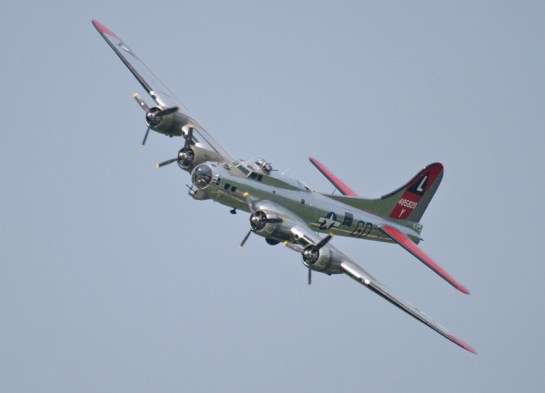
B-17G Yankee Lady turns in toward the crowd line. The “G” model B-17 had several upgrades over the precious “F” and “E” versions, most notably the forward facing chin turret with two Browning .50 caliber machine guns to prevent aerial attack from the front.

AA620

This side view shows a puff of smoke from one of the B-17G’s engines and a good view of the ball turret under the aircraft.
AA770

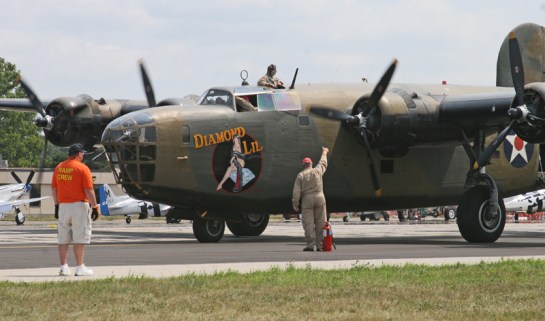
B-24 “Diamond Lil” has a fascinating history as one of the very early B-24A bombers built. The aircraft had a landing accident during its ferry flight to England in the early 1940’s and had to be returned to California for repair. It was converted to a C-87 transport, a modification that likely enabled it survive the war. It went on to be restored as a B-24 with the paint scheme seen here. In this photo the crew is initiating engine start and run-up for its flight demonstration.
AA650

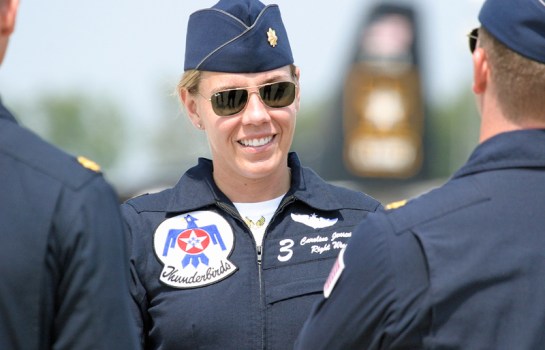
Following the flight demonstrations by the historic aircraft the Thunderbirds held the briefing for their demonstration flight. Here Major Caroline Jensen listens in before the beginning of the demonstration routine.
AA670

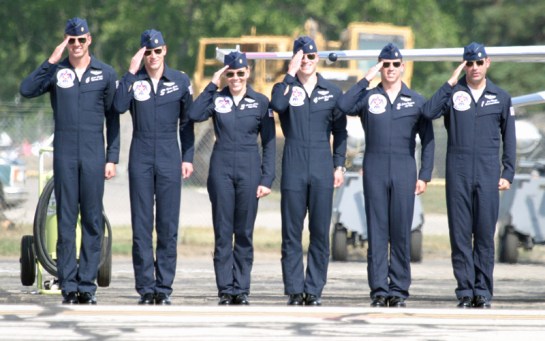
The Thunderbird diamond and solo pilots salute the crowd at the beginning of their flight demonstration routine.
AA660

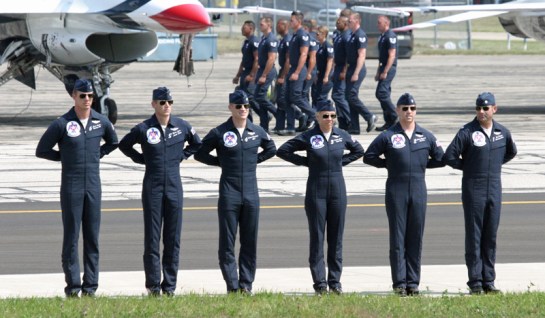
Introductions of the pilots to the airshow crowd over the PA begin the show as the ground crew forms up for the demonstration in the background. From the preparation of the flight to the aerial maneuvers the entire show is carefully choreographed with impressive precision.

AA640

Wearing a pair of G-suit pants the pilots climb the ladder to the cockpit while crew chiefs stand ready to prepare the aircraft for take-off.
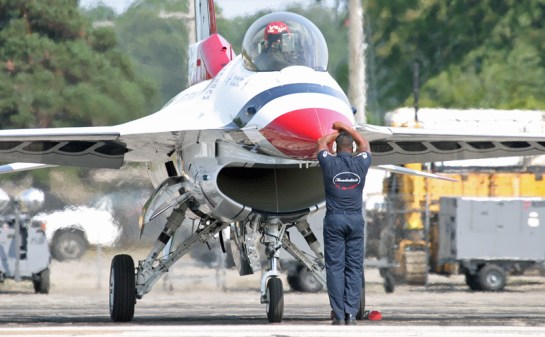
AA630

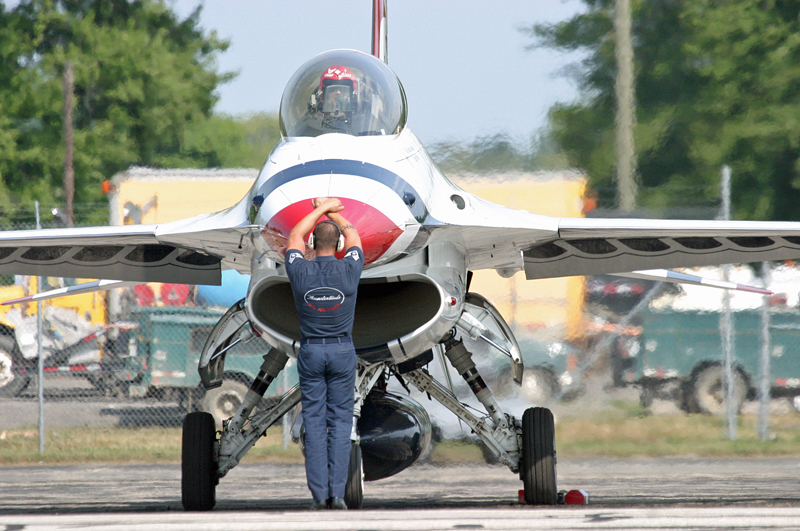
Engine start completed, Thunderbird #1 prepares to taxi to the active runway for take-off.
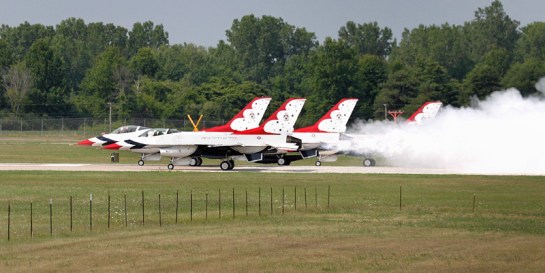
AA690

With a plume of smoke the four-ship diamond formation begins their takeoff roll at the start of the flight demo routine.

AA200

The opposing solo aircraft, Thunderbird #6, Maj. Jason Curtis, turns in across the crowd line as he closes on the the lead solo aircraft for one of their head-on passes.

AA380

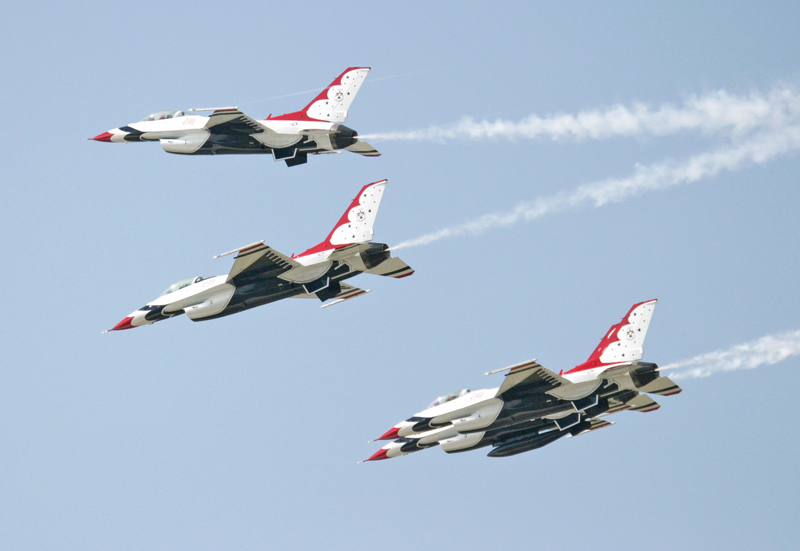
Blue skies and better light gave us a chance to grab good photos of the Thunderbird diamond formation as it flew by the photo stand near show-center.
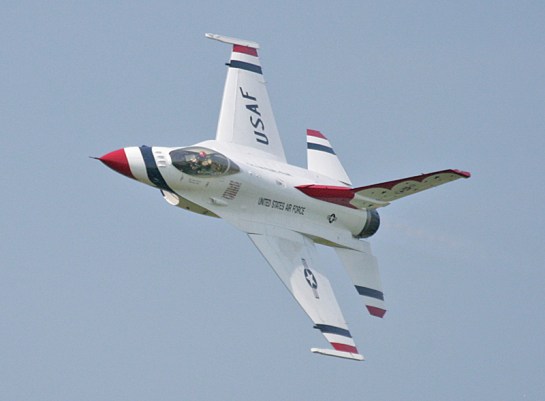
AA430

Lead solo Thunderbird #5 Maj. Blaine Jones turns in toward the crowd line for a high-speed pass.

AA420

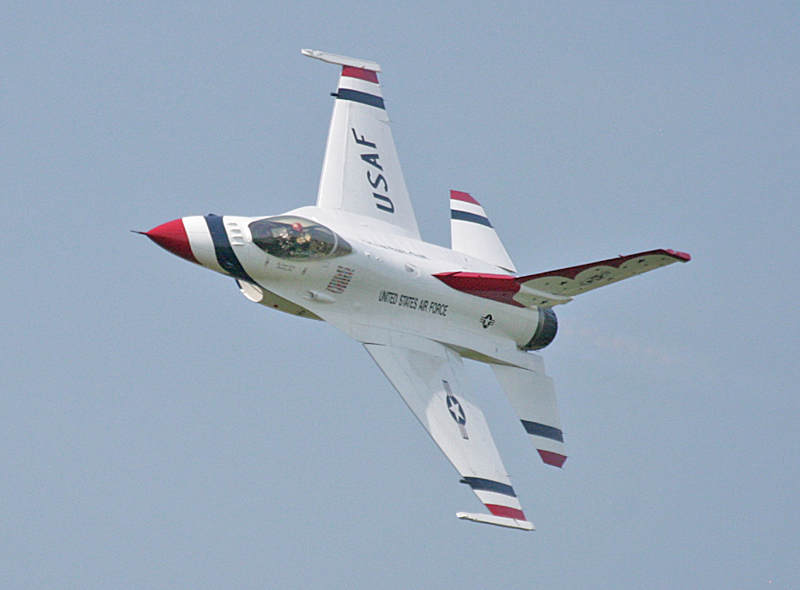
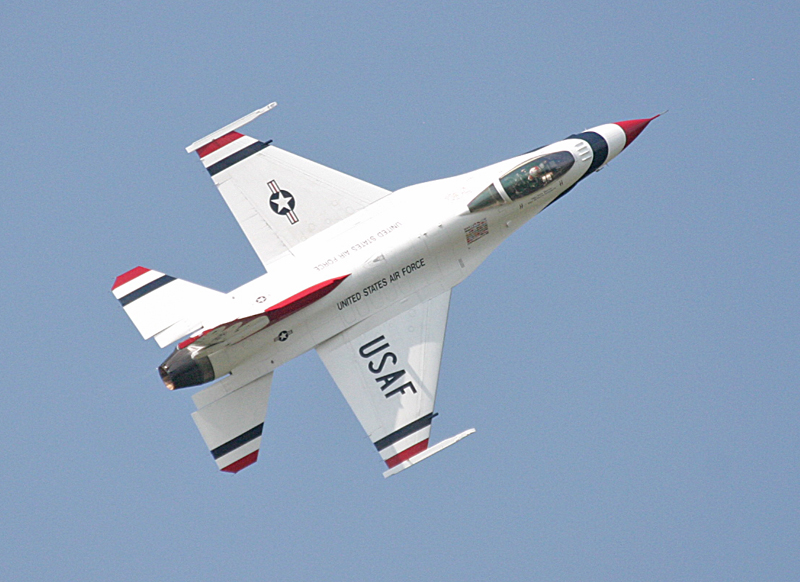
Thunderbird #6 demonstrates a five-point hesitation roll and gives a good plan-form view of the F-16. The paint scheme of the Thunderbirds aircraft is specially designed so the crowd can see the aircraft roll from a distance.

AA460

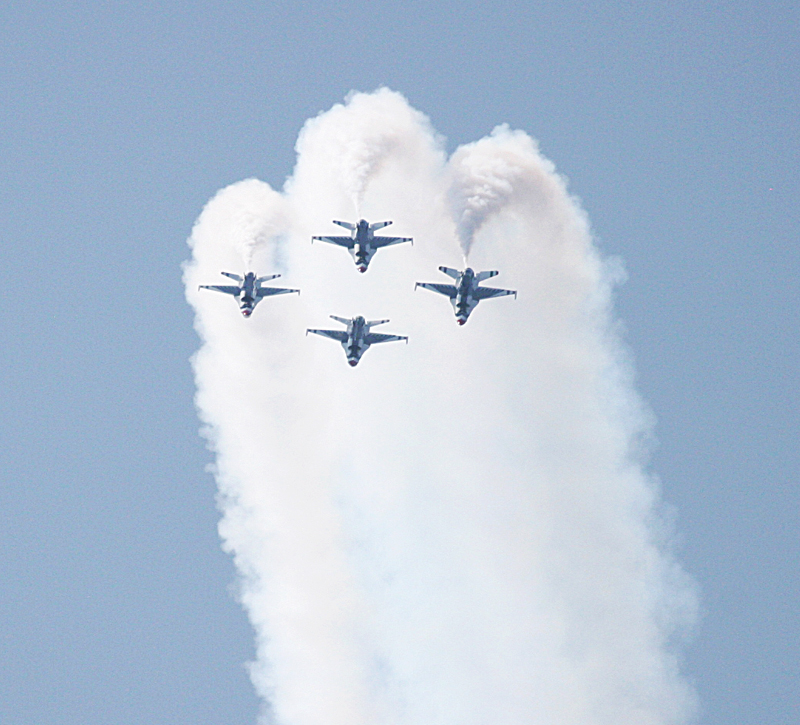
The Thunderbird diamond formation at the top of an inverted loop at an altitude of about 2000 feet above ground level. The Thunderbirds have a “high show” routine and a “low show” routine for overcast conditions when a low cloud deck prevents them from being visible from the ground. We got to see the low show on Friday practice and the high show on Saturday.

airhow1480

“From the left, Thunderbird #5, Major Blaine Jones, the Lead Solo, will execute a maximum performance, high-G turn.” This sequence shows the F-16 turn in under afterburners and pull up to 9G’s. In the third frame you can see the wings of the F-16 flex upward under the G-load.

AA700

The two solos cross in the cross over break, one of the most spectacular and difficult to photograph maneuvers of the show.AA390
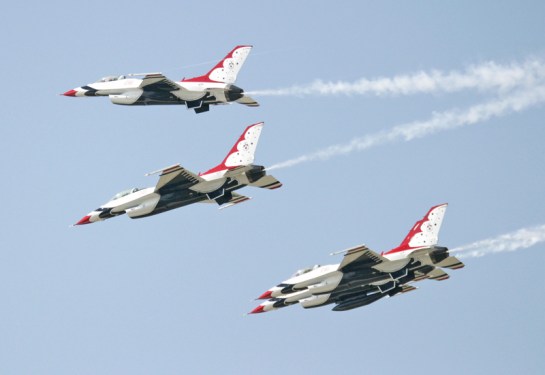
This pull-up maneuver is used to sequentially position the aircraft for entering the landing pattern and makes for a cool shot as the aircraft begin their break.

AA710

This maneuver begins in the trail formation with the aircraft behind each other and completes a loop up to 2,000 feet where the formation rejoins with incredible precision during the inverted, changing to the diamond formation. Condensation formed on the wingtips streams off the aircraft at higher altitude as the air cools.
AA720

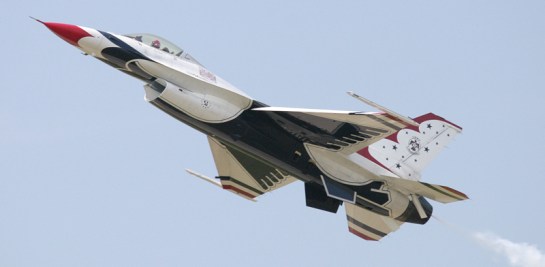
The opposing solo high-alpha pass: Thunderbird #5 flies across show center at about 100 MPH or nearly the minimum speed the aircraft can maintain and still stay in the air. The speed brakes at the back of the aircraft are deployed to slow it down.

AA730

Thunderbird #6, the opposing Solo, trails condensation vapor as it pulls up to the vertical to rejoin the four-ship diamond formation.
AA740

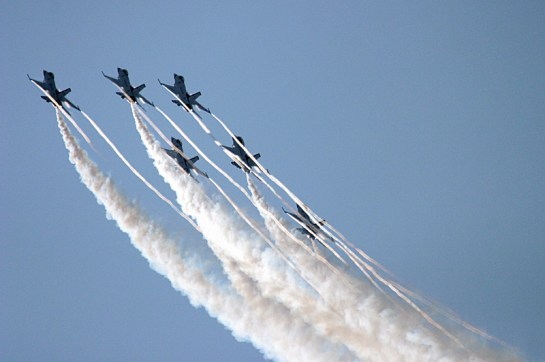
All six aircraft form the wedge formation high into the afternoon sun with thick vapor trails coming off their wingtips.

AA750

The six-aircraft wedge formation passes in review under slight overcast.

AA760

Then flies into clear sky with a complete change of lighting.

AA410

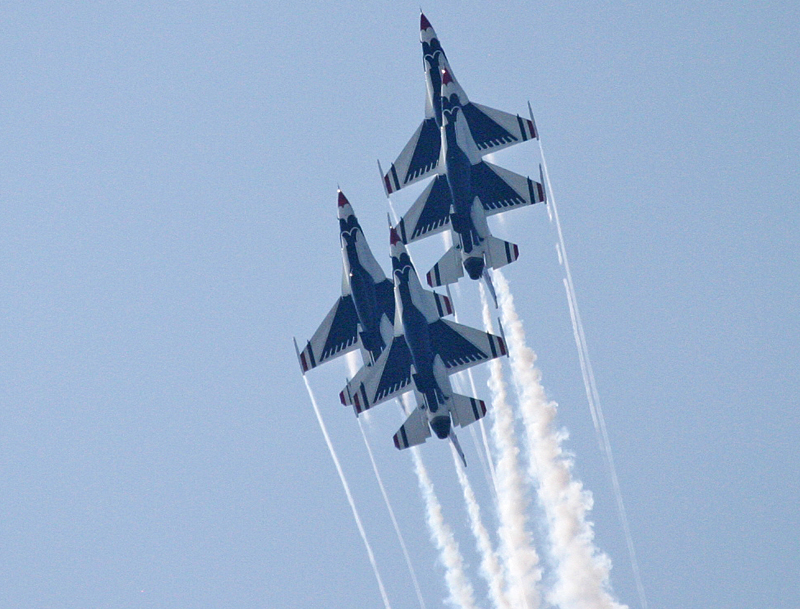
Finally the diamond formation pitches up to the vertical and executes the high bomb burst with one of the solo aircraft rolling vertically through the middle. It was a classic Thunderbird finale.

AA780

Back on the ground with the chocks in place Thunderbird #1 prepares to shut his engine down at the end of the flight demonstration.
AA790

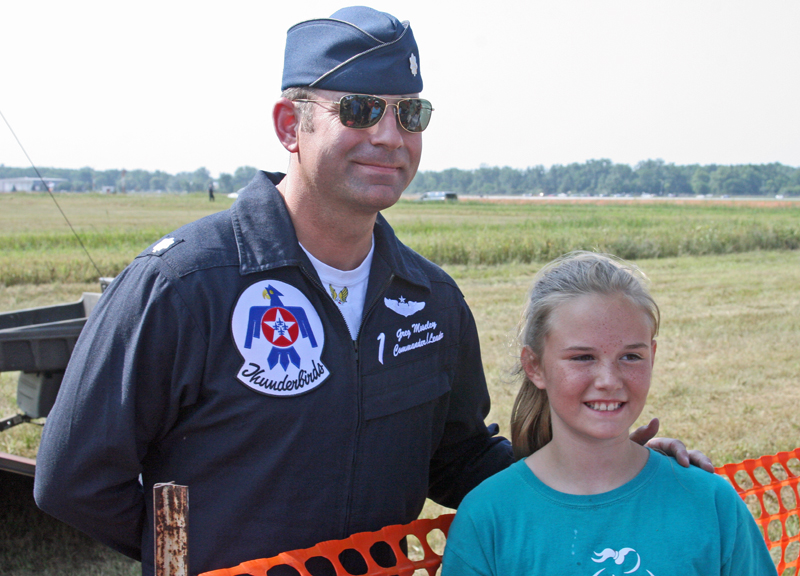
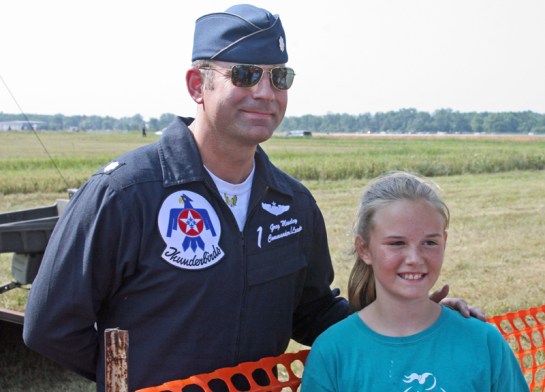
It’s a tradition to wait after the airshow and meet the Thunderbird pilots in person for a handshake, photo and an autograph. Here the Thunderbird team leader, #1 Lt. Col. Greg Mosley, poses for a photo with a fan.
AA7800

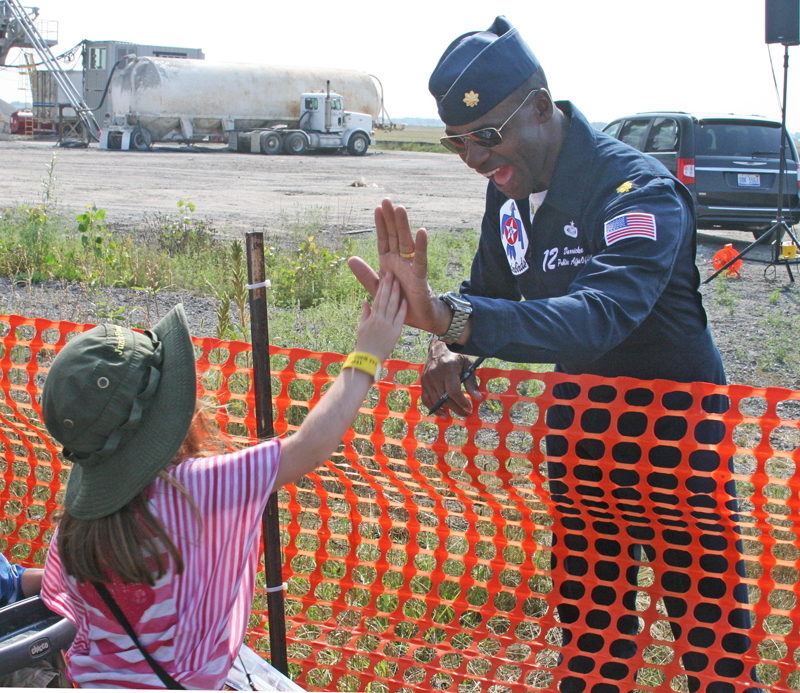
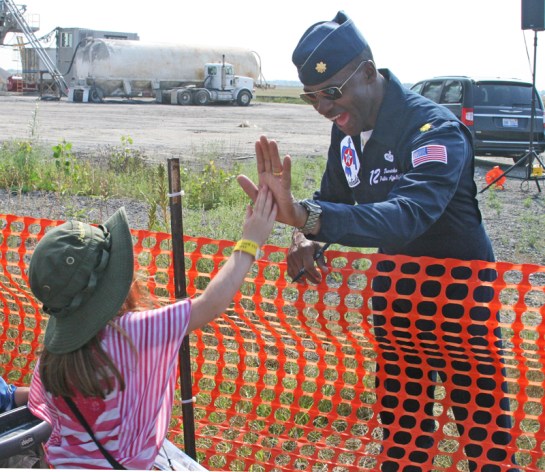
Thunderbird 12, Major Darrick Lee, high-fives a fan at the end of the airshow.

AA210

On my way out of the show I met aviation artist David Ails. Ails was displaying and selling some of his incredible digital aviation art depicting aircraft including the P-61 Black Widow and F-4 Phantom. Ails represents a new breed of aviation artist who uses digital media for creation of incredible images that depict historic aviation events and aircraft.


zerodarkthirty80Tight and tense, Kathryn Bigelow’s Zero Dark Thirty is a masterwork of espionage and special operations storytelling.  Disturbing out of the gate the film is a non-celebratory thriller that will leave audiences with an uneasy sense of semi-relief. Bigelow did not build a “rah-rah, gung-ho” action ode to Bin Laden’s demise, but rather visited the themes of fear and desperation that pervaded much of the military and intelligence community in the immediate post-9/11 era.

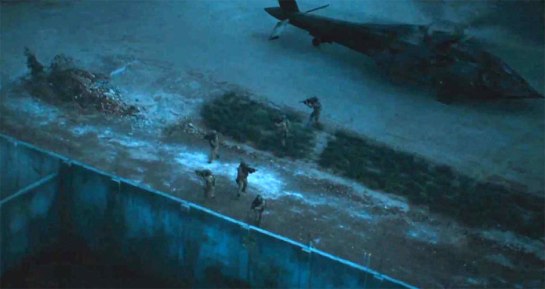
Bigelow’s tale isn’t a documentary or factual depiction of the hunt for Osama bin Laden.  Significant license was taken with the story presumably in the interest of great moviemaking. The fictional story based on the decade long search for the world’s most wanted terrorist is brilliantly executed though. You will want to brace yourself for troubling depictions of torture and violence. You will also thrill to the brilliant computer generated infiltration scene on the way to the raid and the frightening authenticity of the raid scene itself. The haunting appearance of these scenes is testimony to Bigelow’s beginnings as a painter. The look of this film, especially the raid depiction, feels authentic and nervous.

Zero Dark Thirty begins with a reality check. Many people, especially those removed from it, have become complacent in their attitudes toward terrorism in the post-9/11 world. The opening re-acquaints us in a subtle but disturbing way. It also ramps up the tension for the rest of the film, a long one at 2 hours 37 minutes.  The length of the film is a part of its mise-en-scene since it drives home the protracted nature of finding Bin Laden.

You are quickly acquainted with the fictional character Maya, an auburn-haired CIA analyst obsessed with finding Bin Laden.  Jessica Chastain carries the character very well. In the more literal sense Maya is likely not based on one person, but represents an amalgam of people who worked to find patterns in intelligence that eventually led to Bin Laden. The film has taken criticism for this, including from the CIA’s top levels, but distilling a complex intelligence operation that lasted a decade into two and a half hours necessitates this license.

zerodarkthirty20

Jason Clarke’s character, Dan, enters the story and carries the majority of the interrogation scenes. His character is angry and hardened, determined to get results and desensitized to the enhanced interrogation techniques shown in the film. Even he, however, dials back as Maya continues her relentless effort to crack the puzzle of Bin Laden’s hiding place.

The hazy puzzle of spy craft unfolds largely dependent on the information extracted from informants as they succumb to torture and bribery. There are a smattering of factual parallels including a terrible bomb attack that takes the lives of several CIA operatives and contractors. This may be one reason Washington isn’t thrilled with Zero Dark Thirty; some of it hits pretty close, some of it is fabricated. This isn’t all or even most of how Bin Laden was found. That the rest of the tale isn’t included is a matter of expedience but also a significant documentary omission. Remember, this is a great movie, not a documentary.

The story grates on with reasonable pace but also a sense of the duration of the search until Maya connects the dots and manages to threaten superiors to take her seriously. She eventually wins an audience with (then) CIA Director Leon Panetta, played by James Gandolfini. I feel a little bad for Panetta since Gandolfini doesn’t do him justice and is much more overweight that the Former Director. That’s Hollywood.

zerodarkthirty10

There is a massive fast forward to the Groom Lake Test Range where the other stars of the film; the super-secret stealth Blackhawk helicopters, are unveiled.  Popular media does not know what these helicopters actually looked like since only an intact tail rotor section remained at the site of the raid after one helicopter crashed. The inspiration for the appearance of the “stealth hawks” (or whatever they’re really called) came largely from a talented Italian aviation artist and expert David Cenciotti.  Cenciotti’s blog, “The Aviationist”, ran his depiction of what he thought the helicopters may look like, borrowing design and technology themes from the F-117 Nighthawk including “faceting” and the serrated edges of canopy framing. Bigelow and her crew deserve further recognition for creatively interpreting the sound of these helicopters in the film, said to be significantly quieter than a conventional Blackhawk. The effect is haunting and feels authentic. The actual flight crews of the 160th Special Operations Aviation Regiment (SOAR), the “Night Stalkers”, are probably convulsing in laughter though. We probably won’t know for quite a while.

Depictions of the special operations team in the film, a unit of U.S. Naval Special Operations known in the media as “SEAL Team 6” or “DEVGRU” (for “Development Group”) were administered by one of the best technical advisors Hollywood has ever known, a West Coast SEAL named Chief Mitchell Hall. Hall owns a Silver Star and a Bronze Star for combat actions in the Teams. He’s also an accomplished triathlete and no stranger to film. Hall appears in the film as one of the operators on the raid as well as consulting on technical accuracy. As a result the raid scene “feels” very real. A minor technical gaff may be when an Operator recovers a Kalashnikov assault rifle from Bin Laden’s room during the raid. The rifle shown in the movie is different from the shortened “AKSU” version Bin Laden was normally seen with. Another minor miss may include the depiction of “Cairo”, the explosive detection dog that accompanied the raid. Cairo is a Belgian Malinois, the dog in the movie looked like a German Sheppard.

zerodarkthirty30

Technicalities aside the raid scene itself is masterful filmcraft. It does leave out the dramatic refueling in the wadi and the extensive back-up assets that joined the mission, such as the big MH-47E Chinooks, but the haunting sounds of the stealth helicopters and the look of the scenes are interpreted artfully if not accurately. A brilliant effect is the use of showing you the scene from the operators’ perspective through green tinted night vision in key cuts.  Bigelow manipulates the tension so effectively you’ll have a mostly empty seat by the time the SEALs take off for the raid.

If you’re looking for a documentary on the raid to capture Osama bin Laden this movie isn’t it. There is still a need for that media. If you are looking for a tense Hollywood thriller based on a factual story, Zero Dark Thirty delivers like no other film in the espionage and special operations category.  Either way, this masterpiece will terrify and transport you. It’s a fitting tribute to the intelligence services and an acknowledgement of their sacrifice and struggle. It’s also a bold-faced commentary on the controversy surrounding the era. There is so much to take from Zero Dark Thirty that it will likely do even better in DVD sales than in the theater when it hits widespread release. Devote the time to see Zero Dark Thirty; you’ll come away fatigued from the tension of a factual story interpreted in a fictional film with masterful skill.
By Tom Demerly.

“Argo” provides a fitting tribute to our Intelligence Services along with a great ride.

Bam! Out of the park. Argo delivers. In as subtle and dignified a way as Hollywood ever gets this may be the single best film ever on the U.S. intelligence service and what field officers do, or so we hear. It’s also a great period piece made even more relevant by the Global War on Terror.

Argo is the pretty-close-to-true, if it is true, they’d tell us but they’d have to… story of a recently declassified operation to bring U.S. hostages out of Iran in 1979 before the failed hostage rescue mission, Operation Eagle Claw. Tense and technical, it is a tight and terrifying tear through Tehran to a time-sensitive near tragedy that ends in triumph.

Like the spy business itself subtlety is a part of the craft to Argo. That subtlety lends an authentic feel to the portrayal of the real-life lead character, CIA Field Officer and Intelligence Star recipient Anthony Mendez, by Ben Affleck.  Affleck was flat as Jack Ryan in the film adaptation of Tom Clancy’s The Sum of All Fears because Jack Ryan is a fictional character that Clancy built with a more dynamic personality. The real-life Mendez, as with most intelligence officers, was likely more opaque and aloof.  Affleck may be a one-trick pony as the strong, quizzical type and the Mendez character is that trick to perfection. Sprinkle in some truly great, and more animated, characters executed by John Goodman and Alan Arkin as Hollywood execs who agree to craft a bogus film production as a cover story for the extraction and you have an incredible cast.

Ben Affleck’s subtle personality and monotone find perfection as a CIA case officer in “Argo”.

Argo does resort to some clichés in the bottom few minutes but the build-up is so skillful and cumulative it still works to perfection. You’ve seen this closing scene in Where Eagles Dare among others but you haven’t seen it like this.

As a time capsule Argo is worthwhile even though it is fiction purported to be based on fact. The film captures the tension and stalemate of the Iran Hostage Crisis with skill. The usual period newsreel footage is woven with late ’70’s-perfect wardrobe, hair and set dressing. The script and direction are strong despite a couple of clichés granted for effective storytelling.

In a “documentary” sense, even though it’s not, Argo captures the flailing of any intelligence service that is pushed outside its comfort zone during crisis. It does so with dignity and respect to the intelligence services and those who serve in them while remaining vibrant and action-packed.  Argo is to the CIA what Spielberg’s Munich is to the Mossad, Israel’s intelligence service. It also illustrates how volatile a political system with a history of turbulence can be although any depiction of uprising in the Middle East misses the back story that sometimes makes the region look like a perpetual flashpoint.

If you are a fan of the intrigue/spy/thriller genre you’ll love Argo. It adds delightfully to the category and uniquely to the Hollywood catalog of CIA depictions. Although only based on fact it’s still a nice historical start point for discussion of the Iran Hostage Crisis.

Hopefully interest in this era and the current Global War on Terror will lead to great films about the failed Iran hostage rescue mission that drove the U.S. to rebuild its Special Operations forces and create the Joint Special Operations Command (JSOC). There is even a great book to spin a script off of, The Guts to Try by former U.S. Air Force Officer James Kyle.  And while Hollywood is at it, they need to cover Ken Follett’s contracted account of the Ross Perot funded rescue of Paul Chiapparone and Bill Gaylord from a Tehran prison during the same era. The mission was led by one of the men responsible for modern Army Special Operations, Arthur “Bull” Simons, who led the raid on Son Tay prison during the Vietnam conflict. This past four decades has enough incredible true espionage and special operations tales to keep Hollywood busy for the next 30 years and Argo is part of those remarkable tales.

By Tom Demerly.

Get ready for an ordeal with a pay-off at the end in “Life of Pi”.

There are very few movies I am tempted to walk out of, but Life of Pi was one of them. The movie and the story are both an ordeal. I’m glad I stayed though.To appreciate Life of Pi you must have lived some personal version of the fable. If you have it’s worth the trip.

Life of Pi is a classic transitional and survival tale that follows a lad named Pi through his intellectual and spiritual coming of age then a dreadful shipwreck as the main story develops. You know the end at the beginning, some of it at least, so I’m not spoiling anything for you. The movie relies heavily on symbolism to the point of tedium, until the plot pays off in the final few minutes with a truly amazing sleight of storytelling. And that is why I’m glad I stayed.

Based on a book of the same name released in 2001 and shopped around from director to director Life of Pi wound up in Ang Lee’s hands after being considered by the eccentric M. Night Shyamalan. I’ll suggest a version under Shyamalan’s quirky direction would have been the final nail in the coffin for this story. Lee’s interpretation was its best chance short of Steven Spielberg or perhaps Richard Zemeckis who directed the well done Tom Hanks film Castaway of similar plot but different ending. Hollywood reviewers haven’t given Life of Pi much of a chance but audience reviews may prove them wrong. In hard times a movie like this will resonate. Viewer reviews have trended to four star territory even in the crowded holiday movie market.

There are three distinct visual styles in the film. The first is a beautiful and lilting mise-en-scene rich in pastel sepia that provides a gentle and reverent basis.  It has a travelogue quality I liked.  As the story shifts to adulthood it becomes more journalistic then back to stylistic during a tender first love.

Then it gets weird.

A 3D version of Life of Pi was showing at the same time as the normal one I saw. Thinking back after the non-3D version I can see how 3D may have added to the visuals in the bulk of the movie. Critics who saw the 3D version were positive about the effect saying it was used tastefully. I didn’t miss it since good camera work and lavish special effects carry the conventional version well along with the wild twist at the end.

The main body of the film charts Pi’s ordeal on a lifeboat with some unlikely companions. It becomes tense and stressful. Then it becomes downright painful. During one scene I had to convince myself to stay it was so difficult to watch. The only reason I did was in the hopes of some pay-off, some redemption.

An unlikely feature of Life of Pi is its addition to the body of survival literature. The movie teaches textbook survival lessons both technical and behavioral. It harkens to a few epic survival tales such as the book Survive the Savage Sea and a favorite of mine, Kon Tiki. There are lessons in how to survive, cope and go beyond mere survival in Life of Pi. For anyone who may rely on survival skills the film delivers on two levels, technically and with the strange twist at the end that teaches a valuable lesson.

The degree to which this movie works will depend on your own life experience. If you are a survivor, it will resonate and the ending will deliver. If not, it is just a tedious fable until a long-winded pay-off that may not be worth the wait.When you sit down in the theater you’re risking the two hours to see if that pay-off is worth it. For me it was, but I’m an easy sell for survival stories and its metaphors were a gut punch to someone who loves animals. After being pummeled by the harrowing scenes in the middle of the story I really wanted something in return. I came away entirely satisfied, both glad I stayed and glad I didn’t miss Life of Pi.

By Tom Demerly.

While some of the digital effects and scenes in “Red Dawn” are cumbersome the movie does have merit in the recessionary and post 9/11 era.

Remakes usually bomb. They almost always bomb when they’re a remake of a film that was quirky or marginal to begin with. They may have a chance if there is a relevant cultural change that reframes the plot between the original and the remake. That is the case with the new Red Dawn. Things have changed that make this film work oddly well. Red Dawn is a remake of the 1984 movie of the same name with Patrick Swayze and Lea Thompson, both credible actors even before Swayze started dancing.

I have a unique relationship with the original Red Dawn since it was released when I was in U.S. Army Airborne School at Fort Benning, Georgia. Fort Benning had three movie theaters then. All three were playing Red Dawn, and only Red Dawn. Every showing was sold out.  We were soldiers then, and young, new to the military and hot off the successful invasion of Grenada. The fictional prospect of being able to fight the Russians (and Mexicans, oddly enough in the first film) made us feel like we were “ministers of death, praying for war” (Full Metal Jacket).  We saw it over and over, debating the tactics, the weapons, the plausibility.

Patrick Swayze and Charlie Sheen in the original “Red Dawn” from 1984.

On 9/11 we got our war.

The original Red Dawn was written with technical insights from the insurgent war in Afghanistan. Not the one we’re in now, the one before that. It seems we had found a hero of sorts in that war, a courageous and charismatic tall sheik who fought the Russians in the high mountains of Afghanistan. Patrick Swayze’s character in Red Dawn 1984 was inspired by him. His name was Osama bin Laden. Osama eventually fell from U.S. favor in about the biggest way possible and another movie about his inevitable appointment with a red-haired CIA lass and some Navy SEALs is due out next month. You already know how that ends.

Red Dawn 1984 didn’t resonate much beyond the military and right-wing NRA audience since there wasn’t much to hold it up then. The Berlin wall came down in 1989 and Reagan was taking care of those pesky Soviets who would fall altogether in 1991. The entire prospect of an attack on U.S. soil was too farfetched to prop up a story. Until 9/11.

The new Red Dawn leverages not only a post-9/11 realization that the world is indeed, very small, we’re only a short plane ride away from the Global War on Terror.  It also leverages something Adolf Hitler did maniacally in Germany in 1936.  A terrible economy.  Red Dawn 2012 demonizes the North Koreans, the primary villains of the film and depicts them offering respite from a bad economy after they invade. Like Hitler did when he invaded France and Poland. In a sinister way the plot works if you understand the historical context.

I shot this photo on my cell phone on the set of the “Red Dawn” remake in downtown Detroit. The recessionary downtown auto capital was mostly abandoned. After the GM bankruptcy Chinese banners gave the city an eerie feel.

What is even more haunting about the film is that the original villain in Red Dawn 2012 was not the North Koreans, it was the Chinese. The plot would have worked even better with the Chinese invading. Apparently, a little too good for Chinese political sensitivities. Most of the Chinese stuff had to be digitally replaced with North Korean stuff when the Chinese media got a hold of the plot for Red Dawn 2012 and had a fit. Since the film is intended for international release and a big part of the audience is in Asia the idea of having the Chinese invade the U.S. was a little too prickly for the Asian market and for the studio execs who sweated over threats of boycott.

Red Dawn 2012 itself is not a bad action movie. It gets going quickly and the pace remains spritely.  Some of the opening special effects are unconvincing as is a lot of the plot. How did the Chinese, I mean, North Koreans, get all those transports and paratroopers into U.S. airspace without a big fight? What happened to our military? Those are pesky details that get in the way of wrapping your mind around the prospect of the Chinese… sorry, North Koreans getting in a bunch of airplanes and flying over here to parachute into Anytown, USA. That part is a big stretch. The depictions of urban combat, an insurgent war, the doctrine of guerilla warfare and even most of the technical details aren’t bad. In fact, they are a little haunting. There are a couple of scenes in Red Dawn where the kids who form the U.S. guerilla insurgency begin to question the wisdom of what they are doing. To understand the bad guys in the Global War on Terror simply insert a scene here where they are reminded of their religious conviction and now you understand much of the Middle East insurgency. Spooky. There is even a weird little vignette when a free American radio broadcast transmits “…the chair is against the wall”. It’s the same code Free French partisans broadcast in a scene from the D-Day invasion film, The Longest Day.

A connection I share with the new Red Dawn is that, while the movie is set on the U.S. West coast it was mostly shot in Detroit, Michigan. I lived in Detroit then. My friends and I rode our bikes to downtown Detroit where the movie was being shot and took cell phone photos of the giant Chinese Communist Party banners hanging from downtown buildings, sandbag bunkers and TOW missile launchers. It was weird to see that, especially when GM had just filed bankruptcy and most of Detroit was abandoned. In a way the film’s plot became… oddly relevant.

The fact that the Chinese wielded so much influence over Red Dawn and what it showed may suggest we need the Wolverines, the American good guys in the movie, in Hollywood a little sooner than we thought.

Red Dawn 2012 has enough going for it that it’s worth a look if you’ve already seen the new Bond blockbuster Skyfall  and have some interest in the historical influences and controversy about the Chinese in Red Dawn. Those things and a good, “B” grade action shoot-’em-up may make the movie worthwhile despite some weaknesses.