Archive

Commentary.

By Tom Demerly for tomdemerly.com.

todd-heisler

U.S. Marine Corporal OR-4 Dave Morgan is dead.

Bled out while waiting for a medevac helicopter in Helmand province Afghanistan. His wife, 23-year-old Brittany Morgan, will find out tomorrow. It will be about three years and four months until his unborn son will find out.

A notice will run in his hometown paper. His mother, his pregnant widow, her sister, Members of the VFW and his Marine recruiter will go to his funeral.

And that will be it.

Apple will announce a new iPhone, the stock market will fall and rise, a Presidential candidate will say something embarrassing, a policeman will be in trouble for entering a bathroom to make an arrest.

But the news of Corporal Morgan’s death will not appear with those headlines.

Almost no one will know.

Morgan joined the Marines when he graduated from High School. He liked sports, did great in shop classes but not great in English. He hunted with his dad before cancer took him. He kept his used Honda Civic running himself. He was resourceful, responsible and respectful.

And now he is dead.

Why?

Morgan believed he was doing something important. Dave Morgan believed he was protecting his country and the ideals for which it stands: Liberty, Justice and Freedom. The chance to do good. The chance to do something right. The opportunity to be one of the good guys. He did not earn much money. He did it because it was a calling.

The moment at which freedom is compromised, the moment at which the headline contains your hometown, the moment when you personally become a part of the news- the moment war, terror and oppression reach out and grip your throat, that moment is one moment too late to change your opinion, to advocate for a stronger military. You will not know terror until that day. You are insulated from it.

Insulated by the efforts of women and men like U.S. Marine Corporal David Morgan.

And until that day it is unlikely you will ever understand. Because of Dave Morgan and others like him.

In the United States we live in a bubble. A bubble of security and complacency provided by the luck of geography and distance, and maintained by men like Dave Morgan. But a short plane ride away there is war and terror. We’re mostly oblivious to it. It has always been a feature of human history.

Our bubble has been maintained by 1,196,554 women and men who died protecting it in wars since 1776. On Memorial Day, we honor their sacrifice and acknowledge their lives.

Dave Morgan and everyone like him understood this. They sacrificed to prevent our bubble of freedom and security from being pierced. And in the case of Dave Morgan and many others, they died for it.

This weekend we acknowledge that.


tomdisarmsmine

Author’s Note: The main character in this article, “U.S. Marine Corporal OR-4 Dave Morgan”, is a fictitious name representative of all 1,196,554 women and men who have lost their lives in armed service to the United States. This fictitious story spans these million-plus stories, all more than worthy of being told. Instead of telling them all here, which is impossible to do adequately, “Corporal Dave Morgan” represents them all thematically.

The photo at the top of the page was shot by photographer Todd Heisler of the Rocky Mountain News. It is one of the most iconic images of the Global War on Terror and of the armed services. It appears in this essay:

Visions of the Decade: Todd Heisler’s Final Salute

Author Tom Demerly served in the U.S. Army and the National Guard.

Photos and Story by Tom Demerly with Jan Mack.

shark20_700size_wcredit

I’m going to puke.

The waves just won’t let up. My equipment is too tight. It is digging into my guts. I pissed inside my wetsuit and another guy’s fins keep whacking my ankle hard enough to make my legs scream. I’m drenched with cold salt spray. The wind coming over the bow is freezing. I can’t see a thing except some vague notion that we are getting farther and farther from land and the ocean keeps getting rougher and rougher.

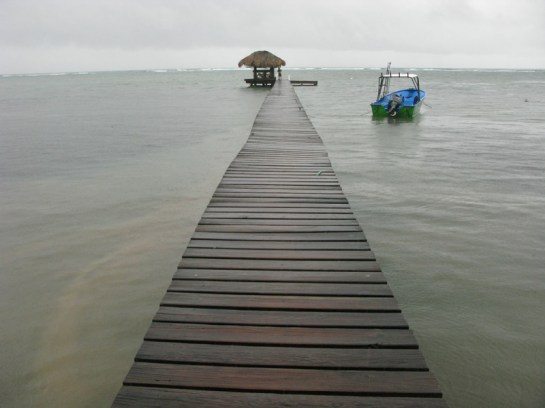
I’m headed south from Roatan Island, Honduras in a very crowded, open skiff that more closely resembles a Somali refugee boat than a dive yacht. My girlfriend is sitting next to me.

At least she was my girlfriend when we got on the boat.

She might not be if we make it back to shore. This week she earned her Advanced Open Water SCUBA Diver certification, often diving in silty, dark brown water with the same visibility as day-old coffee. Now we’re about to dive in heavy seas far offshore at significant depth in a school of sharks. Big sharks.

And we’re not using a shark cage.

Speaking of refugees, some of our boat crew looks more like… well; this isn’t Jacques Cousteau’s Calypso. They find some seemingly random point in the tossing ocean marked by a soccer ball-sized red buoy almost too small to see. It’s too deep to anchor. We tie off to the buoy line.

The incessant, nauseating roll of the ocean is worse once the boat stops. At least I’m not getting pelted by freezing salt spray and having my rapidly contracting nuts crushed on the fiberglass benches of the gunwales anymore.
sharkdive10

The idea is, “Get out of the boat as fast as you can” because being in the boat sucks. Divers are doing back rolls into the waves immediately, like there is a fire on board. I think everybody is ready to barf, and SCUBA divers know it is always calmer underwater.

I glance at my girlfriend. She isn’t smiling.

I roll off the rail and fall a long way into a wave trough before I hit the water tank-first with a commanding splat. The boat slides down the same wave and crushes me underwater. I’m glad I forgot to inflate my buoyancy compensator vest since I really would have gotten clobbered if I had, but now I’m hurrying to get compressed air into my vest since the weight of my gear is dragging me under fast.

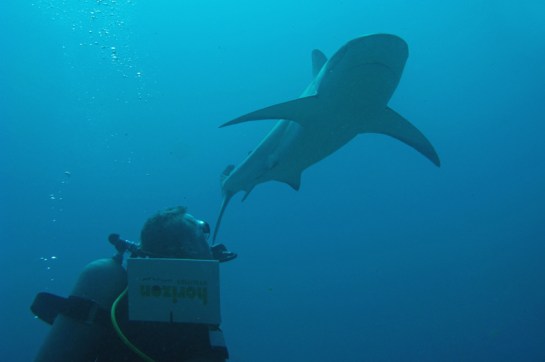
I roll over and look down. There is a shark. About the size of a Toyota. Its pectoral fins are gracefully splayed outward; I have a perfect plan-view of it 60-feet below. There is another. And another… They circle slowly in silence down there.

The sharks know we are coming. They swim up from the depths and wait. Wait for something to eat. Wait for us. Wait for the black-rubber bubble monkeys to come see them.

sharkdive30

This is the Cara a’ Cara dive site. In Spanish, “Face to Face”. It’s named that because it is world famous for having a face-to-face encounter with big sharks at depth without protective cages.

There are a few species at Cara a’ Cara but the most common are Carcharhinus Perezi, the Caribbean Reef Shark.

Caribbean Reef Sharks are large, about 10-feet at full size. They share the top of the food chain with other large sharks in the Caribbean reefs, especially in shallow water above 200 feet depth.

These sharks are not dangerous or aggressive. If they feel threatened, which is rare, they exhibit a “threat behavior” posture akin to a cat arching its back. They eat fish, and because there are a lot of fish around them in the Caribbean, they are seldom hungry. These facts make them a rather threatening looking, but actually agreeable shark species.

We’ve brought fish with us, and a load of camera toting “adventure” tourists looking for a thrill, a good story, a good Facebook post. And I am one of them.

We brought our dive master with us. His name is Russell Nicholson. Nicholson would fit easily into the crew of the Calypso as one of the divers in a Jacques Cousteau documentary. Bearded, slim, handsome, fit, 26. He speaks with a British accent that seems like narration in every Discovery Channel wildlife documentary you’ve seen. Nicholson has dove everywhere. He is calm and relaxed underwater. During our dives earlier this week I studied his technique, fanning his fins in a motion more like an aquatic animal than a SCUBA diver to move slowly along underwater.
sharkdive40

I don’t know it now, but Jan is still on the surface, tossing over the waves and expressing concern about the safety of this dive to Russell.

Me? I’m a tourist who just wants to pet sharks.

As usual it is decidedly less chaotic underwater. Visibility is good, maybe a couple hundred feet, the water is warmer than the air and there are, thank God, no waves churning my stomach down here.

A queue of divers who speak five different languages hangs onto the mooring line beneath the buoy. Our languages don’t matter underwater. We descend the mooring line as a group, as though we are rappelling into the steel blue depth.

There is a reef at our back forming a natural theater. We keep the theater wall to our back, presumably to limit the approach of sharks from behind us but more realistically to keep a bunch of tourist divers from swimming off willy-nilly chasing sharks and getting lost a couple miles off shore.

We pack in, divers next to one another against the reef at 70-feet depth. A moray eel who makes his home here sticks his large, green head out inches from my right elbow in greeting or in grumpy warning to “stay off my lawn”.

sharkdive50

The dive master on this dive brings a bait box to feed the sharks. And this is why they always come. And also why what we are doing may be considered wrong.

According to the late R. Aidan Martin the former Director of the ReefQuest Centre for Shark Research, a Research Associate of the Zoology Department of the University of British Columbia, and an Adjunct Professor of the Oceanographic Center of Nova Southeastern University:

“In recent years, organized shark feeds have provoked considerable controversy. Critics claim that this activity changes the behavior of sharks and the structure of reef ecosystems. There is concern that sharks become dependent on these ‘hand outs’ and may associate all humans with food, increasing the likelihood of attack. Proponents argue that sharks are simply opportunistic, if the feedings stopped, the sharks would simply disperse and go back to feeding upon whatever they fed on before. Although accidental nips have occurred (mostly received by ‘shark wranglers’ conducting the feed underwater), there is no good evidence that shark feedings increase the likelihood of attack away from the feeding site. The issue of modifying reef ecosystems is more difficult to assess. Yes, shark feeds may concentrate predators artificially and the intensified removal of fishes from the environment for use as shark bait is a concern. But populations of sharks and other reef predators have been seriously depleted by overfishing and habitat erosion and many operators use left-over scraps from local restaurants, using fish remains that otherwise would have gone to waste. Clearly, this is a complex issue and a quick or easy resolution is not on the horizon.”

My guilty concerns about reckless “eco-tourism” are somewhat assuaged by Martin’s remarks. If we leave, the sharks won’t flop around on the bottom waiting for handouts from tourists. They’ll just keep being sharks, like they’ve done for millions of years as one of the oldest surviving species on earth.

sharkdive60

The sharks are close now; there are about 20 of them. And they are breathtakingly beautiful.

I’ve loved sharks- or the idea of sharks- all my life. When I was a kid I read Peter Benchley’s novel “Jaws” and saw the movie over and over. I’m not sure why I liked it so much. It just seemed… adventurous.

But as we grow up our perspective changes. And hopefully we learn. Between my years as a zitty teenager reading Peter Benchley books and sitting in the dollar theater and now I had traveled the world. I remembered my fascination with sharks. After nearly 200 triathlons, quite a few of those in the ocean, I had never seen one- a big one, up close. I was a SCUBA diver, but all I saw were nurse sharks. One time a big bull shark followed me while snorkeling in Belize. Another time I found a school of sickle fin lemon sharks in the Virgin Islands and waded in to swim with them while they dined on a school of panicked baitfish.

But I never had that moment with sharks, big sharks. Until now.

sharkdive70

Operating my camera took work as the sharks circled in front of us at 70 feet. I tried to stay relaxed so I got decent photos. Prayed my camera would work down here.

Then I looked up. She was four feet from me, swimming right into my mask. A big 8-footer. A shark bigger than me. I shot one photo of her coming head-on, then gently kicked my fins once to scoot over, to let her pass.

She was only inches from me, so I touched her. You aren’t supposed to touch the sharks on a shark dive, but I will die someday and this may be my only chance. It was selfish, but I wanted to know what it felt like to touch her, and I wanted her to know I did.

I gently laid my hand on top of her right pectoral fin. It remained motionless as she glided forward slowly. I was struck by her… firmness. Her pectoral fin was hard. The sharkskin, just as you read, was rough and like sandpaper. Fine sandpaper.

She did not react, flinch, dart away, rear around and bite. She just swam- glided rather- straight ahead. I watched, her tail barely undulating slowly side to side in an elegant kind of Hula.

The divemaster opened the bait can and the sharks went berserk, a wild spinning mass of 8-foot rifle bullet bodies darting into the same space. The clear water was stirred into a silty mess, and I was surrounded by sharks ripping a small bait bucket to pieces.

I don’t know where my girlfriend was.

sharkdive80

The silt settled quickly as it does at depth, and the sharks regained their composure. Now the divers left the rock amphitheater and swam amongst them. We swam with them, alongside them.

It seemed so incredibly good, so beautiful and safe and wild and good. The gentle sharks, retired from their feeding frenzy, glided amongst us, cameras going off, divers marveling at their size and shape and girth and elegant power.

And then divers began to ascend the rope. But I wanted to stay. As divers left I was on the bottom with more and more sharks- there were more of them and less of us. Finally, the last diver and myself started toward the buoy line to begin our sad ascent to the world of air and problems. I did look down one more time at them, and they were leaving.

I fear that we are losing the world. Nature. Animals. The sea. That it is already damaged beyond repair and despite our quaint efforts to save it, it is too late. And I am old. 54. So this may have been my last chance. And I did, quite selfishly, take it.

One day I will die.

If I am lying in a bed, doped by drugs and drifting in and out of life, I hope I remember them still- the beautiful sharks- and how I felt with them. How perfect and majestic and regal they were. I hope I remember them as I die of old age.

sharkdive90


Author Tom Demerly likes cats as well sharks, can’t help petting them both and has been all over the world.


tom


By Tom Demerly for tomdemerly.com

5856b34468d5f0158ca04541197e36c1

Your chest is tight, your wetsuit is gagging you, you can’t breath, you’re sinking, you can’t see a lifeguard. You are drowning…

It’s your responsibility if your triathlon open water swims are terrifying- and dangerous, and that is good.

Since it is your responsibility, you can do something about it.

Following the death of U.S. Army Col. Gene Montague in the swim at the Chattanooga Ironman 70.3 triathlon on Sunday, May 22, 2016 here are five things to do now to prevent another potential swim accident:

  1. Yes- You Should Get a Medical Check. Even You 

In 2008 I had a stroke while running as a result of a common cardiac birth defect I never knew I had, a Patent Foramen Ovale or “PFO”. If I had the same stroke during an open water swim the likelihood is I would have drowned. Before that day I did hundreds of events without a single cardiac problem. One day, it just showed up out of the blue.

And it nearly killed me.

There are a number of pre-existing medical problems that may be minor if they present themselves on land, but could be deadly if they show up in an open water swim. Many of these are easy to detect with an EKG or other medical tests.

Take the responsibility to have these tests done yourself, because race organizers have not taken the responsibility to require them.

The harsh reality for triathletes is that, if one of these easily detectible conditions strikes during the swim, it is our own fault. We could have detected and prevented the accident prior to race day.

master

Cardiac fitness certificates from a physician are common in ultra-distance running races and some ultra-distance adventure races like the Marathon des Sables and the long course Raid Gauloises. But they are oddly absent from Ironman and triathlon, where the numbers of participants and the lack of preparation make them more relevant.

This is our responsibility, so go to the doctor and have a cardiac check-up and an overall physical to assess your risk to having a serious open water swim medical problem.

  1. Own It: Proactively Manage Thoughts, and Preparation.

Practice Mental Rehearsals and Visualization to Manage Fear. Take control of your pre-race thoughts before they take control of you.

Make a conscious decision to replace destructive fear with constructive mental preparation. Proactively eliminate fear using conscious thought.

If you do not have a purposeful approach to mental preparation for open water swimming then involuntary and subconscious fear will surface. Don’t let it. It is your decision.

Your cognitive brain has a given processing capacity. If you use all of your brain’s processing capacity for purposeful, constructive thought you won’t have any remaining cognitive capacity for fear. You won’t have time to be scared.

You’ll be too consciously occupied visualizing a positive outcome to have fear of a negative outcome affect your performance.

828539fa22e0afd3953faef3c5394c9e

Four to eight weeks before your first race find a quiet place to sit without distractions for 15 minutes. Close your eyes and visualize what you think the transition area might look like on race day. Look for photos of the race venue on line to assist with this preparation.

Imagine yourself racking your bike in the transition area; chatting with other athletes, feeling the cool morning air before the sun rises. Think about pulling your wetsuit on, adjusting it into place. Go over the actions again and again in your head.

Focus on concentration- it isn’t easy to concentrate this purposefully. Visualize walking to the water’s edge, having your goggles with you, stretching your swim cap on and pushing in your earplugs. What will the race announcer be saying over the loudspeaker? What wave will you be in for the start? How many people will you be swimming with? Answer these questions in advance using the race website resources and information about last year’s race.

Occupy your brain purposefully and teach yourself to think calmly and in an orderly manner about controllable factors. Use all of your brain on things you can control and let the rest go.

  1. Practice Swimming In Open Water Before Race Day.

Seems obvious, frequently ignored.

Especially in inland fresh water lakes in the Midwest underwater visibility is poor. Add glare from a rising sun on the horizon and you are swimming blind in the open water in a group of people kicking you with no idea where you’re headed.

That’s scary if you aren’t accustomed to it. Get used to the open water swim environment gradually and in increments before race day.

To moderate your open water anxiety, practice swimming straight and parallel to the shore in shallow, open water prior to race day. This will teach you straighter swimming, sighting strategies and get you mentally acclimated to swimming in poor underwater and surface visibility.

Get used to mucky, sandy and weed-covered lake and ocean bottoms you never encounter in pools.

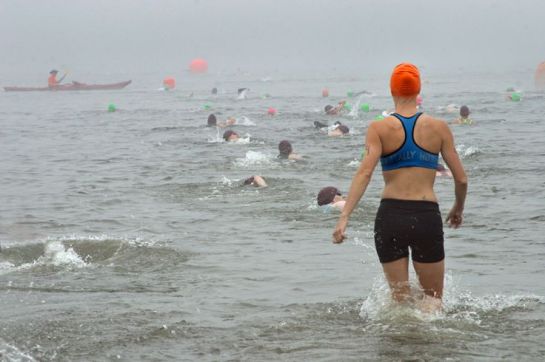
finalopenwaterswimphoto

Ramp your pace up to the speed you’ll swim in a race. Bring a friend to swim with- never swim open water alone- and practice swimming close to each other with occasional bumps. This will get you ready for rough and tumble swim starts.

As your comfort and proficiency swimming parallel to shore increases then practice swimming toward a landmark into deep water with your swim buddy. Always use an area free of boat and watercraft traffic. Try to navigate straight out toward an object on the horizon like a water tower, tall tree or other visible, stationary landmark on the horizon, and then reverse your course back to shore. Keep it short and comfortable and repeat several times to improve your comfort, confidence and proficiency.

  1. Swim More Before Race Day. Way More.

Also Pretty obvious.

Except in competitive swim, surf and lifeguard circles swimming is the event people like the least and practice the least. Change that.

If you increase your swim volume before race day you will get slightly faster , slightly more fit but significantly more comfortable in the water.

This is a simple fix, but since swimming is less convenient than going for run or a bike ride and more people are afraid of it, it usually gets relegated to the thing we train for the least. Most people simply train enough to “get through” the swim. That makes an event less enjoyable and more frightening.

gluck70

Too late you say? You’re big race is a month away and you’ve only been to the pool twice? They will have the same race again next year, and there is wisdom in picking your battles, taking time to competently prepare and coming back in a year.

  1. Get Comfortable With Your Wetsuit and Swim Gear Early. 

I’ve sold triathlon wetsuits since they were invented in the 1980’s. To this day people will buy a wetsuit on Thursday and try to race in it on Saturday.

Don’t do that.

Buy your wetsuit at least a month before race day. Do a dry-land try-on and make sure it fits precisely (read: tight) enough so no excess water enters the suit. Learn to pull the legs and torso up without tearing the outer surface of your suit with your fingernails. Practice getting the torso and arms pulled up so the suit is not restrictive.

New wetsuits usually feel uncomfortably tight and restrictive when you’re doing a dry land fitting. That’s normal.

Follow-up the dry land fitting with a pool and an open water practice swim in the wetsuit and race clothing you’ll use on race day.

4c4178c803b5a668d014af83709cea69

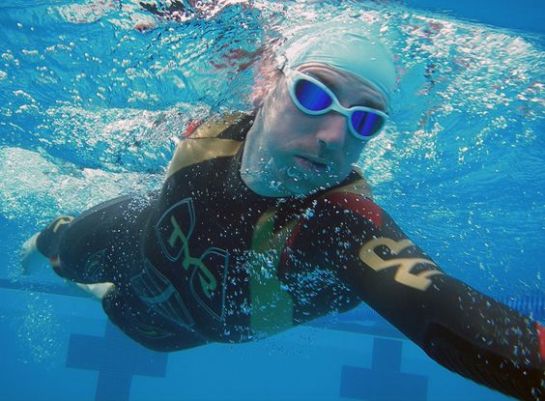
Tip: Triathletes who say it is easier to swim in a sleeveless suit than a full sleeve suit usually didn’t have their full suit on correctly- that is why they had problems swimming in it. Full suits are faster, warmer, more buoyant and you travel farther per stroke making them more efficient. But you have to put them on correctly. If a a suit is not pulled up high enough in the upper torso and the arms aren’t pulled up high enough excess neoprene in the underarm will make swimming more difficult. It isn’t the suit- it’s a poor job of donning the suit.

Few triathletes go to an open water swim venue with their equipment and practice. This is a key error.

Put on your wetsuit, get it adjusted correctly, enter the water, get used to the suit in the water well before race day. Then do some shallow water, slow, controlled swimming to get used to the new sensations.

Take all your race day gear and do a test swim at low speed in waist-deep water. Take time to stop, stand up, adjust your wetsuit, your goggles, and your earplugs. Get used to how all your equipment feels well before race day. Do this in a controlled, non-pressured situation.

If you practice these five proactive behaviors before race day your open water swim will be safer, you will be a more responsible, better-prepared athlete and you’ll have a better performance and enjoy your event more.

Take responsibility for your own performance.

tomA2tribyline


Author Tom Demerly has raced endurance events on all 7 continents, written for numerous triathlon publications including the official USA Triathlon newsletter, Inside Triathlon and many others. He’s done Ironmans around the world Including the Ironman World Championship in Kona, Hawaii and the Discovery Channel Eco-Challenge, The Raid Gauloises, The Marathon des Sables and the Jordan Telecom Desert Cup in Jordan. He is a former member of a U.S. Army Long Range Surveillance Team and a certified Advanced Open Water SCUBA Diver. Demerly also worked with athletes at Doug Stern’s Open Water Swim Camp in Curacao, Dutch Antilles for three years. Most importantly, Demerly loves the water.


By Tom Demerly for tomdemerly.com

bikeshopdentist

Was at the dentist today. $2,297.00.

My dentist is excellent. Truly. Does a fine job, professional and current on modern dental techniques. Great staff. Nice guy too.

As luck would have it my dentist is also a triathlete. While I was at his office I picked up his bike and brought it back to our bike shop to do a tune-up on it. He’s got a nice bike. He should.

I got to thinking: Why can my dentist command $2500 for services, but I will only bill him about $90-150 for his bike tune-up that takes about the same time? And before you argue that your teeth are a serious “health issue” I will suggest that your bike brakes are too when you need to avoid a collision with a car.

Why is the bike industry unable to command prices for service and products commensurate with other industries? Why is a doctor, a dentist, a plumber, an HVAC repairperson or an auto mechanic so much more expensive to hire than a bike fitter, bike salesman or bike mechanic?

Why are similar things so cheap in the bike industry, when they are priced consistently higher in other industries?

Like any single economic question, there is not one singular answer. It is worth inventorying the reasons why the bike industry, benchmarked against other industries, is habitually under-charging- especially for service- despite growth in demand and technology in cycling.

U.S. culture teaches us bicycles are children’s toys. Labor rates for servicing a Jet Ski, motorcycle, snowmobile or an RV are similar to automotive repair rates. But fixing a bike is something we grew up doing in our driveway. Our value calibration of bicycle service starts in our driveway as a kid. Because the bicycle industry as a whole remains largely unsophisticated compared to Apple and Tiffany’s stores, that value calibration of bike retailers remains lower than other consumer experiences.

bike shop kids

What can the bike industry do to change the perception that bikes are toys and labor should be cheap or free? There are a few answers, but the most apparent are to provide a more modern and sophisticated presentation of services and an updated visceral customer experience congruent with newer high-end client services and retail.

Let’s go back to my dentist’s office.

Days before my appointment I always receive a text message reminder from his office. They also phone me and leave a message with a reminder.

The dentist’s office has a trained receptionist, a “Concierge”, who coordinates services, attends to questions and generally administers logistical concerns with patients. It is her only job- to facilitate a smooth and pleasant transaction. She also handles the payments. The entire payment process is segregated to a different staff, a different physical location in the building. This helps solidify the payment experience as finite, non-negotiable, consistent and repeatable.

My dentist’s office is clean and modern, beginning with the exterior of the building. The signage and everything that transmits his brand message is attractive. His treatment spaces are spotlessly clean and meticulously arranged, not only for obvious sanitary reasons, but also to transmit the impression that this is serious business.

drbruce

Bike shops, by comparison, are less formal places where employees dress in shorts and T-shirts and customers “hang out”. You act how you dress, and you charge how you dress too. The vibe in bike shops is decidedly less professional, and consequently, so are the prices.

For these and other reasons my dentist can command $2500 for a service that takes about the same time and experience as rebuilding his Shimano Di2 carbon fiber triathlon bike. He collects more than ten times the revenue I do for a service that is more similar than dissimilar. And remember my analogy about your bike brakes being as important as your cavities when you’re riding toward an intersection at 20 MPH.

And before old timers argue that a more polished, cleaner, professional approach won’t work in bike shops, I will argue that it likely will, since most adult cycling customers are actually new cycling customers whose benchmark of what a customer experience should be is formed in retailers like IKEA, Apple, Victoria’s Secret and Abercrombie– not hanging out with the guys at the local bike shop. In fact, it is likely the only bike consumers that still want a homy, small-town, casual “buddy-buddy” personal feel to bike is the guy behind the counter, not the customer in front of it.

bikefit80

Change channels.

Tiffany’s is a high-end jeweler made famous by the movie “Breakfast at Tiffany’s” and is still famous for a few reasons, one of which is their iconic “Tiffany blue” (trademarked) brand color. Buy any engagement ring of a given size at Tiffany’s and it is roughly ten times the price of an equivalent sized ring from the corner jeweler. It also carries a consistently higher perception of worth and brand identity.

From 2007 to 2015 Tiffany’s revenue grew 60.49% according to Morningstar.com. That is despite the brutal recession in the U.S.

How does Tiffany’s command a price often ten times higher than an apparently comparable product and still increase sales, even during the recession?

tiffanystore

There are several reasons my dentist and Tiffany’s can command more revenue for seemingly similar services and products to the adult cycling industry.

Firstly, they ask for it. And dress for it.

Setting price immediately establishes a value calibration. When I lived in the Middle East I noticed this value calibration is often highly nuanced. The Arabs (and Chinese) invented commerce as we know it today. They know, unless you ask, you will never get the price you want.

Tiffany’s has also established uniqueness and differentiation through their fortunate product placement in a popular old movie and in every brand message they send, right down to their packaging and bags. When a person walks through a high-end shopping mall with a Tiffany blue bag in their hand, it not only calibrates our perception of the customer as affluent and discerning, it also spreads the brand message of Tiffany’s. It’s advertising. And it bolsters our impression of the customer.

By comparison most bicycle retailers use customer bags that look like you should empty a cat litter box in them.

Tiffany’s also maintains a quiet, reverent display and sales environment. A salesperson in Tiffany’s is never interrupted by a telephone ringing on the sales floor. Phone calls to the stores are answered off the sales floor. A phone never rings in the shopping spaces.

Change channels.

e-Bay is backwards retail. People list items, often used, sometimes of dubious value, on e-Bay and consumers compete upward for price in the auction format. Think about that: compete upward.

 Why do people compete upward for price on e-Bay when normal market forces exert downward pressure on pricing in retail?

Two reasons: Time component and repeatability of transaction quality (different from item quality).

e-Bay auctions end at a specific time, and the expiration of an item’s availability manipulates our perception of its value. e-Bay is also competitive since supply on unique items is finite and limited. When it’s gone, it’s gone. Both of those components exert an opposite competitive effect on pricing.

ebayauction

The quality of the transaction on e-Bay is almost always identical. This is different than the conduct of the seller and the quality of the item being sold/purchased. But it makes a case that the quality of the transaction (separate from the item in the transaction) is a key driver in our perception of price.

If the transaction experience is inconsistent and/or below industry standards it devalues the purchase price. Buy an antique figurine at a local resale shop, pay $10 for it. Buy the exact same figurine on e-Bay, pay $20, $25, $40…. Whatever the final bid is. People negotiate upward in a proven, repeatable transactional template with finite constraints on supply and uniqueness rather than commodity.

How can bike shops leverage these strategies to improve both the customer experience while raising revenues and profits?

The good news is there are tons of opportunities for the bike industry to provide a better experience for its customers. Of course, the reciprocal is that our current standard of customer experience is poor and lagging behind professional offices and forward thinking retail brands like Tiffany’s, Apple and others. Still, this creates a massive “empty space” where bike retailers could be earning more and providing a better experience.

negotiating-with-a-car-salesman-612mz111910

Step One: Recalibrate the Bike Shop Experience.

Why do you stand in line at a cash register when paying for a $5000 bike when you sit in a comfortable chair at an automotive dealership or at Tiffany’s to pay for your car or engagement ring?

Seated checkout in a non-cash/wrap setting is a small but significant step in recalibrating customer’s experience and perception of what it is to shop at a specialty bike retailer.

Having one staff member in each shift designated as the “Concierge” who greets, directs customer traffic and may also administer the customer checkout experience during slow traffic hours is another key experience quality feature that recalibrates customers’ perception of our industry.

bestbikedisplay

There are many, many other opportunities for bicycle retail to improve the customer experience by changing the transaction environment and appearance and also by adding tangible value to adult bike sales and service.

In fact, there are enough for me to fill a book with.

A problem in the bike industry is that few bike retailers and service providers are benchmarking outside our industry for ways to make the experience better in our industry. Until that changes, we’ll keep hanging out with our customers before and after shop rides in cool shorts drinking expensive beer while earning cheap wages.

“Nobody knows the future, you can only create the future.” Jack Ma, founder of Alibaba.com.

By Tom Demerly for tomdemerly.com

maik

German pro Maik Twelsiek had the fastest bike split at the Ironman World Triathlon Championship in Kona, Hawaii in 2015 on a Dimond beam bike. It may suggest the re-emergence of the beam design.

In a different life I gathered intelligence for the U.S. Army.

On some missions we would watch something, say a building or a road intersection, for hours or days. And nothing would happen.

Sitting on a target for days and seeing nothing happen may seem like an intelligence failure. But it may not be. It is in the empty spaces that most possibilities exist. And when the silence is deafening, there is often a reason.

Such is the case with a seemingly innocuous set of events in the bike industry over the past two years.

Before I begin, I want to state the standard diatribe about predicting anything in any setting, the analysts’ safety net: I will state facts and from these facts I will make some vaticination about an outcome. This outcome is neither assured nor probable. You may or may not recall what Victorian journalist George Eliot wrote about such insights as I am about to proffer: “Vaticination is only one of the innumerable forms in which ignorance finds expression.”

Exhibit A.

On January 5th, 2015, nearly a year and a half ago, Cannondale hired a man named Damon Rinard.

Rinard is a quintessential geek. Seemingly uncomfortable in his skin, he frequently glances at the ground when talking until the conversation turns to his field: engineering. Specifically, bicycle engineering. Most specifically, aerodynamic bicycle engineering.

When Rinard orates about bicycle aerodynamics and frame engineering his chin is held higher, his voice drops an octave and he commands attention. Rinard is arguably the most sought after engineer in the niche of a niche that is aerodynamic road bicycle design, including most significantly, triathlon bikes.

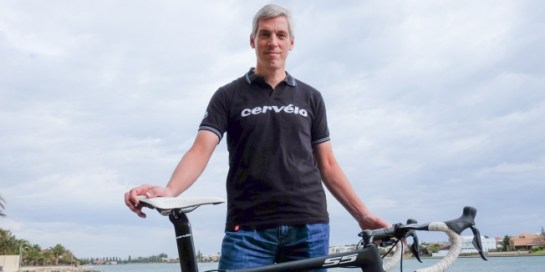
cervelo1-652x326

Rinard was instrumental in the development of the Trek Speed Concept and contributed to the current generation of Cervelo aerodynamic designs. These two brands sit number 1 and 2 atop Lava magazine’s “Kona Bike Count” for 2015. Rinard’s influence touched a staggering 797 bikes at Kona in 2015, nearly half the field. As such, Damon Rinard owns the place as the most important man in triathlon bike design that no consumer has heard of. Your concept of what a triathlon bike looks like is shaped by what Damon Rinard has already done.

When Rinard went to Cannondale at the beginning of 2015 the brand had a strong line of road bikes. These include (arguably) the most advanced aluminum road bikes available since Cannondale is a pioneer of the oversized aluminum road bike and has continued to develop the niche even in the carbon fiber era. Additionally, Cannondale has numerous carbon fiber road and triathlon bike models.

But Cannondale has no aerodynamic bikes.

Enter Damon Rinard. One glaring omission from Cannondale’s current line-up is an aerodynamic road bike platform. A second, more significant, omission is an aerodynamic triathlon bike.

Cannondale has an offering in the “third generation” triathlon bike, the “Slice”, that occupies a nice niche’ for the company. The Cannondale Slice is a short-reach, moderate stack tri bike that excels in fit for short torso riders and in low frame weight. But Cannondale does not have a fourth generation triathlon platform developed using CFD (computational fluid dynamics) with visually conspicuous aerodynamic styling. Nor does Cannondale have an aerodynamic road bike analogous to the Felt AR or Cervelo “S” series bikes.

Rinard is an expert at engineering both the aerodynamic triathlon and aerodynamic road categories.

Was Rinard hired eighteen months ago by Cannondale to introduce new models in the aero road and aero tri categories? Because these two categories, one of them a prominent one (aero tri), are so conspicuously absent from Cannondale’s line-up?

Exhibit B. 

If Andy Potts isn’t the most likeable professional triathlete in the sport, then he is among the top three. Potts is articulate, aware of his image, handsome, affable and fast on the racecourse.

Although Potts has never won the Ironman World Triathlon Championship in Kona, Hawaii, and likely never will, he brings much more to the table than race results. Potts knows what to say, and when to say it. He is also conspicuously American, a trait valuable to a brand that originated in the U.S.

Andy Potts is the perfect front-man for any triathlon brand.

On January 5th, 2016- exactly one year to the day Cannondale hired aerodynamic bike super-engineer Damon Rinard, Cannondale announced sponsorship of Andy Potts.

Exactly one year.

I briefed a private intelligence analyst on this information about Cannondale, Rinard, and the Andy Potts sponsorship and asked them for their calculation, based on my briefing, of the probability of Cannondale releasing new aerodynamic road and triathlon bikes in the next 18 months. The analyst’s probability: “80%”.

The Missing Cervelo.

There is an argument to be made that more things are related in the bike industry than are not.

Only 279 days after Rinard’s announcement that he is going to Cannondale, Cervelo announced they were… announcing a new bike in six more months. That bike introduction has since been delayed.

It is worth merging, for the purpose of discussion, these facts:

  • German athlete Maik Twelsiek set the fastest bike split at Kona in 2015 on a beam bike. Twelsiek rode 4:25:10 at the Ironman World Triathlon Championships in Kona with an average speed of 25.34 MPH for 112 miles. He rode a Dimond carbon fiber beam bike.
  • Damon Rinard’s third bike ever, the “Rinard DR-X”, a one-off technology demonstrator handmade by Rinard years ago, was a beam bike.
  • Beginning with Softride bikes in 1996, beam bikes have already been used in triathlon competition. In an early article about Softride beam bikes published years ago (date unlisted) in Slowtwitch.com, the publication wrote, “They’re more aerodynamic than almost all other bikes, if wind tunnel tests have any validity at all- Softrides always ‘win’ or come very close to winning these tests when they’re applied to a wide variety of bikes.”
  • In an article also published in Slowtwitch.com Damon Rinard told journalist Herbert Krabel that in 2009 he had worked on “…measuring comfort (vibration transmission and human perception).”

The amalgamation of these facts could be used to support an argument that Cervelo’s delayed new bike design may be, and probably is a beam bike.

Additionally, a similar beam bike concept could conceivably be in the works at Cannondale, a dividend of the Rinard “brain drain” from Cervelo to Cannondale.

While the idea that Cannondale is working on a new beam bike under the engineering influence of Damon Rinard’s recent arrival at the company may be a stretch, especially for a 2017/18 model year intro, it is more likely the Cervelo intro may be beam-shaped.

Any Cannondale move to a new triathlon fuselage design would likely have to span several price points, from about $2000-$2500 for the entry range to a full “superbike” spec with race wheels, carbon aero cockpit and electro-mechanical transmission controls (Shimano Di2 or SRAM ETAP) at the lofty $7000-$11,000 price range. This alone may constrain Cannondale and Rinard’s potential new tri bike design to a conventional blade-shaped triple triangle configuration.

In any event the quiet machinations of the industry behind the scenes will certainly lead to a season of significant new introductions during the next 700 days.


By Tom Demerly.

coffeefilters_edited-1

A couple years ago I moved back to Michigan from California to start a new business. I went to Costco with friend Sue Nichols Riegle.

I needed coffee filters for my old coffee machine. Costco only sold them in a 1000-count pack. That’s 1000 pots of coffee. A lot of coffee.

If you make one pot of coffee every day that will last you 2 Years, 8 Months, 3 Weeks, 5 Days, 11 Hours, 33 Minutes and 19 seconds.

When you buy them in bulk, the filters are cheap. So I bought the 1000 coffee filter pack, not so much to make coffee, but also to measure the progress of my life measured in coffee filters.

I made a commitment that by the time I got to the bottom of the coffee filters, all 1000 of them, that my life would be a lot different, and better, than it was when I moved back here to Detroit to open a new business.

This morning I noticed I am about half way through the coffee filters, and my life has changed dramatically from when I opened the container. Dramatically for the better.

One pot of coffee, one coffee filter at a time.

Sometimes I drink coffee when I have to stay up late to finish a project, other times I drink it when I have to get up early the next morning to continue the project, and other times I drink it when I finish a project.

They’re half gone and I’ve made a lot of progress. I wonder what I will have accomplished by the time they are all gone?

Here’s what I’ve learned from the coffee filters, and it’s a pretty simple lesson: It’s rare to make huge improvements in your life over one pot of coffee, over one day. It takes many pots of coffee, drunk on many mornings and many nights, to make the slow, grinding, progress that goes into any kind of success.

A friend of mine named Kim Ross once told me, “Successful people are usually just the ones who never gave up.”

She told me that when we were drinking a pot of coffee many pots of coffee ago.

By Tom Demerly.

MrX hit team

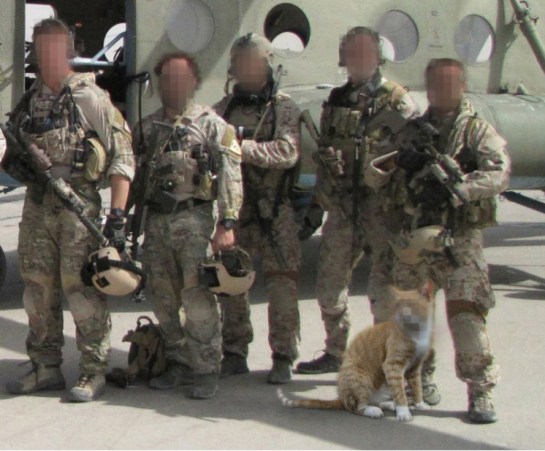
This top secret photo, obtained under the Freedom of Information Act, depicts a U.S. rescue team just after liberating Mr. X and a helicopter load of kittens from Damascus, Syria. Mr. X safeguarded the abandoned kittens until U.S. forces could mount a lightening raid using Russian helicopters operated by the CIA to rescue them. His whereabouts following the operation were unknown, until he showed up in our back yard a month ago.

Across four continents with too many aliases to count, rescuing hostage cats and fending off the advances of top-secret “honey pot” queen cats, smuggling catnip to refugee cats and establishing remote, clandestine scratching posts deep in denied territory- these are just a few of the fur-raising exploits in the secret life of the cat who came in from the cold.

They told us his name was “Chester”, but when the vet read his microchip he told us, “I think there is something you should see here…”

That something is a tale of danger and adventure more incredible than any fiction.

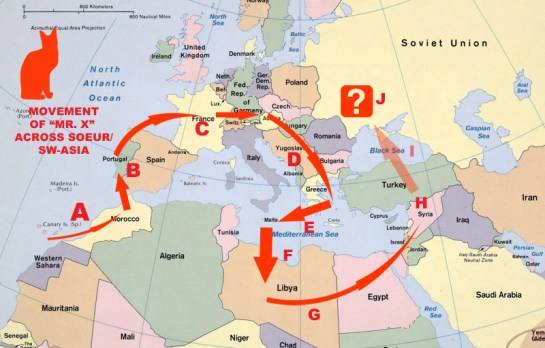
Based on the shadowy details we could piece together Mr. X’s adventure started in the Canary Islands off the coast of West Africa. How he got there is a mystery but documents revealed that Mr. X had been issued a U.S. military I.D. posing as a feline member of an elite Air Force unit in charge of chasing birds.

Mr X map

A. Mr. X arrives in the Canary Islands from a secret U.S. base in Lajes, Portugal. B. He crosses into Morocco, through Casablanca and Meknes, then across the Straits of Gibraltar on a fishing boat while eating tuna and then into Portugal. C. In Paris Mr. X encounters “honey pot” cat Choupette Lagerfeld. D. Crossing eastern Europe to the Greek Isles Mr. X enjoys the spoils of smuggling and espionage on a tuna fish magnate’s yacht. E. He crosses to Malta on a mouse-hunting expedition and then infiltrates Libya to rescue kittens trapped in Libya. F. In Benghazi he rescues a litter of Russian kittens and (G) smuggles them across the desert to Egypt. H. A secret, joint U.S./Russian rescue team airlift Mr. X and his rescued kittens to Turkey. J. Mr. X receives a massive welcome in Russia where he is awarded the “Cat of the Russian Federation” award.

Likely attracted to the Canary Islands because of his fascination with birds, Mr. X, (his alias at the time was “Chester”) was recruited into an experimental U.S. Air Force program that trained cats to conduct audible surveillance with their sensitive hearing. From Lajes, Portugal Mr. X moved by small surface vessel to establish ears-on a bird rookery on Tenerife.

Mr X ID card

False Air Force identity card issued to Mr. X under the alias “Airman David S. Silva” for his clandestine activities off the African coast.

It is off the coast of West Africa that Mr. X’s activities become increasingly difficult to follow. He has now fully adopted a new identity under the name “Airman David Silva”. Airman-cat Silva apparently learns of a massive catnip plantation high in the Atlas Mountains of Morocco near the Algerian/Moroccan border. The catnip is grown in the damp, rain catching mountains before the vast sprawl of the Sahara major in Africa’s north-central expanse. Being a clever businessman Mr. X brokers a deal to move substantial quantities of catnip from the Atlas Mountains overland and north to cross the Straits of Gibraltar. He hopes to resell his secretly obtained catnip on the open market in Paris, France where fashionable cats pay a premium for Moroccan catnip.

In Portugal Mr. X is approached by shadowy members of a secret cat society called “Le Chat Noir” (“The Black Cat”)  who attempt to extort a tax for the safe passage of his vast catnip shipments in exchange for distracting customs officials from seizing the material.

While partying at a late night laser-pointer rave in Lisbon David Silva meets the captivating celebrity cat Choupette Lagerfeld, cat to the famous fashion designer Karl Lagerfeld. In a passion-driven all night purring and licking orgy Choupette and David Silva form an unbreakable bond, waking up at sunrise on the breathtaking Praia da Marinha beach.

chopet_edited-1

Choupette Lagerfeld, the queen-cat who seduced (alias) David Silva during an all-night catnip and laser-show rave in Portugal.

Once in Paris David Silva begins to make contacts through Choupette Lagerfeld for the distribution of his catnip shipments now moving freely from Morocco. Problems surface almost immediately as David Silva suspects that Choupette is working for the French Direction Générale de la Sécurité Intérieure or the “DGSI”, the French equivalent of our FBI. The French agency hopes to stop the flow of Moroccan catnip into Paris in the hopes of driving up catnip prices and collecting a French excise tax on the feline confection.

David Silva feels betrayed by Choupette, urinates on the carpeting in one of Karl Lagerfeld’s estates and shreds designer toilet paper in one of its bathrooms before leaving in a rage. Claws still out from his perceived betrayal he crosses Eastern Europe until he reaches the Greek Isles, where partying aristocats take a liking to Silva and invite him for a month of partying on their yacht docked at the island of Lesbos.

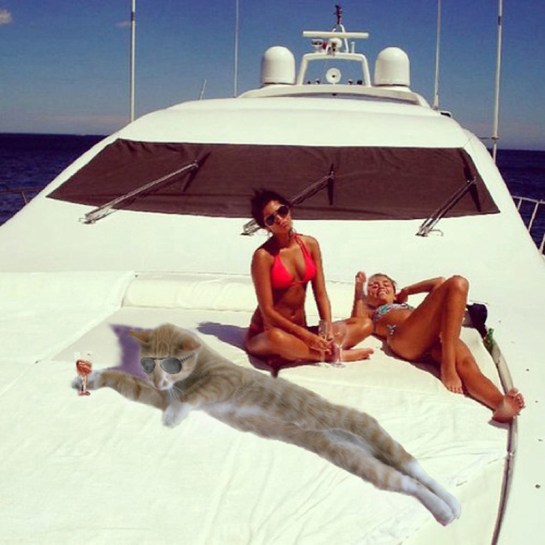
yachtgirls

Still heartbroken from the Paris Affair, Mr. X attempts to recover on a billionaire cat’s yacht in the Greek isles.

Having profited modestly from his catnip venture in Paris before betrayal by Lagerfeld, Mr. X used his resources to travel to the Greek Isles where he hoped for a much needed holiday. There he met a cartel of cats who controlled tuna fishing in the area. These cats had amassed a considerable fortune from their fishing industry that supplied a lucrative canned cat food market across Europe. Mr. X immediately befriended them and boarded their yacht, the M.V. Silent Purr, on the Greek Island of Lesbos.

Mr. X. remained the guest of the Greek tuna cartel cats until one of the cats told him of a rumor of abandoned Russian Blue kittens inside Libya. X immediately made plans to infiltrate Libya, then torn by revolution, to rescue the kittens and repatriate them to Russia. In exchange Greek Cats agreed to pay, through their syndicate, a massive stipend to Mr. X.

Details of Mr. X’s operation to rescue the Russian Blue kittens in Tripoli, Libya remain classified, but the operation was a resounding success. This is especially impressive since his escape route passed through conflict-torn Syria where X actually rescued more cats, repatriating them to Russia. Back in Moscow, a massive reception was held in honor of Mr. X.

MrXPutinfinal

Mr X. at his reception in Moscow.

After Mr. X returned to Moscow with the rescued kittens his path became a mystery. There is no doubt he accumulated substantial financial resources as a result of his activities, and these resources likely enabled him to travel back to the United States.

Another theory, and some recent information that surfaced also as a result of a FOI Act inquiry, was this CIA identity card with a recent photo of Mr. X, who may have returned to his orginal alias, “Chester”.

cia alias


By Tom Demerly.

MrX10

He just appeared.

Out the back window in a pool of light at 12:34 AM. He was interested in what was inside our window. When he looked inside our house he saw two happy, healthy, well-fed cats with rooms full of toys and cat trees and water fountains and beds. He had a sad look of longing on his face.

And then he was gone.

MrX20

It was March 13 that first time we saw him. Since then he has come back many times. Sometimes he just shows up. He comes running when he sees us. Now he answers to our voice when he is around or meows outside the window to come in.

We started calling him “Mr. X”, a man with no name, no obvious place of belonging.

When Mr. X arrived the first time I was concerned. Animals show emotion on their face. After decades of living with cats I could tell Mr. X was not happy outside our house that night. He wanted a warm blanket, a cat tree, something to eat and a friend.

MrX30

We kept an eye out for him and over time he would make his way back for another visit. Then another. Finally, one day, we invited him into the back porch. It’s segregated from our two cats (inside only cats with clean health records). He was incredibly affectionate, loved to be petted, then held, then brushed. He smiled a big cat smile and purred when we gave him his own blanket. Then we bought him a water dish, a food bowl, his own litter box, a heated bed, all on his own glassed-in patio.

MrX40

We wondered where he was from. Was he someone else’s cat? Did a family move away and abandon him? There were five houses for sale on our block- he could have been from one of them- a family moved out and left him behind.

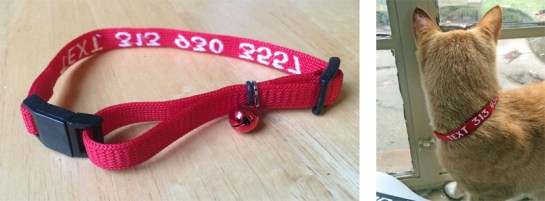
We had a special collar with our phone number made and we planned to put the bright red collar with our contact number on him so if anyone owned him they could call us when he got home. Domestic cats have relatively small territories, males larger than females, but finite territories nonetheless.

MrX50

Mr. X happily accepted the collar and went on his way. We hoped we’d find an answer to the mystery of Mr. X soon.

On April 1st at 10:57 AM I got a text message, “My cat came home with a collar that had this number on it. Did you put it on?”

Success. Mr. X had a home, and a name. His name is “Chester”. We don’t know his last name.

MrX60

As it turns out Mr. Chester lives next door. He comes and goes as he pleases. The people who own him have children who love him and take good care of him. His excellent disposition speaks to their kind treatment of him. But the person who texted me told us her husband is allergic to cats and they were looking to relocate him.

Of course, Mr. Chester has a vote in all this.

Over the next few days Chester made it clear he loves us and enjoys good food, a heated bed and a wide open back porch to lay in while the sun spills through the window during the day.

MrX70

But Mr. Chester also loves his freedom. He wakes up from his daytime naps and wanders out of the back porch at night. He plays in the yard, running around me, playing fetch, getting petted and stalking imaginary things.

Then he disappears.

MrX90

We’ll see him in the window next door. Then outside. Then back in our porch. Our cats haven’t met him except through the window and screen and by sharing scents on the back porch after he leaves. Mr. Chester needs a clean veterinarian exam before he integrates with our cats because of disease that can be transmitted from cat to cat.

But there is more: As it turns out the man next door isn’t the only one allergic to cats though. Jan Mack is also allergic, and she takes a coal shovel full of prescriptions every day to moderate her allergies to our two cats, MiMi and Vice-Admiral Malcom Fredrick Davis III. So the full integration of Mr. Chester into our home may never be possible for three reasons; Jan is allergic, and a third cat may add to the symptoms, Mr. Chester may not want to live inside permanently, and outside cats can put inside cats at risk for transmitted disease. Lastly, MiMi and the Vice-Admiral may not want a new cat. They are curious about Mr. Chester’s visits, but reserved about him being a permanent resident.

MrX100

So, as it turns out, Mr. Chester is the decider in this matter. If he decides he wants to move from next door to our house, he is welcome as long as we can moderate the issues of Jan’s allergies and integrate him with MiMi and the Vice-Admiral. But those factors also weigh heavily on the matter.

For now, Mr. Chester is enjoying the benefits of two households and seems quite pleased about it. A veterinarian visit is in his future, and we worry about his exposure to traffic and other animals outside, but he appears to be a clever man who has made his way so far.

MrX110


By Tom Demerly.

CerveloR3d200

On Wednesday, April 13, 2016 online publication Cyclingweekly.com reported that the Union Cycliste Internationale or UCI, the international governing body for the sport of cycling, has “issued a suspension” on the use of disc brakes for professional road racing events.

The new sanction against disc brakes on road bikes follows a trial period of disc brake use by pro cyclists before their permanent approval for competition.

According to Cyclingnews.com this “second testing phase [would have permitted] every rider in a team to use disc brakes in 2016 and in every major race. This is expected to spark widespread use of disc brakes during the 2016 season.”

But today’s suspension of disc brake use in the pro peloton raises a few questions about disc brakes on road bikes specifically, and about cycling technology and its role in the consumer market more broadly.

The cycling industry is a consumer industry. It relies on interest in new products to drive bike sales. Every season new features need to be released to keep customers interested.

But not every new feature has an attendant benefit.

Some features are just… new.

To a degree disc brakes fall in this category, but only to a degree.

Let’s consider a balance sheet of disk brakes on road bikes:

Pros:

  1. Disc brakes remove the braking surface from the rim, allowing new flexibility in rim shape design.
  1. Disc brakes usually have better stopping performance in wet and dirty conditions than a rim brake.
  1. Because a bike frame designed specifically for disc brakes does not need caliper brake mounts frame designers have new latitude with frame design not available with traditional caliper brakes.

IMG_2552Cons:

  1. Disc brakes are heavier than caliper brakes.
  1. Disc brakes are more expensive than most caliper brakes.
  1. Disc brake equipped wheels take longer to change in a race-service setting.
  1. Disc brake equipped bikes are less tolerant of interchanging wheels from bike to bike; the brake disc spacing on the wheel must be exact for it to work on a given bike and this often varies from bike to bike. Caliper brake equipped bikes are easier to change wheels on.
  1. Disc brakes have different stopping power than caliper brakes. This can create different braking performance on group rides where some riders have caliper brakes and some riders have disc brakes, potentially creating a hazard.
  1. There are not as many wheel options available aftermarket for disc brake equipped bikes as there are for caliper-equipped bikes.

If you weigh both sides of the balance sheet you see that disc brakes offer some advantages, but not necessarily advantages in a professional road race setting.

packvssolo

As with aerobars, disc brakes are not well suited for riding in a group, especially if some riders are also using caliper brakes.

Aerodynamic handlebars are similar; in an individual, time trial and triathlon setting they offer proven performance benefits, but they aren’t optimal for use in mass-start bicycle racing.

The bike industry may not have ever intended disc brakes to be a replacement for caliper brake racing bikes. Instead, the disc-equipped road bike may have been targeted for an emerging demographic of recreational cyclist who rides in all-weather.

I use the word “may” because the cycling industry seldom plans such things, but rather throws new ideas against the consumer wall to see what sticks. The impetus is to constantly release something new, if not necessarily better.

Because consumers seem to want “new”.

Disc brakes aren’t bad. They stop a bike adequately in all conditions and better than caliper brakes in wet and dirty conditions. On mountain bikes, cyclocross bikes, dirt road bikes and randonee’/touring bikes ridden in bad weather they are better than caliper brakes.

Recall the time when suspension forks were installed on road bikes used for the cobblestones in Paris-Roubaix. The trend didn’t last, and riders quickly returned to mostly conventional road bikes with rigid forks and caliper brakes at Paris-Roubaix and in the other Spring Classic races.

Suspension forks didn’t go away. They found their own best application on mountain bikes and some recreational hybrid bikes. And there they remain, because they are a feature that provides a tangible benefit on those bikes.

Do disc brakes belong on road bikes? On some road bikes they do. Not all, and they are not a replacement for caliper brakes. If you ride by yourself on dirt roads and in wet conditions, disc brakes offer a benefit. But disc brake bikes aren’t a replacement for the caliper brake equipped road racing bike. They were never intended to be.


By Tom Demerly.

democracy-spring-twitter

The people were angry. Quietly angry.

Oppressed by despotic rule, subterranean anger and frustration simmered. Until it boiled over.

The virus of discontent spread through the Typhoid Mary of technology; cell phones, YouTube, Facebook, Twitter, Instagram. The people were empowered now. The rulers shut down the Internet. Turned off the cell towers. But the world was too connected to be dragged back into isolation now.

The people knew not to trust “official” media. These were controlled by “The Man” and meant to bend feeble minds. To keep them in line.

Tunisia, Egypt, Libya, Syria then Yemen, Bahrain and even the “moderate” countries like Jordan and Saudi Arabia. The people were angry with the leadership, their lives, their countries. They rose up and overthrew them.

The Arab Spring was a geopolitical reset button that toppled deeply ensconced governments across the Middle East and sent shockwaves into the Mediterranean and Europe.

154848-004-75C2C324

A version of the Arab Spring is here in the United States: the 2016 election face-off between Democratic and Republican extremes.

This is the American Spring.

A two-term President who leaned decidedly left makes his exit. He was, in many ways, a “perfect storm” leader for the U.S. The first to preside during the age of user-generated media, the first to challenge a host of right-wing values, policies and prejudices, the first African-American.

If his agendas are congruent with yours, you will remember him as one of the greatest Presidents in history.

During his two terms the Dow Jones Industrial Average increased a staggering 156.75%, an economic surge not seen since the recovery from the Great Depression. Agree or disagree with the policies of this administration, it was very effective in prosecuting it’s agenda. People who were able to participate in the recovery from the recession got wealthy(ier).

map800

“The Economist” published an accounting of the result of the Arab Spring to date. Their analysis shows a lot of strife, a little reform and a long way to go.

And for eight years the contrarian view simmered to a rolling boil. The country began easing left as the right yearned to jerk the steering wheel back to the other side of the road. As the stock market rocketed upward, turning modest holdings into fortunes, small portfolios into millionaires, the middle class was gutted.

The middle 60% entered the U.S. recession dangling from a precipice by their fingertips. When the weight of the economic collapse settled on them, most lost their tentative grip on middle class and slid down to a subsistence living. Few have clawed their way back up the ladder. With the weight of this economic burden released from the new upper class they rocketed ahead, collecting revenue on the massive new industry of the nouveau broke.

When you talk to some members of the nouveau broke, the new lower class, you hear typically sweeping generalizations. “They’re trying to take my guns and force me to buy health insurance that doesn’t work, but keeps the drug company executives rich.” Similar banter was heard on the streets of Cairo, Benghazi, Amman, and Damascus.

Forecasting political outcomes seems like voodoo but is truthfully as banal as algebra. Equations must be balanced. The terms must cancel. When one factor is thrown out of balance in the delicate equation, it must be corrected by like terms.

And that brings us to now.

The perfect storm of accelerated media change, polarized political environment and massive social evolution have concentrated five decades of change into eight years.

Now the forces of math and physics that preside over everything want to swing it back the other way with increasing speed and amplitude. Like a car beginning to swerve off an icy road the driver’s corrections become increasingly large, increasingly desperate, increasingly dangerous. And then the car careens into a ditch.

“Of the countries involved in the Arab Spring most are still roiling in chaos, some destroyed by war. Almost none are better off.”

Of the countries involved in the Arab Spring most are still roiling in chaos and unrest. Some are destroyed by war. Almost none are better off. That ephemeral, enticing tempest called “freedom” was like smoke in a sandstorm- extremely difficult to contain as long as massive, abrasive forces swirled around it.

When you talk to some Egyptians, Libyans, Syrians and even Iraqis they may quietly suggest an unpopular belief; things were actually better before the Arab Spring. The markets were full, the economy was functional, the streets were some version of safe. Now there is rampant unemployment, a refugee crisis, widespread insurgency and the creeping cancer of ISIL and religious extremism. They tried to grab the golden ring of freedom and spun off the merry go ‘round.

A new government represented an alternative, not necessarily a well-conceived alternative, but just something different. For most countries involved the Arab Spring was a reaction, not a well-conceived set of reforms. And they have suffered ever since.

For more moderate countries like Jordan there was an orderly process of reforms- not an uprising. Al Jaezeera journalist Nermeen Murad wrote that Jordan was spared the destruction of the Arab Spring because of “The ‘maturity’ of the Jordanian public, Western financial support, the UN’s management of the influx of Syrian refugees and last but certainly not least, the kingdom’s official ‘web masters’.”

Another example of orderly and expedient reform contrasted against angry revolution is Iceland’s recent “coup”. In early April this year Prime Minister Sigmundur Gunnlaugsson voluntarily resigned after leaked documents from Panama-based law firm Mossack Fonseca reveal that he failed to declare ownership of an offshore company when he entered Icelandic parliament in 2009. It was oddly tantamount to the U.S. Watergate scandal.

This weekend protesters descended on Washington D.C. in what was termed a “Freedom Spring”. There were a reported “more than 200 arrests”. Evoking the genie of an Arab Spring style reform in the U.S. is reckless political voodoo.

Americans can be stupid. They were on September 10, 2001. They may be again, believing they can segregate themselves from a world more integrated than ever. Believing they can return to doctrine that social and technical evolution has left long behind. Believing they can somehow exist and prosper as an island selectively disconnected from the rest of humanity.

Almost no country that participated in the Arab Spring is more stable than prior to it. Some are devastated. All have relied heavily on the international community. And while some do enjoy a tentative version of liberty now it teeters on a fragile fulcrum above the abyss of even worse extremism. It could go either way.

As we head into an election year the United States would do well to learn from the Arab Spring. Wild swings from one political direction to another seldom leave a culture intact. They most commonly result in turmoil and loss.

No government appeases every political agenda on an individual basis. That is not the job of government. Instead, an effective government moderates conflicting agendas toward a mutually beneficial middle ground. As we go to the polls this November that is a reality worth remembering while the ominous potential of an American Spring is worth avoiding.

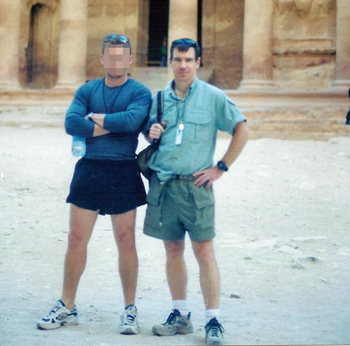
demerlyjordan


On all seven continents including East and West Africa and The Middle East, author Tom Demerly never let not knowing about a topic stand in the way of having an opinion. Here he tries to tuck his shirt in at the Petra ruins in Jordan after the 9/11 terror attacks.