Archive

Commentary.

4

1999, #223, Marathon des Sables, the 55 mile stage, with members of the British SAS and the Queen’s personal security detail.

In reflection on the endurance lifestyle following the bombing at the Boston Marathon I thought about what I’ve been given from endurance sports and running.

When I was a kid I was so overweight they put me in a special education phys ed class. I started running. I lost weight. Running made me thinner and more fit. It gave me self-esteem and taught me to believe in myself. More importantly running taught me that what you put in, you get out in roughly equal measure. There are few bargains in life more straightforward than running. As a young teenager that was a valuable life lesson. Running gave me that.

When I couldn’t run in my early 20’s following a ski accident running taught me to keep going so I bought a bike. I won four state cycling championships and raced bikes in Europe. So running gave me that.

When I joined the Army and went to basic training I had an easier time than the other guys so I was able to help them out in training. I already learned that the toughest part of completing anything is simply not giving up. I was the honor graduate from our basic training and AIT class. So running gave me that.

3

Left, somewhere in Ohio, 1986. Right, Kona pier, Bud Light Ironman Hawaii, 1986.

After I left the Army I started my own business and learned what it really meant to work, something I knew how to do from running. So running gave me that.

When I met people who had never exercised before and didn’t know where to start I could help them and inspire them and empathize with them. So running gave me that.

When I saw a story in a magazine about a 152-mile running race in the Sahara desert it sounded impossible. Running taught me there usually is no such thing as “impossible” so I went there and did it. The Discovery Channel followed me during the race and put me in their documentary about the event. So running gave me that.

Over the next 20 years I raced endurance sports on every continent, from Africa to Asia, America to Antarctica. I saw things people only see on TV and movies, did things people only read about in books. I travelled the world. So running gave me that.

When I climbed the highest mountain in the western hemisphere I was the only person on our climbing team to make it to the summit. My guide told me it was because I was fit and moved fast. So running gave me that.

When my best friend was killed on his bike by a drunk driver riding home from my bike store I was depressed and thought I had lost everything. My friends Mike and Kim said maybe I should go for a run. I did. It took more than a few runs but I realized the friend I lost would have wanted me to keep going, so I did. So running (and my friend) gave me that.

1A

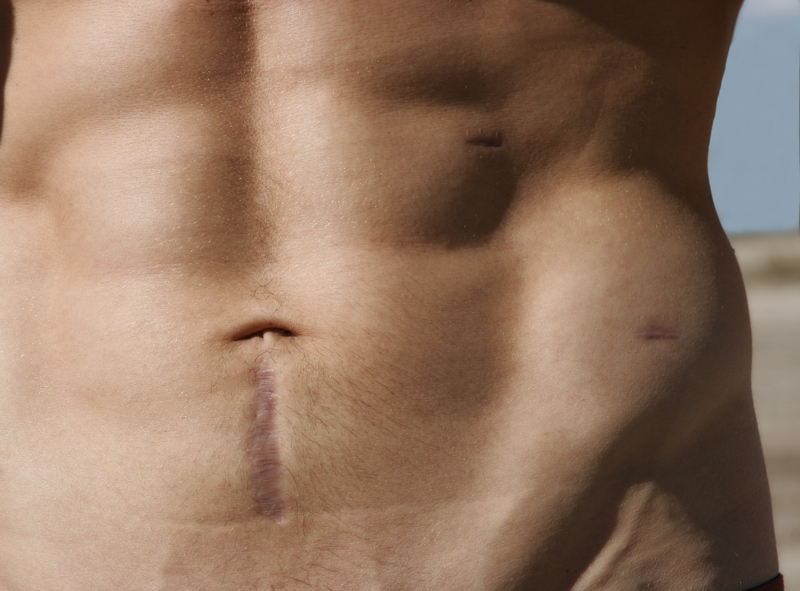
The wire and plastic spider that lives inside my heart. Installed by Dr. Samir Dabbous of Baghdad, Iraq to prevent another stroke. It works perfectly.

I had a stroke when I was running and suffered brain damage and vision loss. The doctors told me that if I hadn’t kept running the damage may have been worse. I may have even died. They fixed the problem that caused the stroke by putting a patch inside my heart and said the procedure was easy on me because I was in good shape and it may have saved my life. So running gave me that.

After I had my stroke and a patch put inside my heart I was afraid I was permanently broken and couldn’t run anymore. But I remembered that sometimes when you are running and you feel the worst you simply have to keep putting one foot in front of the other, so that is what I did. Soon I was running again and I knew having a stroke did not change me one bit. So running gave me that.

When the recession came I lost everything and had to start over on the other side of the country with nothing in a new place and a new job. I learned you are only as good as your last run and, since my business didn’t end very well partially from my mistakes and partially from the recession, I learned I better keep running. So I did. Running gave me that.

When I wanted a new job and a better life I remembered that, in running, sometimes you have to go out of your comfort zone so I did. I got a much better paying job and moved to a nicer place to live. So running gave me that.

I’ve never been a very fast runner or a very good runner, but I’ve never given up. That was one of the first things I learned about running: don’t give up.

So running gave me that.

21

Left, Ironman New Zealand, right, Ann Arbor Triathlon.
27173_374674638567_5646957_n

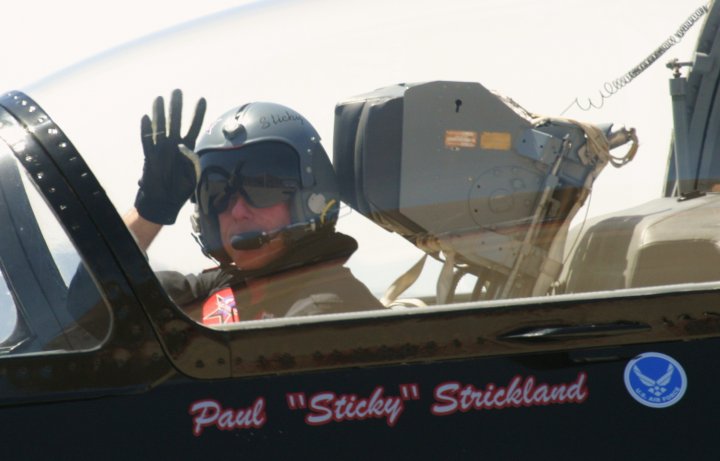
Former Air Force Thunderbird pilot Paul Strickland leads the Patriot Jet Demo Team, a privately funded jet airshow team. Teams like The Patriots may replace the U.S. Navy Blue Angels and U.S. Air Force Thunderbirds at airshows in the U.S.

The sequester federal budgetary cutbacks have grounded the big military flight demonstration teams for 2013 and the airshow industry built around them. It may last a year, it may be longer.

What will take the place of the big military air shows and jet teams? What will inspire our next generation of aviators, engineers and adventurers if we don’t get the big military airshows back?

Despite the sequester coming during a decidedly left-leaning administration the solution may be decidedly right-leaning capitalist in origin. The privatization of airshows is happening. If the big military jet teams stay grounded it is possible commercial enterprise may take their place.

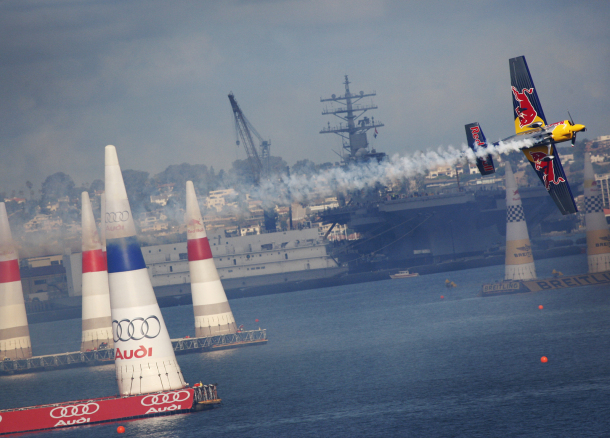
In 2003 beverage brand Red Bull began the Red Bull Air Race Series. Harkening back to the 1930’s with the Thompson Trophy air races, the Gee Bee Racer and soon-to-be war hero Jimmy Doolittle, the Red Bull Air Race Series was a marketing and extreme sports coup. Red Bull Air Racing combined the daring and spectacle of classic piston-driven air racing with competition aerobatics in an urban, waterfront setting. To bring it into the 21st century it featured interactive coverage and point of view cameras. It also had the primary staple of mass-appeal events: the potential for bloody disaster. Aerial collisions with collapsible racecourse pylons were common. At least one aircraft even hit the water and narrowly escaped.

220907AR09

Red Bull Air Race pilot Kirby Chambliss in his Red Bull Edge 540 at the Red Bull Air Race in San Diego, California.

This writer was a guest at three Red Bull Air Races before the series was cancelled in 2011. At the Red Bull Air Race San Diego in 2009 I had access to the opulent Red Bull Flight Club box seat area. Darling hostesses in short skirted, 1950’s stewardess uniforms with pillbox hats brought round after round of Red Bull drinks to your table at the best viewing area on the course. White uniformed chefs served an all day banquet. We enjoyed a huge, private television monitor with live cockpit cameras and instant race timing, placings and commentary. It occurred to me that if an aircraft missed the turn after the far pylon near the San Diego Bridge, we would be dead. Only a few hundred feet separated our VIP seating area from the active racecourse, with no barriers. It harkened back to the spectacle of the Roman coliseum, with the pilots risking their lives for the entertainment of the crowds lining the shore like modern, aerial gladiators.

But the spectacle I enjoyed at the Red Bull Air Races in the Flight Club wasn’t free. Paid admission to the coveted Flight Club was over $300 per person. Spectators around the course viewed the event free, but Red Bull, through its financial sponsorship of the event and, to a smaller degree, through ticket sales of premium viewing areas, created a model for monetizing the private airshow. While large military airshows do generally sell a premium viewing spot with a chair and a good view, the paid viewership usually benefits a local charity, it isn’t a commercial enterprise, and usually isn’t $300+ a seat.
While the Red Bull Air Races and the big military jet teams are gone for now some private flight demonstration teams have surfaced. The Patriots are a private jet team from Byron, California. The team fields six Czechoslovakian built Aero L-39 Albatross single engine jet trainers. While the L-39’s don’t rattle your insides like the afterburner equipped F-16’s of the Thunderbirds or the twin-engined FA-18’s of the Blue Angels they do include former Thunderbird, Blue Angel and Canadian Snowbird jet team pilots and perform some impressive close formation aerobatics.

Chuck Aaron aerobatic helicopter pilot

Red Bull helicopter aerobatic pilot Chuck Aaron, the only U.S. pilot licensed to perform aerobatics in a civilian helicopter.

Red Bull, following the cancellation of the Air Races in 2012 and ’13, have sponsored impressive U.S. airshow acts including their unique aerobatic Messerschmitt MBB-105 helicopter flown by pilot Chuck Aaron, the only U.S. helicopter pilot licensed to do aerobatics in a rotary wing aircraft. Aaron’s loops, rolls and hammerhead turns in the Red Bull MBB-105 helicopter are an incredible spectacle that challenges traditional notions of helicopter performance. His aerobatics are reminiscent of the great Bob Hoover who performed a flight demonstration routine in the Rockwell Aero Commander twin-engine civilian light aircraft. Many of Hoover’s performances in the privately sponsored Aero Commander were as unusual at the time as Chuck Aaron’s are now in the Red Bull helicopter. Both pilots have challenged ideas of what was possible in a conventional aircraft type.

felix-baumgartner-red-bull-stratos

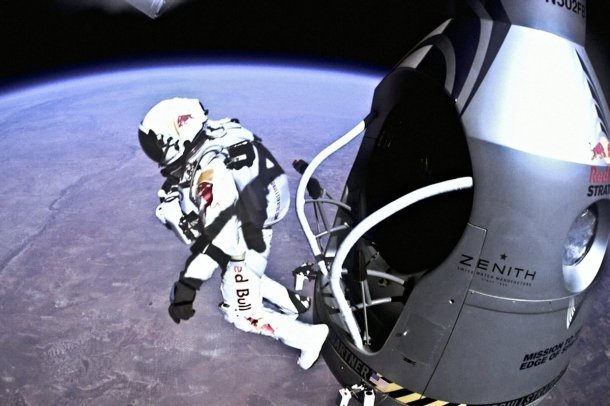
In 2012 Red Bull scored another commercial aerospace and media coup when Red Bull athlete and extreme skydiver Felix Baumgartner set a new free fall parachute record and became the first person in history to break the sound barrier in free fall without a vehicle. The Red Bull Stratos project was entirely privately funded. Even the broadcast was privately produced and shown on the video share website YouTube. The live broadcast of Baumgartner’s record-breaking jump had over 8 million live viewers, a record for YouTube. Since then Baumgartner has been honored with numerous aeronautical achievement awards and was nominated as Time magazine “Person of the Year”.

While private companies, especially Red Bull, seem to be shoring up the flight demonstration losses from the sequester there remains a massive hole in military flight demonstrations and the resultant recruiting benefit. Another odd outcome of the cancellation of military flight demonstrations is that, as taxpayers, we don’t get a chance to see what we’re paying for. For taxpayers there was something to be said for seeing an F-22 in person to digest that $150-million per plane price tag. In the foreseeable future we’ll have to satisfy ourselves with sponsored private flight demonstrations through brands like Red Bull, who now, unlike the U.S. Air Force and Navy, really do “Give you Wings”.

airshow

When I was seven my dad took me to an airshow. It changed the direction of my life.

This past month the new U.S. budgetary restrictions, the sequester, grounded the two major military flight demonstration teams, the Blue Angels and the Thunderbirds. It also grounded the Army’s parachute team, the Golden Knights. Smaller military demonstration teams like the A-10 Flight Demonstration teams (East and West) and the F-22 Raptor Demonstration Team are also grounded.

200530_10150114034398568_5131112_n

USAF F-22 Raptor Flight Demonstration Pilot, Major Henry Schantz, call sign “Schadow”, jumps from the cockpit of his F-22 after a flight demonstration. The F-22 Demo Team has stood down due to the sequester. Photo: Tom Demerly

With the grounding of these military headliners that drew tens of thousands to airshows, most of them with free admission, the entire airshow industry takes a catastrophic blow. Airshows across the country have been cancelled. They brought millions of dollars to local economies. They served as critical recruiting resources and performed public relations roles in the community. Some of those ground-based public relations roles will continue, but the big jet teams are grounded for now. No one can say exactly for how long.

In the broader perspective of the global economic crisis this is insignificant. With Greece and Cyprus effectively bankrupt and the entire European Economic Community in distress it is minor. As the U.S. begins to show signs of slow recovery from the recession the tough cuts from the sequester will likely ease the burden of the federal deficit at least temporarily. That’s good.

We lost the big jet teams and the airshows that built an industry around them for good reason: we couldn’t afford them. That they were one of the first things to go in the sequester attests to their visibility. Lefty pundits could easily point to a weekend airshow and observe, correctly so, “We’re kicking the budgetary can down the road but we can spend millions every summer weekend to host aerial parades?” And they would be right, at least in the short term. That being said our government is rife with budgetary items that are of arguable import, and that is much more than the topic of an Internet blog post.

27173_374670728567_2907355_n

Airshows provided an insight into military careers impossible in any other venue and acknowledged the contributions of those already serving.

I joined the military largely as a result of being exposed to it at airshows as a kid. I met members of the special operations community I would later be a small part of. These men and women were larger than life.  Being in the military was the best education I received, even compared to college. Decades later I still use what I learned many times, every single day. More importantly, my perspective on the world is a privileged and eclectic one, having visited all seven continents as a direct result of starting in the military. I’ve seen things horrible and amazing that most people only see on a screen.

For several generations of kids in the U.S. this summer, that experience is gone. We can calculate the lost revenue from airshows being cancelled. It is a lot of money, especially since many of the biggest shows were in smaller cities like Tucson, Arizona and Dayton, Ohio. We cannot calculate how many young lives will take a different path because they never got a chance to be inspired by the rumble of jet noise or a handshake and autograph from a woman or man in uniform who seem like they walked off a movie screen. So, until the sequester is over and we get the Thunderbirds and Blue Angels back, I hope video games, movies and the Internet can somehow fill that role. That said, I’ve never felt my entire body vibrate from seeing a video on YouTube or felt the honor in shaking a pilot’s hand and saying, in person, “Thank you Ma’am, for what you do for our country.”

I hope, someday, we can afford that again. For now, I hope we can afford to lose it.

TOMairshow

At the 2011 Luke AFB Airshow I had a chance to meet F-16 pilots from Singapore that were training in the U.S.

By Tom Demerly.

Slow checkouts and invasive information gathering keep customers from their most important activity; buying.

“No, I don’t want a membership card, I don’t want to be in your buying club, I’m not giving you my name, you can’t have my e-mail, I’m not interested in earning points. I just want to buy something. And I don’t want to stand at the register more than 120 seconds. “

During  the last three decades buying at stores has become a hassle. Checkout takes longer. Retailers collect personal information with invasive questions. Add marginal Point of Sale software with frequent errors creating more delays and the “service” in customer service is largely forgotten.  It’s a missed opportunity for retailers.

To understand the problem I timed my checkouts at retailers for over a year. The better retailers, usually grocers, chains and small specialties, had me out in under two minutes regardless of how many items. The bad ones took up to eight minutes to process a straightforward sale.

Interaction at the point of purchase is often the only interface a retailer has with a customer. The customers’ opinion relies on that experience. It’s an opportunity to win fans but more often a reason for people to use Amazon 1-Click. It’s also why Walmart is experimenting with iPhone based “Scan & Go” in Rogers, Arkansas. This is a movement to the opposite extreme at Point of Purchase; from too much to too little. The best experience is somewhere in the middle.

How valuable is quick check out? Amazon has a patent on their “1-Click” checkout technology and there is a $10,000 bounty to contest it. No one has.

We develop systems before we create the social conventions for using them. Gadgets before manners. Point of Purchase routines are rarely tested with live customers. Few retailers take the time to adequately train their staff before they have contact with a customer. It shows in the number of “excuse me’s” and “I’m sorry, this will just take a second” at the register.

There are retailers who get it right. Summit Hut in Tucson, Arizona is a specialty outdoor retailer with an online sales component. Checking out in their stores is quick and dignified.  More importantly for the retailer, Summit Hut staff frequently add to the sale during checkout. It’s good, old fashioned customer service; respectful of the customer’s time and attendant to the sales motive without being too invasive. Key components to Summit Hut’s efficiency are a large, uncluttered cash wrap area, employees who know what they sell and sensitivity to the customer’s time and buying behavior. The store isn’t reliant on cookie-cutter systems for good customer service. They use good employees instead. The challenge for retailers is reproducing this behavior.

Summit Hut competes directly with the largest chain of outdoor retailers in the U.S. in Tucson. That chain sells memberships that return a dividend and provide member pricing. Summit Hut still competes because not every consumer wants a membership shopping experience. A component of membership shopping is non-members are penalized and even alienated at the register when the sales associate asks, “Are you a member?” and tells them, “You would have saved $XX today if you were a member.” Data suggests strongly that customer memberships do foster repeat purchases, but they also alienate non-members when skilled customer service can achieve the same loyalty without the negative reinforcement to non-members and the costs and delays associated with membership buying.

The principles of great customer service were born with the earliest retailers and haven’t changed even with new technology.

Key components to a great customer experience at checkout include streamlined, proven POS software, absolute proficiency of the checkout person, respect for private information, the ability to interact sincerely with the customer, expert product knowledge, strong sales motive, separate return and exchange facilities and a well designed check out area. One at a time:

1. Point of Sale software needs to work perfectly. Customers should not be penalized with longer waits if it fails. There is only one remedy for a defect during checkout. Give whatever the customer is buying to them free or cheap and quickly move on with a sincere apology. After a store gives away enough stuff they’ll get this right. There are laws governing errors at checkout with bar-coding. One set of widely drafted state statutes “requires sellers using UPC’s [barcodes] to mark each item with its price” (CGS § 21a-79(b)(4)) as a back-up to software. If a retailer’s  price scanning doesn’t work instantly at checkout it isn’t the customer’s problem.

2. Checkout staff should be highly proficient in the process. Checkout is often the only live contact a customer has with a brand. A few retailers respect this enough to train and test their employees up to six months before they service a live customer. Some retailers separate customer service staff with checkout specialists. The key things with the checkout are expedience, respect, gratitude and service through sales. Retailers should respect the customer’s time by getting it right and moving quickly.

3. No inquiries for contact info. Retailers have confused checkout with an opportunity to gather marketing data. It isn’t. It takes additional time and has no place at the cash wrap. Collecting personal information at the checkout is awkward because of privacy concerns and delays. Customers are sensitive about revealing e-mails and phone numbers or showing ID’s with other customers close by and to a store employee they don’t know. It isn’t appropriate to ask for personal information at the checkout. An alternative is providing customers with a kiosk separate from the cash wrap where they can share that marketing data if they desire in exchange for a one-time gift certificate (but not a percentage discount).

4. People at checkout should have a personality. This requires judgment since not every customer wants to chat. A good customer service person can sense what level of interaction is right. The best customer service people use their proficiency in the sales systems to move quickly and make the customer feel good about their choices. This is an opportunity for add-on sales if the interaction feels right. It requires training, experience and judgment.  It is difficult to quickly process a sale and assess the right kind of interaction with the customer but this talent is what keeps people coming back- and buying.

5. Expert product knowledge keeps customers. At the checkout it can avoid mistakes and add to the sale. It’s takes time and genuine interest to develop, but it’s a strong asset when combined with good judgment. The axiom “shut up and sell” applies as does the motive to move quickly, but a good catch from a checkout person on a sizing issue, product compatibility or other technical point reinforces why a customer should come back and can add to the sale.

6. The best reason to move quickly at checkout is to sell more. The longer it takes to process a customer at the cash wrap the less time is available to sell on the floor. Staff that are incentivized with attainable sales bonuses learn this quickly. They use their time wisely, respect the customers’ time and focus on sales and service.

7. Separate return area. You don’t want buying customers interacting with returning customers. They need to be separated for logistical and sales reasons. A buying customer should never be delayed by anything, worst of all a potentially unhappy customer with a return. Customer service staff should be proficient and expedient in returns processing, remembering it is another opportunity to win or retain customers and even to provide sales ideas. People working in the returns area should have the authority to grant refunds and adjustments without delays or assistance.

By Tom Demerly.

Over the last three decades a new set of business clichés has surfaced. They’re used by small companies trying to act big and big companies on the way to bureaucratic gridlock and subsequent meltdown. Never use these terms. They make you look like an idiotic lamb on the way to the recessionary slaughter of unoriginal thought.

One of my favorite business writers, Seth Godin, said it best: “Clichés make it easy to talk without really saying anything. Clichés make it easy to hide and to lie.”

People resort to clichés for three reasons: They don’t know what to say and clichés are convenient, fashionable and convincing to the dim-witted, everybody else is using them so they must be relevant and cool and they make you sound associated with the codified language of business insiders- but only to the uninitiated. As Godin mentions you can burn hours in meetings by just using these clichés and some Power Point as your business does ever shrinking laps around the drain. Throw in some Excel and you have most of what is big trouble with business both large and small.

Here are the most common business terms and trends to avoid:

1. Best Practice:

The most obnoxious business colloquialism. A best practice is neither. Best practices are what someone talks about when they have no original thought and steal obsolete ideas from other companies, often as not, bankrupt ones. They aren’t the “best” of anything and usually don’t stay in “practice” since hashed over old ideas don’t work. Except in pointed sarcasm or abject mockery, never use this term. If people above you in your company use it, update your resume. If people below you use it, replace them.

2. Spreadsheet:

Spreadsheets are more commonly collections of irrelevant statistics than meaningful tabulations. They are compiled in a manner that feigns logic to support some innocuous conclusion by someone with an agenda.  While the Microsoft Excel application used to craft most of these interpretive works of fiction does have useful applications, like finding Saddam Hussein (they did it with a spreadsheet) it is a lot like a paintbrush and an easel: just because you know how to use them doesn’t mean what you produce is useful. Spreadsheets support the useful business axiom: G.I.G.O., Garbage In, Garbage Out. In fact, the spreadsheet is every bit as interpretive as the brush and canvas but more dangerous since so many people accept a sort of “spread sheet truth”. Beware of people who boast about proficiency with spreadsheets. They wield a mighty ability to manipulate reality and bend it into some statistically supportable fable, generally to their favor. The spreadsheet disproves a time-honored axiom; sometimes numbers do lie.

“Yeah…. I’m gonna need you to go ahead and get those best practices into a PowerPoint along with our latest metrics in a spreadsheet by tomorrow.”

3. Metric:

Metrics come from and go into spreadsheets. That itself makes them evil. They usually wind up in a Power Point presentation from there. Even worse. The people using this term usually have no idea what it means. They are office Mina birds regurgitating some important sounding dribble their ineffectual boss or webinar dweeb spouted. Metrics are supposed to be a measure of something relevant. They’re usually the trees that keep you from seeing the forest, and produce a kind of entrepreneurial nearsightedness  that precedes things like GM’s bankruptcy and the Apple trouncing of Microsoft. The problem with the term “metric” is there are any number of better synonyms for the same thing. It is a term that is more fashion than function. Its adoption by the “Office Space” demographic has doomed it. Unless your goal is to look purposely unoriginal or suggest you lack insight, don’t use the term “metric” to describe any relevant set of business statistics. Pick another word, or better yet, take a tip from fast advancing middle managers everywhere; don’t say anything.

4. Webinar:

Definition; waste of time. The webinar is roughly traceable to the first espousing of calibrated ignorance under the guise of information by the Ancient Greeks and Romans. They called it satire. As with the Greeks, the audience often doesn’t realize they are being played. Webinars usually espouse best practices using metrics from spreadsheets. The perfect storm of commercial cretinism. In general you will know less after a webinar than before. They are sort of a virtual lobotomy. Enough of them and you may actually believe the company you work for has a chance of lasting another year. It doesn’t though, because instead of working, you’re wasting time making some buzzword huckster rich over the Internet listening to their webinar instead of selling anything.

The President was not entertained by another delay in the PowerPoint presentation.

5. “A/B” Testing:

When companies find themselves flummoxed on the edge of a fiscal precipice they will often announce an “A,B Test” to generate “metrics” to put in a spread sheet so they can determine their “best practices” and display them in a Power Point.  They learned this during a webinar last week. These are the death throes of the decreasingly competent. It’s like animals on the plains in Africa walking in ever tightening circles until they die of a brain worm or something bigger with more teeth eats them. Businesses that attempt this don’t know what or how to test. Usually they try to learn from a webinar. We all know the result of that. The danger with this term is it suggests some orderly and sentient analysis. There is seldom a correlation between the use of this term and execution of an orderly and empirical investigation. It’s just another thing companies do before they file.

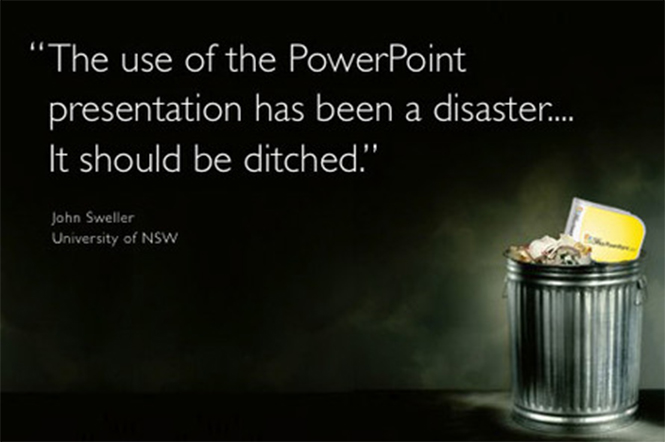
Here’s a PowerPoint slide about bad PowerPoints.

6. PowerPoint:

The PowerPoint application would have been a useful presentation tool prior to the 1930’s when people were still amazed by anything big on a screen. Prior to PowerPoint there was the overhead projector.  PowerPoint is somehow worse than the overhead because it seems so easy to use. People rely on it too much and it has compromised the art and practice of delivering convincing and skilled presentations. Just throw up a PowerPoint, after all, when people are sleeping they can’t tell how stupid you really are. Putting any content into a Power Point slide lowers its “punch” by a massive factor. People have simply seen too much Power Point, and too much of it is bad Power Point. When the slides go up, people tune out. It is the crutch of the weak presenter. The bane of Power Point is it rarely works on the first attempt. Power Point would be better software if it electrocuted the presenter with increasing voltage for every second their stupid slide show doesn’t work before a live audience. Then the problem would fix itself, and be more entertaining.

7. Reach Out:

This is another truly awful one. My skin crawls when I hear this. It smacks of desperation. No one wants to be “reached out” to. Drowning people and zombies “reach out”. Worst of all, there is a better word for this concept. It’s called: “Ask”. Don’t make yourself look foolish and trendy by using two ambiguous, trendy words when one will do. Just ask. Don’t reach. It’s not polite.

8. Mission Statement:

If your company has mission statements plastered on walls it’s likely they are so far away from their original area of competence they need written reminders of why they are there. Businesses write mission statements for one reason: No one knows what the company is really supposed to be doing. The irony is most businesses need a two-word mission statement: “Sell something”. That sums up the purpose of most commercial enterprise. When businesses get so distracted from that central purpose they need constant reminders of what they actually do a sign on a wall won’t pull them back.

By Tom Demerly.

Poorly administered sponsorships are like showing too much cleavage at a dinner party. They attract plenty of attention, but not the right kind of attention.

Earning a net profit in the bicycle industry is extremely hard.  Poorly managed  sponsorships, mostly at the dealer level, contribute to making it harder.  They create a damaging subculture of “sponsored consumers” who expect to pay less than retail,  are trained to resist MSRP’s, set an example for others to expect discounts and return almost nothing measurable – except red ink. Worse yet, through unprofessional use of social media some amateur sponsored athletes have created the impression that if you are paying full price, you are somebody’s fool, and you’re not one of the cool kids.

It’s a tough thesis, but one the specialty bike retailer needs to own. Low level “sponsorship” discounting isn’t all that is wrong with bicycle retail, but it is one of the many small wounds that has bled the dealer network dry in a sort of financial “death by a thousand cuts”.

The National Bicycle Retailer Association, the NBDA, reports a significant contraction in the number of independent bicycle dealers over the previous two decades.

The NBDA, National Bicycle Dealer’s Association, reports that the “number of bicycle retailers is dropping” from a high of about 8,000 independent bike shops in the early 1980’s to about 5,000 in early 2004. In 2011 the NBDA reported 4,100 independent bicycle retailers, a loss of nearly 50% since the 1980’s. This is contrasted by significant growth in the number of USA Triathlon licenses sold, the number of triathlon events and the growth in popularity of cycling during the Armstrong era prior to the loss of his titles. It doesn’t make sense that there are less bicycle retailers today than there were before the triathlon boom and the Armstrong era. If we had seen similar expansion in any other specialty consumer population we would have seen growth in the number of retailers servicing them. We haven’t. In fact it has been the opposite.

Business owners driven by personal involvement in the sport and not  focused on the bottom line have created a subculture of amateur “sponsored athletes” that don’t generate additional net profits at all. These “sponsored athletes” have full-time jobs outside of endurance sports, earn middle class or greater incomes in their full-time careers and don’t devote a significant amount of hours returning anything to their so-called sponsors. They are hobbyists. Worse yet, if they weren’t “sponsored” most of them would still be buying at full retail. Retailers have, in many cases, “sponsored away” their best customers.  Many of these customers are very good athletes but they aren’t in the business of sports marketing to return a profit to their sponsors. They are consumers turned bad, ruined by a bike retail industry not focused on the bottom line and looking for quick popularity from customers looking for a quick deal. It’s like buying votes rather than earning them, or showing a little too much cleavage too early and risking a bad reputation.

Sponsorships work to drive full margin sales in professional sports through top level media exposure. That promotional loop seldom succeeds with lower level sponsorships.

Consumer level athletes aren’t the ones to blame for the sponsorship dilemma. Undisciplined retailers are. I should know, I’ve been one, and the last four years have been a cathartic process of trying to learn something from my own mistakes and teach others as well. Teaching bike dealers anything is tough since, like most entrepreneurs, they believe they know everything. I did. Before I failed. Many dealers are impervious to business education. Before their nearly inevitable failure though, they are unrepentant champions of knowing everything about how to run a small retail business. Right into the ground.

Another obstacle is that once local bike dealers launch their sponsored athletes and teams they do almost nothing to broadcast the message about it. There are proven axioms in professional sponsorship that, for every one dollar a sponsor spends on sponsorship they need to spend eight to ten dollars talking about it. Big brands can afford this. Bike dealers can’t. As a result the effectiveness of local club and individual sponsorship programs erodes to nothing with no real return at full margin for the dealer. Once the discounts and schwag are given out the dealer sees little in return, except more sponsorship requests as savvy consumers learn to “never pay retail” when they can easily negotiate a sponsorship discount instead. It begins a death spiral of increasing expectation for discounts that the retailer has a difficult time reversing.

The quandary of this phenomenon is that, if bicycle dealers offering sponsorships had a higher degree of attentiveness to the bottom line they would realize a series of elegant solutions to the dilemma. Realizing that giving the local hot shots a discount hasn’t sold much (or anything) at full margin is step one. Secondly, working with brand-level suppliers to leverage their sponsorship efforts is a better plan than trying to run a local sponsorship/discount program and it preserves the integrity of the local market. Big brands can afford to sponsor big names and pay for the media to talk about it. That is one factor that drives full-price consumers to a brand in an independent bicycle retailer. Thirdly, discounting product to retail consumers through sponsorship sends a bad message; the better you are, the more visible you are in social media, the less you pay. Instead of regular participants becoming better consumers, they are trained by retailers to become discounted/”sponsored” consumers.

An argument the local bike retailer has made for their consumer discount “sponsorship” programs has been that it supports their local market. That’s a good argument, for something else. If the local dealer wants to support the sport locally, build relationships and create additional demand they wouldn’t sponsor local athletes, they would sponsor local events. The difference between sponsoring events and sponsoring athletes locally  is significant. Firstly, price and margin are not eroded and demand is increased. Supporting local events creates more full price consumers on a broader level. Done correctly it can leverage a shop’s brand identity to full price consumers every weekend. Event promoters shoulder the burden of continuing the message on Monday morning with their own website when they report results. The branding message reaches everybody in the event. It reaches them before the event date through promotions to enter the event, during the event and then after the event with results. It also gives local retailers an easy “out” when the inevitable neighborhood hotshots come calling for sponsorship discounts. The retailer simply says, “We support the sport locally through our sponsorship of local triathlons, bike tours, mountain bike series and cyclocross races. If it weren’t for our support, those events couldn’t continue to grow and provide cyclists with events to enjoy.” Everybody wins.

A better use of sponsorship resources by the local dealer is events instead of individual athletes or teams. Sponsoring events benefits every athlete in the community and does not compromise dealer margins.

Like all arguments there are a few exceptions, but only a few. One good example is Fraser Bicycle and Fitness in Fraser, Michigan. Their “Club Fraser” initiative to involve athletes in the sport has created community rather that eroded it. It has benefitted charities and encouraged athletes to participate. It is built on involvement and development rather than discounting and schwag deals. It creates good customers rather than converting them to discount customers. It’s also hard work for Fraser to administer. The program has raised the visibility of Fraser at regional and national events and been recognized in national publications like the USA Triathlon newsletter. Best of all, the program hasn’t eroded the strong business model of Fraser Bicycle. Fraser Bicycle and Fitness is the exception rather than the rule, and few independent dealers have the focus and business discipline the Fraser management team has demonstrated in innovating and administering a sponsorship program.

Poorly conceived and administered sponsorships at the dealer level aren’t the only obstacle to earning a net profit in bicycle retail. There is no single factor to the contraction in specialty bicycle retail over the last two decades. It is an awful conspiracy of recession, changes is how consumers access products and information and ineptitude on the dealers’ part among other factors. The first step to facing the challenges to improving profitability is owning the problems, something independent dealers have had a difficult time with.  Seeing each contributing factor for what it is from the perspective of objective business will help the independent bike dealer mount a comeback. Starting with one problem at a time, like poorly administered shop sponsorships, is part of the solution.

In the crush of social media brands only have seconds to be heard. Don’t waste it on hollow engagement. Shut Up and Sell.

Notice to companies using social media for marketing: Stop trying to engage me. I’m not interested. Instead, take a tip from author and super salesman Don Sheehan, “Shut Up and Sell”.

With the advent of social media there has emerged a demi-industry of “teaching” people how to market using social media. It’s bunk. The truth is social media is so new and dynamic no one knows how to wield it most effectively for marketing and if they did, they wouldn’t sell that knowledge in a hundred dollar webinar. 

What we do know are the basics of what works in sales, and those basics work across all media. Media has changed. People haven’t. Most marketers forget their end goal is as simple as selling to people. Whether that is putting your tomatoes on a vegetable stand in downtown Beirut or posting a photo of your products on Facebook, the rules are the same. Shut Up and Sell. Focus on your brand. Show your products. Ask for the sale. 

The mistaken idea that brands and companies ought to “engage” on Facebook comes from a common quark of human character transferred to brand management: Ego-centricity. Many Facebook “marketers” view their Facebook contributions in a vacuum. They think their post is the only one “friends” and potential “Likes” will see. They think the people who “Like” them will be so thrilled with an attempt to “engage” them they will surrender a fragment of their precious (and fleeting) attention span. Wrong. The time-tested principles of sales show that neither works nor contributes on the bottom line. It does waste a lot of time though, time you could be selling.

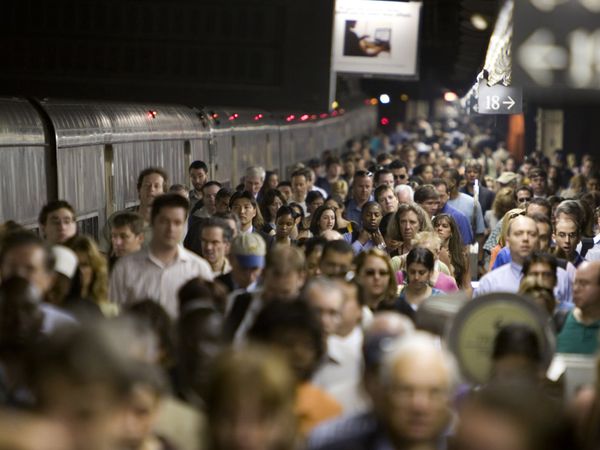
Picture this: A man is seated in the middle of Grand Central Station. The normally packed station is abandoned. He sits in solitude. Suddenly, you walk in and “engage” him. He devotes his full attention to you. That’s not reality. Grand Central Station is never empty. It is a chaotic throng of people, lost and looking, busy and on task- just like social media. They do not want to engage. They want a quick peek and to be on their way. Now, walk up to that same person in the crowded, real world setting and try to “engage” them. They are annoyed by you.

According to a range of results the average Facebook user has between 120 and 300 “Friends”. With that number of inputs commercial users need to be concise and focused with their message.

The high discretionary income Facebook users most marketers crave are sophisticated enough to know they are talking into a hole if they respond to hollow “engagement”. The brands and companies posting open-ended Facebook posts like, “Dave Morgan won Olympic Gold today, what do YOU think of Dave Morgan’s victory?” are getting responses from people who have little better to do than post on Facebook. The real consumers are busy earning discretionary income and spending it, hopefully as fast as they can. They don’t waste time “engaging”. They see something. They want to know about it. They either buy it or they don’t.

How do the most profitable (key word there; profitable) Facebook users look? Here are two:

Dan Whitsett’s “Secrets in Lace” retro apparel brand wields social media effectively to drive measurable results in sales. Their Facebook page is all product, no empty content. Fans respond by exercising their only option: Buying.

 Secrets in Lace is a niche lingerie brand that sells retro-themed women’s apparel. Dan Whitsett started the company in 1984. Whitsett had a singular and focused market vision. His company faultlessly executed that laser-beam focus in their social media. They have 22,000+ fans and the only thing they post about is their products. All their photography is professional and original, no “copy and paste” images on their Facebook page. Their Facebook pages have the same look and feel as their website and print catalog. The message is consistent. They only show their product. They only promote their product.

Patrick Ma of Triple Aught Design is a master of selling with social media. His weekly product “teasers” create a rush on new introductions that drive sell-through. His focus is on brand, product and sales.

Bay area entrepreneur Patrick Ma didn’t just found a company, he founded a category. His company, Triple Aught Design, designs tactical/military inspired outdoor gear. Ma is widely attributed with the invention of the “tactical softshell” jacket, a category now embraced by mega-brands like The North Face and Arcteryx. His 15,000 Facebook fans are served a weeky menu of product “teasers” that provide hints to what new products will be released every Friday. They usually sell out in less than three hours. In a strange quirk of social media some Triple Aught Design customers rant about short supply of new product. Ma lets the rants run, understanding this is the best “call to action” for brand fans there is. It is the advertising you can’t buy.

 There are many other good brands wielding social media effectively and their key link is narrow brand focus, product focus and asking for the sale. Facebook and social media “marketers” need to remember the metrics that count on the bottom line. They aren’t “Likes” or number of fans, they are sales results. A bank deposit slip doesn’t have a box on it for “Likes”.

By Tom Demerly.

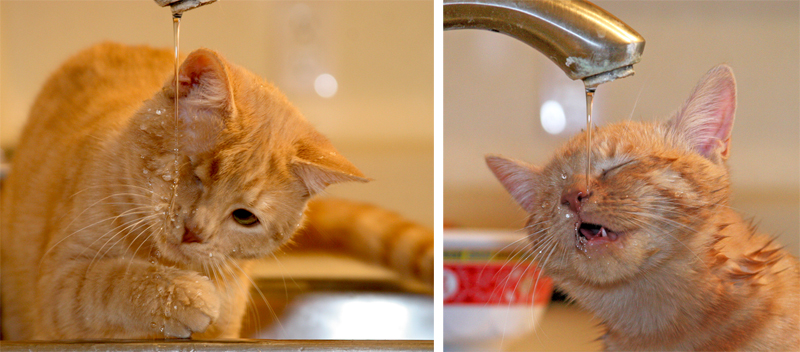
Mimi the cat loves the sink.

I don’t believe in fairy tales. That I’ll admit to…

This is a story of heartbreak, healing and coincidence so odd it makes my brain itch.

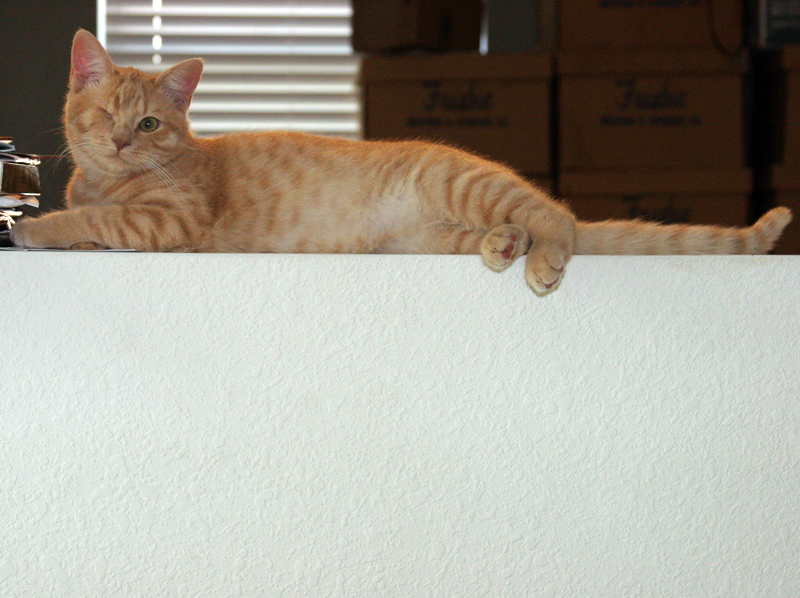
Fred was my cat, my very best friend. Every pet owner will tell you their pet is the best but Fred actually was. Mistreated as a young cat before I got him Fred wound up with me after being rescued and cared for. He had only one functioning eye- his left eye- and was missing teeth. He was orange and white with the temperament of a cartoon character. A trifle overweight, Fred was a cookie-stealer. If you set your cookie down he would grab it with what teeth he had left, then settle for licking it. I lost a lot of cookies to Fred.

At night Fred would sit on the counter watching me do dishes or make tea. I would read to Fred, he liked the sound of a human voice. He loved books about African safaris. He also liked the BBC World News on the wireless. Fred would purr most times when you talked to him. If I asked him a question he wouldn’t say anything because cats can’t talk, but he would always seem interested in what I had to say. At night Fred would sleep next to me, purring until one of us drifted off.

Even though Fred suffered terribly as a young cat something in his cat brain made him a kind animal. His default reaction was kindness. If Mia, my little cat, would attack him, he would simply lay down. If she attacked him again he would make a low rumbling noise and walk away. Fred outweighed Mia by ten pounds, but he never took advantage of it. Fred was wired for kindness. In this life that is a miracle.

 Eventually the things Fred suffered as a young cat caught up with him. He was old, no one knows how old. In his later days he moved slower, stayed in one place more. He never complained. One morning I woke up and Fred wasn’t in bed anymore. He got up early, walked downstairs and lay down near his water dish. He didn’t look good. I called my friend T.J. to take him to the emergency vet. T.J. lives about 15 minutes away but was at my house in 10. I phoned the veterinary emergency hospital 3 miles away and gave them Fred’s vitals. Then Fred looked at me, meowed twice, and died.

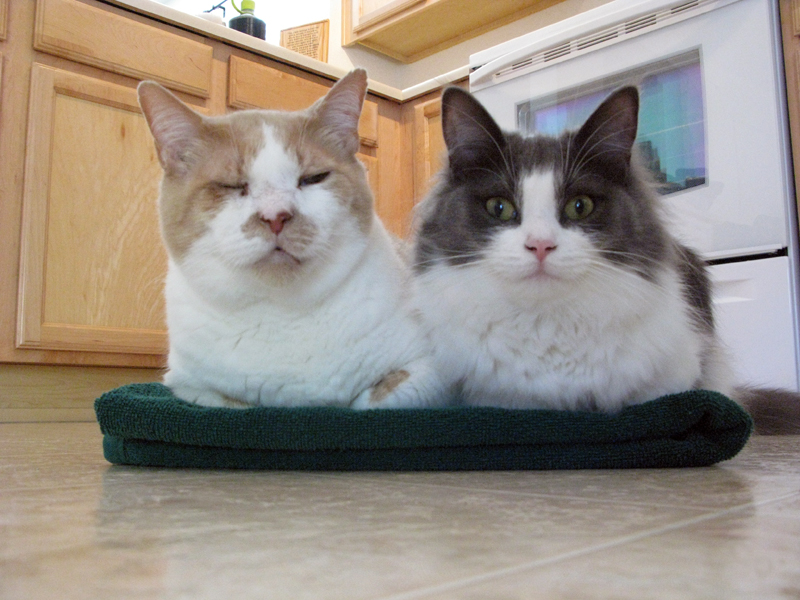
Frederick and Mia.

I cleared his airway, gave him mouth to mouth- all those dramatic things. I picked him up and we drove to the vet. The vet immediately went to work trying to revive him. But Fred didn’t want to come back. He was gone. His little paws turned white.

The vet brought him into an exam room with me. He was on a white blanket. And I was absolutely alone.

When I got home my little cat Mia, only 3, knew something was wrong. Fred wasn’t there. She had an odd look on her face and she lay on the counter in Fred’s spot in a little ball. For three days.

My friend Billy at work is one of those lads whose wild blonde hair is always messy, but always looks right. He rides a big motorcycle, wins his age category in triathlons. Billy decided to quit his job where we worked and move on. It was a blow since he brought expertise and personality to our workplace. They gave Billy a nice send off at a local pizza place. I normally don’t go to these things but Billy, being a good guy and a great coworker, was a special case.

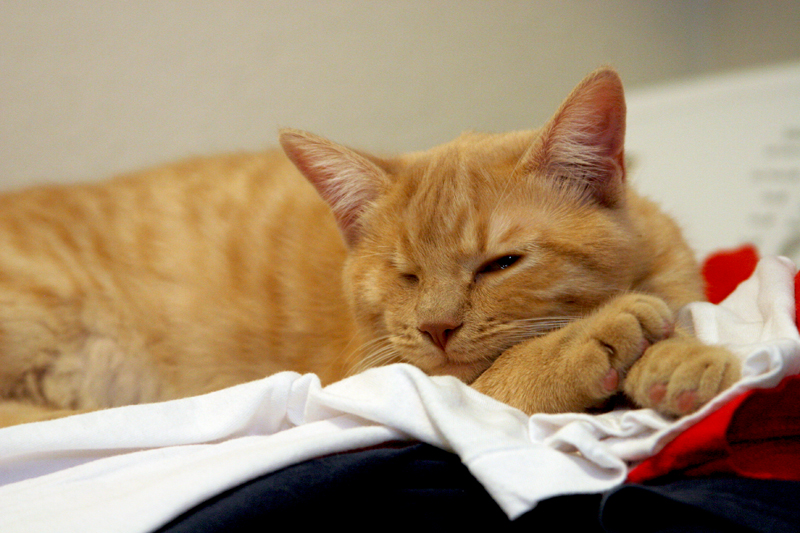
Fred on the left before he passed away, Mimi the day I brought her home on the right.

I was hurting from Fred being gone. Life was awful. I was shuffling around the outside of the giant hole people fall into when they believe life is filled with suffering and loss. I hung a few toes over the edge of the hole. I felt like I was being sucked in. I pulled it together and went to the pizza place for Billy’s sendoff party. Everyone was enjoying the banter, my friend Pete from work was there and a nice sales rep named Travis.

People said they were sorry about Fred. Then Billy told me a story.

“I found this kitten when I was out running.” He said. I felt myself stepping closer to the edge of the hole. It was going to be one of those bad stories where he found a cat and it died. I couldn’t hear too many more of those. He continued:

“It’s eye was hangin’ all the way out of its head, it was in really bad shape man…” God, can it get any worse? This was painful to hear after losing Fred. “So I picked it up and took it to the animal hospital. They saved her.” He took a pull on his beer.

Then it struck me.

“Hey, which eye was the cat missing?” I asked Billy.

“Ahh, right eye dude.” I felt an odd charge.

“What color was this cat?” I had to nip the onset of hopefulness in the bud. In this life, hopefulness only leads to disappointment. Things don’t work out.

“It’s orange and white.”

On the very same day Fred, my left eyed orange and white cat, died Billy found another orange and white kitten in a field with only its left eye. Run the variables. That is statistically bizarre.

But it gets weirder.

Billy took the one eyed kitten to an animal rescue run by a vet student named Gabe. They named the cat “MiMi”. They did an operation, removed MiMi’s damaged right eye. The same bad eye Fred had. They nursed her back to health. She put on weight, started playing with the other cats. She was oddly good natured according to Gabe.

I went to see this kitten. Gabe brought her into an exam room with me. Then he left the room, closing the door behind him with me and this little one-eyed orange cat inside.

The cat walked around, jumped on the counter. It was extremely small. Only 7 months they said. It sniffed, moving its little head swiftly to compensate for only having one eye. Sunlight filtered through a window in the room.

I sat there, this little kitten with one eye on the counter across the room from me. The absurdity of what I was doing hit me. A grown man. Sitting here like an idiot with an abandoned kitten with one eye. My cat died. It was gone. Maybe I should just deal with it. Life sucks and then you die. The kitten kept its distance. Quite some time passed. Why did they leave me in this room so long?

Then a thought entered my head, from nowhere. No one can hear me in here…

“Say,” I said to the cat, “Do you know Frederick the Cat?” MiMi went wild. She walked in tight circles and meowed three times. She leapt from the counter to the exam table, then from the exam table into my lap. She rolled over on her back in my arms, looked at me with that one eye and meowed one more time. Then she closed her eye and started purring.

I filled out some forms and brought MiMi home. She knew where the litter box and the food were. She jumped up on the counter and sat in the sink. She tried to play with Mia the Cat but Mia couldn’t figure out who this new cat was and hid in the corner. Like she had seen a ghost. MiMi listened to the radio and fell asleep when I read to her.

Yesterday I was petting MiMi’s kitten fur. Before Fred died he had a sore on his left shoulder near his scapula bone. It was a raised bump that had to be drained of fluid. It was almost an inch long and about a quarter inch wide.

MiMi has a little scar there.

This slideshow requires JavaScript.

A gallery of images from the 2011 Ford ironman Arizona on November 20, 2011 in Tempe, Arizona.

The scars of brotherhood.

Seven months ago he gave his brother a kidney. Next week he does Ironman.

Ironman, university student, athlete, TriSports.com employee… organ donor: 26 year old Antonio Soto.

Soto is a quiet and dignified lad. His voice floats to your ear on a Latin accent. He is given to understatement. Think Enrique Iglesias combined with Mark Allen. As Antonio and I chat he hands me celery sticks, alternates between looking me in the eye and glancing to the floor.

Antonio’s mother died when he was one and a half. His brother, Gerardo, was only six months. Gerardo contracted SLE or systemic lupus erythematosus, commonly called “lupus”. He fought the disease for years until he was forced onto a dialysis machine for 6 hours a day. For nine months. During the search for a kidney Antonio was initially disqualified as a match. Another donor was found, but fell through since they smoked. A subsequent blood test revealed that Antonio was, in fact, a match to donate a kidney to his brother.

I wondered how Soto’s brother asked him to donate a kidney. “He didn’t”, Soto whispered. “He didn’t want me to donate it.”

“How did you make the decision to give away a kidney?” I’ve never asked an athlete this question before.

Soto glanced back to the floor, pulled another celery stick from the baggy. “You have to know… what is your priority? No sport is as important as my brother.”

Antonio Soto training east of Tucson near Gates Pass. He owns a 10:10:00 Ironman PR and races Ford Ironman Cozumel next week in Mexico.

The Soto sense of family emanates from Tigre Soto, Antonio and Gerardo’s father. Tigre was a competitive canoeist, a difficult and dangerous sport of negotiating rapids in a highly maneuverable hybrid of canoe and kayak. He sometimes trained with Antonio in the back of his canoe. It is obvious those early days between the Soto men forged tight bonds- the type of bonds rare in today’s families.

This weekend I rode with Antonio- me on the back of a camera moto, Antonio on his Giant Trinity triathlon bike. The ride was a combined photo op/meet and greet for BH sponsored athletes Eneko Llanos and Angela Naeth. You may remember Llanos for his gutsy battle in Kona with winner Chris McCormack. Antonio rode like a gentleman through town then, when we reached the rollers of McCain Loop, he went to the front. The group dwindled. On the narrow, curvy road riders slid off the back in ones and twos. I asked my moto pilot, Adam McCreight, to take us to the front. A 50 M.P.H. acceleration on our BMW moto pulled us by flailing riders. There were only six men in the lead group. I looked at our speedometer. On a shallow climb we were going 27 M.P.H. Uphill.

Antonio was on the front. Llanos on his wheel. Four men hung on. They looked under pressure. Antonio looked quite relaxed.

On November 27, 2011, 12 days from now, Antonio is racing Ford Ironman Cozumel. Seven months after giving away a kidney. How will losing a kidney affect Antonio’s Ironman? “It won’t” he tells me, “The body adjusts. As long as you drink enough water and do the right things, there is no difference.”

Antonio takes another celery stick from the bag. “It is no problem. Just a race…” It occurs to me, I’ve never heard another Ironman say it quite that way.

Antonio Soto is a member of the TriSports.com retail staff here in Tucson, Arizona.