Archive

Tag Archives: tom demmerly

By Tom Demerly

jack-ryan-shadow-recruit

The greatest fear I had going into Jack Ryan: Shadow Recruit was that it would be a sad eulogy to Tom Clancy’s genius. I’m pleasantly surprised to be wrong.

Director Kenneth Branagh did his homework and borrowed subtle and successful elements from each of the Jason Bourne, James Bond, Mission Impossible and Tom Clancy franchises to weave a surprisingly good story thread that is visually well done.

Jack Ryan: Shadow Recruit is a tight and snappy spy thriller. It’s well written, tightly shown and quickly paced. Camera, sound and production techniques are tasteful and pay homage to its influences. Very little is over blown. Even the sets are well dressed and chosen.

Writers David Koepp and Adam Cozad used Tom Clancy’s character Jack Ryan with reverence for Clancy’s original vision of Dr. Ryan, the nerdy analyst turned reluctant but capable action hero.

Jack Ryan gets his first kill James Bond style, in a bathroom.

Jack Ryan gets his first kill James Bond style, in a bathroom.

Chris Pine as Jack Ryan is fantastic as is Kevin Costner as Thomas Harper, his CIA boss. And because no great spy film is a success without great villains, it is a pleasure to have Kenneth Branagh as the dangerous Russian, Viktor Cherevin.

The plot hits ominously close to home, literally and figuratively, with a story line that weaves into the little known world of economic warfare. Villains originate from Dearborn, Michigan in the shadow of Ford World Headquarters. The plan is to crash the stock market in a combined terror and economic attack; a scenario everyone hopes will remain fiction.

But Tom Clancy’s fiction has an ominous way of weaving its way into the headlines.

Jack Ryan: Shadow Recruit never sags and builds well to a strong climax. There are a few corny moments but remember, this isn’t a strict Clancy plot. It weaves influences from every corner of the spy thriller genre, and does it with respect and tribute to each. While these stories do become somewhat cookie-cutter this one is flavored uniquely and with enough craft to make it a snappy 105-minutes. And yes, there is a sequel planned that hopefully continues with this fine cast in the upcoming Without Remorse.

Tom Clancy would have loved Jack Ryan: Shadow Recruit. It is tight, quick and nice looking. This is a pleasant surprise after the painful loss of a great author and storyteller who created these characters. That new writers are able to execute on Clancy’s vision confirms their talent and reverence for his mastery.

Taking to the streets with a nod to Bourne franchise in "Shadow Recruit".

Taking to the streets with a nod to Bourne franchise in “Shadow Recruit”.
By Tom Demerly.

Screen-Shot-2013-08-02-at-10.07.53-AM-640x306

Early July 2005: I was in the car. CNN was on. There was a report of a “U.S. long range reconnaissance team lost in Afghanistan”. They went to a commercial.

I pictured what must have been going on. Marine recon, Army Special Forces, Naval Special Warfare, Air Force Special Operations. It was one or some combination of them.  They had no comms, they were cut off, they may be lost, their food was gone. They may not even be alive by the time it made the news.

In the mid to late 1980’s I was a member of a U.S. Army National Guard Long Range Surveillance Team, Co. F., 425th INF (RANGER/AIRBORNE), Michigan National Guard. I was the scout/observer for our five man reconnaissance team.  We never saw combat then. But the sense of being a long way from home, cold, wet, hungry and with no communications is a very familiar one. Our radios never worked. We rarely got comms. We often walked home, even on training missions.

In 2007 when Marcus Luttrell wrote his book Lone Survivor I read it in one sitting, and didn’t sleep well for days. His account of a long range surveillance mission gone bad is harrowing and realistic.

4fb1de7ab2793.image

“Lone Survivor” author Marcus Luttrell signs his new book “Service”. Luttrell’s incredible account of Operation Red Wings deserved a better film adaptation.

This weekend Director Peter Berg’s adaptation of Lone Survivor hit theaters. Berg is the mastermind behind the impressive and haunting film The Kingdom from 2007.

Berg executes the complex story of Operation Red Wings told in Luttrell’s Lone Survivor with the level of authenticity you expect for a 121-minute Hollywood movie. There are moments when the film “works”, sort of. But for the most part it is clunky, forced and unrealistic feeling.

Berg may get a pass because faithfully depicting the horror of a small recon team retreating down a cliff side in the high Afghan mountains of Kunar Province is technically demanding. But remember Steven Spielberg’s D-Day landing scene in Saving Private Ryan, a scene so real it makes you recoil in terror and smell the cordite, exhaust fumes and gore. Even Ridley Scott’s Blackhawk Down, while very “Hollywood-ized” provides a more authentic and vertiginous sense of what combat must be like. Both Saving Private Ryan and Blackhawk Down “feel” more realistic. Lone Survivor relied too heavily on bad set dressing, rotten camera movement, poor make-up and a generally inauthentic “look” to deliver.

lonesurvivor

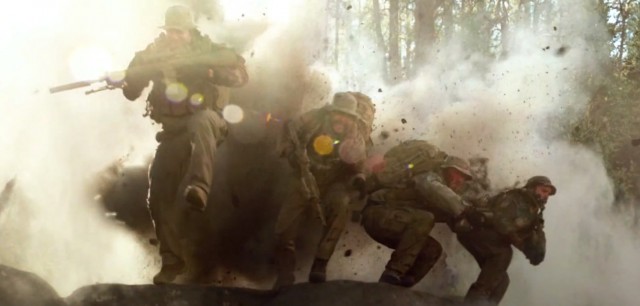
The cast of “Lone Survivor” look more like an airsoft convention than a Long Range Surveillance Team.

The shape and storyline of Lone Survivor is good but the look and feel is shallow and contrite. There is so much “punch” and terror to this story it could have been done better. The digital effects, especially of aircraft and wide scenes, are embarrassingly poor by current standards. Lone Survivor simply looked “hurried” and synthetic. The make-up effects of wounds and blood looked like something you’d see in a Halloween haunted house. Even after three days of a long range reconnaissance patrol the characters didn’t look authentically dirty and grimy.

Another nick against Lone Survivor is that the “Afghanis” didn’t look like they lived in the mountains of Kunar Province. They looked like people from an L.A. cattle call for “Afghan” extras for a film shoot. For reference on how to get it right look at the realistic pirate depictions in Paul Greengrass’ Captain Phillips . Barkhad Abdi and Barkhad Abdirahman were authentic and believable in their roles as Somali pirates, in no small part because they are from Somalia.

Peter Berg’s Lone Survivor is not a total failure. The audience in the theater spontaneously applauded when the credits rolled, so it got their attention. But it isn’t the authentic and horrifying insight into Long Range Surveillance and Marcus Luttrell’s incredible book that I had hoped for.

By Tom Demerly.

20100617_poverty_33  Is our lower class truly poor? Or, is there a cultural shift in expectations that create a conspicuously affluent, but fundamentally impoverished lower class?

The answer points to an important idea: We need to re-orient our society to value education, initiative and personal responsibility and de-emphasize conspicuous consumption and government support of basic necessities.

The United States is in an accelerating crisis that is creating more economic distance between an affluent upper class and a growing “lower class”.

Consider these oddly disparate statistics:

  • 88% of Americans own a cell phone, with 56% owning a smart phone.[i]
  • “Nearly 90% of Americans now own a computer, MP3 player, game console, e-book reader, cell phone, or tablet computer.”[ii]
  • “95% of Americans own a car…”[iii]
  • 15.4% of people in the U.S. were uninsured [in 2012].[iv]
  • “75% of Americans don’t have enough savings to cover their bills for six months.”[v]

Our lower class is often measured by income and employment statistics. But is our lower class truly poor? Or, is a part of the current crisis a cultural shift in expectations that create a conspicuously affluent but fundamentally impoverished lower class? Does a portion of our lower class spend money on the wrong things? And, if so, how could that change?

There is an argument that the U.S. has the richest- and most underemployed- lower class in the world. Our lower class has privately owned cars, cell phones and non-utilitarian clothing but lacks education, savings and healthcare. They have some of the icing but little of the cake. As a result our society must prop up the foundation of personal financial responsibility by subsidizing necessities like food, medical care, housing, education and retirement.

By contrast Forbes reports that China’s personal savings rate is the highest in the world.[vi] One reason, according to both Forbes and the BBC, is that China subsidizes few truly useful social programs. The Chinese must fund their own retirement. China does not yet have national social security legislation.[vii] And despite numerous other Chinese social programs the emerging Chinese middle class and larger, accelerating lower class still feel the need to save money for a rainy day according to one BBC report.

0019b91ed7d1135c841601

On the back of a manufacturing economy bolstered by consumers in the west, Chinese are saving more money than any nation while Americans are saving less.

This is ominous as it puts the U.S. at a strategic disadvantage to China in the economic sector. This also increases U.S. social reliance on government administration of vital programs, a paradigm that has significant risk given the federal government’s weak balance sheet. In short, it weakens our country, not only exclusively, but more dramatically in comparison to our global economic competitors.

“The Affordable Care Act doesn’t provide health care for the poor; it provides financial care for the healthcare industry.”

An additional concern about our current social and governmental direction is that programs like the Affordable Care Act don’t provide health care for the poor; it provides financial care for the healthcare industry. Unlike the federal government’s bailout of the auto industry in 2008-10 there is little provision for a return on investment or any remuneration from the ACA. Its current configuration requires the costs of administration but little revenue stream for administrators. The government becomes a billing agent for private healthcare and pharmaceuticals.

We need to change the direction of America toward valuing the things we’ve discounted over these previous two decades; access to education, quality of education, valuing teachers as pivotal contributors to our nation’s future. We need to teach and reward personal responsibility and initiative. Wealth is not measured by possessions but by capability, output and income.

By Tom Demerly.

christmasshopping

Here we go; Holiday Shopping Season. Black Friday, Cyber Monday. This is the 25-day period when retailers earn their net profit for the year and consumers do most of their buying.

Before the gun goes off this Thursday at midnight (and even before) let’s take a brief look at what customers should demand in the post-recession economy.

There are more retailers and fewer customers than any time since the early 1980’s according to industry expert Mark Ellwood, author of Bargain Fever; How to Shop in a Discounted World. That means you have more choices and retailers have to get it right.  The margin for error- literally and figuratively- is razor thin. A well-run retailer is doing well to earn 1% net profit on gross sales after all expenses at the end of the year. Also, this year, the holiday shopping season is unusually short, only 25 days, because of Thanksgiving’s proximity to Christmas on the calendar.

Stores, both online and brick and mortar, have two major tools to earn sales: Great customer service and lowest price. A wide spectrum exists between these extremes and some especially skilled retailers manage to combine the two. Whether you aspire to the Tiffany’s personal shopping experience or a Walmart elbow-throwing, door-busting footrace to the big screen aisle these are the minimum standards you should expect as a customer:

1.    You should be treated as a Lady or Gentlemen.

You’re giving away hard-earned money at the end of the worst recession in history. You’re not a number, not a commodity. You’re not easily replaceable. Life long retailer and founder of the quirky, niche specialty retailer Harry’s Army Surplus in Dearborn, Michigan, Irv Zeltzer, said it best, “Every dollar has 100 cents”.  To earn that precious 100 cents retailers should treat you with respect and reverence. Retailers should value you.

2.    You Deserve to be Waited On.

Remember when clerks waited on you? Good service means there are employees or well-designed online resources to find out information and help you with buying decisions. This is a key feature since it adds value and savings to a purchase by reducing costly errors and returns. Your time is tangibly valuable. A sales associate or web resource that helps you make a faster, wiser purchase saves you time, and time is money.  Smart retailers also know good customer service reduces returns and adds to sales and profits.

3.    You Deserve Honesty and Openness in Pricing.

There are a lot of pricing shenanigans this time of year, triple and quadruple mark-downs, fine print, weird return policies, coupons, membership buying. Straightforward pricing is a key tool to understanding the value of a purchase. Beware of convoluted pricing schemes. Remember, the time it takes you to figure out if a deal is any good just cost you something more valuable than money; it cost you your time.

4.    You Deserve Good Service After the Sale.

Retailers should do “back end” planning for their post-holiday returns and customer service. The staff should know the policies and be empowered to make decisions. Lines shouldn’t be long and waits to make returns should be short. Retailers have a great opportunity to retain customers and earn new ones with great service after the sale. They need to get this right. It will bring in customers during the other 345 days of the year.

Customers fall into a trap of using price as the measurement of quality in a retail transaction. Good value is about more than markdowns and low prices. If you are focused on what you deserve as a customer before you line up on Friday morning you’ll have a better shopping experience this season.

By Tom Demerly.

81b63d97a3731980aa9fd7e0f4f513ff

Contrary to popular belief, rich people don’t cause other people to be poor. That’s a feeble excuse for our national condition.

There is a sentiment that the distribution of wealth in the United States, as inequitable as it is, comes from the wealthy “keeping the little man down”.  To horde disproportionate amounts of wealth- taking it from the backs of Walmart workers.

That’s wrong.  We’re not victims, we’re Americans. “The Man” isn’t keeping us down. That’s just an excuse. It’s us who let us down, and I am a perfect example.

I started and owned a successful business for over 16 years. Then lost everything. I lost my savings, my house, my car, my belongings, my income, my employees, my business, even my health… everything. There were circumstances that contributed to my loss. But ultimately I am the one responsible. Part of the proof is that two friends of mine in the same area and the same industry survived the recession. They survived because they made better decisions than me. They are better businessmen than me.

I am a reason why America failed during this last decade. There are a lot of “me” out there.

There is a reason to own this. Until we own the recession, the mortgage crisis, the banking collapse- unless we own these disasters, on an individual basis, we cannot correct them. We won’t truly recover.

The first step to correcting any problem is owning it. Taking responsibility for it. We need to take a painful and specific look at where we made bad decisions individually that led to our financial hardship. Once we understand how we got here, on an individual basis, we can get out, on an individual basis. America is built on the backs of individuals, and it fell on the backs of individuals who let it down. Guys like me.

Dearborn, Michigan, 2009 on Michigan Ave.

Abandoned businesses, downtown Dearborn, Michigan in 2009 on Michigan Ave.

What did I do wrong? Too much credit, not enough saving. Poor planning. Relying on the fact that money was easy to make and would always be easy to make. Becoming complacent, assuming business would always be good. Trusting the wrong institutions and people. Not saving enough for a rainy day. Beginning to think that earning a living was easy and success was common. Ignoring the basics. Never planning for a downturn in business. Those are some of the general mistakes I made. When you apply those mistakes to a huge company like General Motors before their bankruptcy, the banks before their collapse and the real estate market you see how these behaviors rippled from the individual through our entire culture. It was a house of cards. When the wind finally blew it didn’t need to blow very hard for it to topple.

So what now?

First, we need to own the problem on an individual basis. Look at how we failed. Individually, collectively. Then, with that knowledge, return to the basics of saving and building, working and taking risk, thinking and innovating. Our economic system, as chaotic as it seems, rewards risk and hard work with opulent success and penalizes failure with ruthless disregard and gut-wrenching impunity. It also rewards us with a second chance. It isn’t easy, in fact it is extremely difficult. My life these past few years has been more difficult than I care to share. It’s humiliating. Our system does work though. It provides a level of opportunity, however abrasive and difficult to achieve, that is nearly unmatched in the world. This is the greatest country, the land of opportunity, but it is also a ruthless arbiter.

It demands we own our past before we can earn our future. But our system also forgives.

In my case that meant a lot of tough years. Now I am certain I’ll never make these mistakes again. I’m thankful for a country that allows me to start again with what I’ve learned, no matter how difficult it is. That is the American way.