Archive

Tag Archives: tom demerly’s new bike shop

By Tom Demerly.

Specialized Bicycles' Founder and CEO Mike Sinyard personally traveled to Cochrane, Canada to delivery an apology to Cafe Roubaix founder Dan Richter.

Specialized Bicycles’ Founder and CEO Mike Sinyard personally traveled to Cochrane, Canada to delivery an apology to Cafe Roubaix founder Dan Richter.

In a widely shared story on social media from December 8, 2013, bicycle mega-brand Specialized Bicycles threatened legal action for alleged trademark infringement against small local retailer Cafe Roubaix Bicycles in Cochrane, Alberta, Canada. The threat originated from concerns by Specialized Bicycles over their legally protected trademark for the word “Roubaix” when referring to specific product categories.

Social media critics, including this writer, were quick to point out what appeared at the time to be a heavy-handed approach by Specialized.

On Thursday, December 12, 2013 Specialized founder Mike Sinyard was quick to reply with a sincere apology to Cafe Roubaix Bicycles’ owner Dan Richter. In the apology, Sinyard said, “I just want to say a big apology for this whole thing that got way out of line…”

“I just want to say a big apology for this whole thing that got way out of line…” Mike Sinyard, Specialized Bicycles.

Sinyard traveled to Cochrane, Canada to deliver the apology in person at Cafe Roubaix Bicycles. In a text book example of social and business crisis management Sinyard went on to say, “I completely take full responsibility.”

Specialized Bicycles can be credited with financial support of independent bicycle dealers across the U.S. who have suffered during the recession. In several cases Specialized has provided financing, management, merchandising and inventory assistance that saved local retailers from closing. In addition Specialized Bicycles has demonstrated extensive support of social and environmental causes through their “Sustainable Innovation” initiatives that include environmental, import and workplace guidelines for corporate integrity.

Sinyard’s textbook example of crisis management establishes a new standard of corporate responsiveness and accountability in the cycling industry and cements Specialized Bicycles’ status as a leading brand in cycling.

By Tom Demerly.ap_twinkies_comeback_jt_130623_wgOwn it.

Before you can change it, you have to own it. Owning your failures is the first part in not repeating them. Understand that owning your failures may be different from fixing them. Some failures can’t be fixed, they can only be owned. The difference is taking a hard look in the mirror and understanding what you did to fail in the first place so you never repeat it. Making excuses and blaming others doesn’t work.

Dissect it.

Once you own your failure you can examine it in a forensic manner. What did you do wrong? Hindsight is 20/20. A detailed accounting of what got you into failure is the second step in climbing out of it and, most importantly, avoiding it again.

One warning: Avoid the paralysis of analysis. Once you dissect your failure and own it you must have control over it. It can’t own you through fear. The perspective of friends and associates can help with this. Understand what things are inside your “sphere of influence” (Stephen R. Covey, The Seven Habits of Highly Successful People) and what lies outside it. Control what you can control and let the rest go.

Get to Work.

There is only one way back from failure: Hard work. This means work without pay, work without sleep, work without adequate food, work without convenient transportation and work without the things that make work easy. It’s just ditch digging. You may need to work in an austere environment and not make excuses while doing it. Accept that. In fact, embrace it. This is the filter through which you must pass to achieve success again and the reason why few people do. They simply aren’t tough enough.

No excuses, no shortcuts. Hard work, measured risk and good decisions led to the only American to ever win the Tour de France, Greg LeMond's, spectacular victory in 1989.

No excuses, no shortcuts. Hard work, measured risk and good decisions led to the only American to ever win the Tour de France, Greg LeMond’s, spectacular victory in 1989.

Except in dire need (such as feeding children), avoid government social programs to assist you. They are time consuming to apply for and laden with bureaucracy. You are better served working a minimum wage job. This is part of the axiom in any survival situation that following the crowd will make you a refuge. Refuges don’t have control of their future. They are victims. The real danger of reliance on social programs is that once you get on them it could be hard to get off.

Don’t Compare Your Situation to Others.

When you own your situation you don’t look at other people and feel sorry for yourself. Instead, you celebrate the successes of others and take inspiration and hope from them. They are a source of strength. Be focused on your own life and goals. Don’t permit distractions. Maintain a “glass half full” mentality that author Stephen Covey called the “abundance mentality”.

Network.

While it’s tempting to crawl into a hole and hide when you fail, resist that temptation. Instead, show others how proactive and vigorous you are. Instead of just asking for help, ask to help them. You always have something to offer even if it is shoveling snow or listening to someone’s problems. Helping others boosts your self worth and keeps you positive. Remember that no job is beneath you. Even if you were the owner of a million dollar company and you land a job cleaning toilets treat those toilets as your business and a reflection of yourself. Make them the cleanest, best toilets you know how and find ways to improve on that. Always strive. Never settle.

By Tom Demerly.

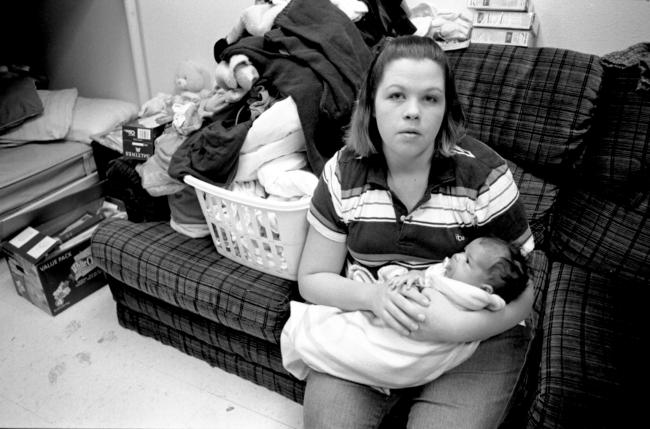
20100617_poverty_33  Is our lower class truly poor? Or, is there a cultural shift in expectations that create a conspicuously affluent, but fundamentally impoverished lower class?

The answer points to an important idea: We need to re-orient our society to value education, initiative and personal responsibility and de-emphasize conspicuous consumption and government support of basic necessities.

The United States is in an accelerating crisis that is creating more economic distance between an affluent upper class and a growing “lower class”.

Consider these oddly disparate statistics:

  • 88% of Americans own a cell phone, with 56% owning a smart phone.[i]
  • “Nearly 90% of Americans now own a computer, MP3 player, game console, e-book reader, cell phone, or tablet computer.”[ii]
  • “95% of Americans own a car…”[iii]
  • 15.4% of people in the U.S. were uninsured [in 2012].[iv]
  • “75% of Americans don’t have enough savings to cover their bills for six months.”[v]

Our lower class is often measured by income and employment statistics. But is our lower class truly poor? Or, is a part of the current crisis a cultural shift in expectations that create a conspicuously affluent but fundamentally impoverished lower class? Does a portion of our lower class spend money on the wrong things? And, if so, how could that change?

There is an argument that the U.S. has the richest- and most underemployed- lower class in the world. Our lower class has privately owned cars, cell phones and non-utilitarian clothing but lacks education, savings and healthcare. They have some of the icing but little of the cake. As a result our society must prop up the foundation of personal financial responsibility by subsidizing necessities like food, medical care, housing, education and retirement.

By contrast Forbes reports that China’s personal savings rate is the highest in the world.[vi] One reason, according to both Forbes and the BBC, is that China subsidizes few truly useful social programs. The Chinese must fund their own retirement. China does not yet have national social security legislation.[vii] And despite numerous other Chinese social programs the emerging Chinese middle class and larger, accelerating lower class still feel the need to save money for a rainy day according to one BBC report.

0019b91ed7d1135c841601

On the back of a manufacturing economy bolstered by consumers in the west, Chinese are saving more money than any nation while Americans are saving less.

This is ominous as it puts the U.S. at a strategic disadvantage to China in the economic sector. This also increases U.S. social reliance on government administration of vital programs, a paradigm that has significant risk given the federal government’s weak balance sheet. In short, it weakens our country, not only exclusively, but more dramatically in comparison to our global economic competitors.

“The Affordable Care Act doesn’t provide health care for the poor; it provides financial care for the healthcare industry.”

An additional concern about our current social and governmental direction is that programs like the Affordable Care Act don’t provide health care for the poor; it provides financial care for the healthcare industry. Unlike the federal government’s bailout of the auto industry in 2008-10 there is little provision for a return on investment or any remuneration from the ACA. Its current configuration requires the costs of administration but little revenue stream for administrators. The government becomes a billing agent for private healthcare and pharmaceuticals.

We need to change the direction of America toward valuing the things we’ve discounted over these previous two decades; access to education, quality of education, valuing teachers as pivotal contributors to our nation’s future. We need to teach and reward personal responsibility and initiative. Wealth is not measured by possessions but by capability, output and income.