Archive

Tag Archives: Tom Demerly

Photos and Story by Tom Demerly with Jan Mack.

shark20_700size_wcredit

I’m going to puke.

The waves just won’t let up. My equipment is too tight. It is digging into my guts. I pissed inside my wetsuit and another guy’s fins keep whacking my ankle hard enough to make my legs scream. I’m drenched with cold salt spray. The wind coming over the bow is freezing. I can’t see a thing except some vague notion that we are getting farther and farther from land and the ocean keeps getting rougher and rougher.

I’m headed south from Roatan Island, Honduras in a very crowded, open skiff that more closely resembles a Somali refugee boat than a dive yacht. My girlfriend is sitting next to me.

At least she was my girlfriend when we got on the boat.

She might not be if we make it back to shore. This week she earned her Advanced Open Water SCUBA Diver certification, often diving in silty, dark brown water with the same visibility as day-old coffee. Now we’re about to dive in heavy seas far offshore at significant depth in a school of sharks. Big sharks.

And we’re not using a shark cage.

Speaking of refugees, some of our boat crew looks more like… well; this isn’t Jacques Cousteau’s Calypso. They find some seemingly random point in the tossing ocean marked by a soccer ball-sized red buoy almost too small to see. It’s too deep to anchor. We tie off to the buoy line.

The incessant, nauseating roll of the ocean is worse once the boat stops. At least I’m not getting pelted by freezing salt spray and having my rapidly contracting nuts crushed on the fiberglass benches of the gunwales anymore.

sharkdive10

The idea is, “Get out of the boat as fast as you can” because being in the boat sucks. Divers are doing back rolls into the waves immediately, like there is a fire on board. I think everybody is ready to barf, and SCUBA divers know it is always calmer underwater.

I glance at my girlfriend. She isn’t smiling.

I roll off the rail and fall a long way into a wave trough before I hit the water tank-first with a commanding splat. The boat slides down the same wave and crushes me underwater. I’m glad I forgot to inflate my buoyancy compensator vest since I really would have gotten clobbered if I had, but now I’m hurrying to get compressed air into my vest since the weight of my gear is dragging me under fast.

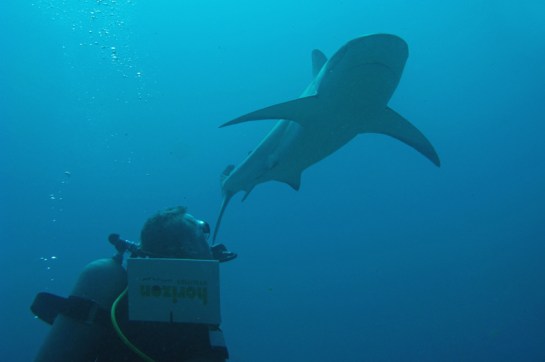
I roll over and look down. There is a shark. About the size of a Toyota. Its pectoral fins are gracefully splayed outward; I have a perfect plan-view of it 60-feet below. There is another. And another… They circle slowly in silence down there.

The sharks know we are coming. They swim up from the depths and wait. Wait for something to eat. Wait for us. Wait for the black-rubber bubble monkeys to come see them.

sharkdive30

This is the Cara a’ Cara dive site. In Spanish, “Face to Face”. It’s named that because it is world famous for having a face-to-face encounter with big sharks at depth without protective cages.

There are a few species at Cara a’ Cara but the most common are Carcharhinus Perezi, the Caribbean Reef Shark.

Caribbean Reef Sharks are large, about 10-feet at full size. They share the top of the food chain with other large sharks in the Caribbean reefs, especially in shallow water above 200 feet depth.

These sharks are not dangerous or aggressive. If they feel threatened, which is rare, they exhibit a “threat behavior” posture akin to a cat arching its back. They eat fish, and because there are a lot of fish around them in the Caribbean, they are seldom hungry. These facts make them a rather threatening looking, but actually agreeable shark species.

We’ve brought fish with us, and a load of camera toting “adventure” tourists looking for a thrill, a good story, a good Facebook post. And I am one of them.

We brought our dive master with us. His name is Russell Nicholson. Nicholson would fit easily into the crew of the Calypso as one of the divers in a Jacques Cousteau documentary. Bearded, slim, handsome, fit, 26. He speaks with a British accent that seems like narration in every Discovery Channel wildlife documentary you’ve seen. Nicholson has dove everywhere. He is calm and relaxed underwater. During our dives earlier this week I studied his technique, fanning his fins in a motion more like an aquatic animal than a SCUBA diver to move slowly along underwater.
sharkdive40

I don’t know it now, but Jan is still on the surface, tossing over the waves and expressing concern about the safety of this dive to Russell.

Me? I’m a tourist who just wants to pet sharks.

As usual it is decidedly less chaotic underwater. Visibility is good, maybe a couple hundred feet, the water is warmer than the air and there are, thank God, no waves churning my stomach down here.

A queue of divers who speak five different languages hangs onto the mooring line beneath the buoy. Our languages don’t matter underwater. We descend the mooring line as a group, as though we are rappelling into the steel blue depth.

There is a reef at our back forming a natural theater. We keep the theater wall to our back, presumably to limit the approach of sharks from behind us but more realistically to keep a bunch of tourist divers from swimming off willy-nilly chasing sharks and getting lost a couple miles off shore.

We pack in, divers next to one another against the reef at 70-feet depth. A moray eel who makes his home here sticks his large, green head out inches from my right elbow in greeting or in grumpy warning to “stay off my lawn”.

sharkdive50

The dive master on this dive brings a bait box to feed the sharks. And this is why they always come. And also why what we are doing may be considered wrong.

According to the late R. Aidan Martin the former Director of the ReefQuest Centre for Shark Research, a Research Associate of the Zoology Department of the University of British Columbia, and an Adjunct Professor of the Oceanographic Center of Nova Southeastern University:

“In recent years, organized shark feeds have provoked considerable controversy. Critics claim that this activity changes the behavior of sharks and the structure of reef ecosystems. There is concern that sharks become dependent on these ‘hand outs’ and may associate all humans with food, increasing the likelihood of attack. Proponents argue that sharks are simply opportunistic, if the feedings stopped, the sharks would simply disperse and go back to feeding upon whatever they fed on before. Although accidental nips have occurred (mostly received by ‘shark wranglers’ conducting the feed underwater), there is no good evidence that shark feedings increase the likelihood of attack away from the feeding site. The issue of modifying reef ecosystems is more difficult to assess. Yes, shark feeds may concentrate predators artificially and the intensified removal of fishes from the environment for use as shark bait is a concern. But populations of sharks and other reef predators have been seriously depleted by overfishing and habitat erosion and many operators use left-over scraps from local restaurants, using fish remains that otherwise would have gone to waste. Clearly, this is a complex issue and a quick or easy resolution is not on the horizon.”

My guilty concerns about reckless “eco-tourism” are somewhat assuaged by Martin’s remarks. If we leave, the sharks won’t flop around on the bottom waiting for handouts from tourists. They’ll just keep being sharks, like they’ve done for millions of years as one of the oldest surviving species on earth.

sharkdive60

The sharks are close now; there are about 20 of them. And they are breathtakingly beautiful.

I’ve loved sharks- or the idea of sharks- all my life. When I was a kid I read Peter Benchley’s novel “Jaws” and saw the movie over and over. I’m not sure why I liked it so much. It just seemed… adventurous.

But as we grow up our perspective changes. And hopefully we learn. Between my years as a zitty teenager reading Peter Benchley books and sitting in the dollar theater and now I had traveled the world. I remembered my fascination with sharks. After nearly 200 triathlons, quite a few of those in the ocean, I had never seen one- a big one, up close. I was a SCUBA diver, but all I saw were nurse sharks. One time a big bull shark followed me while snorkeling in Belize. Another time I found a school of sickle fin lemon sharks in the Virgin Islands and waded in to swim with them while they dined on a school of panicked baitfish.

But I never had that moment with sharks, big sharks. Until now.

sharkdive70

Operating my camera took work as the sharks circled in front of us at 70 feet. I tried to stay relaxed so I got decent photos. Prayed my camera would work down here.

Then I looked up. She was four feet from me, swimming right into my mask. A big 8-footer. A shark bigger than me. I shot one photo of her coming head-on, then gently kicked my fins once to scoot over, to let her pass.

She was only inches from me, so I touched her. You aren’t supposed to touch the sharks on a shark dive, but I will die someday and this may be my only chance. It was selfish, but I wanted to know what it felt like to touch her, and I wanted her to know I did.

I gently laid my hand on top of her right pectoral fin. It remained motionless as she glided forward slowly. I was struck by her… firmness. Her pectoral fin was hard. The sharkskin, just as you read, was rough and like sandpaper. Fine sandpaper.

She did not react, flinch, dart away, rear around and bite. She just swam- glided rather- straight ahead. I watched, her tail barely undulating slowly side to side in an elegant kind of Hula.

The divemaster opened the bait can and the sharks went berserk, a wild spinning mass of 8-foot rifle bullet bodies darting into the same space. The clear water was stirred into a silty mess, and I was surrounded by sharks ripping a small bait bucket to pieces.

I don’t know where my girlfriend was.

sharkdive80

The silt settled quickly as it does at depth, and the sharks regained their composure. Now the divers left the rock amphitheater and swam amongst them. We swam with them, alongside them.

It seemed so incredibly good, so beautiful and safe and wild and good. The gentle sharks, retired from their feeding frenzy, glided amongst us, cameras going off, divers marveling at their size and shape and girth and elegant power.

And then divers began to ascend the rope. But I wanted to stay. As divers left I was on the bottom with more and more sharks- there were more of them and less of us. Finally, the last diver and myself started toward the buoy line to begin our sad ascent to the world of air and problems. I did look down one more time at them, and they were leaving.

I fear that we are losing the world. Nature. Animals. The sea. That it is already damaged beyond repair and despite our quaint efforts to save it, it is too late. And I am old. 54. So this may have been my last chance. And I did, quite selfishly, take it.

One day I will die.

If I am lying in a bed, doped by drugs and drifting in and out of life, I hope I remember them still- the beautiful sharks- and how I felt with them. How perfect and majestic and regal they were. I hope I remember them as I die of old age.

sharkdive90


Author Tom Demerly likes cats as well sharks, can’t help petting them both and has been all over the world.


tom


By Tom Demerly for tomdemerly.com

bikeshopdentist

Was at the dentist today. $2,297.00.

My dentist is excellent. Truly. Does a fine job, professional and current on modern dental techniques. Great staff. Nice guy too.

As luck would have it my dentist is also a triathlete. While I was at his office I picked up his bike and brought it back to our bike shop to do a tune-up on it. He’s got a nice bike. He should.

I got to thinking: Why can my dentist command $2500 for services, but I will only bill him about $90-150 for his bike tune-up that takes about the same time? And before you argue that your teeth are a serious “health issue” I will suggest that your bike brakes are too when you need to avoid a collision with a car.

Why is the bike industry unable to command prices for service and products commensurate with other industries? Why is a doctor, a dentist, a plumber, an HVAC repairperson or an auto mechanic so much more expensive to hire than a bike fitter, bike salesman or bike mechanic?

Why are similar things so cheap in the bike industry, when they are priced consistently higher in other industries?

Like any single economic question, there is not one singular answer. It is worth inventorying the reasons why the bike industry, benchmarked against other industries, is habitually under-charging- especially for service- despite growth in demand and technology in cycling.

U.S. culture teaches us bicycles are children’s toys. Labor rates for servicing a Jet Ski, motorcycle, snowmobile or an RV are similar to automotive repair rates. But fixing a bike is something we grew up doing in our driveway. Our value calibration of bicycle service starts in our driveway as a kid. Because the bicycle industry as a whole remains largely unsophisticated compared to Apple and Tiffany’s stores, that value calibration of bike retailers remains lower than other consumer experiences.

bike shop kids

What can the bike industry do to change the perception that bikes are toys and labor should be cheap or free? There are a few answers, but the most apparent are to provide a more modern and sophisticated presentation of services and an updated visceral customer experience congruent with newer high-end client services and retail.

Let’s go back to my dentist’s office.

Days before my appointment I always receive a text message reminder from his office. They also phone me and leave a message with a reminder.

The dentist’s office has a trained receptionist, a “Concierge”, who coordinates services, attends to questions and generally administers logistical concerns with patients. It is her only job- to facilitate a smooth and pleasant transaction. She also handles the payments. The entire payment process is segregated to a different staff, a different physical location in the building. This helps solidify the payment experience as finite, non-negotiable, consistent and repeatable.

My dentist’s office is clean and modern, beginning with the exterior of the building. The signage and everything that transmits his brand message is attractive. His treatment spaces are spotlessly clean and meticulously arranged, not only for obvious sanitary reasons, but also to transmit the impression that this is serious business.

drbruce

Bike shops, by comparison, are less formal places where employees dress in shorts and T-shirts and customers “hang out”. You act how you dress, and you charge how you dress too. The vibe in bike shops is decidedly less professional, and consequently, so are the prices.

For these and other reasons my dentist can command $2500 for a service that takes about the same time and experience as rebuilding his Shimano Di2 carbon fiber triathlon bike. He collects more than ten times the revenue I do for a service that is more similar than dissimilar. And remember my analogy about your bike brakes being as important as your cavities when you’re riding toward an intersection at 20 MPH.

And before old timers argue that a more polished, cleaner, professional approach won’t work in bike shops, I will argue that it likely will, since most adult cycling customers are actually new cycling customers whose benchmark of what a customer experience should be is formed in retailers like IKEA, Apple, Victoria’s Secret and Abercrombie– not hanging out with the guys at the local bike shop. In fact, it is likely the only bike consumers that still want a homy, small-town, casual “buddy-buddy” personal feel to bike is the guy behind the counter, not the customer in front of it.

bikefit80

Change channels.

Tiffany’s is a high-end jeweler made famous by the movie “Breakfast at Tiffany’s” and is still famous for a few reasons, one of which is their iconic “Tiffany blue” (trademarked) brand color. Buy any engagement ring of a given size at Tiffany’s and it is roughly ten times the price of an equivalent sized ring from the corner jeweler. It also carries a consistently higher perception of worth and brand identity.

From 2007 to 2015 Tiffany’s revenue grew 60.49% according to Morningstar.com. That is despite the brutal recession in the U.S.

How does Tiffany’s command a price often ten times higher than an apparently comparable product and still increase sales, even during the recession?

tiffanystore

There are several reasons my dentist and Tiffany’s can command more revenue for seemingly similar services and products to the adult cycling industry.

Firstly, they ask for it. And dress for it.

Setting price immediately establishes a value calibration. When I lived in the Middle East I noticed this value calibration is often highly nuanced. The Arabs (and Chinese) invented commerce as we know it today. They know, unless you ask, you will never get the price you want.

Tiffany’s has also established uniqueness and differentiation through their fortunate product placement in a popular old movie and in every brand message they send, right down to their packaging and bags. When a person walks through a high-end shopping mall with a Tiffany blue bag in their hand, it not only calibrates our perception of the customer as affluent and discerning, it also spreads the brand message of Tiffany’s. It’s advertising. And it bolsters our impression of the customer.

By comparison most bicycle retailers use customer bags that look like you should empty a cat litter box in them.

Tiffany’s also maintains a quiet, reverent display and sales environment. A salesperson in Tiffany’s is never interrupted by a telephone ringing on the sales floor. Phone calls to the stores are answered off the sales floor. A phone never rings in the shopping spaces.

Change channels.

e-Bay is backwards retail. People list items, often used, sometimes of dubious value, on e-Bay and consumers compete upward for price in the auction format. Think about that: compete upward.

 Why do people compete upward for price on e-Bay when normal market forces exert downward pressure on pricing in retail?

Two reasons: Time component and repeatability of transaction quality (different from item quality).

e-Bay auctions end at a specific time, and the expiration of an item’s availability manipulates our perception of its value. e-Bay is also competitive since supply on unique items is finite and limited. When it’s gone, it’s gone. Both of those components exert an opposite competitive effect on pricing.

ebayauction

The quality of the transaction on e-Bay is almost always identical. This is different than the conduct of the seller and the quality of the item being sold/purchased. But it makes a case that the quality of the transaction (separate from the item in the transaction) is a key driver in our perception of price.

If the transaction experience is inconsistent and/or below industry standards it devalues the purchase price. Buy an antique figurine at a local resale shop, pay $10 for it. Buy the exact same figurine on e-Bay, pay $20, $25, $40…. Whatever the final bid is. People negotiate upward in a proven, repeatable transactional template with finite constraints on supply and uniqueness rather than commodity.

How can bike shops leverage these strategies to improve both the customer experience while raising revenues and profits?

The good news is there are tons of opportunities for the bike industry to provide a better experience for its customers. Of course, the reciprocal is that our current standard of customer experience is poor and lagging behind professional offices and forward thinking retail brands like Tiffany’s, Apple and others. Still, this creates a massive “empty space” where bike retailers could be earning more and providing a better experience.

negotiating-with-a-car-salesman-612mz111910

Step One: Recalibrate the Bike Shop Experience.

Why do you stand in line at a cash register when paying for a $5000 bike when you sit in a comfortable chair at an automotive dealership or at Tiffany’s to pay for your car or engagement ring?

Seated checkout in a non-cash/wrap setting is a small but significant step in recalibrating customer’s experience and perception of what it is to shop at a specialty bike retailer.

Having one staff member in each shift designated as the “Concierge” who greets, directs customer traffic and may also administer the customer checkout experience during slow traffic hours is another key experience quality feature that recalibrates customers’ perception of our industry.

bestbikedisplay

There are many, many other opportunities for bicycle retail to improve the customer experience by changing the transaction environment and appearance and also by adding tangible value to adult bike sales and service.

In fact, there are enough for me to fill a book with.

A problem in the bike industry is that few bike retailers and service providers are benchmarking outside our industry for ways to make the experience better in our industry. Until that changes, we’ll keep hanging out with our customers before and after shop rides in cool shorts drinking expensive beer while earning cheap wages.

“Nobody knows the future, you can only create the future.” Jack Ma, founder of Alibaba.com.

By Tom Demerly for tomdemerly.com

maik

German pro Maik Twelsiek had the fastest bike split at the Ironman World Triathlon Championship in Kona, Hawaii in 2015 on a Dimond beam bike. It may suggest the re-emergence of the beam design.

In a different life I gathered intelligence for the U.S. Army.

On some missions we would watch something, say a building or a road intersection, for hours or days. And nothing would happen.

Sitting on a target for days and seeing nothing happen may seem like an intelligence failure. But it may not be. It is in the empty spaces that most possibilities exist. And when the silence is deafening, there is often a reason.

Such is the case with a seemingly innocuous set of events in the bike industry over the past two years.

Before I begin, I want to state the standard diatribe about predicting anything in any setting, the analysts’ safety net: I will state facts and from these facts I will make some vaticination about an outcome. This outcome is neither assured nor probable. You may or may not recall what Victorian journalist George Eliot wrote about such insights as I am about to proffer: “Vaticination is only one of the innumerable forms in which ignorance finds expression.”

Exhibit A.

On January 5th, 2015, nearly a year and a half ago, Cannondale hired a man named Damon Rinard.

Rinard is a quintessential geek. Seemingly uncomfortable in his skin, he frequently glances at the ground when talking until the conversation turns to his field: engineering. Specifically, bicycle engineering. Most specifically, aerodynamic bicycle engineering.

When Rinard orates about bicycle aerodynamics and frame engineering his chin is held higher, his voice drops an octave and he commands attention. Rinard is arguably the most sought after engineer in the niche of a niche that is aerodynamic road bicycle design, including most significantly, triathlon bikes.

cervelo1-652x326

Rinard was instrumental in the development of the Trek Speed Concept and contributed to the current generation of Cervelo aerodynamic designs. These two brands sit number 1 and 2 atop Lava magazine’s “Kona Bike Count” for 2015. Rinard’s influence touched a staggering 797 bikes at Kona in 2015, nearly half the field. As such, Damon Rinard owns the place as the most important man in triathlon bike design that no consumer has heard of. Your concept of what a triathlon bike looks like is shaped by what Damon Rinard has already done.

When Rinard went to Cannondale at the beginning of 2015 the brand had a strong line of road bikes. These include (arguably) the most advanced aluminum road bikes available since Cannondale is a pioneer of the oversized aluminum road bike and has continued to develop the niche even in the carbon fiber era. Additionally, Cannondale has numerous carbon fiber road and triathlon bike models.

But Cannondale has no aerodynamic bikes.

Enter Damon Rinard. One glaring omission from Cannondale’s current line-up is an aerodynamic road bike platform. A second, more significant, omission is an aerodynamic triathlon bike.

Cannondale has an offering in the “third generation” triathlon bike, the “Slice”, that occupies a nice niche’ for the company. The Cannondale Slice is a short-reach, moderate stack tri bike that excels in fit for short torso riders and in low frame weight. But Cannondale does not have a fourth generation triathlon platform developed using CFD (computational fluid dynamics) with visually conspicuous aerodynamic styling. Nor does Cannondale have an aerodynamic road bike analogous to the Felt AR or Cervelo “S” series bikes.

Rinard is an expert at engineering both the aerodynamic triathlon and aerodynamic road categories.

Was Rinard hired eighteen months ago by Cannondale to introduce new models in the aero road and aero tri categories? Because these two categories, one of them a prominent one (aero tri), are so conspicuously absent from Cannondale’s line-up?

Exhibit B. 

If Andy Potts isn’t the most likeable professional triathlete in the sport, then he is among the top three. Potts is articulate, aware of his image, handsome, affable and fast on the racecourse.

Although Potts has never won the Ironman World Triathlon Championship in Kona, Hawaii, and likely never will, he brings much more to the table than race results. Potts knows what to say, and when to say it. He is also conspicuously American, a trait valuable to a brand that originated in the U.S.

Andy Potts is the perfect front-man for any triathlon brand.

On January 5th, 2016- exactly one year to the day Cannondale hired aerodynamic bike super-engineer Damon Rinard, Cannondale announced sponsorship of Andy Potts.

Exactly one year.

I briefed a private intelligence analyst on this information about Cannondale, Rinard, and the Andy Potts sponsorship and asked them for their calculation, based on my briefing, of the probability of Cannondale releasing new aerodynamic road and triathlon bikes in the next 18 months. The analyst’s probability: “80%”.

The Missing Cervelo.

There is an argument to be made that more things are related in the bike industry than are not.

Only 279 days after Rinard’s announcement that he is going to Cannondale, Cervelo announced they were… announcing a new bike in six more months. That bike introduction has since been delayed.

It is worth merging, for the purpose of discussion, these facts:

  • German athlete Maik Twelsiek set the fastest bike split at Kona in 2015 on a beam bike. Twelsiek rode 4:25:10 at the Ironman World Triathlon Championships in Kona with an average speed of 25.34 MPH for 112 miles. He rode a Dimond carbon fiber beam bike.
  • Damon Rinard’s third bike ever, the “Rinard DR-X”, a one-off technology demonstrator handmade by Rinard years ago, was a beam bike.
  • Beginning with Softride bikes in 1996, beam bikes have already been used in triathlon competition. In an early article about Softride beam bikes published years ago (date unlisted) in Slowtwitch.com, the publication wrote, “They’re more aerodynamic than almost all other bikes, if wind tunnel tests have any validity at all- Softrides always ‘win’ or come very close to winning these tests when they’re applied to a wide variety of bikes.”
  • In an article also published in Slowtwitch.com Damon Rinard told journalist Herbert Krabel that in 2009 he had worked on “…measuring comfort (vibration transmission and human perception).”

The amalgamation of these facts could be used to support an argument that Cervelo’s delayed new bike design may be, and probably is a beam bike.

Additionally, a similar beam bike concept could conceivably be in the works at Cannondale, a dividend of the Rinard “brain drain” from Cervelo to Cannondale.

While the idea that Cannondale is working on a new beam bike under the engineering influence of Damon Rinard’s recent arrival at the company may be a stretch, especially for a 2017/18 model year intro, it is more likely the Cervelo intro may be beam-shaped.

Any Cannondale move to a new triathlon fuselage design would likely have to span several price points, from about $2000-$2500 for the entry range to a full “superbike” spec with race wheels, carbon aero cockpit and electro-mechanical transmission controls (Shimano Di2 or SRAM ETAP) at the lofty $7000-$11,000 price range. This alone may constrain Cannondale and Rinard’s potential new tri bike design to a conventional blade-shaped triple triangle configuration.

In any event the quiet machinations of the industry behind the scenes will certainly lead to a season of significant new introductions during the next 700 days.


By Tom Demerly for tomdemerly.com

151207093511-06-obama-sotu-1206-exlarge-169

The President made several substantive statements during his address to the nation on Sunday, December 6, 2015. In the diplomatic subtlety that is a necessity from a U.S. President he signaled five key shifts in U.S. policy and additional changes in the perspective of his administration. Here is an analysis of the President’s remarks:

  1. The U.S. President told us the shooting in California was “An act of terrorism, designed to kill innocent people”.

Key Shift #1. For two days after the shooting the media and government was reluctant to label this attack as “terrorism”. That word carries with it gravity beyond terms like “mass shooting”. It specifies a coordinated, planned attack by a group, not an individual, with the goal of undermining the way of life in the United States.

This acknowledgement grants clemency to make future policy decisions congruent with a new goal: preventing terrorism in the United States. It also signifies a different political environment. When a U.S. President acknowledges an “Act of terror” inside the U.S. the thematic and actual rule set for every U.S. military, intelligence and law enforcement agency changes. We saw that change before our eyes last night, albeit in the subtle words of a President practiced in measured language. But as of today, it is no longer business as usual.

  1. In the very next paragraph of his address President Obama said, “Our country has been at war with terrorists since Al Qaeda killed nearly 3,000 Americans on 9/11.”

Key Shift #2. That remark further recalibrates our policy decisions going forward: We are at wartime footing now. Previous remarks have used words like “conflict” or the word “war” in a more colloquial context. This was a very George W. Bush-like declaration. President Obama said, substantively, that the United States is at war. That acknowledges the nature of the attack and grants a change in tenor toward our response, and our future responses to similar incidents.

  1. “…We will continue to provide training and equipment to tens of thousands of Iraqi and Syrian forces fighting ISIL on the ground so that we take away their safe havens. In both countries, we’re deploying Special Operations Forces who can accelerate that offensive.” 

Key Shift #3. The President announced we have special operations forces deployed on the ground in Syria. Through the masterful use of a plural pronoun for Iraq and Syria referencing this first sentence, the President told us there are U.S. Special Operations forces on the ground in Syria. This may be the first executive acknowledgement of U.S. intelligence and military personnel deployed on the ground inside Syria. He also said, by masterful omission, they are there in a combat role by using the words, “…can accelerate that offensive.”

Specialoperationsinsyria

The President acknowledged there are U.S. Special Operations troops inside Syria.

In Washington-speak there is a difference between deploying small special operations direct-action and intelligence gathering personnel and using larger military assets from the U.S. Quick Reaction forces including Army Rangers, U.S. Marines, Army Airborne and light infantry units.

The conduct of a sophisticated and subtle special operations/intelligence war compared to the deployment of more conventional forces is the difference between treating a cancer with sophisticated chemotherapy that subtly targets key cells, or treating it with an amputation. The President told us we are doing the former.

  1. The President told us, Congress should act to make sure no one on a no-fly list is able to buy a gun.” 

Key Shift #4. This suggests a recalibration for the President’s argument for reviewing gun laws when he asked for changes in weapons buying for people on an existing no-fly list. It isn’t easy to get on a no-fly list, and this step resonates with common sense in a time of war. It is also a minor concession from his more sweeping rhetoric for gun law reform. Polarized conservatives will likely still reject this proposed change in firearms buying law, but it does suggest a concession, however minor, in the President’s relentless admonitions for new gun legislation.

  1. The President brought the inertia of unity to his argument, acknowledging that “…65 countries that have joined an American-led coalition.”

This is an “all against one” war against ISIL. This acknowledgement of the balance of power and the cooperation of the international community is significant.

  1. The President said, “…We should put in place stronger screening for those who come to America without a visa so that we can take a hard look at whether they’ve traveled to warzones. And we’re working with members of both parties in Congress to do exactly that.” 

Key Shift #5. This administration has come under criticism for not being tough enough on immigration. This statement signals a shift in that mindset.

immigrants

  1. The President’s most important thesis statement may have been, “We cannot turn against one another by letting this fight be defined as a war between America and Islam.” 

America has become a culture that mistakenly seeks one solution to one problem. Any experienced analyst will tell you that is not possible, especially in a complex conflict. This is an asymmetrical war, not a conventional war. There is no front line, the enemy doesn’t wear uniforms and the battlefields are not the vast oceans, high skies and sweeping deserts on some faraway continent.

The battlefields are our churches, schools, festivals, arenas, shopping centers, airliners and anywhere a vulnerable crowd gathers that can be exploited through violent terrorism and instant media.

DearbornWEB

  1. If we’re to succeed in defeating terrorism we must enlist Muslim communities as some of our strongest allies, rather than push them away through suspicion and hate.”

 This continued agenda of inclusion and mutual problem solving is the most effective doctrine in undermining ISIL’s “us against them” rhetoric. A key strategy to any insurgency is to divide the larger opponent into polarized factions that will fight against themselves. It is the manifestation of the ancient Arabic saying, “The enemy of my enemy, is my friend” and it is exactly the doctrine ISIL is employing in Syria. Unity in the United States makes us impervious to that doctrine.

  1. “…It is the responsibility of all Americans — of every faith — to reject discrimination.” 

More than just a call to reject discrimination, this is a call for all Americans to think more deeply and learn more about this conflict. Most Americans couldn’t find Syria on a map, or name its capital. They don’t understand the conflict. Rather than applying the template of old belief sets to new conflicts, Americans must seek first to understand this conflict before trying to apply old rules to fighting ISIL. This is a different war. There will be no carpet-bombing, no sweeping armored assaults across vast deserts and no squaring-off of infantry divisions. ISIL has no sophisticated air force (yet), no large navy and does not field massive armored divisions. They are a cancer, not a compound fracture.

By Tom Demerly for tomdemerly.com

IMblog40

It’s been another big year for Ironman; new races and more athletes earning finishers’ medals. It’s worth asking: why is Ironman so popular?

Consider the downside of Ironman:

Ironman is hard, beastly, grindingly hard. If you haven’t done an Ironman think about this: when was the last time you exercised non-stop for 10-17 hours, and paid to do it?

Ironman is a “dry pain”. An abrasive, gnawing bone-on-bone scream to just stop and give up. It’s combined with a wearing fatigue that doesn’t end until you reach the finish line. People have the ominous sensation that they’re actually doing harm to themselves, permanent, medical harm. Yet they continue. You find a lot of things on an Ironman course; common sense usually isn’t one of them.

You won’t feel right for weeks after Ironman. After the glow has faded you may sink into a mild depression, a depression that attempts to moderate the realization that hitting that finish line may have been the single biggest day in your life.

And so, inevitably, like an addict to the needle, you go back. Just one more hit…

Second, Ironman is expensive. Racecar engineer Carroll Shelby said, “Speed costs money, how fast do want to go?” That realism applies to Ironman. Entry fees, equipment, travel. It would be tough to complete an Ironman for less than a few thousand dollars and it’s easy to spend over ten thousand. Racing anything is expensive; racing three sports is three times as expensive. Traveling to do Ironman costs even more. Divorce attorneys add to the cost. And eventually, so do therapists- for your bones and your brain.

IMblog110

Ironman hammers your life. You spend endless time training and worrying that you aren’t training enough. You never realize how little time you have until you have to squeeze long rides, runs and swims into a normal life. And speaking of that fleeting thing you used to have called “A Life”, well, you can forget about that when you are training for Ironman. You become an “Ironmonk” somehow sworn to an oath of servitude to distance, diet and determination so deep your old friends who don’t share your goals become distant friends.

You may do Ironman to bolster your confidence, but the journey to the start line and the crushing enormity of the distance stacked next to the puny sum of your training is enough to dash any ego. At the start line you are small and weak. At some point in the race you become broken. But at the finish you grow to ten feet tall.

But there are compelling reasons to love Ironman:

  1. Welcome to your whole life, condensed into one day.                             

Ironman is the physical metaphor for every obstacle we’ve faced in life packaged into one long day. But unlike the other struggles in our life, there is a defined finish line. And we get a medal.

Your education, job, and relationships are all undefined. There are no mile markers, no finish lines. They become a grind with a generally anti-climactic ending, a finish line that keeps moving. At Ironman, they announce your name, give you a medal and take your picture. The finish line does not keep getting farther away. Every stroke, turn of the pedals and step brings it closer on race day. The finish at Ironman isn’t a moving target. It’s clearly defined. That is tough to find these days. At Ironman, you actually do get the carrot on the string.

IMblog10

  1. It’s us against life.

More than anything else in life we race against time. We try to get things done faster, try to live longer, and try to end hardship sooner. We never win that race. Ironman is one of the only places you can win that race. You get to the finish line before midnight, you won. Ironman gives you the chance to win life in one day.


  1. Ironman is cooperative, not competitive.

At Ironman every participant is united against two common adversaries: time and distance. Almost no one except the top ten athletes actually “race”. Most of us are competing against the terrible distance and relentless procession of the clock. Separate from the politically correct notion that “everyone is a winner”, every person who makes it to the finish at Ironman actually is a winner. They slayed the dragon. They beat the distance and the cut-off. Sharing that win with like-minded people creates a sense of community. Normal sports create winners and losers. They create divisions. Ironman creates bonds against a common adversary. No one who makes it to the finish line loses.

IMblog20

  1. Instant Gratification. (Almost).

They hang your medal around your neck when you cross the finish. It’s instantaneous. Ironman has gotten more clever by erecting trendy photo backgrounds to pose in front of for social media snapshots. You look like a Hollywood celeb at a premier, only you’re covered in your own urine.

  1. It’s Good for the Ego.

If only for a little while, Ironman gives us the chance to be somebody. It makes us feel strong, capable, invincible. It validates something that exists in every person; our incredible ability to overcome an obstacle greater than we think we can. In a way, Ironman athletes may be weak of confidence since they seem to gravitate toward a store-bought, conspicuous brand of self-confidence: the finisher shirt, the medal, the sticker, and the tattoo. But judgments aside, it feels darn good to cross that finish line, sit down and drink something cold. For at least a fleeting few moments we can wrap the thin foil blanket of accomplishment around us.

IMblog50

  1. We’re Doers, not Spectators.

You can broadly divide people into two categories: spectators and competitors. But like any division between a group as vast as all mankind there exists grey. We are that grey area. A culture of people who may not be eligible for Olympic Gold or Superbowl fame but who are as uncomfortable on the couch as they would be running a 4:40 marathon pace. We land in between. We want to participate, we don’t want to just watch, and we will likely never win. That’s us. We just want a piece of the action.

Social media is another reason Ironman has exploded. We now have a vast space where we can talk about ourselves. And we do. Ironman weekend is a litany of selfies with our bike, race number, shoes, porta-johns and barf. This perfect storm of Ironman and social media has created a legion of everyday Geraldos, Diana Nyad’s, John Krakauers and even a few Ernest Hemingways. Even if no one is looking we still love to post, tweet, strava and share.

  1. If We Can Do This…

Our lives are increasingly convenient and safe. From airbags to instant communications and weather warnings, we are exposed to very little real risk. So, we have to manufacture synthetic risk. Ironman does that. It interjects much needed doubt into our lives. Ironman makes us feel like we are on some kind of edge, even if the edge is the synthetic manifestation of distance and time.

There are as many motives for doing Ironman as there are competitors, and the thing that pulls us to the start line then drags us to the finish line is usually personal, often difficult to articulate. We likely don’t understand all of our motives. And there may be no necessity to understand entirely. One thing that is certain is the choice to do Ironman is an ephemeral one that can- and will- be revoked at any time, usually without warning. An injury, illness, the rigors of age or disease will someday take away the choice. That alone may be the best reason to try to make it to the finish line- because we still can.

IMblog100

By Tom Demerly.

coldwar10

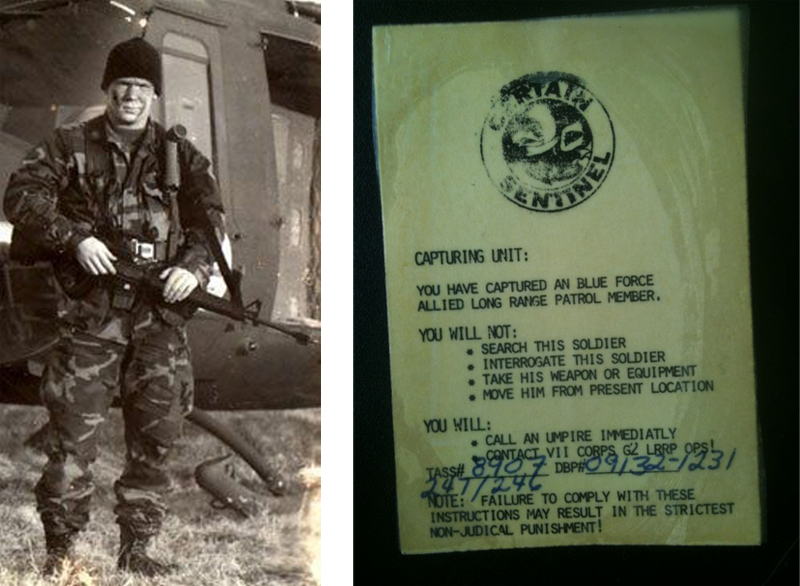
Left: Me at a training exercise in Northern Michigan with Co. “F”, 425 INF (AIRBORNE) Long Range Surveillance Unit. Right: My “Get Out of Jail Free” card for REFORGER.

25 years ago my phone rang at home. “Are you seeing this?”

“What?” I asked. “You better turn on your TV.” The Berlin wall was coming down. We won.

During my brief and very non-illustrious military “career” (if you could call it that) part of what my unit did was trained to conduct “stay-behind surveillance” on Eastern Europe, mostly along the Warsaw Pact/NATO dividing line. Especially East and West Germany. And the Berlin Wall.

We were a special operations long-range surveillance unit. Our unit trained to infiltrate deep behind the wall and watch things. Counting. Observing. Classifying. Reading. Installing sensors called “SID” or Seismic Intrusion Devices to monitor the movement of armored vehicles along key roads, aircraft movement and anything else the Warsaw Pact was doing. Then, if all went well, we would enter the intelligence into a device we called a “dumb-dog” or Digital Message Device Group (DMDG) attached to our radios and send a burst transmission with our S.A.L.U.T.E. report, a kind of outline that classifies Size, Activity, Location, Uniforms (or Unit), Time and Equipment. After that we’d quickly change positions to another hide site since the Soviets and East Germans had a nasty habit of calling in air and artillery strikes when they detected a burst radio transmission, knowing that they were being spied on in their own back yard.

Every year we participated in an operation called REFORGER or “REturn of FORces to GERmany”. Part of our unit would go to England to cross-train with the British Special Air Service, another part would go to Germany to their special Long Range Surveillance School, and a third part would go to REFORGER.

At REFORGER, business was serious.

wall40

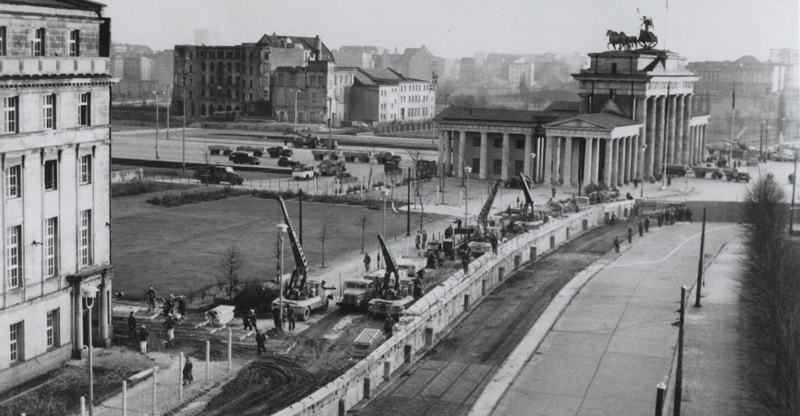
Construction of the Berlin Wall showing open kill zones, the early installation of the anti-scaling barrier and the raked areas where mines were installed.

We flew on a C-130 from Selfridge ANGB in Mt. Clemens, Michigan to Lajes, Portugal. In Portugal we landed to refuel, stretch our legs, and receive a briefing that, once in Germany, we were “at war”. Equipment was changed. Uniforms were sterilized of insignia that identified our unit. And we were given a yellow “get out of jail free” card to hand to friendly forces when our own units captured us and they had no idea who or what we were. We, of course, were not allowed to say a thing to them. Only, “Call the number on the card”.

During the time we were deployed to Europe near the East/West German border espionage was the national industry. A briefing told us “1 in 8 East Germans are involved in some form of espionage”. “While inside West Germany you will be under constant East German surveillance.” There was no way to shake it. And the East Germans weren’t subtle about it. An apartment building across the street from the former WWII German barracks we lived in constantly had observers in the window. They took our photos as we came and went. We went through ridiculous rituals to evade surveillance. Following one incident we were forbidden to wear uniforms off post.

The place we were staying was built before WWII and it hadn’t been updated since. Especially the plumbing. It was build out of quant stone and concrete and had low ceilings and iron bars. The basement, really a dungeon, was where our equipment masters kept our armory. Drawing your equipment down there was like a scene from a Bond movie or “Where Eagles Dare”. The only thing missing was “Q”, and we didn’t have any Aston-Martins. Or fancy suits. Or watches that shot missiles.

Our surveillance patrols consisted of six-man teams, sometimes less, sometimes more depending on what we were doing. Sometimes other members of different services, and even different countries joined us.

I was our team’s “Scout Observer”, the guy who looked at stuff. I had to be able to identify things. Part of the reason I landed this job was I had an encyclopedic knowledge of military equipment, theirs and ours. Especially aircraft. Another reason is because I had graduated as honor graduate from my schooling at Ft. Benning, Georgia.

The Berlin Wall was different in different places depending on where you were along its length. Sometimes it was simply a bricked-up building booby-trapped with mines. Other times it was a brightly lit open expanse, the “kill zone”, with mines and dog runs on each side of the wall. Where we visited this day it was actually a series of barriers; a barbed wire topped, chain link fence, a carefully raked pea-gravel kill-zone with anti-personnel mines and interlocking fields of sniper fire, the wall itself- a tall, concrete affair with what looked like a horizontal row of large diameter pipe on top of it. The sinister thing was, if a person lived crossing the minefield and the sniper kill zone, and actually managed to scale the wall itself, they were greeted on top by these rotating cylinders. They would simply spin backwards under your desperate grasp until a sniper’s bullet found you. In this spot, many people had tried to get across. None made it.

We were observing an interesting phenomenon. The East Germans had closed a factory near the wall and taken it over as an observation post to look on our side of the wall. The OP was located atop a high smoke stack that used to be part of the now abandoned factory. At the top of the smoke stack was an East German observer.

The intel we had was that this observer would change at regular intervals. It was freezing up there in the smoke stack observation point, and the poor East German border guard, or whoever he was, must have been miserable. He surveiled our side of the border through rifle scopes and powerful binoculars.

But he was not entirely without creature comforts.

One day a rickety-looking Lada compact jitney of a car pulled up near the base of Red Smokestack OP. It jerked to a halt. Oddly, a woman dressed in a huge, poofy white fur coat climbed out, carrying a cylinder from which steam was rising. Nerve gas? Radioactive isotope? It was soup to be delivered to the man in the tower. Two border guards accepted the soup canister and one appeared to try to make progress with the woman in the fur coat. He failed, she returned to her decrepit little car, reversed away from the kill zone and left. One of the guards spent the next few minutes carrying the large thermos of soup up to the top of the guard tower.

We later learned that observation assignment to the guard tower OP was a kind of “punishment detail”. That the border guards who watched from the tower got there because they had screwed something up, been late to report to duty, etc. It must have been miserable up there in the freezing wind. And it is no wonder East German morale among their supposedly “elite” border guard units was reported to be poor just before the wall came down.

wall20

While observing the wall, I learned a profound and sad lesson about humankind. Ducks had flown into a river on the NATO (free) side of the border. They paddled around as ducks do. But then, in complete contravention to all official doctrine surrounding border activity, the ducks took to wing, flew a brief circle over the pond on the West German side, and then flew directly over the Berlin Wall into East Germany. The ducks crossed the border without a thought or a care. No clearance, no identification, no checkpoint, no shooting. They just flew across the border.

My concept of freedom was forever altered in that moment. My respect for the wisdom of man was also. The ducks could come and go. We built artificial barriers to separate ideas and ideals.

Of course, The Wall didn’t work. And one day my phone rang. And the war that never started, a war that Tom Clancy wrote was, “A war with no battles, no monuments… only casualties” was over. And while I always stop short of declaring a “winner” in any war, I was quietly pleased to see that the cause of freedom and liberty had won the day the wall came down.

CoF425IRAQ

Our unit was one of the smallest and least known of the entire U.S. arsenal. To this day, even its modest Wikipedia page is short and light on details. In the records of units who participated in REFORGER, our unit is buried deep inside another. That I know of, there is not a single photo of us in Germany. An unofficial unit insignia we made had the inscription, “Around The World, Unseen.” We were, as my Patrol Leader was fond of saying, “Like smoke in a hurricane”.

What we learned from the Cold War and the Berlin Wall coming down served us well. In the first Gulf War Long Range Surveillance Teams, now part of a new secret U.S. Army Special Forces unit, penetrated deep into Iraq to survey routes for armored invasions, find Scud missiles and direct airstrikes and rescue downed U.S. airmen. Long Range Surveillance and its value was more than proven. Again, as it was by the reconnaissance teams before us, the LRRPs in Vietnam and recon and intelligence units in WWII.


By Tom Demerly.

vets10

Private E-2 Jerome Davis from Corpus Christi, Texas is 18 years old. It is his eighth day of basic combat training at the U.S. Army Infantry School, Sand Hill, Fort Benning, Georgia. It’s 88 degrees out today with 71% humidity and only 5:00 AM, or 05:00, in the morning. Private Davis is on the PT (Physical Training) field doing “mountain climbers”, sit-ups and push-ups. Lots of push ups.

He hasn’t written a book about himself, but he is a Veteran.

Specialist E-4 Lashonda Davis of Mobile, Alabama is 20 years old. She is at Ft. Rucker, Alabama learning how to work on helicopters. She studies manuals, checklists, written procedures and maintenance schedules from 06:00 to 21:00 every day. She wants to be a crew chief on a $6.2 million dollar Army Blackhawk helicopter. In less than four years, she will achieve her goal.

There are no movies about Specialist Davis. But she is a Veteran.

Lance Corporal Alan Mayfield, United States Marine Corps, from Madison, Wisconsin says he gets up in the morning, does PT up on the flight deck, holds map reading, communications and weapons maintenance classes with his squad between breakfast and lunch, does more PT in the afternoon, then “sits around and watches movies or plays games” the rest of the day on the USS Bonhomme Richard (LHD-6) in the Pacific during a long deployment at sea. “It’s pretty boring,” he says. When he is not at sea he is stationed at Camp Pendleton, California as part of a U.S. Marine Corps Expeditionary Force.

Lance Corporal Mayfield has never been paid to give a speech about himself. But he is a Veteran.

110512-A-NR754-014

Maurice Fregia is a police officer in Houston, Texas now. He was in the 82nd Airborne Division at Ft. Bragg, North Carolina. He parachuted into Grenada on 25 October, 1983 to help secure the airport at Point Salinas. He went on to be a part of an intelligence unit attached to the 82nd at Fort Bragg before leaving the Army to be a police officer in his hometown.

There are no video games with Maurice Fregia in them, but he is a Veteran.

According to Wikipedia there are 1,369,532 people in the active U.S. military and another 850,880 in the reserve components. Less than 0.5% of the population of the U.S. serves in the military but they provide security for the other 99.5% of Americans. Only half a percent of the population, many of them young and with only a basic education, provide security and enforce U.S. doctrine in nearly 150 countries around the world. All for the rest of us. So we are safe.

But while one-half of one percent of our population assures our security, that small minority makes up 40% of our homeless population. A fact that is perhaps our greatest national disgrace.

There are no books, movies, TV shows, video games, documentaries or speaking tours about any of them. Every day, around the world, they do their difficult, long, cold, tiring, tedious, complex, boring, hot, wet, uncomfortable, lonely, frightening jobs without recognition, with minimal praise except from their peers and family, and with modest and humble character.

They do this so that we can remain insulated from a world where security and freedom is granted to only a privileged few, and often on the backs of a subjugated many.

Today is Veteran’s Day and we recognize the efforts of this quiet culture of humble sentinels.

So while you may enjoy a book about chiseled men from stealth helicopters on daring raids in foreign countries, those books never tell the millions of stories of hard working Soldiers, Sailors, Marines, Airmen and Coast Guardsmen that we recognize on this day.

Today, you may be well served to reflect upon their contributions to our liberty and freedom. Their story will never be on the big screen, the game console or the bestseller list. But it is no less heroic and selfless.

vets30

In a great national tragedy Veterans make up almost 40% of the entire U.S. homeless population.

By Tom Demerly.

fury50

Brutal and intimate, Fury delivers an artful insight into the horror of war so masterful it leaves you tense and beaten.

Writer and Director David Ayer, who also made Training Day and End of Watch, rivals the terror and rhythm of Saving Private Ryan in Fury but with a more visual and animated presentation. Many of the scenes in Fury appear ghostly and impressionistic, almost like a graphic novel. They combine a vivid and experiential depiction of war. The movie is so effective at drawing you in you leave the theatre stiff and battle fatigued, as though you had spent cold hours in a rattling Sherman tank like the characters so brightly brought to life in the movie.

Fury opens a little clunky, trying a little too hard to show the horrors of war and knocking off the initial story line of Saving Private Ryan perhaps more closely than not. Once the movie moves out, literally and figuratively, it hits its stride and you better take a deep breath.

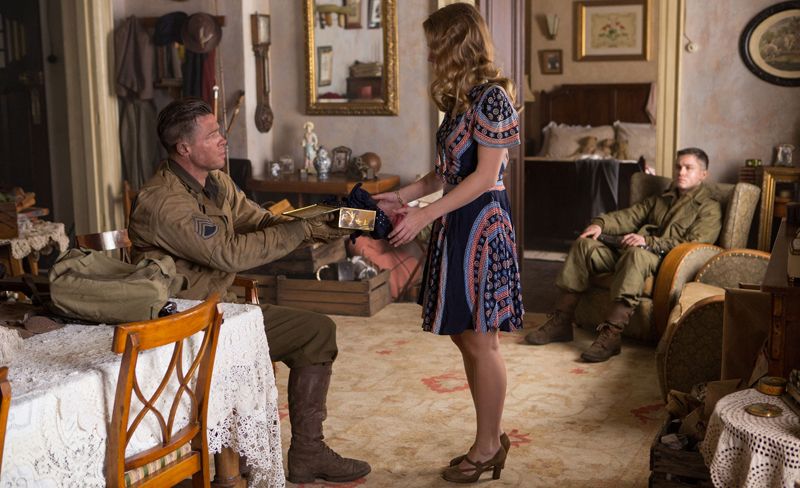
The second act of Fury is one of the most incredible scenes in any war movie. In an artful reflection of the true horror of war, David Ayer builds this scene without a shot fired or even a weapon in the scene. It is only characters, dialogue and circumstance combined with terrifying contrast and predicament that build an awful tension. Ayer was brilliant to include this scene because it adds an ingredient missing from the current perspective of conflict; context. It dramatically shows the contrast between fragile civility and apocalyptic war. Most war movies show sweeping battlefields and fast action. This scene brings the horror of war into your dining room. This scene alone is a triumph of the film and leaves you ragged and stressed.

fury10

The degree of technical accuracy in Fury is remarkable, down to the minute details of personal equipment, tactics and set dressing. The entire production is built around meticulous attention to detail, and this realism supports a plot that does, at times, feel like a bit of a stretch until you recall your history of WWII. Fury is likely more realistic than we’re comfortable accepting.

In a four on one tank duel with the vastly superior German Tiger I tank, the U.S. Sherman tanks demonstrate the authentic tactics used to try to defeat the boxy German monster, and with the usual authentic result. This scene conjured images of the huge tank battles in the Iraq Wars along with WWII.

Brad Pitt is predictably excellent and does not weigh the film down with his brand. Other characters follow the real life storylines of the people you knew in the army; the offensive hick, the Latino, the brainy guy. Those stereotypes are redone in Fury but with maxed-out realism. If there is a standout performance in the film it is Alicia von Rittberg as Emma. Her character is a flower in the battlefield, and this impossible contrast creates an unbearable tension.

Fury is an ordeal to see. You don’t leave wanting another look, but you do leave in awe of what a well-crafted visual story can do to you. It’s also an ode to the harrowing ordeal of our greatest generation and the horrors that contrast against their great successes. Fury earns its place on the shelf with truly great war films with its realism, horror and even its sensitivity.

(Really…) By Tom Demerly.

action

The cycling press has seen some pointed allegations of plagiarism recently, especially in equipment reviews. Most notably the online publication Bikerumor.com has come under criticism for potential plagiarism of gear reviews from noted editors like James Huang of cyclingnews.com.

In cycling media it’s pretty easy to flush out who the original authors are and who the copycats are. You look at content and publication dates. When things are worded closely it may be a coincidence or it may be strict adherence to journalistic format. You can only say so much that is unique about a guy riding around a track for an hour.

But when things are worded identically and formatted in exactly the same order that smacks of quick and dirty cutting and pasting: that’s plagiarism.

Luckily, most writers in the cycling industry are terrible and have no training or even a grasp of English usage. You wouldn’t want to copy their work, let alone read it. So it goes un-copied. And unread.

I’m lucky. My early journalism, media and English teachers hammered me with the rules for original content. Every one of my journalism and media teachers worked in active news and feature publication before they taught. One of them, Mr. Russ Gibb, revolutionized media by popularizing subscriber television. These are the guys I learned from; Mr. Bartell, Mr. Korinek, Mr. Gibb. Later I had editors who were both smarter and better writers than me. That helped, and I learned from them too.

Like libel, plagiarism can be difficult to prove. Part of the reason is that a formally trained journalist writes in a format taught to all journalists. It’s the common “Inverted Pyramid” that starts with a lead, contains a “who, what, where, when…” and ends with a conclusion. Feature content is a little less structured but generally starts with a “hook” to draw readers in, something fast and catchy to hold them and then terse, tight copy to tell the story.

That’s how it should be.

The biggest temptation for journalists to cheat the system came when word processing software gave them “cut and paste” capability. It became easier to cut and past with a few keystrokes, do a quick rewrite and call it your own. Before that, and I am proud to say I wrote in this era, we used typewriters with no “CTRL C” capability. We actually had to think.

Any journalist or creative writer will tell you there are only so many stories, so many plots. That’s a fact. Depending on where you learned to write you ascribe to the knowledge that there are somewhere between 7 and 20 storylines in all of human communication. That’s it. Everything written is some variation on those formats. The problem isn’t when someone tells the same story, even in the same order or similar voice. The problem is when someone steals someone’s hard work through a quick cut and paste and then calls it there own, then sells it (and ad space around it) and benefits from it.

I recently wrote a feature about an endurance athlete who did a long distance open water swim. It was a luxurious article to write, something I could really get into since I knew the characters and genuinely admire them. I took my time with it. Fawned over it. Spent too much time on it by the measure of any barking editor hanging over a copywriter like a Damocles deadline.

Two days after I wrote that story a local feature writer knocked off my article nearly word-for-word including verbatim quotes that came from questions I had written, and asked. They stole my “slant” on the topic. I earned that journalistic intimacy over time because of my familiarity with the topic. Those were the things I brought to the table with this story, and another writer pulled them off my table, put it on their own and said, “Look at this story!”

What can I do? Nothing. Nor do I have the rancor to do anything. Instead it makes me want to be more original, more stylized, more unique and more professional in my writing. It makes me want to hone my craft to a degree that, when people read my stuff, they know it is me. And when they read something similar, they say, “This sounds like something Demerly would write.”

The ultimate praise for a writer and author is to have a “style” attributed to them. You hear literary comparisons that say, “This is like Hemmingway” or, an ultimate complement like “Reads like a Tom Clancy novel.” Through style, voice, innovation and commercial success some writers have built their own “brand”, a style so unique they own it, no matter who borrows it.

Until a writer achieves that level of uniqueness and originality it kind of all boils down to “who, where, when and what”. And the best way to rise above the in-actionable (even when accurate) accusations of plagiarism is to simply elevate your writing above it, so no one can steal it.

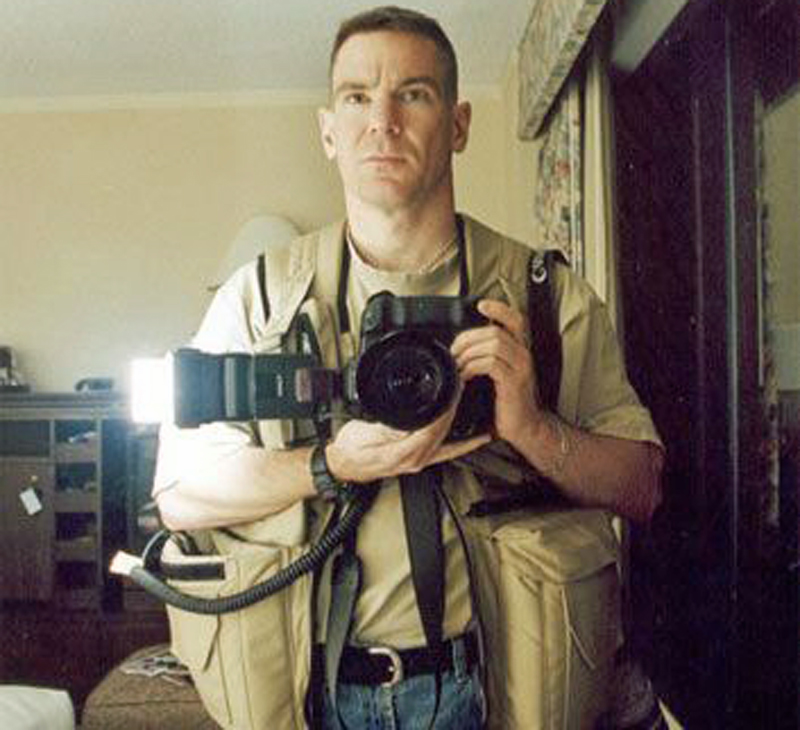
tomphotoguy

Photos and Story by Tom Demerly. (Feel free to share these photos and mention Baltia Thunder Over Michigan)

AA50

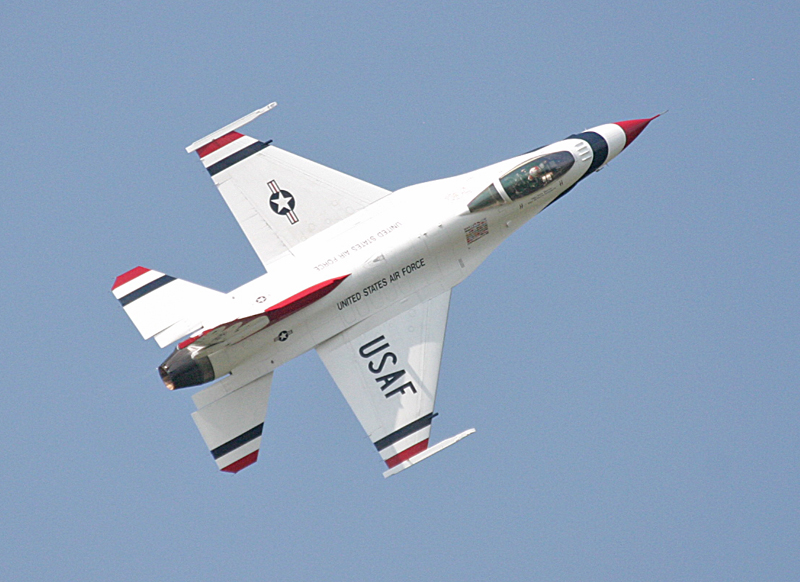
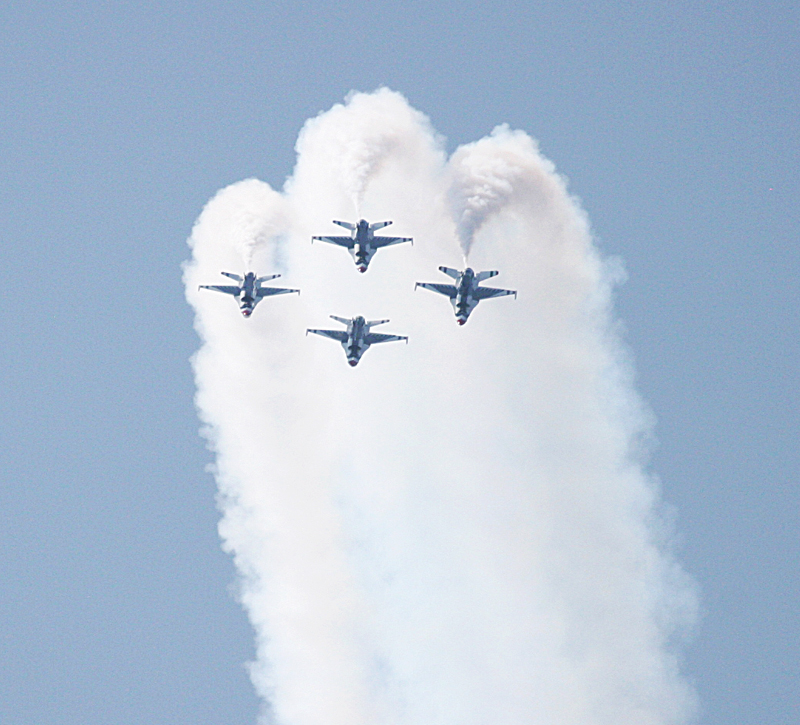
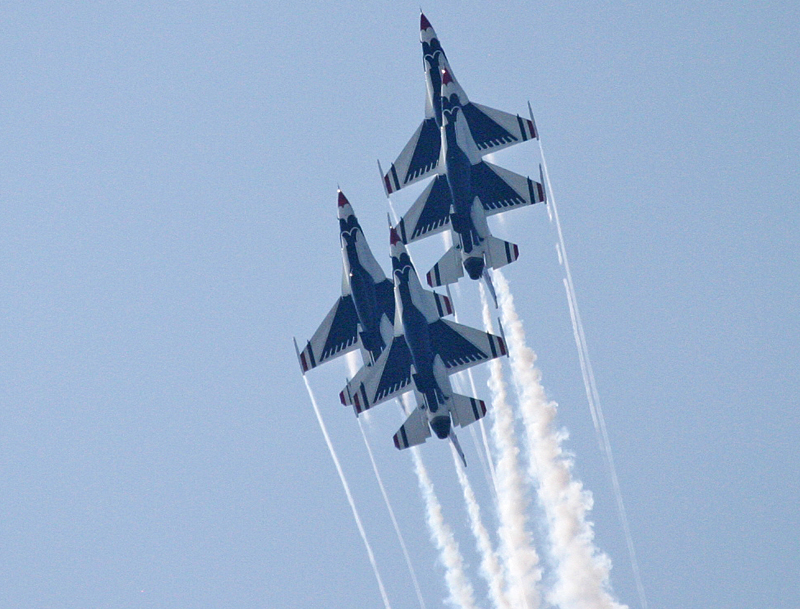
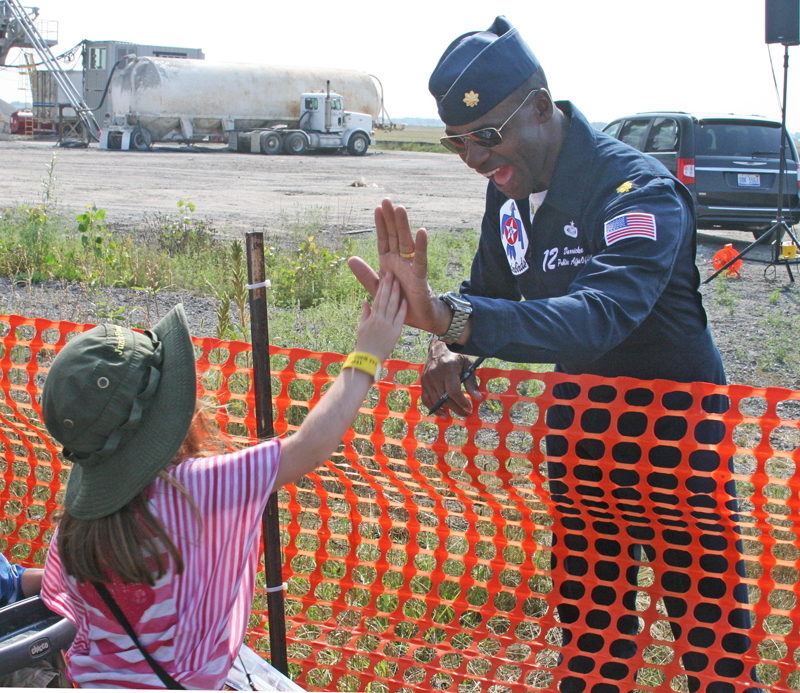
The Baltia Thunder Over Michigan Airshow at Willow Run Airport in Ypsilanti, Michigan on Saturday and Sunday, August 9 and 10, 2014 was one of the largest displays of historic and modern aircraft this year. Most of the aircraft displayed are privately owned, including one of the largest gatherings of T-6 Texan and Harvard trainers anywhere. Thunder Over Michigan also featured the U.S. Air Force Flight Demonstration Team, The Thunderbirds, along with the U.S. Army’s Golden Knights Parachute Team and other airshow acts.

This is my home town airshow, one of the shows I grew up with, so it was a special event to me. Airshow organizers provided photographers with taxiway passes for special access to the aircraft and crews along with a great hospitality tent with food, drinks, bathrooms and detailed information on every aircraft in the show. Tom Walsh, the coordinator of the photo area, did an incredible job hosting aviation photographers from around the world.
AA240

The early morning light provided a unique opportunity for photos on both Friday before the show opened and on Saturday, the first show day.

This crew (above) prepares the famous B-17G, “Yankee Lady”, that lives at Willow Run Airport as part of the Yankee Air Museum. It is a flying piece of history that is beautifully maintained. Several years ago I got a chance to fly in Yankee Lady out of Willow Run as a guest.

Yankee Lady was built in 1945 and once flew as a Coast Guard PB-1G before being sold at auction for only $5,997 to a smelting company and then to an aerial survey company. It later had a career as an aerial fire bomber and also flew in the filming of the movie Tora Tora Tora about the attack on Pearl Harbor. In it’s current condition the aircraft has been completely restored, including the replacement of all fuel and electrical systems. It is seen flying frequently around Willow Run airport.

AA130

Thunder Over Michigan attracted veterans who were pleased to share stories about the planes and people who built the history celebrated here. The show crossed aviation eras from before WWII to the modern era. Here a veteran and one of the airshow pilots chat before the arrival of show crowds.

AA60

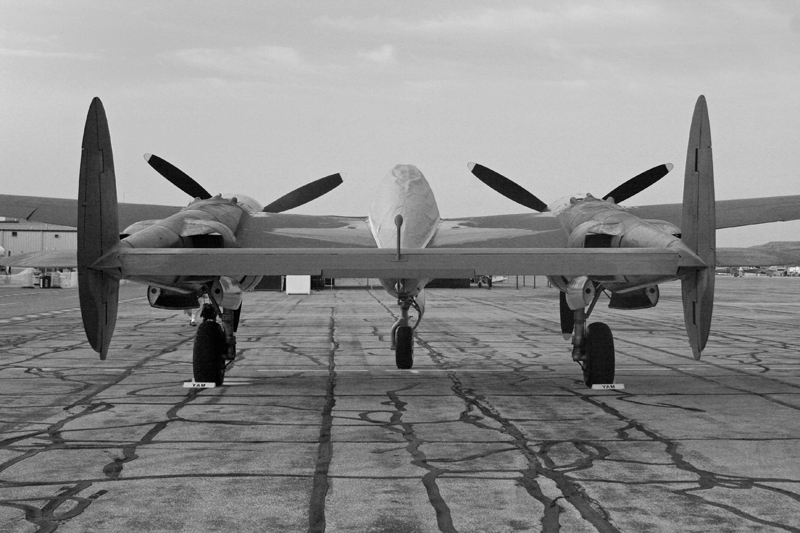
A unique perspective on the “Fork Tailed Devil”, the P-38J Lightening “Ruff Stuff”, belonging to Mr. Ron Fagen of Granite Falls, Minnesota. There are only seven P-38 Lightenings left flying and this is the second one I’ve been lucky enough to see. Ruff Stuff was built in 1945 and never saw active service. It has changed ownership several times but its most recent restoration and the stewardship of Ron Fagen in his Fagen Fighters Museum insure its future as a national treasure.

AA40

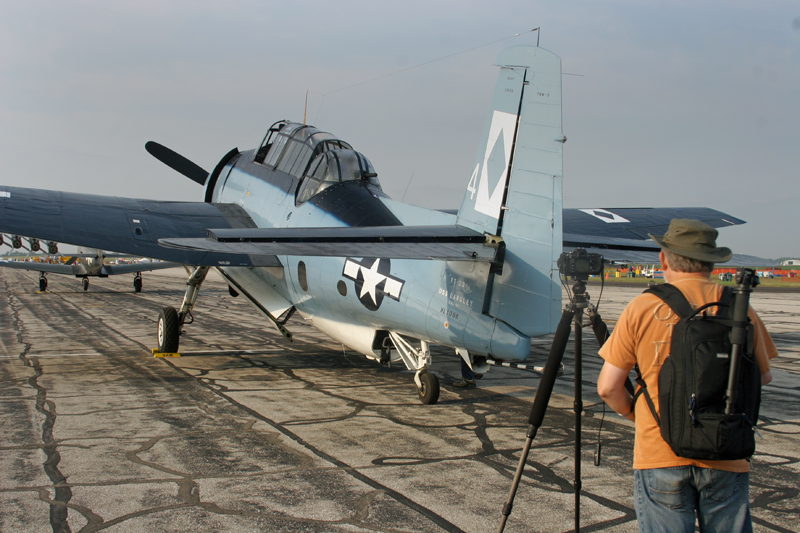
We each shot unobstructed photos of the incredible airplanes out on the flight line, an area restricted from the general public on show day during flight demonstrations. Here we set up his shots of a TBM Avenger torpedo and dive bomber.

AA20

Photographers brought an impressive array of photo equipment to capture the action. We used aviation band scanners to listen in on aircraft communications and air traffic control radio from the show Air Boss.  Shooting aircraft requires big telephoto and zoom lenses to capture the action. Canon equipment outnumbered Nikon significantly. Monitoring the show and airport air traffic control enabled us to set up shots before aircraft arrived, especially helpful with fast jets.

AA110

All the photographers enjoyed the same access to the field as the official Air Force Thunderbird photographers Manuel Martinez (left) and Stan Parker (right). I got a chance to grab a photo with these guys as they worked and even got a few tips on aviation photography from two of the best guys in the business.

AA480

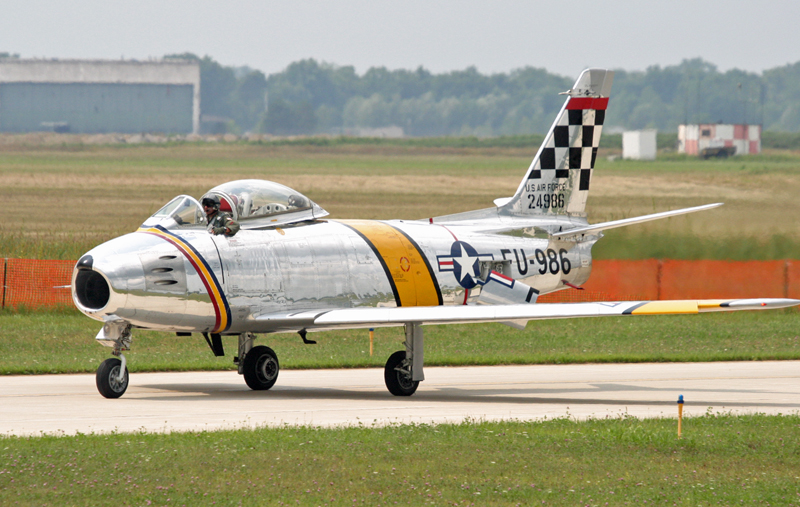
Friday, August 8, was arrival day for many of the aircraft in the show, with planes flying in from all over the U.S.. A highlight was this F-86F Sabre, “Smoky”, owned by Paul Wood from Waukegan, Illinois. The restoration and maintenance of this Korean War era jet is impeccable and it is a favorite of photographers. The aircraft was first owned by the U.S. Air Force then sold to the Fuerza Aerea Argentina or the Argentinian Air Force in 1960. It was later acquired privately in the U.S.

AA30

Paul Wood taxis his F-86F Sabre into the parking area. Notice the open speed brakes and the three holes for the .50 caliber machine guns.

AA90

The F-86F has a natural metal finish that is difficult to maintain but brilliant to see on a sunny day. The bubble canopy of the F-86F provided pilots with excellent visibility and inspired the design of the canopy on the most recent fighters including the F-22 Raptor. Pilots like to taxi with the canopy open for ventilation but must duck down to close the canopy fully.

AA100

Paul Wood cranks his F-86F through a flight demonstration that showed the maneuverability and thrust to weight ratio of the F-86F. Considering this jet was built in the late 1940’s it remains an impressive performer. The F-86 was the first fully operational U.S. jet fighter with swept wings.

AA570

A few minutes later the U.S. Army Parachute Team’s C-31A Troopship flew into the pattern at Willow Run for a landing. The pilots obliged photographers with a low pass before final approach. This is a nice sounding, Rolls-Royce powered aircraft built by Fokker. It can carry up to 25 jump equipped soldiers for demonstrations.

AA370

We had excellent access to active taxiways throughout Friday and were accompanied by helpful “safeties” who kept us from getting run over by aircraft when we were looking through a camera viewfinder. It was a remarkable experience to be so close to the aircraft as they came and went during arrival and show rehearsal.

AA360

This unusual aircraft is the de Havilland DH-115 Vampire formerly of the Royal Navy and now belonging to Marty Tibbits of Detroit. It is a pretty, unusual aircraft that operated from Royal Navy aircraft carriers after 1945 and also served, in a different version, with the Royal Air Force. The Vampire, in its many versions, was a successful aircraft that was flown by several countries through the 1990’s, including, oddly enough, Rhodesia.

AA350

If there was one perfect P-51D Mustang at the show it was Mark Peterson’s “Hell-er Bust” from Boise, Idaho. The aircraft is painted in a photogenic livery and carries a pair of simulated 500 lb. general purpose bombs. Here Mark taxis in after his arrival on Friday. Hell-er Bust has an impressive history since being built in 1945 at the North American Aircraft plant in Inglewood, California. She first joined the legendary 8th Air Force in 1945 but was transferred to the Swedish Air Force in 1948 and the to the Dominican Republc from 1952 to 1984, making it one of the last remaining truly operational Mustangs while in service with the Dominican Republic. Hell-er Bust uses the classic Packard Merlin V-1650-7 engine that produces that goose bump-inducing Mustang sound.
AA300

The B-25D “Yankee Warrior” is one of the planes that lives at Willow Run as part of the Yankee Air Museum. We are lucky enough to see it fly around the airport occasionally and got a good look at it on reception day. Five of its .50 caliber machine guns are visible in this view. Yankee Warrior is a combat veteran of WWII, having flown eight bombing missions over Italy before it was retired, then restored.
AA510

Yankee Warrior had a rather attractive pilot flying on arrival day and was meticulously turned out in its natural metal finish. This B-25 is a frequent visitor to air shows around the U.S. but I never found out who the pilot pictured here is.

AA290

A number of exciting private jets flew in on Friday including this Aero Vodochody L-39C belonging to Tim Brutsche of Battle Creek, Michigan. Brutsche owns Brutsche Concrete in Battle Creek and is a licensed Air Transport Pilot (ATP) who has been an active promoter of youth in aviation for years.

AA280

Here is Tom and his co-pilot, perhaps his wife Beth Franklin-Brutsche who frequently flies with him, taxiing their L-39C to its parking ramp.

AA520

Aircraft owners spent time on Friday chatting with photographers and polishing their airplanes for the show opening on Saturday. This TBM-3E Avenger gets a shine in the morning.

AA500

The P-47D Thunderbolt “Jacky’s Revenge” was restored from former Peruvian Air Force service in 1966 and painted in U.S. livery with D-Day invasion stripes on the wings and fuselage.

AA530

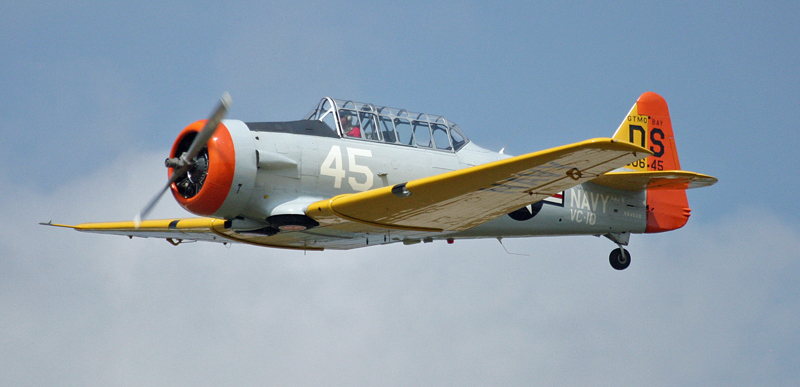
There were so many T-6 Texans, Harvards and this AT-16 Texan from Blanchester, Ohio it was hard to pick just one to photograph, but this bright orange and yellow paint scheme stood out from the other aircraft.

AA220

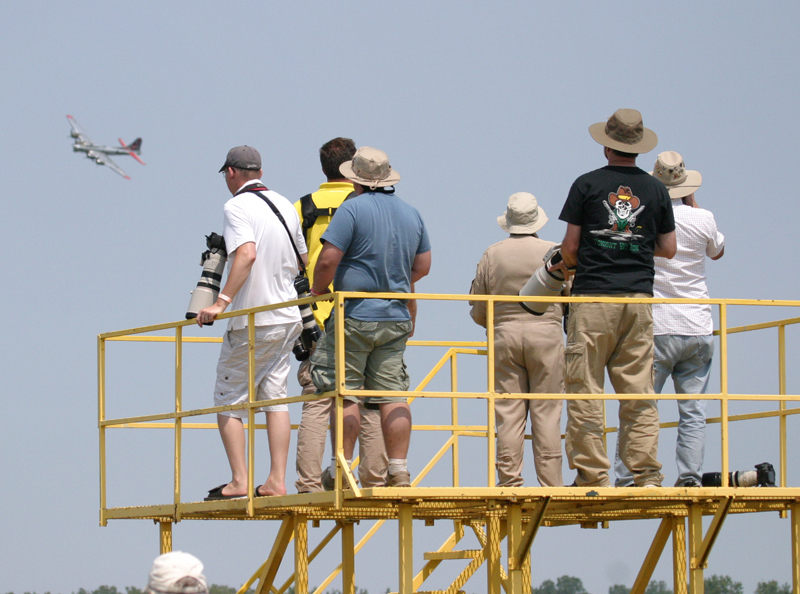
We got a raised maintenance platform to shoot photos from each day, making it easy to get great shots of aircraft taxiing and of the flight demonstrations. Each of the photographers took turns in a corner. We used a pilot band radio receiver to help locate inbound aircraft. When one photographer would see an aircraft inbound to the demonstration field they would shout out, “Aircraft, inbound, from the east…” for the other photographers to get their shot.

AA320

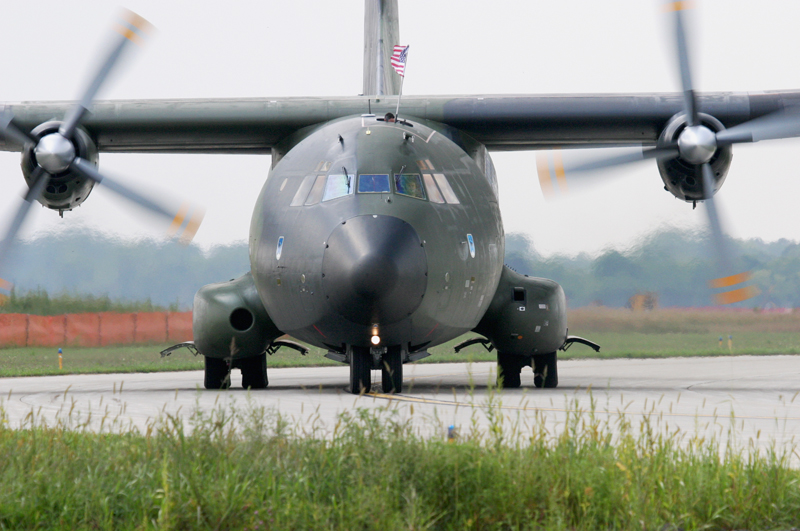
An operational German Luftwaffe Transall C-160D from Air Transport Wing 61at Penzing AB, Germany made a special visit to the show. The Transall is a workhorse twin-engine tactical transport that serves air force around the world and is especially prolific in Europe and Africa. It makes a pretty “whirring” noise like a mini-C-130.

AA120

The flight crew of our visiting German Transall were happy to be at the air show and brought a big tent filled with their squadron mugs, T-shirts, patches and other memorabilia. They enjoyed chatting with the crowd in English and in German and also had fun shooting photos of the other flight demonstrations while they earned some cash selling souvenirs.

AA80

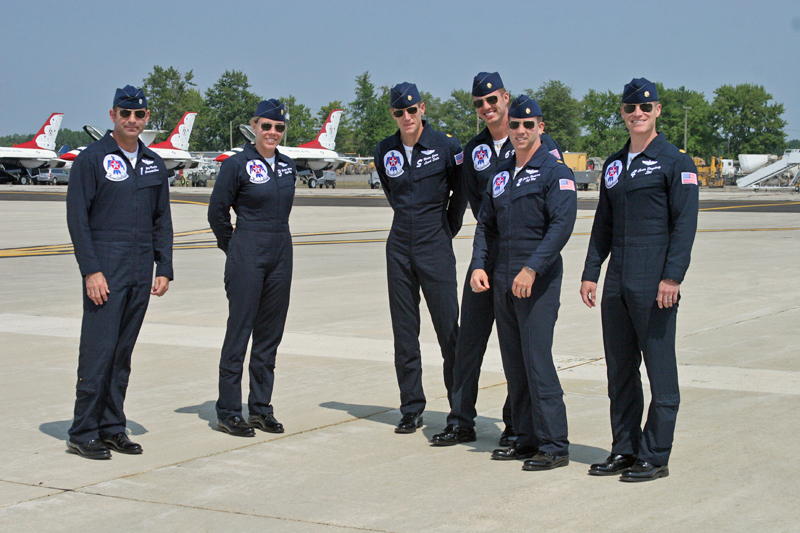
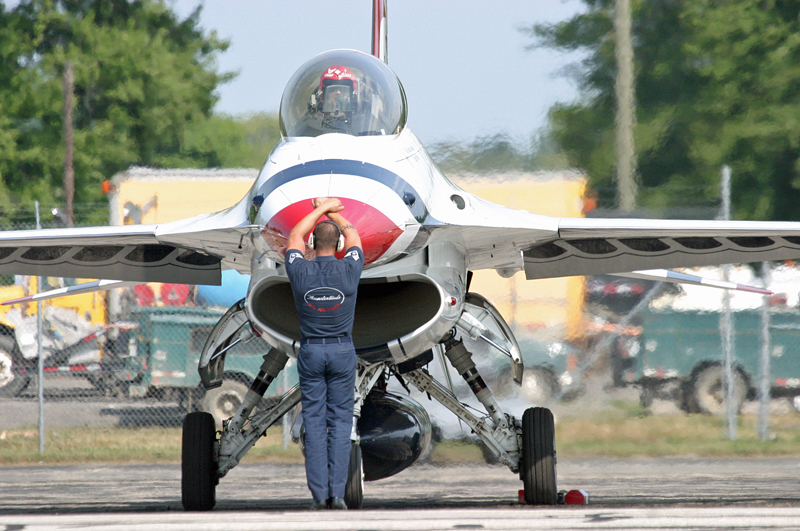
Friday was a relaxed day and a chance to meet the Thunderbird pilots in person without any fences. I caught the entire flight demonstration team here for a candid group shot here.

AA140

Thunderbird #6 Opposing Solo, Major Jason Curtis of Kalispell, Montana, taxis out for Friday practice. He is a drummer and competitive snowboarder and graduated from the U.S. Air Force Academy in 2004.

AA340

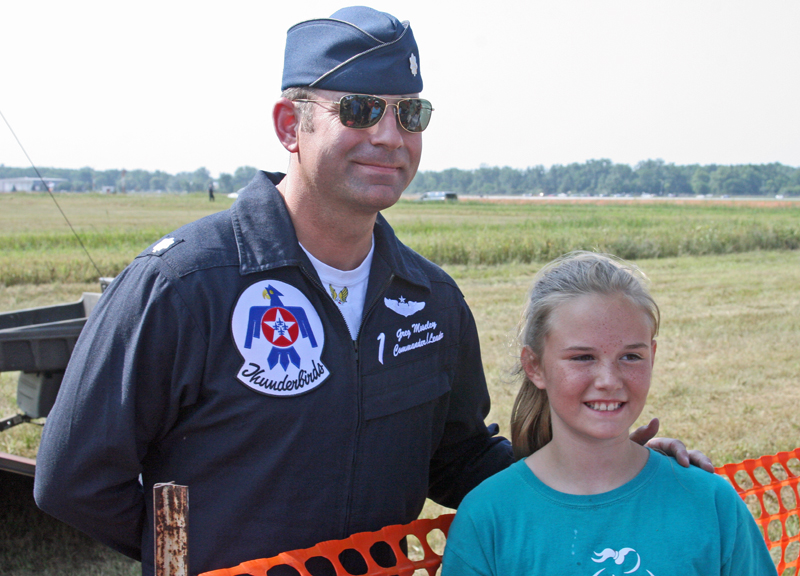
Thunderbird #1, Lt. Col. Bob Moseley taxis out for flight demonstration practice on Friday. The names of the enlisted flight maintenance crew for this aircraft are painted on the right side of the cockpit with Lt. Col. Moseley’s name on the left side of the aircraft. Moseley is a graduate of Virginia Military Institute and has flown both the F-15 and F-22.

AA470

We had an interesting incident on Friday, practice day, when Thunderbird #3, Maj. Caroline Jensen, had a “bird strike”, sucking a bird into the intake of her F-16. The bird damaged the engine and caused her to safely circle the field and make an expedient landing.

AA490

Major Jensen taxied past the photo stand on her way back to the flight line to switch to the reserve aircraft that was already preflighted by the Thunderbird ground crew and ready for engine run-up.

AA560

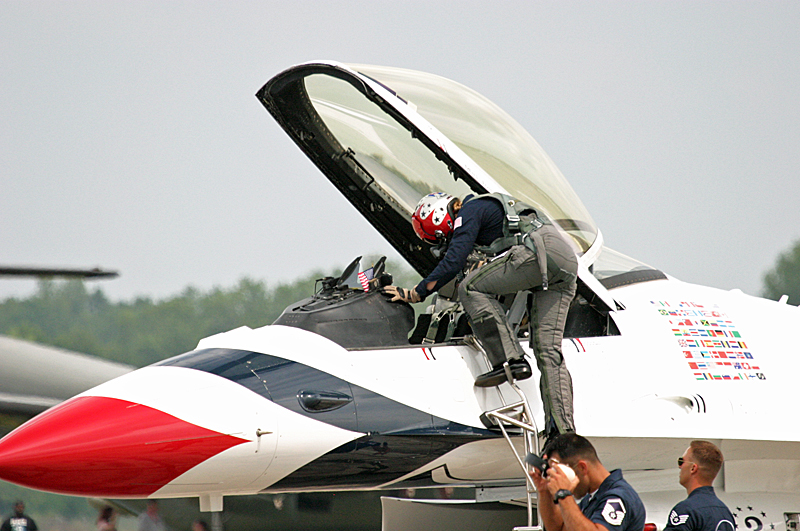
She quickly climbed down from the damaged #3 aircraft and ran to the waiting reserve aircraft while the ground crew began to survey the damage to her F-16.

AA10

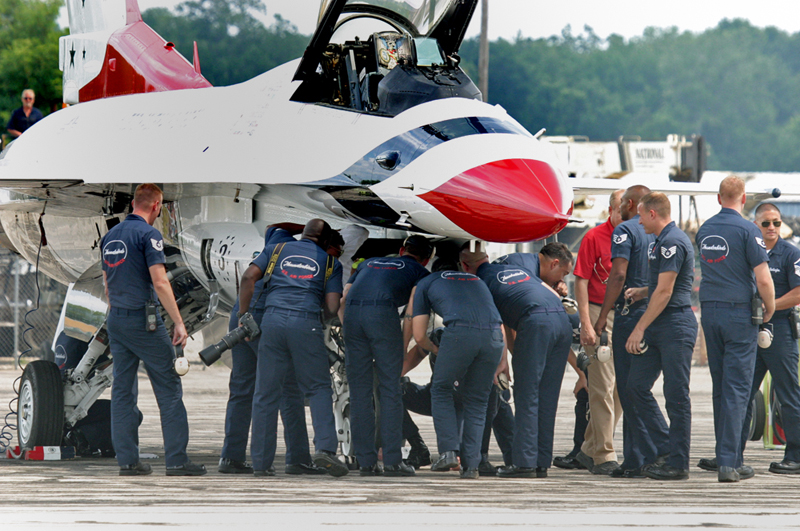
All of the Thunderbird ground crew wanted to see the damage to the inside of the F-16 intake from the bird strike. The man in the red shirt is likely the aircraft engine manufacturer’s technical rep who travels with the Thunderbirds, Mr. Tom Eshelman from Pratt & Whitney aircraft engines. That a jet engine can withstand a high speed bird induction through its turbine fans and continue to fly safely is an impressive accomplishment by Pratt & Whitney.

AA540

Major Jensen climbs up to the reserve F-16 to rejoin the demonstration formation after running to the alternate jet that was already preflighted by the Thunderbird ground crew.

AA550

Lighting conditions on Friday practice for the flight demonstration were poor with flat and overcast skies. It was less than ideal for good photos. We enjoyed the practice after shooting a few photos and checked the weather for Saturday, hoping for better lighting conditions for aerial photography.

AA170

The weather on Saturday started misty but the fog burned off quickly as crews got their aircraft ready for the first day of the show. I liked this shot of the B-17G Yankee Lady with the U.S. flag in the sky overhead.

AA310

The first big flight demonstration was an giant formations of T-6 Texans and Mk IV Harvards. This is only half of the total formation. The  combined sound of their radial engines was an amazing recollection of what it was like to be near one of the big WWII fighter training bases.

AA260

The formation flying continued throughout the morning with an intricately coordinated double-racetrack pattern of aircraft flying over Willow Run. This tight formation of a P-38, P-51 and the B-17 G Yankee Lady is a living display of air power over the Pacific and the European theaters during WWII. I can’t help but wonder what the view from inside the cockpit must be like.

AA230

Ruff Stuff, the Lockheed P-38, did a few photo-pass fly-bys for photographers, giving us the opportunity to shoot photos from different angles.

AA580

P-38 Lightening Ruff Stuff as viewed from the rear quarter. Notice the superchargers on top of each of the engine booms.

AA590

The chunky looking P-47D Thunderbolt, predecessor to the modern A-10 Thunderbolt II, becomes more graceful in the air. The P-47D was used extensively in the ground attack role. The black and white stripes on the fuselage and wings are called “invasion stripes”. These helped other allied aircraft identify each other following the D-Day invasion to prevent them from shooting at each other and prevented ground crews from shooting at them.

AA600

This P-63 King Cobra has a number of unique features including a centrally mounted M-37 30 mm cannon that fired through the propeller hub and an engine located directly behind the pilot. The pilot enters the aircraft through a side-hinged door, not a sliding canopy like the P-51 and P-47. Notice the intake for the centrally mounted engine immediately behind the cockpit. The tricycle landing gear was unique to the P-63 and its less successful little brother the P-39 Airacobra. Most P-63’s saw service with the Soviet Union, over 2,000 of the total of approximately 3,000 built were given to Russia by the U.S. under a lend-lease agreement. Russian pilots actually downed several Japanese planes in WWII with King Cobras.

AA610

B-17G Yankee Lady turns in toward the crowd line. The “G” model B-17 had several upgrades over the precious “F” and “E” versions, most notably the forward facing chin turret with two Browning .50 caliber machine guns to prevent aerial attack from the front.

AA620

This side view shows a puff of smoke from one of the B-17G’s engines and a good view of the ball turret under the aircraft.

AA770

B-24 “Diamond Lil” has a fascinating history as one of the very early B-24A bombers built. The aircraft had a landing accident during its ferry flight to England in the early 1940’s and had to be returned to California for repair. It was converted to a C-87 transport, a modification that likely enabled it survive the war. It went on to be restored as a B-24 with the paint scheme seen here. In this photo the crew is initiating engine start and run-up for its flight demonstration.

AA650

Following the flight demonstrations by the historic aircraft the Thunderbirds held the briefing for their demonstration flight. Here Major Caroline Jensen listens in before the beginning of the demonstration routine.

AA670

The Thunderbird diamond and solo pilots salute the crowd at the beginning of their flight demonstration routine.

AA660

Introductions of the pilots to the airshow crowd over the PA begin the show as the ground crew forms up for the demonstration in the background. From the preparation of the flight to the aerial maneuvers the entire show is carefully choreographed with impressive precision.

AA640

Wearing a pair of G-suit pants the pilots climb the ladder to the cockpit while crew chiefs stand ready to prepare the aircraft for take-off.

AA630

Engine start completed, Thunderbird #1 prepares to taxi to the active runway for take-off.

AA690

With a plume of smoke the four-ship diamond formation begins their takeoff roll at the start of the flight demo routine.

AA200

The opposing solo aircraft, Thunderbird #6, Maj. Jason Curtis, turns in across the crowd line as he closes on the the lead solo aircraft for one of their head-on passes.

AA380

Blue skies and better light gave us a chance to grab good photos of the Thunderbird diamond formation as it flew by the photo stand near show-center.

AA430

Lead solo Thunderbird #5 Maj. Blaine Jones turns in toward the crowd line for a high-speed pass.

AA420

Thunderbird #6 demonstrates a five-point hesitation roll and gives a good plan-form view of the F-16. The paint scheme of the Thunderbirds aircraft is specially designed so the crowd can see the aircraft roll from a distance.

AA460

The Thunderbird diamond formation at the top of an inverted loop at an altitude of about 2000 feet above ground level. The Thunderbirds have a “high show” routine and a “low show” routine for overcast conditions when a low cloud deck prevents them from being visible from the ground. We got to see the low show on Friday practice and the high show on Saturday.

airhow1480

“From the left, Thunderbird #5, Major Blaine Jones, the Lead Solo, will execute a maximum performance, high-G turn.” This sequence shows the F-16 turn in under afterburners and pull up to 9G’s. In the third frame you can see the wings of the F-16 flex upward under the G-load.

AA700

The two solos cross in the cross over break, one of the most spectacular and difficult to photograph maneuvers of the show.AA390

This pull-up maneuver is used to sequentially position the aircraft for entering the landing pattern and makes for a cool shot as the aircraft begin their break.

AA710

This maneuver begins in the trail formation with the aircraft behind each other and completes a loop up to 2,000 feet where the formation rejoins with incredible precision during the inverted, changing to the diamond formation. Condensation formed on the wingtips streams off the aircraft at higher altitude as the air cools.

AA720

The opposing solo high-alpha pass: Thunderbird #5 flies across show center at about 100 MPH or nearly the minimum speed the aircraft can maintain and still stay in the air. The speed brakes at the back of the aircraft are deployed to slow it down.

AA730

Thunderbird #6, the opposing Solo, trails condensation vapor as it pulls up to the vertical to rejoin the four-ship diamond formation.

AA740

All six aircraft form the wedge formation high into the afternoon sun with thick vapor trails coming off their wingtips.

AA750

The six-aircraft wedge formation passes in review under slight overcast.

AA760

Then flies into clear sky with a complete change of lighting.

AA410

Finally the diamond formation pitches up to the vertical and executes the high bomb burst with one of the solo aircraft rolling vertically through the middle. It was a classic Thunderbird finale.

AA780

Back on the ground with the chocks in place Thunderbird #1 prepares to shut his engine down at the end of the flight demonstration.

AA790

It’s a tradition to wait after the airshow and meet the Thunderbird pilots in person for a handshake, photo and an autograph. Here the Thunderbird team leader, #1 Lt. Col. Greg Mosley, poses for a photo with a fan.

AA7800

Thunderbird 12, Major Darrick Lee, high-fives a fan at the end of the airshow.

AA210

On my way out of the show I met aviation artist David Ails. Ails was displaying and selling some of his incredible digital aviation art depicting aircraft including the P-61 Black Widow and F-4 Phantom. Ails represents a new breed of aviation artist who uses digital media for creation of incredible images that depict historic aviation events and aircraft.