Archive

Tag Archives: tom demerly author

By Tom Demerly.

the-waltons-40th-anniversary-today-show-interview

I walked into my friend Mark’s house around 6:30 PM one evening. He lives about a block away. I was returning, in a small way, one of the many big favors he has done for me since I moved back to Michigan. What I saw was shocking. To me at least.

Mark and his wife were seated at a small, round table with a tablecloth. They each had plates, and cups. They were eating food with knives, forks and spoons. It was like the set of a 1950’s movie: a husband and wife having dinner around 6:30 PM, a new baby sound asleep in another room. It was positively… normal.

It struck me pretty hard: This is what that fleeting, ephemeral thing called “normal” looks like.

Like many people I didn’t have  a “normal” family when I was a kid. I had a dad with mental problems, a single mom, and two sisters long gone for those reasons. My childhood was not bad. I didn’t have everything I wanted, I did have everything I needed. But my childhood was different from what I saw at Mark’s house that night.

My family was fractured. Fractured by distance, disapproval, loneliness, lack of communication, forgiveness and trust. In other words, we’re like most families. We have our problems. We have more skeletons than a medical school.  One sister got married in Africa; I’ve got a niece in who lives in Japan. The only way we could keep our distance any better would involve NASA.

Two things that happened in the last decade caused me to revisit the value of family: I almost died and so did my 91-year old mom. As I type this she lays in Beaumont Hospital after two heart surgeries in three days.

When I moved back to Michigan my friends urged me to moderate the fractures in my family. It took time, but I did. It was frightening and humbling. It has also been rewarding and invigorating.

Peace efforts within a family are a lot like negotiating between warring factions in a third world country. Since I have a little exposure to the later, I used what I learned there.

Firstly, you approach it with ownership of your own mistakes and a lot of humility. Secondly, you do a lot of listening. You do what author Stephen Covey said, “Seek first to understand, then to be understood.” Thirdly, you bring some pretty thick skin.

A critical mindset is that you have to leave the past where it belongs- behind you.  You talk a lot about how things could be. Should be. You replace blame with empathy; you replace the lesser past with the idea of a greater future. And you focus on the half of the glass that is full. And mostly, you forgive. Living in the previous world of family arguments, disconnects, betrayals, broken promises and let-downs cannot result in a constructive dialog. It doesn’t foster healing.

Not everyone will get it at first. Families are made of complex personalities and complex pasts. But the behaviors of listening, understanding and forgiving are as contagious as the ones that drive families apart.

Ultimately we decide which behaviors we want in our family by which ones we choose to live in our present. When we make that decision and live it, we get along better.

By Tom Demerly.

1be786d9fe2cdc1fa6a77072d7adefc3

When I woke up in the room I had no idea where I was but something smelled like dust and urine.

There was a man I had never seen before asleep in the twin bed next to the one I was in. He snored.

I sat up, put my feet on the floor and saw they were in decent shape, slightly swollen, skin mostly intact, nine toenails, only one gone. Much better than last time. My mouth was dry. I had a headache. I could stand on my own though.

It took two showers to get all the dust, sand, grime, urine, blood, smoke, stale sunscreen and even fabric bits off of me. I was thankful I didn’t run out of hot water. There were some dead insects in my hair that rinsed out. I took mouthfuls of warm water from the shower. Brushed my teeth four times. After I threw out the clothing that was producing the smell of piss and dust in the room I actually felt clean.

Petra, Jordan, 9 November, 2001; 105.38 miles from the Gaza Strip, 168 miles (by helicopter) on heading 24.1 degrees to the Syrian border, 267.16 miles on heading 55.4 degrees to Iraq.

The Jordan Telecom Desert Cup was a 105-mile non-stop running race from Wadi Rum to Petra, Jordan. I had just finished as the top American, or the second American, I don’t remember which. I had informally allied with a man named Andrew during the previous night. He was a soft-core pornographer from South Africa.

1b0dab114e831d2475db1c5f161b0725

Andrew and I had a mutual interest in racing together. As the youngest male in the race at 22 he was competing for a special prize at the finish line. I had an interest in being the top U.S. finisher. If we worked together to keep each other on course, awake and from freezing to death in the high desert during the night, then made a 30-mile dash at sunrise into Petra we would each achieve our independent goals.

As we trotted into the desert night, packs on our backs, Andrew recounted lurid tales of his business to keep us awake. He met an opulently configured, 18-year old aspiring young lass he described as a… “milk maid”, apparently a common South African colloquialism. The pair drove her father’s expensive Land Rover to the beach one night where she intended to “audition”. Apparently her performance was so commanding that Andrew neglected to notice the tide coming in. It swamped their Land Rover. They only noticed when it began to float and teeter. They were forced to immediately abandon the vehicle, sans apparel, before it capsized. They were left naked on the beach with a long walk ahead of them. Andrew volunteered for the nude jog for help while the young lady searched the tide for swaddling clothes. He considered it training for this race.

It was so cold in the freezing, high desert wind just before dawn that we stopped at a nomadic encampment and asked to roll ourselves up in their rugs for warmth. The incredulous Bedouins obliged and we made ourselves into a kind of human shawarma-wrap in their tent carpets. I promptly passed out. Andrew did too. We slept for over an hour.

Just before we arrived at the finish line we descended a series of ancient steps carved into the wall of a deep desert wadi or canyon. They led to the Lost City of Petra. Jesus Christ had walked these steps. It was said that if you descend these steps you are cleansed of your sins. I could use that.

I remembered we were lunching with staff from the U.S. Embassy in Syria. After I dressed and returned from lunch I learned the man in my room was a U.S. helicopter pilot, and this adventure had only just started.

b504a3bb3c605a3e16327fb56aa9b5aa

By Tom Demerly.

cali

I survived the collapse of Detroit, the Middle East after 9/11 and watched East Germans through binoculars while dodging spies. I’ve never had a sense of looming change like California. The ground beneath your feet is unstable, and it’s not just geology.

California is ruled by silent fear. The culture is collectively grasping the dead image of the California dream.

It must be similar to sailing on the RMS Titanic in 1912 or being on Wall Street on 9/10. Everything seems fine, but there is a tectonic uneasiness. Consider that both the Titanic tragedy and the 9/11 attacks happened by the slightest of circumstances. California is vulnerable to a similar flutter of the butterfly’s wings. It is a culture perched on the fulcrum of the American dream, or nightmare. It can so easily go either way.

I lived in Mission Viejo, California for a year. The neighborhood was idyllic with soaring palms, manicured landscaping, and artificial lakes. Traffic jams of BMW’s delivered perfectly coiffed teenagers to the local high school in what looked like a cattle call for an Abercrombie catalog shoot. If nothing else, Californians are beautiful.

When I arrived in California I walked around a corner to discover two 40-ish females hefting their breasts in comparison. “Oh!” The woman remarked when she noticed me, “We’re sorry… we just got these.” Californians eat natural foods but have artificial breasts. They are afraid of the inevitability of aging and spend enormous amounts in a losing battle to avoid it. There is a cultural aversion to dressing your age in California.

California is crowded. So crowded that I lived inside a massive, sprawling strip mall. The expanse of strip malls is like a skin-eating disease on the terrain. The lesions have connected with each other across the tissue of the landscape to engulf the corporate housing boxes of consumers. We were caged there between purchases and labor shifts.  It resembled an above ground ant nest with nice landscaping. The ants drove Benzs instead of following scent trails.

My cell between the strip malls in California had 2 windows, 2 rooms and cost about $1600 a month. Now I live in a house with 17 windows, 9 rooms and it is $800 a month. I also have a massive yard. In California I slept with my head 9 feet from the front bumpers of cars parked outside. And their constantly bleating alarms. I did have a nice pool though.

Southern California is fragile. One morning on my five-mile commute to work a traffic light went out. One traffic light. The ripple effect throughout Orange County was bizarre. Nearly the entire distance of my five-mile route was delayed or stopped because of one traffic light failure. One. What would happen if there were power failures here like the East Coast power failure of 2003?

California works (now) because of a little known but real principle of space management called the “chicken coop” theory: When there are too many chickens in the coop to all sit on the floor at once you must continually bang on the side of the coop to keep some chickens in the air. The result is an unsustainable society of increasingly collective fatigue. If every Californian had to drive somewhere at once the roads could not handle the number of vehicles. If too many Californians flush their toilets at once…

You may ask, “What about the authentic surf culture? The liberal, progressive attitude and the tolerant society?” Those are the depictions of California we see in themed mall stores, music videos and media. The reality has shifted to an industry of depicting those things. Instead of being California, California is in the business of selling California to the rest of the world, or at least what they think California is. Or was.

What was most embarrassing is that many Californians were very up-tight about being laid-back. They were incapable of poking fun at themselves. When they made fun of me for calling a carbonated beverage “pop” I would reply, “Sorry dude, it’s totally soda man, that was so lame of me…” they would stare at me blankly, as if I had just taken the laid back Dude-God’s name in vein. The reality is that the California surfer dude is simply a hillbilly with a trust fund. Sorry to totally harsh on your scene dudes.

Mostly, Californians are lonely and afraid, and I was one of them. I asked a close friend who was moving if he needed help. He said, in all seriousness, “I don’t want you to help me because you might need me to help you.” That was California in a nutshell.

I went to the same pretty little check out girl at the grocery store every time for a year. The last week I lived there the girl asked, “Why do you always come through my line?”

“I think you are pretty.” I told her. She told me she was taking her break at six and asked if I wanted to have coffee with her next door at Starbucks.

“No,” I said. “I am moving back to Detroit tomorrow.”

By Tom Demerly.

Specialized Bicycles' Founder and CEO Mike Sinyard personally traveled to Cochrane, Canada to delivery an apology to Cafe Roubaix founder Dan Richter.

Specialized Bicycles’ Founder and CEO Mike Sinyard personally traveled to Cochrane, Canada to delivery an apology to Cafe Roubaix founder Dan Richter.

In a widely shared story on social media from December 8, 2013, bicycle mega-brand Specialized Bicycles threatened legal action for alleged trademark infringement against small local retailer Cafe Roubaix Bicycles in Cochrane, Alberta, Canada. The threat originated from concerns by Specialized Bicycles over their legally protected trademark for the word “Roubaix” when referring to specific product categories.

Social media critics, including this writer, were quick to point out what appeared at the time to be a heavy-handed approach by Specialized.

On Thursday, December 12, 2013 Specialized founder Mike Sinyard was quick to reply with a sincere apology to Cafe Roubaix Bicycles’ owner Dan Richter. In the apology, Sinyard said, “I just want to say a big apology for this whole thing that got way out of line…”

“I just want to say a big apology for this whole thing that got way out of line…” Mike Sinyard, Specialized Bicycles.

Sinyard traveled to Cochrane, Canada to deliver the apology in person at Cafe Roubaix Bicycles. In a text book example of social and business crisis management Sinyard went on to say, “I completely take full responsibility.”

Specialized Bicycles can be credited with financial support of independent bicycle dealers across the U.S. who have suffered during the recession. In several cases Specialized has provided financing, management, merchandising and inventory assistance that saved local retailers from closing. In addition Specialized Bicycles has demonstrated extensive support of social and environmental causes through their “Sustainable Innovation” initiatives that include environmental, import and workplace guidelines for corporate integrity.

Sinyard’s textbook example of crisis management establishes a new standard of corporate responsiveness and accountability in the cycling industry and cements Specialized Bicycles’ status as a leading brand in cycling.

By Tom Demerly.ap_twinkies_comeback_jt_130623_wgOwn it.

Before you can change it, you have to own it. Owning your failures is the first part in not repeating them. Understand that owning your failures may be different from fixing them. Some failures can’t be fixed, they can only be owned. The difference is taking a hard look in the mirror and understanding what you did to fail in the first place so you never repeat it. Making excuses and blaming others doesn’t work.

Dissect it.

Once you own your failure you can examine it in a forensic manner. What did you do wrong? Hindsight is 20/20. A detailed accounting of what got you into failure is the second step in climbing out of it and, most importantly, avoiding it again.

One warning: Avoid the paralysis of analysis. Once you dissect your failure and own it you must have control over it. It can’t own you through fear. The perspective of friends and associates can help with this. Understand what things are inside your “sphere of influence” (Stephen R. Covey, The Seven Habits of Highly Successful People) and what lies outside it. Control what you can control and let the rest go.

Get to Work.

There is only one way back from failure: Hard work. This means work without pay, work without sleep, work without adequate food, work without convenient transportation and work without the things that make work easy. It’s just ditch digging. You may need to work in an austere environment and not make excuses while doing it. Accept that. In fact, embrace it. This is the filter through which you must pass to achieve success again and the reason why few people do. They simply aren’t tough enough.

No excuses, no shortcuts. Hard work, measured risk and good decisions led to the only American to ever win the Tour de France, Greg LeMond's, spectacular victory in 1989.

No excuses, no shortcuts. Hard work, measured risk and good decisions led to the only American to ever win the Tour de France, Greg LeMond’s, spectacular victory in 1989.

Except in dire need (such as feeding children), avoid government social programs to assist you. They are time consuming to apply for and laden with bureaucracy. You are better served working a minimum wage job. This is part of the axiom in any survival situation that following the crowd will make you a refuge. Refuges don’t have control of their future. They are victims. The real danger of reliance on social programs is that once you get on them it could be hard to get off.

Don’t Compare Your Situation to Others.

When you own your situation you don’t look at other people and feel sorry for yourself. Instead, you celebrate the successes of others and take inspiration and hope from them. They are a source of strength. Be focused on your own life and goals. Don’t permit distractions. Maintain a “glass half full” mentality that author Stephen Covey called the “abundance mentality”.

Network.

While it’s tempting to crawl into a hole and hide when you fail, resist that temptation. Instead, show others how proactive and vigorous you are. Instead of just asking for help, ask to help them. You always have something to offer even if it is shoveling snow or listening to someone’s problems. Helping others boosts your self worth and keeps you positive. Remember that no job is beneath you. Even if you were the owner of a million dollar company and you land a job cleaning toilets treat those toilets as your business and a reflection of yourself. Make them the cleanest, best toilets you know how and find ways to improve on that. Always strive. Never settle.

By Tom Demerly.

mandela-prison

Activist, terrorist, president, communist, freedom fighter, humanitarian, bully, saint and sinner; human. Nelson Mandela’s dossier spans the entire spectrum of social administration and life experience.

Like any complex character, Mandela had many sides. It is tempting to remember him as a great liberator, a fighter for freedom and equality. And, while correct, this would not be a complete accounting of Nelson Mandela’s life.

Mandela won both the Nobel Peace Prize and the Order of Lenin, a seemingly paradoxical set of accolades. That fact alone attests to the complexity of his character, and his political skill. He did prison time and won the Presidency of South Africa. He once quipped to a U.S. president, “In Africa, our leaders go to jail before they become president.”

First, the bad news. Mandela was a terrorist in the strictest sense of the word. He is proof that one man’s freedom fighter is another man’s terrorist. His reign of terror was so conspicuous that in 1965 Amnesty International refused to acknowledge Mandela as a “Prisoner of Conscience” then back-pedaled in 2006 to name him an “Ambassador of Conscience”. Mandela learned and perpetuated the African truth that, “The guys with the guns make the rules.”

But Mandela understood the ends might justify the means in the fallibility of the human experience. He knew the paradoxical meaning of “fighting for peace”. While he is best remembered for his long 27-year prison term it is important to resist romanticizing the violence he brought to bear on South Africa. The victims of his violence bled just as red as the blood coursing through the veins of those he liberated.

And therein lies the reason we should remember Mandela. He was a realist. A man at comfort with the paradoxical cruelty of the human condition. That is also part of the reason why he achieved so much.

It is up to us what we do with Mandela’s legacy and how we decide to remember him. I say we remember Mandela as a common man with titanic burdens thrust upon him. The burdens of, at first, a nation, and then all of mankind. And then we remember that Mandela did not romanticize or philosophize. He set about the untidy ditch digging that “waging peace” truly is on this earth. What made Mandela uncommon was his iron will and tireless endurance to stay the course. And be advised, if you find favor with Nelson Mandela then you ought brush up on your history of Richard Nixon and George Bush. Their dossiers could be argued as roughly analogous.

That is unequivocally part of Mandela’s worth; he verifies that the ends do, indeed, justify the means from the altitude of history.

And as we remember Mandela, we do not abandon the work for a better world, but we embrace the reality of our collective frailty. Because to embrace it is to keep it in close check.

By Tom Demerly.

christmasshopping

Here we go; Holiday Shopping Season. Black Friday, Cyber Monday. This is the 25-day period when retailers earn their net profit for the year and consumers do most of their buying.

Before the gun goes off this Thursday at midnight (and even before) let’s take a brief look at what customers should demand in the post-recession economy.

There are more retailers and fewer customers than any time since the early 1980’s according to industry expert Mark Ellwood, author of Bargain Fever; How to Shop in a Discounted World. That means you have more choices and retailers have to get it right.  The margin for error- literally and figuratively- is razor thin. A well-run retailer is doing well to earn 1% net profit on gross sales after all expenses at the end of the year. Also, this year, the holiday shopping season is unusually short, only 25 days, because of Thanksgiving’s proximity to Christmas on the calendar.

Stores, both online and brick and mortar, have two major tools to earn sales: Great customer service and lowest price. A wide spectrum exists between these extremes and some especially skilled retailers manage to combine the two. Whether you aspire to the Tiffany’s personal shopping experience or a Walmart elbow-throwing, door-busting footrace to the big screen aisle these are the minimum standards you should expect as a customer:

1.    You should be treated as a Lady or Gentlemen.

You’re giving away hard-earned money at the end of the worst recession in history. You’re not a number, not a commodity. You’re not easily replaceable. Life long retailer and founder of the quirky, niche specialty retailer Harry’s Army Surplus in Dearborn, Michigan, Irv Zeltzer, said it best, “Every dollar has 100 cents”.  To earn that precious 100 cents retailers should treat you with respect and reverence. Retailers should value you.

2.    You Deserve to be Waited On.

Remember when clerks waited on you? Good service means there are employees or well-designed online resources to find out information and help you with buying decisions. This is a key feature since it adds value and savings to a purchase by reducing costly errors and returns. Your time is tangibly valuable. A sales associate or web resource that helps you make a faster, wiser purchase saves you time, and time is money.  Smart retailers also know good customer service reduces returns and adds to sales and profits.

3.    You Deserve Honesty and Openness in Pricing.

There are a lot of pricing shenanigans this time of year, triple and quadruple mark-downs, fine print, weird return policies, coupons, membership buying. Straightforward pricing is a key tool to understanding the value of a purchase. Beware of convoluted pricing schemes. Remember, the time it takes you to figure out if a deal is any good just cost you something more valuable than money; it cost you your time.

4.    You Deserve Good Service After the Sale.

Retailers should do “back end” planning for their post-holiday returns and customer service. The staff should know the policies and be empowered to make decisions. Lines shouldn’t be long and waits to make returns should be short. Retailers have a great opportunity to retain customers and earn new ones with great service after the sale. They need to get this right. It will bring in customers during the other 345 days of the year.

Customers fall into a trap of using price as the measurement of quality in a retail transaction. Good value is about more than markdowns and low prices. If you are focused on what you deserve as a customer before you line up on Friday morning you’ll have a better shopping experience this season.

frogmen100

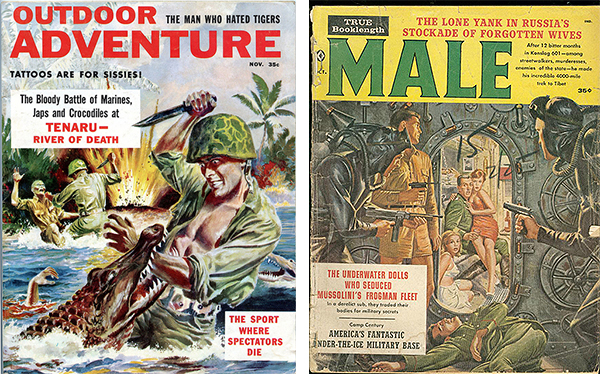
When I was a kid my dad and my uncle read magazines like Men, Argosy, and True Adventure. I wasn’t allowed to see them since they were filled with scantily clad women. This made them all the more exotic so I secretly read them when I could. This, along with the more educational voice of National Geographic were influences that shaped my taste for travel and adventure.

The writing style of the men’s magazines was unique in voice. It was laced with drama and embellishment and written in a crude, masculine language common to men who served in the military or worked in blue collar assembly jobs. With the end of WWII and Korea a new generation was born who were exposed to the stories of men who served in two wars but who had never been exposed to the terrible realities of war themselves. For this generation, born in the ’50’s and ’60’s, the wars were a series of romantic, adventurous and exciting stories that inflated heroes to mythical status.  

frogmen200

By the time the stories reached the pages of men’s magazines they were a long way from journalism. They had become bawdy tales, often sexualized, always exaggerated. I grew up on these stories. They created the demand for the Ian Fleming and Alistair MacLean novels and were the precursors to Tom Clancy.

Some time ago another writer whom I’ve had the good fortune to accompany around the world, Ms. Robin Postell, inspired me to try to write a short story as if I were one of those writers for the men’s magazines in the 1960’s. It was more difficult to capture the language and feel of the writing style than I thought. Here is the final version:

frogmen500

Death Dance of the Cong She-Devil: Navy Frogmen in The ‘Nam.

Lt. Steele doesn’t give a damn. He has too many missions in the Rung Sat Special Zone to count.  Steele cheated death by the skin of his teeth so many times they say he can’t die. He knows different. The only thing that keeps him out of a body bag in the Rung Sat is moving quieter and shooting faster than Charlie Cong.

Steele’s a frogman, Navy “SEAL” they call them. His team hunts Charlie Cong in the murderous Vietnamese swamp. It’s a dark green, stinking wet, real life hell.

The “Rung Sat Special Zone” holds a buzzing hive of deadly Cong half sunk in a stinking mangrove swamp that cuts the ‘Nam in half. Charlie Cong holes up in the Rung Sat because it’s impossible to move in- except for him. The mud is so thick it sucks the boots off your feet. The mangroves so twisted you’ll never see the black cobra that gets you. Your last worry is a Commie bullet since the Rung Sat kills most men before Charlie Cong does. The Huey choppers and Skyraider bombers fly over it, the PBR patrol boats skirt around the outside of it, but only Lt. Steele’s gang of tiger striped, green-faced frogmen hunt Charlie Cong inside the Rung-Sat.

And hunt Cong they do. Take the night of January 19, 1968. Word came down to Lt. Steele’s frogmen that a VC tax collector was making the rounds with a platoon of North Vietnamese regulars as bodyguards. That was normal. What was different was the tax collector was a woman, if you could call her that. You think of a woman as your Mom or your girl. You can’t think of Madame Kang Tomb like that. She’s a she-devil from the swampy jungle hell. The crack NVA guard that follows Madame Tomb fear her. They see her unspeakable acts on the peaceful little swamp-people and her own bodyguards. Tomb isn’t fussy. If you glance at her the wrong way, she’ll have your skin peeled off and string you up to a nipa palm for the ants and the sun to finish. It usually takes a couple days.

Steele got the word that Tomb was expected the following night in the Rung Sat. The information cost a Viet spy a bullet in his head. She’d make her rounds, take what rice and chickens the little swamp people had as tax, murder some during her she-devil death dance, then melt back North where she kept her hive surrounded by terror-worker bee NVA bodyguards. It was Steele’s job to make sure she met a bullet or a blade.

Steel’s men are a gang of roughnecks and he-men. Back in “the world” they were surfers, skin-divers and longshoremen.  All of his men are fit enough to win the Olympics. Here in the ‘Nam they’re green-faced murderers, paid to kill by Uncle Sam and made hard by the freezing waters of Coronado, California where only four men in a hundred could pass the gladiator training torture test called “Hell Week”.  The Navy would half-drown them, freeze them, make them crawl on their bellies ‘til their skin was raw then do it all over again for seven days and nights with no sleep. Some men went mad, others cried for mommy. A few became frogmen. Steele was one, his gang of green-faced assassins a few more.

Their sixth man is the mystery, a jungle tribesman named Nimh. They call him “Charlie Brown” since he loves hunting Charlie Cong and his skin is dark brown from the Vietnamese sun. Charlie Brown isn’t even five feet tall, maybe a hundred pounds after a bowl of rice. His brown skin is like cowhide leather. He could be a hundred by the lines in his face; they say he’s less than twenty. He carries a handmade crossbow that shoots deadly poison arrows, wears a thing like a filthy diaper. No boots or sandals. He fights mostly naked. And there is the necklace. You know… ears strung on a leather thong, cut from Cong killed with his poison arrows. The frogmen told Charlie Brown he’s not allowed to do that. Charlie Brown makes his own rules though. He really doesn’t follow any rules anyway, except kill Cong before he kills you. He has a knife tucked into his loincloth, an old Kabar the frogmen gave him. Charlie Brown is part of the team because of his nose, ears and eyes- and his thirst for Cong blood. He can track the Cong through the Rung Sat when there is no trace; smells a day-old cooking fire a click away. He hears the Cong’s whispers no matter how hard it’s raining or how thick the nipa palm and mangroves are.
frogmen600

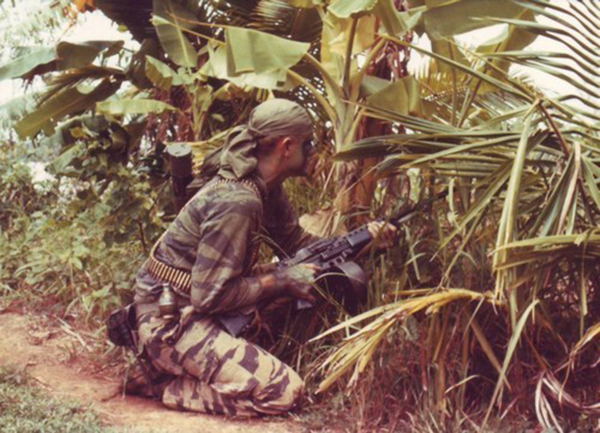
Lt. Steele carries a Remington pump action 12-gauge, sawed off short so he can swing the barrel quick from one charging Cong to another in the thick mangroves. Over his back he slings an M79 “blooper” grenade gun. On his hip he wears a pistol belt, gunslinger style, with a Colt .45 in a special canvas holster tied to his leg. He carries a custom Randall knife hand made in Florida. It has a short blade because, as Steele tells it, “Cong necks ain’t that thick.” Steele uses the 12-gauge because the brand new M16 Marauder rifle the army carries doesn’t work in the Rung Sat. They jam up, too delicate.  The bullets don’t cut through jungle. Steele’s men use the top secret Stoner machine gun, the M1 carbine used to fight the Japs in WWII and the new M14 rifle the Marines are carrying. Sure, the Stoner is fussy, but it spit bullets like a rancher spits Skoal, the M-14 hits like a needle-nosed freight train. Steele sticks to the sawed-off 12-gauge scattergun ‘cause he “likes to work close”. The SEAL-frogmen don’t wear normal battle uniforms. They wear special-made jungle camouflage rip-proof safari shirts with pockets sewn all over them. For pants the men wear regular blue jeans tucked tight into their Army canvas-topped jungle boots. Some men wear a green camouflage beret, others a narrow brim, camouflage beach hat. All of them rub boot-black on their faces so the only thing that shows at night are the whites of their eyes.  Steele wears extra slugs for his 12-guage across his chest in a specially sewn bandoleer like a Mexican bandit.

Just after midnight Steele’s frogmen loaded up in a low, dark green Navy motorboat heavy with machine guns and grenade launchers. It cruised on the black water with silent engines along the bank of the Song Dua River in the T-10 Special Military Zone. This is one of the many rivulets that feeds off the Long Tau Shipping channel into the Rung Sat.

Using his red-lens flashlight in the pitch black to save his night vision, Steele showed the Navy boat captain where he wanted to be dropped off on a map, right in the thick mangroves where the main channel meets the Ong Keo River. The tidal current runs fast through there so Steele’s men will wade directly from the boat into the chest deep water inside the mangrove hell. The Navy boat captain is nervous. This is the deadliest part of the Rung Sat.

The boat captain cut the silent waterjet engines early, letting the current carry them into the mangroves. Lt. Steele jumps first, his shotgun in hand. He sinks to his neck and half swims, half walks along the pitch-black, sucking mud bottom. He hears the “ker-plunk” of a snake falling out of the mangroves into the water. Charlie Brown is next into the water, too short to touch bottom he paddles like a dog along the shiny black surface with his crossbow on his back. The rest of the men follow, slipping silently into the water while the boat backs away and disappears downstream in the opaque blackness on the swift tidal current.
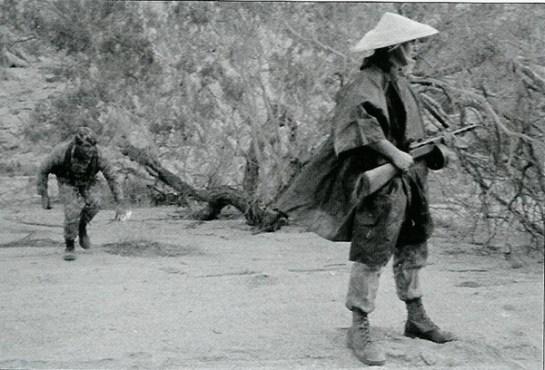
frogmen300

It got shallower, the frogmen were almost on land, only waist-deep now, except for Charlie Brown whose bare feet just now touched bottom. They stopped. Listened. The jungle sounds drifted on black, humid air along with the fragrance of rotting vegetation and… smoke. Charlie Brown taps Steele’s shoulder, points off to the left, the due west, and the team of assassins slowly makes their way through tangled branches and ankle grabbing vines submerged in the black water. After an hour, they went 100 feet. Charlie Brown tugged on the back of Steele’s fatigue jacket, pointed his crossbow forward.

Barely visible in the darkness, up on the narrow, overgrown trail: a man in a triangular hat holding a curved-clip machine gun.

Cong.

In less than a few seconds the Cong guerilla is flat on his face with Charlie Brown’s poison arrow in his temple. Silence, not even a whisper. Steele steps forward, pointing his boots as he lifts his feet out of the mud, moving silently. There is a narrow trail where the VC sentry stood before he took a poison arrow to the head. Steele carefully skirts it, staying a few meters inside the jungle.

frogmen400

He moves silently through the thicket as the ground comes up, and then onto solid ground, crouching down low. Charlie Brown squeezes Steele’s shoulder, he pinches his nose. Smoke. The village where Madame Tomb is reigning terror.

At the edge of the jungle the frogmen come on line. The man at either end slips around back of the village through the jungle, including Steele. He steps up to a thatch hut, unsheaths his Randall and silently slips it under the wall, turning it blade up. He cuts through the nipa palm thatch like flame through ice. Steele looks inside. Two men with rifles are sleeping there. He enlarges the hole and slides silently through it, into the thatched hut. First one man, then the other, both silently, both dead. Throats cut. He wipes the blade of the Randall off and stows it back in the leather sheath on his shoulder. He looks out the front of the small hut, too low for him to stand in.

Tomb stands in the center, villagers gathered around on the ground, sitting on their haunches. She collected baskets of fruit and rice. In front of her is a man, hands tied, on his knees. She’s getting ready to exact her toll on the Vietnamese swamp people. She raises her arms over her head in her weird murder-mamba dance, chanting an oath to the Commies as she begins to gyrate slowly in her death dance.

It’s too far for the shotgun, Steele might hit one of the tribesmen kneeling on the ground with the buckshot. It’s too close for his M-79 grenade gun. He pulls his secret weapon from inside his jacket, a Hi-Standard .22 caliber pistol with a silencer built on it. It shoots hollow-tipped bullets that blast apart when they hit Cong skin.

Steele takes a two-handed grip from inside the hut. Madame Tomb gyrates and chants her murderous mantra.

One shot chuffs clear of Steels’s Hi Standard, then two more. One to the head, two in her back. For a moment Madame Tomb seems bulletproof. Then, like a coon who only caught a piece of buckshot, she topples over. Dead. On the ground.

It’s silent for an instant, one loud VC voice barks. It’s drowned by a frogman lead orchestra as men on two sides of the village cut loose in an “L” shaped ambush. In less than a few seconds every Cong is down and bleeding. The couple that survive the crossfire scramble like monkeys back into the jungle, dropping their rifles in a terror-driven dash. The villagers lay flat on their face, terrified but unhurt. The black-faced frogmen are back.