The U.S. Air Force F-35A Demo Team flew its first Heritage Flight with a P-51 and F-22 in Cleveland: Here is the report.
First Civilian Airshow F-35A Heritage Flight.
Leave a comment
The U.S. Air Force F-35A Demo Team flew its first Heritage Flight with a P-51 and F-22 in Cleveland: Here is the report.
By Tom Demerly for tomdemerly.com

The Olympics celebrate unity and cooperation, sport and humanity.
They also support a greatly maligned human aspiration: Winning.
Contrary to modern myth everyone is not a winner. And that is just fine. Some people are better than others at specific things. They are winners at that task. No one is a winner at everything. And therein lies one of many reasons we need unity and cooperation, but not false equity.
We’ve moved toward a society that enforces a synthetic equity for fear of offending, fear of excluding, fear of discriminating, fear of discouraging.
That’s wrong.
Offense, fear, discrimination and discouragement are all bad things, but they are all part of life. Sport is a microcosm of life- an entire life played out in the time it takes a person to swim a length, run a lap, fall off a bike. It is life, concentrated. And that is part of what makes the entire spectacle so beautiful, so powerful, so tragic and so magical. It’s life in a one-minute swim heat.

Eyebrows went up when U.S. swimmer Lilly King made derogatory and accusing statements about Russian swimmer Yulia Efimova. Efimova has been banned two times for testing positive for performance enhancing substances. King called bullshit on Efimova, mocked her gestures, then went out and kicked her lycra-covered well-trained Russian ass in the 100-meter breaststroke.
Talk the talk. Walk the walk. King delivered. Good story. End of story.
Michael Phelps raised eyebrows by giving the stink-eye to South African swimmer Chad le Clos who beat him in the 200-meter butterfly in 2012 by only 0.05 seconds for the Gold Medal. That is only five-one hundredths of a second. No human activity takes that little time, except losing your ass, and Phelps has built a career of kicking ass. So that loss to Le Clos in 2012 was a bad day at the office for Michael Phelps. He wanted payback. Phelps settled his account with Le Clos last night by swimming 1:54:12 to Clos’ 1:55:19 in the 220-butterfly. In Olympic swimming that is a rout.
And Michael Phelps isn’t sulking anymore.

In the Women’s road race Dutch rider Annemiek van Vleuten crashed heavily on a dangerous descent of the closing lap only a couple minutes from a potential Gold Medal ride. Annemiek was out-descending American breakaway companion Mara Abbott of the United States, at least for the moment. But Van Vleuten gambled, and the reason they call it gambling is because sometimes you lose. She lost. Broken vertebrae, concussion, dashed medal hopes. Tragedy. But she is recovering, and she will race again. The U.S. rider chasing her, she lost too, only meters from the line. Ironically, Mara Abbott lost to one of Anniemiek van Vleuten’s teammates.
So one thing we’ve learned so far in this Olympics is there are very definitely winners, and losers. Not everyone is a winner. There has to be losers to perform in valiant, tragic contrast to winners. And there is nothing wrong with that.
All Photos and Story By Tom Demerly for tomdemerly.com

The day before the tragic Dallas police shooting on Thursday, July 7, 2016, where five policemen were killed and nine other persons injured, I was invited to embed with a Dearborn Police Special Weapons and Tactics (SWAT) training operation by SWAT Team officer Sergeant [name withheld for operational security].
I did not know the techniques employed by Dearborn Police SWAT would be showcased in international headlines 24 hours later in Dallas.
The Dearborn Police simulation a day before the Dallas shootings was hauntingly similar. What is it like to be a Police SWAT Team operator entering a building with a deadly shooter barricaded inside? Come inside a SWAT team operation and find out…
0830 HRS. Wednesday, 6 July, 2016: Joint Dearborn Police Special Weapons and Tactics (SWAT) Team, FBI, U.S. Army Training Operation; Ford Research and Innovation Building (RIC), Village Road, Dearborn, Michigan.
John David Smith is dangerous.
Anxiety, depression, paranoia and substance abuse. Coworkers reported his angry outbursts to managers. They counseled him, offering help on three occasions. Today he must be separated from the company.
Smith knows this, and he is irate. He puts a hunting shotgun and a homemade pipe bomb in a garment bag and drives to work.
0843 HRS. Wednesday, 6 July 2016: SWAT Training Simulation; Ford Research and Innovation Building (RIC), Room 2155.
The Ford Research and Innovation Building is where vehicles of the next decade are engineered today. PhD engineers keep Ford Motor Company at the top of market share with innovation for 2020 and beyond.
The Ford RIC building is a modern facility in the center of a large complex across from The Henry Ford Museum and Greenfield Village and next to the luxurious Dearborn Inn. It is a safe place to work, with OSHA compliant safety placards and employees certified in safe work practices. A massive decade-long rebuilding of the complex was announced earlier this year. This is one of few buildings modern enough to remain as building the new complex begins.
Workers in Room 2155 see John Smith storming toward their office. He is bent over at the waist; head down, carrying a stiff garment bag. Smith has always been standoffish, but staff is trained to engage with dissatisfied employees and make conversation to lighten the atmosphere.
Smith responds by pulling a pump action shotgun from his garment bag and shooting them.
A mass shooting from a mentally disturbed assailant has begun at the Ford RIC complex.
0851 HRS. Wednesday, 6 July, 2016: SWAT Training Simulation; South Parking Lot, Ford Research and Innovation Building (RIC).
I am embedded with the Dearborn Police Special Operations, Weapons and Tactics (SWAT) Unit. I will move as part of the team, “stacked up” in the line with their rescue and assault element. The special police officers carry advanced first aid equipment, breaching and rescue gear, bulletproof shields, surveillance equipment, and an array of cell phones and tactical radios. They are also armed with M4 rifles with holographic sights, handguns, smoke, tear gas and stun grenades.

In the training scenario an explosion of 911 calls arrives at Dearborn Police Dispatch miles away on Michigan Avenue in east Dearborn.
“Someone is shooting!” “We hear screaming.” “It sounds like bookshelves fell over and people are running up the hallway.” There is no clear picture.
Through the confusion dispatch officers trained to make order of chaos alert the SWAT team. Regular officers and Ford Security have cordoned off the building with an expedient security perimeter. SWAT positions their vehicles inside the secure perimeter at a concealed location in the south parking lot. The team is gearing up and getting their briefing. It only takes minutes.
By most comparative metrics Dearborn has one of the best law enforcement units in the United States. The department is modern and practices advanced training around the U.S. and the world. Its Special Operations SWAT Team is made up of officers with diverse backgrounds and extensive training, most with military experience, some with combat tours. But this is a civilian setting, vastly different- and more complex- than a battlefield.
The SWAT team leader is one of the older operators. His name is withheld here for security reasons. With his team in a tight circle around him the team leader briefs his men in calm tones:
“One shooter. Our objective is to get to him as fast as possible and neutralize the threat.” He shares the intelligence gathered from 911 calls, Ford Security and from cell phone communications with employees still inside the building being evacuated.
This is a near worst-case scenario: a shooter inside a massive building a city block in size. It’s an ant-maze of cubicles, engineering spaces, workshops, laboratories and vehicle service bays. There are flammable chemicals, explosive gases and high vantage points. Hundreds of places for a gunman to take hostages and barricade himself for a standoff that could end in the loss of innocent lives. The shooter can move with impunity and has demonstrated that he is willing to kill.
While hundreds of people are running out of the building, these men in black uniforms with Spartan patches on their body armor are running in.
We quietly cross an open zone behind ballistic shields and make entry. Fire alarms are blaring. The emergency exits are flung open by escaping employees. It is impossible to communicate above the din.

The team enters against a rushing tide of fleeing, panicked employees. They jam up in an emergency exit. The SWAT operators calmly establish order and clear the evacuees to open the exit. They do it without a word, quickly searching the evacuees and signaling them to raise their hands. The shooter could be concealed among them. Fast action by the team insures he is not. Police outside secure the evacuees and move them to a safe assembly point.
Once inside the team separates into two elements without a word. They are each lined up, or “stacked” behind a thick bullet-resistant shield wielded by point men. If they come around a corner and find the shooter, the operator holding the ballistic shield will stop the incoming bullets at point-blank range while his teammates neutralize the target.
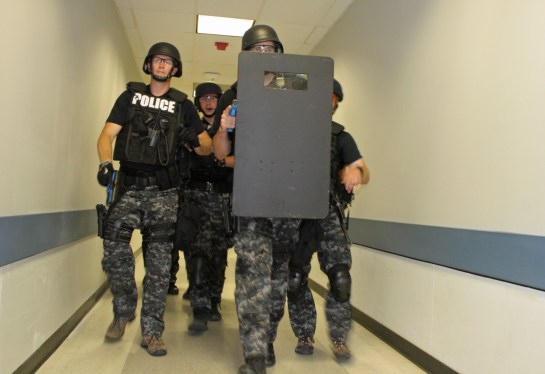
We split the team. One assault element moves to an area where there may be hostages. They operate on sketchy intelligence gleaned from 911 calls that keep coming in, keep changing. The second element, the element I am with, moves immediately to the top floor. We begin a top-down clearing of the building, room by room, in case the first team cannot locate the shooter.
The fire alarm stops blaring. It falls deathly silent in the building. And it is getting hot. The team’s intelligence support unit operating in a large black van outside the building has disabled phones, Internet and air-conditioning. It is critical the suspect shooter does not have access to media. He could use it to watch live video about police response.
First problem: Research equipment in the building is interfering with the team’s tactical radios. The team leader commandeers the radios from Ford Security that are still working. They do a communications check on cell phones and radios. Within seconds new communications are improvised and tested. Problem solved. Forty seconds.
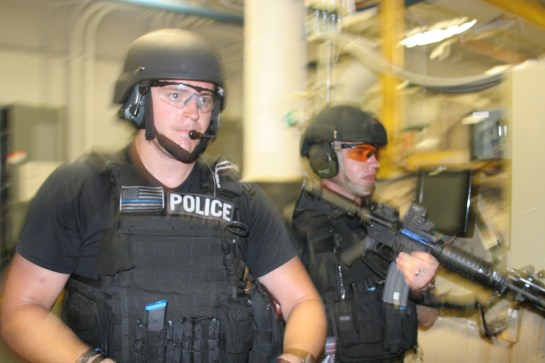
We are sweating now. I carry three heavy cameras and some extra equipment and wear a similar uniform as the SWAT operators. They carry 6-pound rifles, wear heavy body armor, and have on large backpacks with first aid gear, crowbars and door breaching tools. Each man has at least 40 pounds of gear on his back in addition to his ballistic helmet and eye protection. They wear special lightweight tactical boots that make no noise on the floors as they move and provide traction on wet floors. Each one wears hard-shell kneepads in case they must kneel or dive to the prone position.
I’ve done Ironman triathlons and can barely keep up with the team on the stairs with only half their load. These men are in superb condition. When we reach the top of the stairs the only sound is my breathing.
Element 1, the team moving to the possible assailant location, has located an “IED”, an improvised explosive device. A bomb. The U.S. Army and other law enforcement/intelligence units are here for the exercise to provide support and to learn from the operation. I am not allowed to photograph the techniques used to disable the bomb.
In only minutes the EOD team announces “clear”. The bomb is disarmed. There are two (simulated) casualties. SWAT operators use marking pens to write a letter on the casualties’ hands coding their condition for triage by EMT’s once the building is safe.
Our team silently rounds another corner in the systematic sweep of endless corridors.
There is carnage.
The floor is slick with (simulated) blood. There are… 10, 12… 14 casualties down in the hallway. Some dead. Some wounded. Some dying. Some screaming.

It has gone from a hostage situation to a mass shooting, and a small tactical team in a huge building with limited emergency medical capability must make an instant, and agonizing decision: stop and render aid to victims or continue the search for the shooter- who may be creating more victims elsewhere in the building at this moment.
This is a test. A test of the team’s training in decision-making and prioritization. Like most decisions made under extreme circumstances there is no perfect outcome, only a “least bad” choice. Training and mission dictate that choice, and it is made instantly and without hesitation.
The team leader radios the first element. They move to link-up with our team in under two minutes. Instead of briefing the first team members when they arrive, which would take valuable seconds, the team leader briefs them over the radio while en route to our position in the casualty hallway. Seconds are everything.
Wounded people see us. They are screaming for help now. They may be rigged with explosives, one may be the shooter, the shooter may be in any of the doorways emptying into the hallway.
This is a kill zone filled with casualties and the team must manage the conflicting priorities of saving lives and avoiding becoming another victim. The first rule of rescuers: don’t create new victims.
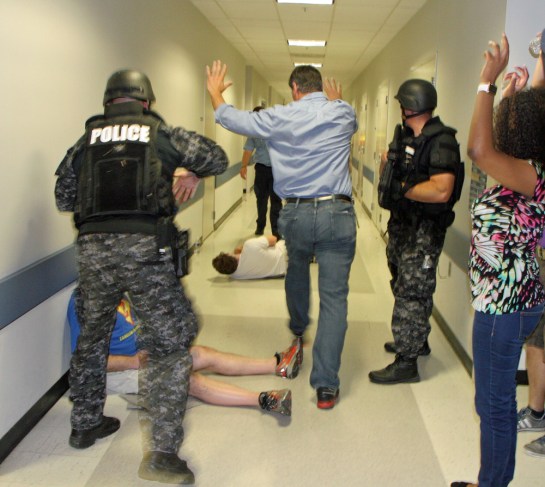
We split again, assault element sweeping to the front of the hallway, our medic moving behind us while the assaulters secure the hallway in front of us. None of the victims are rigged with explosives. None of our victims match the description of the shooter. In seconds the team has swept an adjacent office, secured it, checked the casualties for explosives and weapons and begun treating them. Regular Dearborn Police are pressed into service to help evacuate the wounded. Several victims are dead. We leave them behind. There is a (simulated) bloody bandage stuck to my boot.
After the shock of seeing shooting victims it’s hard to get back into stealth mode. It’s hard to calm my breathing. I look at the operators around me; their faces are neutral with focus.
We enter a meeting room. One operator sweeps left, one right, without a word, skirting the walls of the room with their M4 rifles in the ready position, weapon moving as one with their eyes. They avoid the fatal “funnel” inside the doorway where a shotgun blast from the shooter could cut the team down.
I’m momentarily puzzled when one man scans above us for disturbed ceiling tiles. The other checks a large waste container. The shooter could be anywhere- hiding in trash, concealed in the drop ceiling.

Top floor. We have cleared the entire upper building. The shooter has moved and intelligence suggests there may be hostages since the count of employees rescued, the wounded in the hallway and the number of people who are supposed to be in the building does not match.
Intelligence and training suggest the shooter has moved down to a place where he can secure his hostages and remain defensive. It is rapidly evolving to a standoff hostage situation.
That situation must be avoided.
From the top floor both elements move quietly and quickly to the bottom floor engineering spaces. In total with have covered more than a mile of hallways and stairs. The Ford Security workers show signs of stress, their uniforms soaked through with sweat. I could use water. The building continues to get hotter.
The lower floors are not office cubicles. They are shop spaces and laboratories. Hundreds of places to hide. Flammable chemicals. Gasoline. We enter a large garage area with shiny, new F150 pick-ups hooked to test equipment. The team leader looks in the cab of each truck. Another team member checks the bed of the truck.
There is a voice. Shouting.
At the end of the garage, through a high, clear garage door we make contact with the shooter. It’s the first time we’ve seen him. He is a big man, face contorted in a mix of anger and fear. It occurs to me that the role player simulating a deranged mass shooter must have experience with real shooters like this. His performance is convincing. There are several members of the simulation team I am not allowed to photograph for security reasons. He is one.
The team forms up behind their ballistic shields. They remain quiet. The shooter is shouting something, muffled by the clear garage door that separates us. One team member, our sniper, speaks quietly:
“I have a shot”.
Our team leader must make a decision: Let our sniper take the shot or advance closer in an attempt to assault the garage where the shooter is, potentially apprehending him alive and securing the hostages.
“Move up.” The team leader directs.
We advance along the wall out of sight of the shooter.
There is no hesitation. A concussion grenade cracks blinding light. The team pours into the room, flowing along the walls, weapons tracking the shooter who is now stunned by the deafening noise of the flash-bang grenade. His next flinch decides his fate, and it is a fatal one. He begins to raise his shotgun.
Two shots. Center mass. It is over.
I’m soaked in sweat, my hair is wet. My back hurts from the tension. The team begins an immediate, systematic search of the hostages. There could be an accomplice. It is too soon for “Stockholm Syndrome”, a psychological phenomenon when hostages empathize- and even defend- their assailant. There is an additional search for explosive devices.
More than anything else the team demonstrated their training enabled them to keep the momentum of their search high enough to end the standoff quickly. There are no easy choices when a life may be taken, and that is weighed against innocent lives being saved. The weight of that decision balances on a delicate fulcrum played out in the court of public opinion and the media days, weeks and months after a real incident takes place.
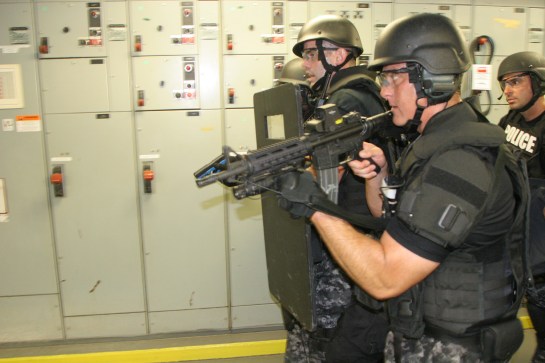
Drenched in sweat and looking for a cold drink I set down my cameras and loosen my boots. The operators converse in measured tones, attentively critiquing the exercise. The outcome of this exercise will be evaluated for months and even years as a way to assess and modify doctrine against evolving threats. If the situation that happened in Texas ever comes to Dearborn our own SWAT Team is more than ready; they are trained, proficient and experienced in meeting the challenge optimally.

Writer/photojournalist Tom Demerly is a former Army Long Range Surveillance team member and has written for numerous military, aviation and specialty publications while traveling to all seven continents, including Antarctica. He is from Dearborn, Michigan.
Photos and Story by Tom Demerly with Jan Mack.

I’m going to puke.
The waves just won’t let up. My equipment is too tight. It is digging into my guts. I pissed inside my wetsuit and another guy’s fins keep whacking my ankle hard enough to make my legs scream. I’m drenched with cold salt spray. The wind coming over the bow is freezing. I can’t see a thing except some vague notion that we are getting farther and farther from land and the ocean keeps getting rougher and rougher.
I’m headed south from Roatan Island, Honduras in a very crowded, open skiff that more closely resembles a Somali refugee boat than a dive yacht. My girlfriend is sitting next to me.
At least she was my girlfriend when we got on the boat.
She might not be if we make it back to shore. This week she earned her Advanced Open Water SCUBA Diver certification, often diving in silty, dark brown water with the same visibility as day-old coffee. Now we’re about to dive in heavy seas far offshore at significant depth in a school of sharks. Big sharks.
And we’re not using a shark cage.
Speaking of refugees, some of our boat crew looks more like… well; this isn’t Jacques Cousteau’s Calypso. They find some seemingly random point in the tossing ocean marked by a soccer ball-sized red buoy almost too small to see. It’s too deep to anchor. We tie off to the buoy line.
The incessant, nauseating roll of the ocean is worse once the boat stops. At least I’m not getting pelted by freezing salt spray and having my rapidly contracting nuts crushed on the fiberglass benches of the gunwales anymore.
The idea is, “Get out of the boat as fast as you can” because being in the boat sucks. Divers are doing back rolls into the waves immediately, like there is a fire on board. I think everybody is ready to barf, and SCUBA divers know it is always calmer underwater.
I glance at my girlfriend. She isn’t smiling.
I roll off the rail and fall a long way into a wave trough before I hit the water tank-first with a commanding splat. The boat slides down the same wave and crushes me underwater. I’m glad I forgot to inflate my buoyancy compensator vest since I really would have gotten clobbered if I had, but now I’m hurrying to get compressed air into my vest since the weight of my gear is dragging me under fast.
I roll over and look down. There is a shark. About the size of a Toyota. Its pectoral fins are gracefully splayed outward; I have a perfect plan-view of it 60-feet below. There is another. And another… They circle slowly in silence down there.
The sharks know we are coming. They swim up from the depths and wait. Wait for something to eat. Wait for us. Wait for the black-rubber bubble monkeys to come see them.
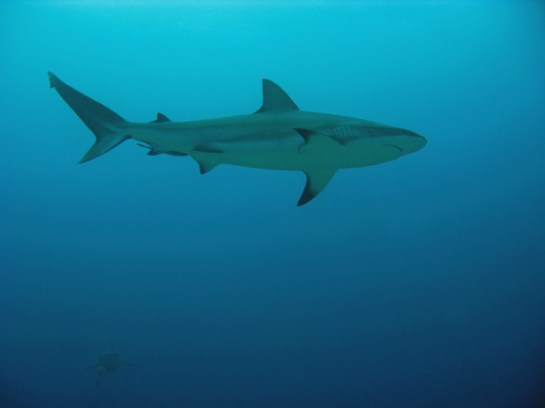
This is the Cara a’ Cara dive site. In Spanish, “Face to Face”. It’s named that because it is world famous for having a face-to-face encounter with big sharks at depth without protective cages.
There are a few species at Cara a’ Cara but the most common are Carcharhinus Perezi, the Caribbean Reef Shark.
Caribbean Reef Sharks are large, about 10-feet at full size. They share the top of the food chain with other large sharks in the Caribbean reefs, especially in shallow water above 200 feet depth.
These sharks are not dangerous or aggressive. If they feel threatened, which is rare, they exhibit a “threat behavior” posture akin to a cat arching its back. They eat fish, and because there are a lot of fish around them in the Caribbean, they are seldom hungry. These facts make them a rather threatening looking, but actually agreeable shark species.
We’ve brought fish with us, and a load of camera toting “adventure” tourists looking for a thrill, a good story, a good Facebook post. And I am one of them.
We brought our dive master with us. His name is Russell Nicholson. Nicholson would fit easily into the crew of the Calypso as one of the divers in a Jacques Cousteau documentary. Bearded, slim, handsome, fit, 26. He speaks with a British accent that seems like narration in every Discovery Channel wildlife documentary you’ve seen. Nicholson has dove everywhere. He is calm and relaxed underwater. During our dives earlier this week I studied his technique, fanning his fins in a motion more like an aquatic animal than a SCUBA diver to move slowly along underwater.
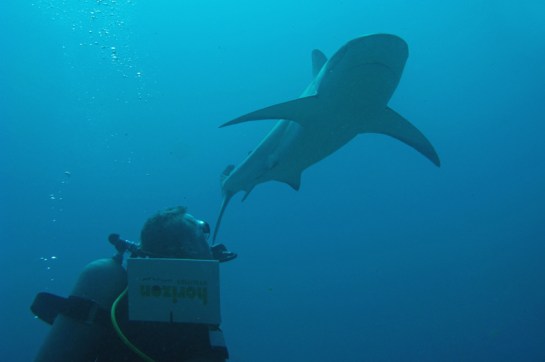
I don’t know it now, but Jan is still on the surface, tossing over the waves and expressing concern about the safety of this dive to Russell.
Me? I’m a tourist who just wants to pet sharks.
As usual it is decidedly less chaotic underwater. Visibility is good, maybe a couple hundred feet, the water is warmer than the air and there are, thank God, no waves churning my stomach down here.
A queue of divers who speak five different languages hangs onto the mooring line beneath the buoy. Our languages don’t matter underwater. We descend the mooring line as a group, as though we are rappelling into the steel blue depth.
There is a reef at our back forming a natural theater. We keep the theater wall to our back, presumably to limit the approach of sharks from behind us but more realistically to keep a bunch of tourist divers from swimming off willy-nilly chasing sharks and getting lost a couple miles off shore.
We pack in, divers next to one another against the reef at 70-feet depth. A moray eel who makes his home here sticks his large, green head out inches from my right elbow in greeting or in grumpy warning to “stay off my lawn”.

The dive master on this dive brings a bait box to feed the sharks. And this is why they always come. And also why what we are doing may be considered wrong.
According to the late R. Aidan Martin the former Director of the ReefQuest Centre for Shark Research, a Research Associate of the Zoology Department of the University of British Columbia, and an Adjunct Professor of the Oceanographic Center of Nova Southeastern University:
“In recent years, organized shark feeds have provoked considerable controversy. Critics claim that this activity changes the behavior of sharks and the structure of reef ecosystems. There is concern that sharks become dependent on these ‘hand outs’ and may associate all humans with food, increasing the likelihood of attack. Proponents argue that sharks are simply opportunistic, if the feedings stopped, the sharks would simply disperse and go back to feeding upon whatever they fed on before. Although accidental nips have occurred (mostly received by ‘shark wranglers’ conducting the feed underwater), there is no good evidence that shark feedings increase the likelihood of attack away from the feeding site. The issue of modifying reef ecosystems is more difficult to assess. Yes, shark feeds may concentrate predators artificially and the intensified removal of fishes from the environment for use as shark bait is a concern. But populations of sharks and other reef predators have been seriously depleted by overfishing and habitat erosion and many operators use left-over scraps from local restaurants, using fish remains that otherwise would have gone to waste. Clearly, this is a complex issue and a quick or easy resolution is not on the horizon.”
My guilty concerns about reckless “eco-tourism” are somewhat assuaged by Martin’s remarks. If we leave, the sharks won’t flop around on the bottom waiting for handouts from tourists. They’ll just keep being sharks, like they’ve done for millions of years as one of the oldest surviving species on earth.

The sharks are close now; there are about 20 of them. And they are breathtakingly beautiful.
I’ve loved sharks- or the idea of sharks- all my life. When I was a kid I read Peter Benchley’s novel “Jaws” and saw the movie over and over. I’m not sure why I liked it so much. It just seemed… adventurous.
But as we grow up our perspective changes. And hopefully we learn. Between my years as a zitty teenager reading Peter Benchley books and sitting in the dollar theater and now I had traveled the world. I remembered my fascination with sharks. After nearly 200 triathlons, quite a few of those in the ocean, I had never seen one- a big one, up close. I was a SCUBA diver, but all I saw were nurse sharks. One time a big bull shark followed me while snorkeling in Belize. Another time I found a school of sickle fin lemon sharks in the Virgin Islands and waded in to swim with them while they dined on a school of panicked baitfish.
But I never had that moment with sharks, big sharks. Until now.

Operating my camera took work as the sharks circled in front of us at 70 feet. I tried to stay relaxed so I got decent photos. Prayed my camera would work down here.
Then I looked up. She was four feet from me, swimming right into my mask. A big 8-footer. A shark bigger than me. I shot one photo of her coming head-on, then gently kicked my fins once to scoot over, to let her pass.
She was only inches from me, so I touched her. You aren’t supposed to touch the sharks on a shark dive, but I will die someday and this may be my only chance. It was selfish, but I wanted to know what it felt like to touch her, and I wanted her to know I did.
I gently laid my hand on top of her right pectoral fin. It remained motionless as she glided forward slowly. I was struck by her… firmness. Her pectoral fin was hard. The sharkskin, just as you read, was rough and like sandpaper. Fine sandpaper.
She did not react, flinch, dart away, rear around and bite. She just swam- glided rather- straight ahead. I watched, her tail barely undulating slowly side to side in an elegant kind of Hula.
The divemaster opened the bait can and the sharks went berserk, a wild spinning mass of 8-foot rifle bullet bodies darting into the same space. The clear water was stirred into a silty mess, and I was surrounded by sharks ripping a small bait bucket to pieces.
I don’t know where my girlfriend was.

The silt settled quickly as it does at depth, and the sharks regained their composure. Now the divers left the rock amphitheater and swam amongst them. We swam with them, alongside them.
It seemed so incredibly good, so beautiful and safe and wild and good. The gentle sharks, retired from their feeding frenzy, glided amongst us, cameras going off, divers marveling at their size and shape and girth and elegant power.
And then divers began to ascend the rope. But I wanted to stay. As divers left I was on the bottom with more and more sharks- there were more of them and less of us. Finally, the last diver and myself started toward the buoy line to begin our sad ascent to the world of air and problems. I did look down one more time at them, and they were leaving.
I fear that we are losing the world. Nature. Animals. The sea. That it is already damaged beyond repair and despite our quaint efforts to save it, it is too late. And I am old. 54. So this may have been my last chance. And I did, quite selfishly, take it.
One day I will die.
If I am lying in a bed, doped by drugs and drifting in and out of life, I hope I remember them still- the beautiful sharks- and how I felt with them. How perfect and majestic and regal they were. I hope I remember them as I die of old age.

Author Tom Demerly likes cats as well sharks, can’t help petting them both and has been all over the world.

By Tom Demerly.

He just appeared.
Out the back window in a pool of light at 12:34 AM. He was interested in what was inside our window. When he looked inside our house he saw two happy, healthy, well-fed cats with rooms full of toys and cat trees and water fountains and beds. He had a sad look of longing on his face.
And then he was gone.

It was March 13 that first time we saw him. Since then he has come back many times. Sometimes he just shows up. He comes running when he sees us. Now he answers to our voice when he is around or meows outside the window to come in.
We started calling him “Mr. X”, a man with no name, no obvious place of belonging.
When Mr. X arrived the first time I was concerned. Animals show emotion on their face. After decades of living with cats I could tell Mr. X was not happy outside our house that night. He wanted a warm blanket, a cat tree, something to eat and a friend.

We kept an eye out for him and over time he would make his way back for another visit. Then another. Finally, one day, we invited him into the back porch. It’s segregated from our two cats (inside only cats with clean health records). He was incredibly affectionate, loved to be petted, then held, then brushed. He smiled a big cat smile and purred when we gave him his own blanket. Then we bought him a water dish, a food bowl, his own litter box, a heated bed, all on his own glassed-in patio.

We wondered where he was from. Was he someone else’s cat? Did a family move away and abandon him? There were five houses for sale on our block- he could have been from one of them- a family moved out and left him behind.
We had a special collar with our phone number made and we planned to put the bright red collar with our contact number on him so if anyone owned him they could call us when he got home. Domestic cats have relatively small territories, males larger than females, but finite territories nonetheless.
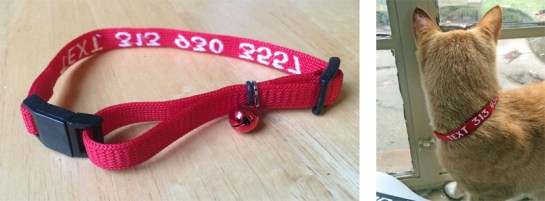
Mr. X happily accepted the collar and went on his way. We hoped we’d find an answer to the mystery of Mr. X soon.
On April 1st at 10:57 AM I got a text message, “My cat came home with a collar that had this number on it. Did you put it on?”
Success. Mr. X had a home, and a name. His name is “Chester”. We don’t know his last name.

As it turns out Mr. Chester lives next door. He comes and goes as he pleases. The people who own him have children who love him and take good care of him. His excellent disposition speaks to their kind treatment of him. But the person who texted me told us her husband is allergic to cats and they were looking to relocate him.
Of course, Mr. Chester has a vote in all this.
Over the next few days Chester made it clear he loves us and enjoys good food, a heated bed and a wide open back porch to lay in while the sun spills through the window during the day.

But Mr. Chester also loves his freedom. He wakes up from his daytime naps and wanders out of the back porch at night. He plays in the yard, running around me, playing fetch, getting petted and stalking imaginary things.
Then he disappears.

We’ll see him in the window next door. Then outside. Then back in our porch. Our cats haven’t met him except through the window and screen and by sharing scents on the back porch after he leaves. Mr. Chester needs a clean veterinarian exam before he integrates with our cats because of disease that can be transmitted from cat to cat.
But there is more: As it turns out the man next door isn’t the only one allergic to cats though. Jan Mack is also allergic, and she takes a coal shovel full of prescriptions every day to moderate her allergies to our two cats, MiMi and Vice-Admiral Malcom Fredrick Davis III. So the full integration of Mr. Chester into our home may never be possible for three reasons; Jan is allergic, and a third cat may add to the symptoms, Mr. Chester may not want to live inside permanently, and outside cats can put inside cats at risk for transmitted disease. Lastly, MiMi and the Vice-Admiral may not want a new cat. They are curious about Mr. Chester’s visits, but reserved about him being a permanent resident.
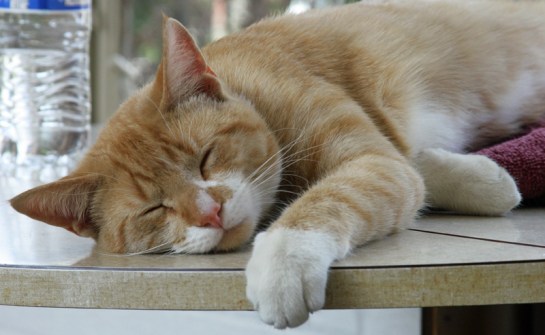
So, as it turns out, Mr. Chester is the decider in this matter. If he decides he wants to move from next door to our house, he is welcome as long as we can moderate the issues of Jan’s allergies and integrate him with MiMi and the Vice-Admiral. But those factors also weigh heavily on the matter.
For now, Mr. Chester is enjoying the benefits of two households and seems quite pleased about it. A veterinarian visit is in his future, and we worry about his exposure to traffic and other animals outside, but he appears to be a clever man who has made his way so far.
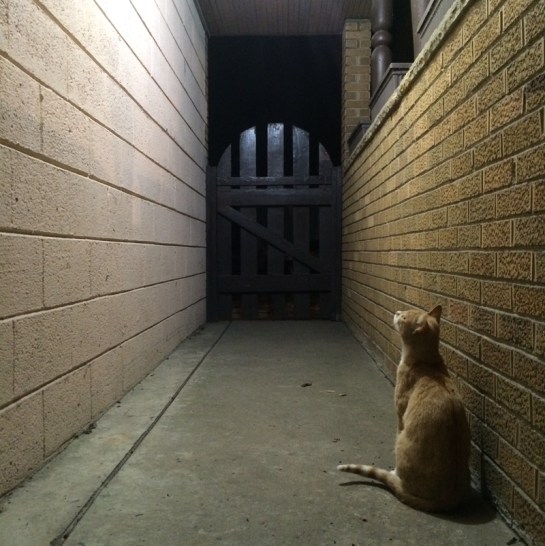
By Tom Demerly.

Bike fitting is big business. Having some version of “professional” bike fitting is the new standard for any bike sold above $1000.
How do you tell if your bike fitter knows what they’re doing? Are they a credible, trained, experienced fitter or just repeating buzzwords in a kind of bike fit “theater” learned in a weeklong clinic under the guise of years of experience fitting athletes during the evolution of bike fitting?
Here are ten checkpoints to assess the credibility of your bike fitter:
If a bike fitter knows what it’s like to be a beginner triathlete filled with anxiety and not even know what questions to ask they can help the newest beginner with solid recommendations. A good fitter knows the “beginner’s mind”.
At the opposite end of the experience scale, if your fitter knows what it’s like to sit on an uncomfortable saddle for six hours at Ironman- and can fix it– it’s easier for them to understand what you’re experiencing. If they have done it themselves, you’ve found a fitter you can relate to.
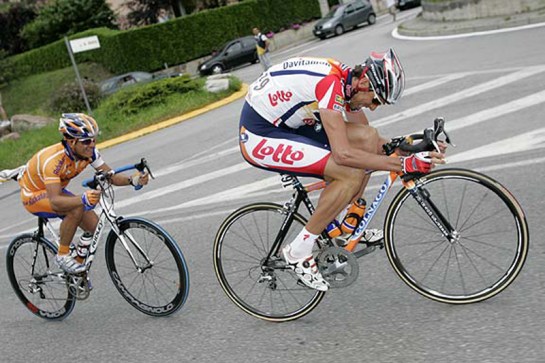
“After their bike fits Dave and Enrique couldn’t help but wonder if there had been some confusion between their two appointments…”
When a bike fitter combines the “beginner’s mind” with elite level competitive experience balanced with formal training and tempered against learned judgment from doing thousands of bike fits, you have a master. And the less a new rider knows, the more the fitter must.
There are a few credible fitters who are not triathletes or bike racers but do know bike fit well. But they are the exception.
Having the practical experience of riding the way you do (beginner or expert) makes communication more effective. It also means your fitter had to apply what they’ve learned about bike fit to themselves. It teaches them critical thinking and hones their analytical skills. That makes them a better fitter.
There is a dark side to the super-athlete bike fitter though, see #10 below.
Beware of any shop or fitter than espouses a single fit methodology. If a shop tells you “We do Retül (or Guru, or FitKit, or Body Geometry, or FIST)” but uses no other system and is not familiar with any others, it’s worth learning how deep their understanding of bike fitting and positioning really is.
How long have they been fitting? Have you spoken to any other fit clients of theirs? What are their reviews?
Bike fit systems are only tools to make the fitting process easier, more theatric, and in some cases, to sell bikes.

Dan Empfield, inventor of the triathlon bike and of the Stack and Reach sizing convention teaches a F.I.S.T. bike fitting class in England.
The quality of the end product depends on the fitter, not the system. A fitter with experience across a number of systems has a more balanced understanding of the bike fit landscape and assesses your fit from a broader perspective. That likely means you’ll get a better bike fit. Beware of the one-trick pony and the Johnny-come-lately with the shiny new fit bike and laser levels.
If a fitter uses only the cookie-cutter fitting system associated with the bike brand they sell, you may still get a good fit on that brand, but the fitter’s capabilities may be limited.
As with point #2 above, bike fitting systems are merely tools. All of them will produce a favorable result in the hands of a skilled fitter- but all of them rely on an experienced fitter.

Nice tools, but do they know their stuff?
When was the last time you asked your bike mechanic, “What kind of wrenches do you use?” As bike fitters become more experienced and capable the system they use becomes less relevant.
It’s the experience and skill of your fitter that matters, not the system they use.
Saddle discomfort is a leading motive for bike fit, but if the only thing your fitter does to make you more comfortable is bolt different saddles on your bike or try to measure your “sit bones” to sell you the right saddle, then they are a good salesperson, but a poor bike fitter.

A good fitter will take a holistic approach to saddle discomfort, addressing fit, position, saddle comfort habits, rider fitness and posture and the rider’s clothing to improve saddle comfort.
Bolting on new saddles is a great way to drive sales and usually the most logical approach to the customer, but it is a myopic view of what makes a person comfortable on a bike seat. Your fitter owes you more than a sales pitch on another magic saddle.
A great way to tell if a fitter is a hack is if they claim to be able to make you more aero without using wind tunnel testing or computational fluid dynamics.
A bike fitter can use empirical, data-driven checks to verify joint angles. They can take specific measurements of frame dimensions and geometry. They can take quantifiable measurements of your body and make mathematical comparisons to determine relevant ratios for bike fit.
A bike fitter cannot do this for aerodynamics. If your bike fitter claims to be able to make you more aerodynamic on your bike they are guessing, and lying.
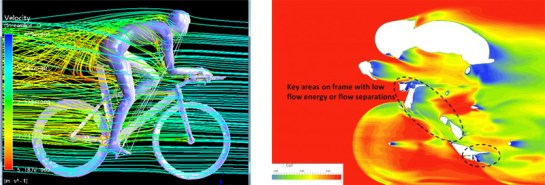
Air is 784 times less dense than water, and it is nearly impossible to predict the behavior of water swirling around your finger. Guessing how air will swirl around a pedaling rider at speed in different wind conditions is impossible without empirical analysis.
I know- I’ve been that guy. I spent over ten years telling clients I would get them “more aero” by lowering their handlebars and making them “more aggressive” until a wise man who happened to have a PhD in aerodynamics told me to “stop embarrassing yourself” by trying to guess at aerodynamics.
I’ve been privileged to wind tunnel test with two bike brands and one independent engineering laboratory in three different wind tunnels over 25 years, on the bike and in the control room. I’ve learned that no one can guess what small changes will make a rider faster over the entire length of a triathlon bike leg. And remember, the goal is to get faster, not just “more aero”, and while those two things are closely related, they are not entirely the same– especially for new riders with comfort issues.

“Jim wondered about riding 112 miles at Lake Placid like this after his bike fit was over.”
Firstly, no bike fitter without a wind tunnel or computational fluid dynamic analytics can guess at the behavior of the boundary layer of air surrounding your body across the entire performance envelope.
Secondly, even if they could, the constantly changing variables of speed, terrain, wind yaw angle and rider posture would make that snapshot in time a very fleeting case study.
Thirdly, while rider aerodynamic drag is the most significant force to overcome in cycling even at moderate speeds, wind tunnel positioning concepts were developed in testing at very high speeds, usually over 25 MPH. British professional triathlon coach Russell Cox discovered the median bike speed for the Men’s 40-44 age category at Ironman Florida, one of the fastest courses in the U.S., was only 17.5 MPH. At these sub-25 MPH speeds there are more opportunities for your fitter to improve your bike split through things that they can actually test for, as opposed to things they are guessing at for speeds you don’t even ride at.
The narrative “Let’s lower your bars to get you more aggressive…” is a valid way to tell if a bike fitter is regurgitating empty rhetoric from YouTube, a triathlon forum, or a three-day fit clinic.
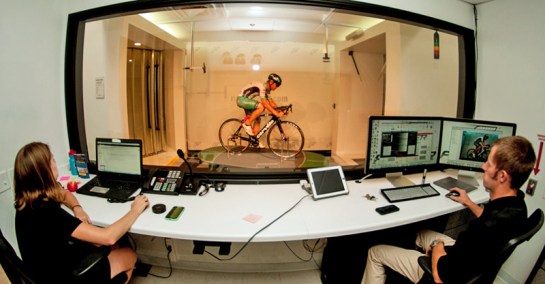
Faster Bike Shop in Scottsdale, Arizona was the first and is likely the only bike retailer in the U.S. with actual wind tunnel test facilities.
If a fitter tries to critique your aerodynamics challenge them by asking, “Can we measure my drag coefficient before and after any changes?” You’ll likely get the sideways puppy stare or a litany of qualifying excuses. Don’t fall for it. There is only one bike retailer in the United States with a wind tunnel, Faster in Tempe, Arizona. If you aren’t there, then your fitter is guessing.
There is a sub-segment of bike fitting and positioning that tries to enforce symmetry on the human form. The only symmetrical human is Mona Lisa. The rest of us are crooked.
It’s simple to use lasers and shims to try to make a person “straight”, but it may create further skeletal misalignment since our skeletons are usually not straight and symmetrical, especially as we age and accumulate injuries.
The craft of the experienced fitter is to find a functional balance between moderating asymmetries that could contribute to discomfort, or even an injury, and facilitating them. There is likely a “sweet spot” between facilitation and adaptation that provides the optimal benefit to each unique rider. This sweet spot is different for a new triathlete than a person doing their 10th Ironman.
If a bike fitter’s singular goal is to “get you straight” you should tell them to get bent.
Many bike fitters try to- or claim to be able to- do too much.
A retail bike fitter should be able to recommend a new bike model, frame size name and geometry that fits you optimally for the type of cycling you want to do. They can then adjust that bike for an optimal basic position, often using different handlebar stems, aerobars and other size-specific components to achieve the best result. Then, they can use any number of analytical tools to verify the results against commonly known bike fit standards.
That’s all.
Bike fitters can’t make you comfortable or “fix” you. They can’t add additional fitness or make you less overweight. They can’t produce the perfect saddle that feels right to you. You still have to train, lose weight if you are overweight and get acclimated to sitting on a bike seat. Those things don’t happen in a two-hour bike fit.
Unless the bike fitter in your store has a formal University level credential in anatomy, physical therapy, medicine or exercise physiology that should be their boundary, and they should respect their customers by working within their boundaries.
Beware of the bike fitter who tries to do too much without the degree to back it up. If a bike fitter learns a customer is suffering from a sports injury they are correct to refer them to a qualified physical therapist. Some licensed physical therapists now have formal instruction in bike fitting too, and you (or your health insurance) will pay extra for that, but it is worth it.
If your bike shop bike fitter tries to play physical therapist, limp out of there.
Ten years ago it was still easy to sell a bike with a quick test ride. Now customers are smart enough to demand a more empirical, data supported process to selecting and adjusting the right bike. As a result there has been an explosion in the number of new “bike fitters” in the last ten years.
Not all of the new bike fitters are good.
Many new bike fitters are adequate and recognize their capabilities- and limitations- but many are also quick-talking hucksters who can sling the lingo and the laser beams to appear credible.
Ask your bike fitter questions about their training, their experience, their own cycling background and their limitations. A fitter who claims to be able to do everything has big shoes to fill.
It’s a good sign if a bike fitter occasionally “walks” a customer by telling them he has nothing in his store to fit them. That suggests their first motive is to get the customer on the right bike, not just get a bike out the door.
A specialty bike shop will stock a well-planned assortment of bikes that have subtly different fit characteristics. Some work well for larger, heavier riders, some for smaller riders, some for long torso cyclists, others for short torso cyclists.
When Triathlon Hall of Famer and inventor of the triathlon bike, Dan Empfield, invented the “Stack and Reach” table for comparing bike dimensions he created a kind of Rosetta Stone for bike fitters to make meaningful comparisons of different bikes and their dimensions. This leveled the playing field and decoded cryptic bike brand size names that have little to do with actual bike dimensions. Empfield’s accounting of bike dimensions gave bike fitters one of their most valuable tools since the tape measure, and also held fitters accountable for being honest.
A good bike fitter conducts an interview with his customers, listening to their experiences, their goals and what they are thinking very carefully. This leads to more questions from the bike fitter. In fact, a good bike fitter often asks the customer more questions than the customer asks them when selecting a new bike.
The best bike fitters listen carefully to position their clients optimally on a continuum between facilitation and adaptation. Facilitating a client means the fitter exclusively listens to the client and does what they say makes them comfortable. Adapting a client means the fitter applies known principles of bike fitting without input from the rider and says, “This is right, get used to it.” The best bike fitters know how to listen to their clients to find the optimal balance between these extremes.
Some bike fitters try to be know-it-alls or local heroes. They try to mold each client into a specific posture or fit model, and they have little space left in their effusive knowledge of all things bike fit, cycling and triathlon related to learn anything from a lowly client. If you can’t get your bike fitter to listen to you, let them talk to the hand.

Craig Turner, founder of Nytro, one of the first triathlon shops in the world, is also one of the best listeners and bike fitters in the industry.
I once listened to Craig Turner, founder of Nytro in Encinitas, California, work with a bike customer. I was surprised by how little Craig said, how much he listened, and how he restated the key points the customer made back to them. It was clear that Turner was a careful and analytical interviewer, asking the right questions and leaving space for complete answers. When he was done with the interview he had the expertise to make learned and supportable recommendations. It was like listening to an expert attorney advise a client.
About The Author:
While Tom Demerly can be full of shit he has been fitting bicycles since 1984 and performed well over 5,000 bike fittings including Olympic athletes Sheila Taormina and Olympian, National Champion and Tour de France rider Frankie Andreu. More importantly, Demerly has fit thousands of first time triathletes and only a few of them still have numb crotches.
By Tom Demerly.
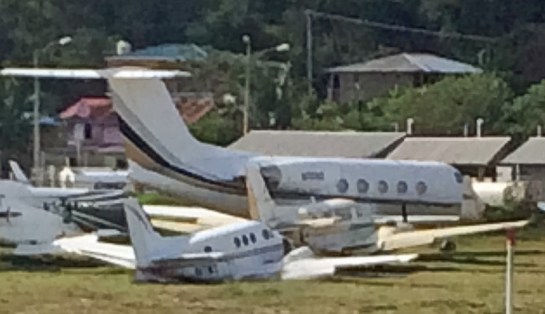
The mysterious, abandoned Gulfstream II business jet with registration number N707KD at Roatan Airport. Photo shot on Saturday, 20 February, 2016 by the author.
Tuesday, April 1, 2014, approximately 1540 HRs Local, North of Roatan, Honduras in the Southern Caribbean.
Eric Emanuel Mejia Montes is sweating.
Montes is sitting in the right, co-pilot’s seat of a Gulfstream II private jet wearing registration N707KD. Only 40-feet below, and slightly behind him is a Cessna 182 single engine, prop-driven civil aviation light plane.
Flying in tight formation the two planes are on final approach to Aeropuerto Internacional Juan Manuel Gálvez, the only airport on Roatan Island, 30 miles off the Honduran coast in the southwestern Caribbean.
The Cessna’s maximum speed is 173 MPH. The Gulfstream II’s minimum stall speed is 121 MPH. Any slower and it falls out of the sky. The Cessna can’t fly any faster to keep up with the jet, now flying so slow it is a wind gust away from falling out of the sky.
The two very different aircraft, one a private executive jet designed for intercontinental travel, the other a light general aviation plane, were never intended to fly close formation with each other, let alone in bumpy tropical air near sunset on short-final approach to a small island runway with no air traffic control facilities.
On radar the two aircraft look like one because they are so close, and despite the stress of trying to hold a close formation (Montes isn’t much of a pilot, barely qualified to fly the Gulfstream) it is more important they risk a midair collision than be detected by the radar-carrying AWACS planes of the U.S. and Mexican security forces.
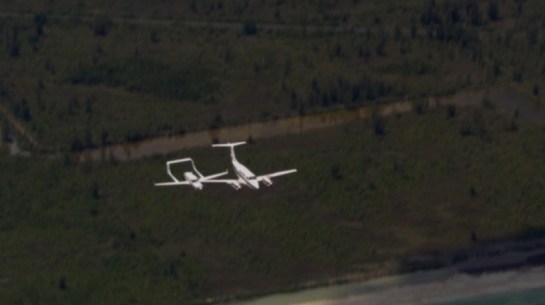
The Michael Mann fictional movie “Miami Vice” depicted two drug smuggling aircraft flying in close proximity to appear as one on radar for the purpose of concealing one of the planes.
Co-Pilot Montes and his “captain” have the easier job. The man, or men, in the Cessna beneath them must wait until the last second before they steer away from the jet above them, avoid a midair collision and quickly land on the same runway behind the jet. Then Montes and Ríos will taxi the jet to a parking area, abandon it and run to the still-running Cessna light plane for a hasty take-off from Roatan. All without official clearance and mostly without detection.
The two planes and their crews followed a mysterious, untraceable path south toward Roatan. No one knows where they took off from, and there was no flight plan filed for their destination. The authorities at Juan Manuel Gálvez Airport, what authorities there are, knew nothing of the arrival of this unusual formation of aircraft.
No one knows exactly what Gulfstream II N707KD and the Cessna 182 are doing. No one knows where they came from.
Three years later what I learned poking around Roatan’s little airport, its island shops and restaurants, from taxi drivers on the island and local SCUBA divers, is that the next day the Cessna 182 that left Roatan with both flight crews- was shot down. All of the crew members were killed according to reports- what reports there are- and no accessible record of who the original Cessna pilots were, where they came from or what they were doing exists.

A Russian-built Venezuelan Air Force Sukhoi SU-30MKK.
From other sources I learned the Cessna 182 was intercepted that next day over the jungle by a Russian-built Venezuelan Air Force Sukhoi SU-30MKV Flanker-G. The big Venezuelan fighter shot the Cessna down with a burst from its GSh-30-1 30 millimeter cannon. The charred bodies of Darimel Guerrero Ríos and Eric Emanuel Mejia Montes- the flight crew of Gulfstream II N707KD- were found inside.
But no one else was.
Reports revealed the Gulfstream II that landed without clearance the day before on Roatan and was quickly abandoned without explanation “tested positive for having carried narcotics”. It didn’t take an expert intelligence analyst to figure that out.
But what happened afterwards- the disappearance of the Cessna flight crew, the shoot-down by the Venezuelan fighter, the lack of documentation of most of the incidents and the almost complete lack of reporting on the entire incident- is perhaps the most fascinating part of the story.
Or maybe not.
In a search of the Drug Enforcement Agency’s database for fugitives the name of one, “’Mike’, Mohammed Mouied, alias EL KHATEEB and/or Mike KHATEEB” is revealed in a search for the names of Darimel Guerrero Ríos and Eric Emanuel Mejia Montes.
Mouied or El Khateeb, or Mike Khateeb- whichever alias you prefer (they’re likely all fake) is a Jordanian. There is a moderately serious criminal record for meth-amphetamine attached to his name and the directive “Do not attempt to apprehend this individual.” His activities appear unrelated to the incident of abandoning the aircraft on Roatan and the shooting-down of the Cessna the next day by the Venezuelans. But he is still somehow linked to the incident- at least in the DEA database.
The abandoned Gulfstream II, registration N707KD, remains at Juan Manuel Gálvez Airport in Roatan. If you fly onto the island for a holiday, look to your left as your plane lands. That’s it sitting north of the runway across from the small terminal. No one has claimed the half-million dollar jet. Curiously, it has not been seized and sold by authorities. It just sits.
And in the mystery of Gulfstream II N707KD there remain many more questions than there are answers.
All Photos and Story By Tom Demerly and Jan Mack.
What is left of our oceans? Is it too late to “save” our planet? Does sustainable tourism exist?
Roatan, Honduras is an island 40 miles off the coast of mainland Honduras in the western Caribbean. It is home to the largest barrier reef in the western hemisphere, the Mesoamerican Reef, second largest in the world.
My girlfriend Jan and I went to Roatan to find a place that is quiet and safe, untrampled by tourists and free from the industrial harvest of its resources. We wanted to see if there is anything left.
We found interesting- and disturbing- contrasts.
One 7,858-foot concrete airport runway serves Roatan. It’s large enough to land a Boeing 757 on- barely, and according to some sources, not quite long enough to take it off from. But Delta Airlines operates 757 service to Roatan once a week if weather permits.
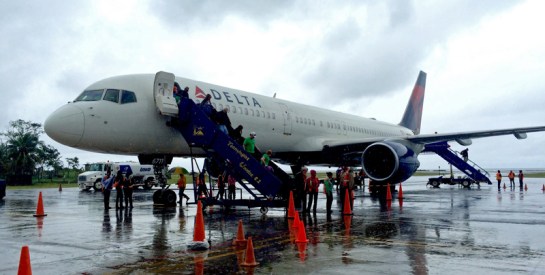
The Saturday we flew into Juan Manuel Gálvez International Airport was iffy. Low cloud and driving rain raked the island. It was February 13, 2016.
There is no modern landing approach system for Roatan’s only runway- no runway lights either. If the weather is too bad to land when you get there, you fly back home. The landing is even sketchier since your aircraft has to carry at least enough fuel to fly back to the mainland if it can’t land because of bad weather. During the fifth circle above the airport at 3,000 feet over a barely broken- and thickening- cloud layer our pilot’s announcements became increasingly tense.
“We’re going to try for it.” The pilot announced. Airline passengers are uneasy with terms like “try for it” when it comes to landing a big plane loaded with fuel on a short island runway.
Our huge Boeing caromed onto the end of runway 07/25 right on the ocean’s edge like a fighter onto an aircraft carrier. Brakes screeched hard as the thrust reversers on our twin jet engines shot an eight-foot diameter plume of spray forward of our plane. With only yards of runway left we stopped. We didn’t know when we landed we would need every inch of it for take-off a week later if it were a hot day, which is almost every day in Honduras.
Minutes later a United 737 twin-engine airliner made a similar attempt at getting into Roatan- and failed. He flew back to the mainland. We were the only flight to get onto the island that day. When we left the immigration checks, the airport closed.
They fingerprint you coming into Roatan and take your picture. There have been problems. Problems with people coming to commit fraud, sexual crimes, drug use and trafficking. It isn’t an epidemic though. The island is, based on our experience, safe and friendly. The islanders have built this line of defense against the things that make mainland Honduras, one of the most dangerous places in Central America, unsafe for tourism.

Every islander told us that mainland Honduras milks Roatan tourism as its cash cow but returns little back to the island. Both holiday tourism from the few cruise ships that visit for day trips and slightly more adventurous “eco-tourism” for the SCUBA diver crowd. Jan and I were the later. We imagined ourselves as somehow… “better” or more authentic than the cruisers.
Our base would be Blue Island Divers, a rustic, beautiful dive center on the north coast of Sandy Bay with two cottages on the beach. Eric and Carly White run Blue Island Divers. They’re Texans, with the attendant drawl and pleasant manner. But their easy attitude belies a work ethic that is tireless. Filling SCUBA tanks, fixing plumbing, scheduling dives, maintaining boats, serving drinks, teaching new divers and improving existing ones- all done quietly behind the scenes against a backdrop of relaxed island paradise.

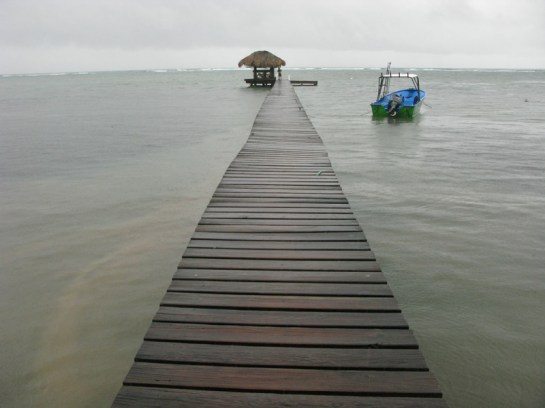
What Carly and Eric have created at Blue Island Divers is a sparkling gem in a vast sea of lesser experiences. Authentic and welcoming, small and quant, this is exactly what we had hoped for- a quiet cabin on a remote beach with tropical birds and roosters for alarm clocks, sunset views and hammocks swaying under jungle palms. It looks like a movie set. Exotic reef fish swim in shallow, crystal water forty steps from where our heads hit the pillow in our cottage. You can walk the beach for kilometers in either direction. The reef sits yards off the beach, creating a calm estuary ideal for swimming, snorkeling, sunning and teaching new divers. In our front yard lies some of the best diving anywhere on earth- a two-minute small boat ride away. Some dives sites you can swim to.

Our beach cabin at Blue Island Divers in Roatan.
My girlfriend Jan is a new SCUBA diver and I am an old one who hasn’t been underwater in years. We took basic and refresher dive training in Michigan then went to Roatan for her open water certification dives and to explore one of the most renowned dive sites in the world.
Jan is a triathlete who had open water swim anxiety. She ‘s an Ironman finisher. It may seem odd that she was uncomfortable swimming in open water but fears of the unseen live in our minds that way. SCUBA diving is a way to understand what is really below the surface to moderate those fears.

Our dive instructor and dive master at Blue Island Divers is Russell Nicholson, 26, originally from Newmarket, United Kingdom. Nicholson looks the part; short, Errol Flynn beard, curled hair and relaxed eyes that never waver, never suggest alarm or urgency. His voice is a laconic monotone of British accent, always spoken at a volume that politely requests attention rather than loudly demands it. His remarks about a dive site, sea conditions, dangerous sea life and submarine lesson plans are precisely spoken and trimmed of any sensation. There is the slightest hint of Ian Fleming’s James Bond when he suggests we “Just go inside, and have a nice swim-through” at an underwater cavern in 65-feet of ocean that opens over a submarine cliff dropping into a black abyss. No other dive master could have made us confident in such an expedition. Nicholson made it seem almost… pastoral. “We’ll just kip down and have a look, then we’ll decide.”
Russ Nicholson got here after finishing college, sciences and exercise physiology, in England at the height of the recession. With poor job prospects he did what any self-respecting English adventurer does, he traveled the world as a SCUBA instructor.
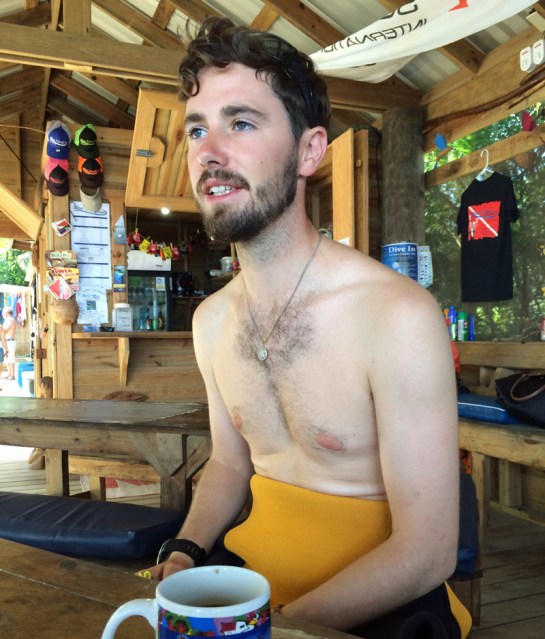
Dive Instructor Russ Nicholson.
“Egypt was incredible, but the Muslim Brotherhood and the unstable government made things a bit dodgy at times…” From there to Asia, Thailand, Indonesia across the Pacific to Australia where he worked construction for a couple years. Then back on the road of undersea adventure as an expert dive instructor. Nicholson certified over 500 divers and built a reputation as one of the finest dive instructors across that part of the world. Now he sat across from us, our own private instructor and underwater guide.
Drenching rains and ocean gales pummeled the island washing rivulets of thick jungle mud through swollen rivers dumping into the ocean when we arrived. The island wore a dense, brown belt between its beaches and the reefs. Diving was nearly impossible in the salt-water muck upon our arrival.

A short day later as the weather broke we boarded one of Blue Island Divers’ small dive skiffs from their dock and motored over peeling tubes of big waves that looked like the opening of “Hawaii Five-O”. Our boat Captain, Elden, is an islander. To him the sea has road signs on it. To us it was a dangerous tempest. He navigates the waves and reef like a commuter on a cloverleaf with a Garmin.
Elden found passage between a small island and the reef, ducking behind it then out to sea between waves. Once past the reef our dive boat rose and fell with nauseating amplitude. Combined with a grey sky, dark water and threatening rain it was a good day to lose your lunch over the rail. I dry-heaved five times in the attempt.
After Russ administered our pre-dive checklists and Jan and I did a buddy check we did a back roll entry, swam the five-foot rollers on the surface to the reef marker and deflated our buoyancy compensators for the descent.
Everything changed. A vast landscape, varied and perfect, spanned below us as we fell like underwater skydivers to the white sand sea floor. It was calm underwater. Swarms of colorful fish swam easily in relaxed processions over white sugar sand between coral arrangements the size of buildings. Instantly ten or fifteen species were in front of us. As if queued by our entry a peaceful sea turtle flew over the bottom. What was chaotic and stormy on the surface gave way to Roatan’s main paradise- the paradise beneath the waves.

Nothing prepared us for the enormity and splendor of underwater Roatan. It’s shocking. Otherworldly. Only feet below the surface the world changes entirely. No other transition in human experience is as abrupt and dramatic. It takes billions of dollars and decades of technology to fly into outer space. It only takes a few SCUBA lessons to fly into the inner space of underwater Roatan as weightless aquanauts.
We dove on reefs and shipwrecks, to 100-foot depths and searched for fish species, cataloguing them on an underwater slate. Russell planned underwater navigation exercises for us on land, briefed and rehearsed us, then lead our dives and administered tests in underwater compass reading, distance measurement and every aspect of open-water recreational sport diving. We did two and three dives a day.
Roatan skies yielded to sun and calm seas. The surface conditions improved. We became more relaxed and at home in the ocean. Bobbing on the calm surface before and after a dive under warm sun was relaxing. When we surfaced we ate orange slices picked from trees the day before.

The only contrasts came when we were back on land. Roatan is a poor island. People lead a subsistence life working in service industries. When we walked on some of the beaches toward the small tourist area visited by the cruise ships the amount of trash on the beach was disheartening. During some of our dives we collected bits of plastic bags from the reef at depths of 60-feet, deadly plastic bags that could choke a sea turtle or strangle coral.
In a strange irony the deadliest things in the ocean were plastic bags from cruise ship gift shops. The jellyfish, stingrays and sharks posed no threat. The tourist trash was killing things in front of us.
Among its dive attractions Roatan has a population of large Caribbean reef sharks (Carcharhinus perezii). One dive site, “Cara a Cara”, rests on the bottom in 70 feet of water about two miles off the south coast. Cara a Cara is the farthest from shore of hundreds of popular dive sites on Roatan. The sharks gather there. And so do the adventure tourists.
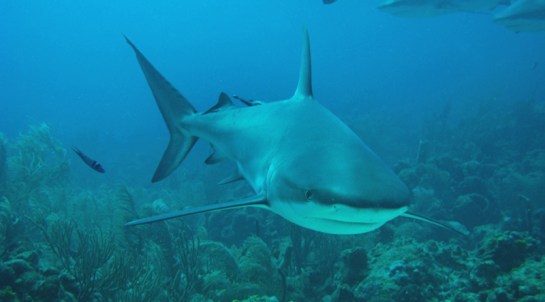
I’ve been a diver on and off almost since I was a teenager. Sharks, big sharks, have only been a rare, distant shadow in the sea that fades into the abyss after we entered the water. I learned sharks didn’t like people. Sharks ran from us. But at Cara a Cara the sharks will return each day if the divers do. The divers descend with a white plastic bucket with a few fish heads in it- not nearly enough for a meal if you’re a nine-foot shark, but enough to tempt them close enough for photography.
We rode a typical open-skiff dive boat packed with divers about two miles out to the dive site. It was rough, waves broke over the bow, we were soaked. One of the other divers, a Frenchman, joked that we looked like the opening scene from “Saving Private Ryan”. He was right.
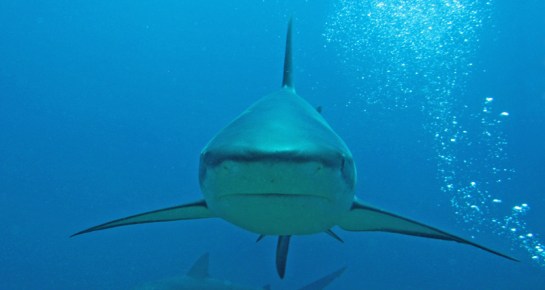
At the moment I back-rolled off our dive boat I had become a part of the problem. I had become a tourist hoping to grab some snapshots of something that should be regular and natural in the ocean, but is increasingly fleeting, exploited and rare.
Descending the mooring line to Cara a Cara I saw the plan form of a big reef shark below me. Gliding on his pectoral fins, he steered a patient course over the white sand 60 feet down. Circling, weaving, looking, waiting. Then there were two, then six, then twelve- then too many to count. Some were massive, the size of a kayak. None were small. Most were pristine and perfect. One trailed a length of fishing line from a hook gouged into the right corner of his mouth. All of the sharks were, curiously, female. Five of them were pregnant. A hopeful sign.
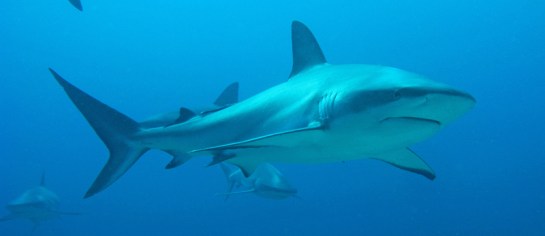
We landed on the white sand bottom in a natural coral amphitheater at 70 feet. Two rows of divers, me on the end. Russ Nicholson dove with Jan and I on the dive. We brought our own SCUBA tanks and equipment since the shark dive operation’s compressor was broken and they had a reputation for allowing their SCUBA tanks to drain too completely for safe operation. Russ looked after us and the other divers. Only minutes after reaching the bottom Russ had to ascend with two divers whose tanks had become dangerously low on air way too quickly.
One diver ran a large video camera, the dive master on the dive administered the bait bucket and the sharks obliged with a display that reached a crescendo when they spun into a whirling feeding frenzy, sending sand flying into the water and reducing visibility. I was in the middle of a shark feeding frenzy 70-feet under heavy seas two miles off shore.
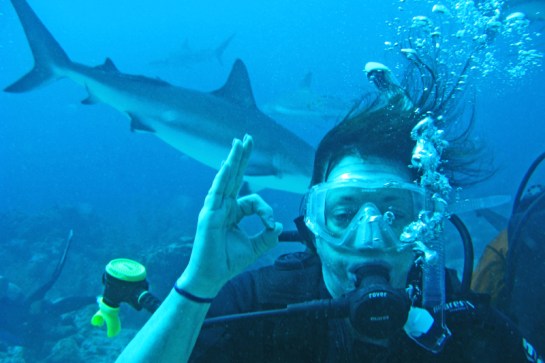
We swam amongst the sharks. They shared their ocean with us for a few minutes. We took their picture. After about 25 minutes on the bottom the sharks began to slowly drift back to the depths and we began to slowly ascend our buoy line, each party returning to its respective worlds.
I don’t know if what we did at the shark dive was good. Am I part of the problem? Did we somehow alter the sharks’ behavior? Does our diving with them threaten them? My rationalization included a promise that I would tell the story of the Sharks of Roatan Island, and now I have.
If you are a diver, you can see them too for $100 if you think that is a good thing. The dive boat is too crowded and the sea can be rough, but the sharks are nothing short of a miracle. A miracle that I am afraid may last only slightly longer than a perfect sunset on Roatan.

Tom Demerly has written for “Outside” magazine along with a host of others and traveled on all seven continents. He isn’t any good at catching fish though.
By Tom Demerly for tomdemerly.com

Purity and distillation. In endurance sports these two things reduce us to our motives, our capabilities. They hold a mirror to our our inner core and reveal what drives us. What keeps us going forward when there is nothing else there- no music, no crowds, no finish line, no mile markers. Only distance and our own strength.
Between Clearwater and Tampa, Florida stretches a rare 9-mile ribbon of white pavement. Set against a stark backdrop of water and sun it distills ambition to reality and leaves a volatile cocktail of capability. What is left after the distillation process is what you have to work with. The Courtney Campbell Causeway is a two-lane traffic span for people driving to the Florida coastal region of Tampa from Clearwater and back. Purpose built next to the highway span is a multi-use path for bikes and runners.
When you run Courtney Campbell out and back it is 18 miles. And it is hot.

The Garmin Connect map display from my Garmin 920XT showing the mile markers.
I ran Courtney Campbell on Monday, January 25th. It was 60-degrees Fahrenheit with an East North East wind at only 6 MPH and low humidity at 57%. Perfect conditions.
You run Courtney Campbell at noon by yourself on a weekday. There are almost no other people there. You are left alone with your ambitions, your shortcomings, your capabilities. After 18 miles of running the concrete ribbon across the brilliant ocean you understand what you can, and can’t, do. And that is why I was there.
It is quiet. Brilliantly, disturbingly quiet. The ocean surface is finely rippled. Seabirds paddle in groups above submerged weed patches on the sand looking for fish. You hope for a good omen- perhaps a shark or a dolphin, to add some mystic power, some suggestion of allegiance to the wild sea.

A boat crosses under the causeway toward the other elevated highway to the south.
Because the miles accumulate without markers or fanfare you simply glide for hours without concern. It just feels good to be next to the ocean, running, in the company of the wild sea.
People run and do triathlons for many reasons. As you grow older your reasons change. Evolve. If you are still in this sport after 30 years it isn’t to impress someone, it isn’t to prove anything, it isn’t for a tattoo or a medal or a T-shirt. It is for the things on the Courtney Campbell Causeway.
Wind. Distance. Air. Ocean. Strength. Purity. Solitude.
I found those things on the Courtney Campbell Causeway, and I had missed them for the past few years.
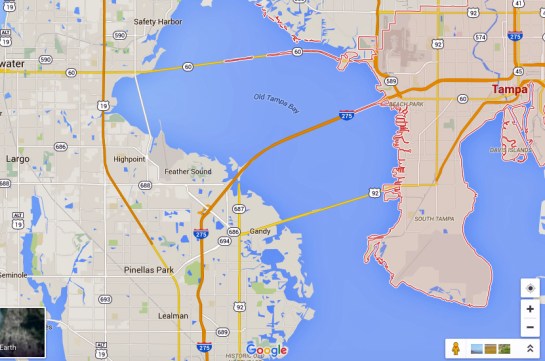
The Courtney Campbell Causeway is Highway 60 at the North end of Old Tampa Bay. There is parking at either end and restrooms at the east side, but no water or restrooms on the causeway.
By Tom Demerly.

“Our greatest calling as soldiers is to create a world that is secure for all mankind. Free of war, tyranny and oppression. Equitable and tolerant. If we do our jobs we render ourselves obsolete, so we are remembered in museums and quiet parks by regal memorials.”
I wrote that for the graduating class of the U.S. Army Infantry School, Fort Benning, Georgia, Cycle C-6-1 in 1982. I was the honor graduate of my first military school, a combined course of instruction for new soldiers called “OSUT” or “One Station Unit Training”. It was an efficient factory that turned out good soldiers. We were supposed to stem the tide of the red menace we feared would blow through the Iron Curtain like a steel hurricane and storm across Europe to push liberty and democracy into the Atlantic under the crushing torrent of Communism.
We were ready to fight. We just never knew what war we would be fighting. “A war with no battles, no monuments… only casualties” as Tom Clancy wrote in The Hunt for Red October.
This week two incredible monuments of this Cold War were consigned to museums and displays. And their internment is symbolic of the end of this terrible era.

The last flying Avro Vulcan, XH558, at an airshow appearance earlier this year.
The only flyable Avro Vulcan Bomber, aircraft number XH558 made her final flight this week. The four jet engines that power the massive, bat-like bomber have been declared too old to fly safely so she returns to the surly bonds of earth as a relic.
The day before the only surviving North American XB-70 Valkyrie was wheeled to a new and permanent indoor display facility at the National Museum of the United States Air Force in Dayton, Ohio near Wright-Patterson Air Force Base.
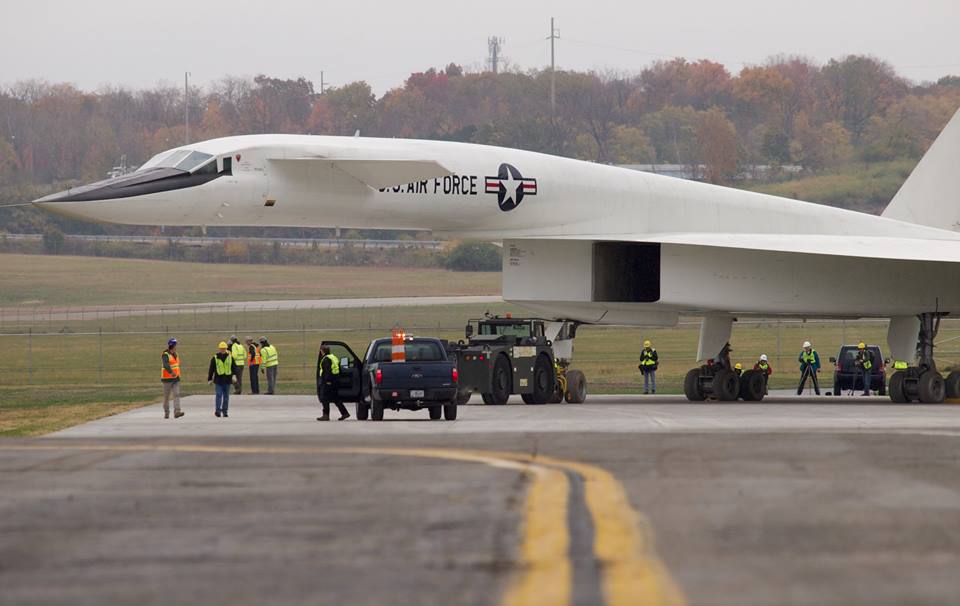
The only remaining North American XB-70 Valkyrie being towed to its final exhibition building at the National Museum of the Air Force in Dayton, Ohio.
These two giant bombers were designed to deliver nuclear mega-death in an atomic slugfest that thankfully never came. Some strategists who espouse the deterrent theory suggest that it is because these bombers flew that the Cold War never got hot.
The two aircraft are quite different. The Avro Vulcan was an operational jet bomber used by Britain’s Royal Air Force. She wore a huge cloak of camouflage and the red/blue roundels of The Empire. The Vulcan saw combat in the 1982 Falklands war when she launched long-range bombing raids on Argentinean positions in Port Stanley in support of a British invasion. Vulcans flew a complex 3,914-mile transit one-way to their targets after leaving an airbase on Ascension Island. They relied on a relay system of aerial tankers to refuel them. The Vulcan was also a star of the 1965 James Bond film Thunderball in which a nuclear-armed Vulcan is hijacked to the Caribbean and its atomic bombs ransomed by an evil network.
The Rockwell XB-70 Valkyrie’s lineage is less illustrious but no less sensational. The XB-70 was a massive, six-engine supersonic jet bomber intended to penetrate Soviet airspace over the arctic at three times the speed of sound. Then it would level Russian cities with nuclear megadeath. The Valkyrie wasn’t a total disaster, but very close to it. One of the two prototypes crashed in an ill-fated publicity photo shoot in the California desert, killing two test pilots. The single remaining Valkyrie was subsequently grounded. The program cancelled. It became an elephant as white as its gleaming, heat resistant paint. An impossible fist of an airplane for a conflict decided in whispers.
And so the big cold war bombers are consigned to the ground. To the museums. Their stories will be told and retold. They will be cleaned and preserved and shined and photographed. Boy Scouts and school children and old men will visit them.
While the internment of these two massive Cold War relics signals the passage of a dangerous era it is an irony that a new mega-bomber project, the “LRS-B” or Long Range Strike Bomber was awarded to Northrup Grumman this same week.
On Wednesday Defense Secretary Ash Carter and the U.S. Air Force announced that Northrop Grumman won the development contract over competitors Boeing and Lockheed Martin. The program is expected to generate $55 billion in revenue for Northrup Grumman over its life making it one of the largest defense acquisition programs in history.
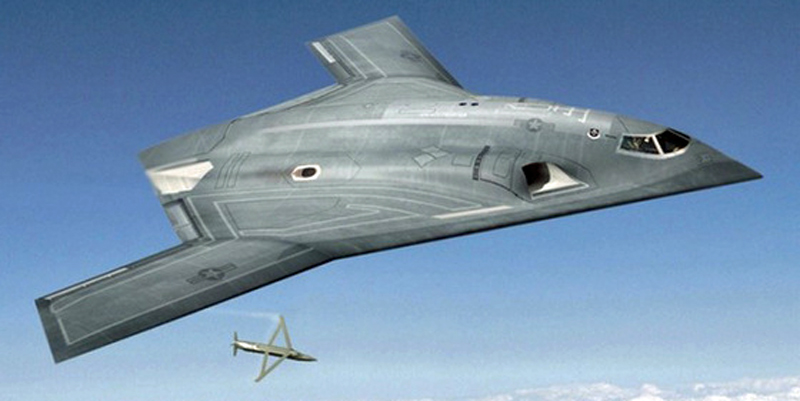
Artist’s concept of the LRS-B bomber project awarded this week to Northrup Grumman.
Some believe the next secret stealth bomber has already been seen, and photographed, over the American southwest when photographers got long range photos of a mysterious flying triangle.
One member of the mega-bomber club absent from the party due to work obligations is the venerable Boeing B-52. The B-52 still flies operationally. It is 52 years old this year. The aircraft is much older than the crews who fly it, and there is no end in sight for the giant, eight-engine “BUFF”. In fact one B-52 stored at the Aviation Maintenance and Restoration Group facility at Davis-Monthan Air Force Base in Tucson, Arizona for eight years was actually returned to service after being refurbished.
While the consignment of the Vulcan and the XB-70 to static displays signify the end of the Cold War they don’t signal the end of conflict I hoped for back at Fort Benning. The conflict between ideologies continues, in some ways more like ancient war than modern conflict. While it is solemn and peaceful to say goodbye to these graceful leviathans it is also worth reflecting on the fact that their replacements have likely long been in the air, veiled in secrecy and flying from remote desert runways. For, as the often misattributed but entirely accurate quote goes, and contrary to my flowery and hopeful speech as a young soldier, “Only the dead have seen the end of war”.
 tomdemerly