By Jan Mack and Tom Demerly.

Today is Trish Morgan’s first triathlon.
It’s a beginner triathlon with a ¼-mile swim, 10-mile bike and a 3-mile run.
Trish has run a few 10K’s, a half marathon (she has a “13.1” sticker on her Honda), did a three-day charity bike ride and swam on the intra-mural swim team in junior high school. She followed a “Ten Weeks To Your First Triathlon” program on line.
So Trish is ready.
She’s at the swim start. The loudspeaker says something important. She catches every third word. Her swim cap feels too tight. It’s her first time swimming in this new wetsuit. It feels too tight. She can barely take a full breath. The salesman said that was OK. Her goggles feel so tight they are making her eyes pop out. They keep fogging up. She won’t be able to see where she’s swimming. In the middle of Mud Lake, with foggy goggles and a new wetsuit choking you, what are you supposed to do?
She can’t see where the lifeguard kids on the paddleboards are. How is a kid on a paddleboard supposed to save you anyway? She can’t see the swim buoys that mark course. The loudspeaker keeps saying something. The wetsuit is too tight. They said this was the right size…
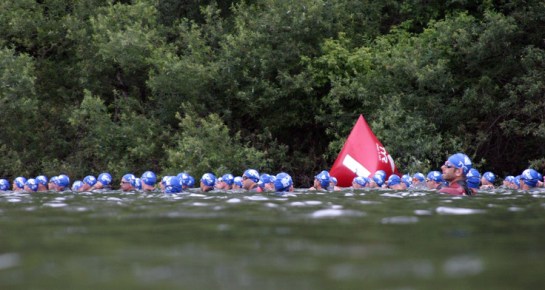
It’s too late to worry. Like a herd of lemmings her group with pink swim caps is moving… into the lake. The dark, weed-filled lake. They are like people trying to escape a fire. Trish moves with them, swept along in the crowd. A rising voice inside her begs attention. It begins as a whisper but gathers volume and urgency.
The rush of cold thickness in the water at her thighs makes it hard to move forward. When do you start swimming? It gets deeper. Quickly. The bottom is giving way- sandy and mucky. She feels something touch her foot… A weed? It grabs at her toes, sending a spike of panic. The water is too deep to stand now. Everyone is still moving forward. She has to swim. There is no choice now.
Her first few strokes are desperate churns of the water that now feels too thin to grab or support her weight. At least the wetsuit floats, and her legs seem to bob uncontrollably behind her while she tries to manage some kind of swim stroke other than a panicky dog paddle. But the wetsuit feels like a straightjacket now, binding her arms and squeezing her chest.
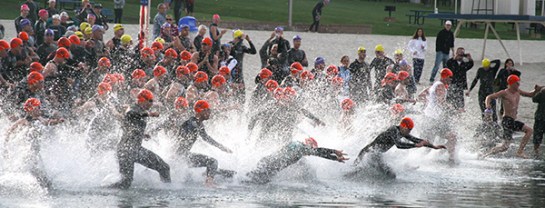
“Put your face in the water and swim,” she tells herself. But the cold bite of the water on her face sends shock through her body, seeming to steal her breath. A jet of icy water shoots down her wetsuit. And through the grey water another swimmer’s heel emerges- she sees it just before it cracks into her left goggle lens. Something touches her foot, a person next to her where she can’t see bumps into her. She cannot see land behind her, she cannot see the first swim buoy, she cannot see a lifeguard. She cannot see in the murky water as the fog in her goggles begins to thicken. Sun glare bounces off the surface blinding her. She can’t see. The buoyancy of her wetsuit is replaced by a rising sensation that she can’t breathe. The voice in her head shouts one word: drowning.
Her chest tightens. She flails against the ever-thinning water. The wetsuit is her enemy now; squeezing what little breath she has out of her lungs. Another swimmer collides with her from behind. And another…
Drowning.
Trish Morgan ends her first race in tears clinging to a lifeguard’s rowboat as he slowly paddles her toward shore.
Trish is a fictional character, but her terrifying ordeal is typical of first time triathletes with no open water swim experience. This horror story is the combination of every swim disaster story I’ve heard during my 30 years in triathlons.
Ask twenty triathletes what the hardest part of a triathlon is, eighteen will tell you the swim.
This contradicts the reality of swimming. Swimming is the easiest part of a triathlon. The swim leg comes at the start when athletes are freshest. It is not weight bearing. There is no foot strike or saddle discomfort. Your body is horizontal so your blood pressure is the lowest of all three sports. It is the only part of a triathlon that is monitored every few yards by safety personnel. You are moving the slowest so risk of impact injury is lower than the bike or run. And unless the water is really rough, there are no hills on the swim course.
But despite the cognitive realities that open water swimming is safe it is consistently perceived as the most difficult and dangerous leg of triathlons, especially for new athletes.
Why do people have swim anxiety and how can they moderate it?
Like any single problem, there is no single solution. Swim anxiety emanates from many origins, some founded in rational fears of drowning, others founded in irrational fears of being attacked by sea life, entangled by weeds or sucked underwater by invisible forces.
Two common triggers are present in open water swim anxiety:
- Lack of experience in the open water swim environment.
- Absence of a purposeful, step-by-step approach to building proficiency and competence in the open water.
You can’t just jump in the open water and expect to feel comfortable, especially in a crowded mass swim start. People often have unreasonable expectations when they enter their first triathlons. They have not adequately prepared for open water swimming, both mentally and physically.
How to Overcome Fear: A Meeting with the Sensei.
I went to California to find out how the best open water swimmers in the world, the Navy SEALs, overcome terrifying swim conditions, often at night, usually with a very real enemy trying to find- and kill them.
I’m sitting on a log at the Phil H. Bucklew Naval Special Warfare Center in Coronado, California. The man sitting at the beach with me is SO1 (SEAL Operator 1st Class) David Goggins.
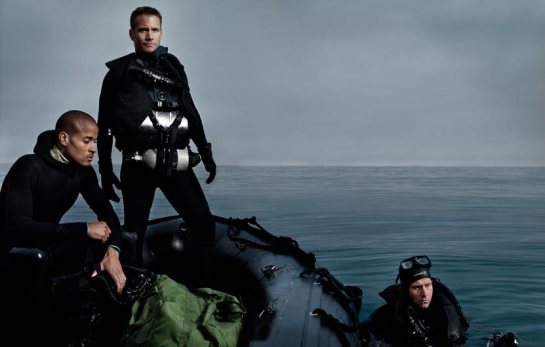
Naval Special Warfare Operator (SEAL) Dave Goggins (Left). Photo Credit: Outside Magazine.
Goggins is a legend in the Navy SEAL community, a title that most of these naval special warfare operators don’t care for with the recent flood of Navy SEAL books, movies and media attention. They prefer “Naval Special Warfare Operator”.
David Goggins is a graduate of the U.S. Navy Basic Underwater Demolition School (BUDS), SEAL Qualification Training (SQT), the U.S. Army Ranger School, The U.S. Army Airborne School, and The U.S. Air Force Special Tactics “P” School. Because of challenges he faced during his Basic Underwater Demolition School Goggins had to go through the most difficult phase of BUDs, Hell Week, almost three times. He may be the only person in history to have done so. Goggins’ Hell Week became Hell Month.
Goggins is an African-American, a demographic not populous in competitive swimming. Black Americans do not widely integrate swimming into their adolescent development. According to USA Swimming, “70% of Black-Americans cannot swim”.
Goggins also came from a broken home, has battled obesity and has a heart defect, a hole in his heart, for which he underwent surgery to correct. None of it has stopped him from being a Navy SEAL, Ironman finisher and ultra distance runner.
“How did you overcome physical and mental barriers to swim for hours in the dark?” I asked Goggins.
“You can push yourself past physical limits.” He told me. “You simply have to focus.”
“Really? It’s as simple as one word; ‘focus’?”
Goggins is right. The singular problem new triathletes have with open water swimming and the single largest cause of open water swim anxiety is the failure of athletes to systematically prepare for the specific task of swimming in the open water environment.
New swimmers practice avoidance, not focus, with learning survival in the open water.
They don’t use a step-by-step approach to open water swimming. They literally jump in all at once.
Jan Mack is a corporate executive and an Ironman finisher. She also has swim anxiety. Or, more correctly, had swim anxiety.
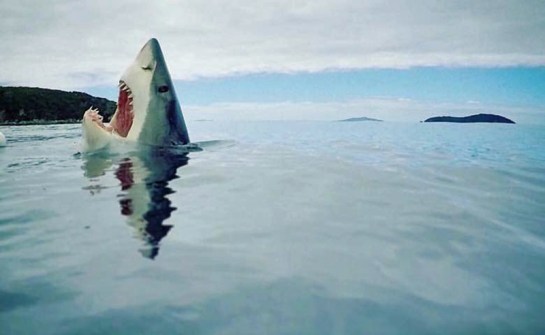
In only eight weeks Mack went from terrified of open water swimming to being a competent open water competitor and SCUBA diver. Previously she stood on the beach crying in fear at the start of a race, her friend pulling her by the arm into the water. Now she is a certified PADI Expert Open Water SCUBA diver who swam through underwater caves at 60-feet depth, explored sunken shipwrecks, swam in the open ocean in 5-foot waves three miles offshore and dove in a school of 6-9 foot sharks without an anti-shark cage.
How?
“Crawl, walk, run.” “Slow is smooth, and smooth is fast”.
Learning any new skill is best done in a systematic process broken into steps.

This is especially true of skills that require confronting fear. The most common reason for open water swim anxiety is the failure of the athlete to engage in a step-by-step process for acclimating to the open water.
It’s a Sunday morning, eight weeks ago and I am at the Ford Community and Performing Arts Center pool in Dearborn, Michigan with Jan Mack.
We are in three-feet of water, about knee-deep, and she is learning to flood her snorkeling mask of water and then clear it underwater without panic.
She’s having trouble.
When Jan’s swim mask is flooded she must continue to breath through her snorkel underwater, but only through her mouth, and she cannot see clearly since her mask is now filled with pool water. When she tries to inhale through the snorkel some of the water inside her flooded mask goes up her nose, producing a drowning sensation. It is terrifying, the same sensation suspected terrorist detainees at Guantanamo Bay experienced when they were waterboarded. According to most international watchdog organizations, what Jan is subjecting herself to in preparation for open water swimming could be considered “torture”.
In repeated evolutions I explain and demonstrate the process to Jan. Slowly, smoothly, repeatedly. Slow is smooth. Explanation, demonstration. Then Jan tries a practical application by ducking underwater on her knees, flooding her mask, panicking and surfacing. And we start over. Slow is smooth, smooth is fast. Explanation, demonstration, practical application. Crawl, walk, run.
There is no time limit, no starting gun, no dark water, no pressure.
Jan tries her fifth or sixth time. It works. There is coughing and sputtering and spitting, but it works. She did it. In three feet of clear, warm pool water Jan Mack has become a “Go” at task number 1, clear your mask of water in a pool without showing undue signs of panic and continue breathing through your snorkel underwater.

Jan Mack advances to the next phase of basic open water training. And the next. And the next.
At each step Jan receives an explanation, demonstration and then performs a practical application of her assigned new skill; using swim fins, wearing a SCUBA tank, maintaining neutral buoyancy… The skills build upon one another. And so does her confidence.
At the same time she is assigned bookwork on open water diving and must take graded tests. Her knowledge about ocean conditions, the sea, her equipment and open water physiology increase. She learns a checklist mentality. She is focused. The new knowledge combined with the skills she practiced beginning in the kiddy pool and advancing to the deep end has built on each other.
Crawl, walk, run. Slow is smooth, smooth is fast.
She has learned through deliberate progression. Jan Mack focused- exactly like Navy SEAL David Goggins, on specific intermediate goals on the way to a bigger goal.
It’s seven weeks later, Friday, February 19, 2016. Jan Mack and I are in a small boat bouncing through big waves three miles off the coast of Roatan Island, Honduras. 70-feet below us a school of sharks, big sharks, circles. I’m fighting seasickness and Jan is fighting fear. But we have our dive instructor, Russ Nicholson, with us and we have our training and experience up until this moment.

There are 20 big Caribbean reef sharks (Carcharhinus perezii) swimming below us.
For the next hour Jan swims with the sharks, no shark cage, no protection. She learns the sharks are like any animal in wild; commanding of respect but not aggressive toward people if unprovoked.
“I don’t know why I was ever afraid” she says after her dive training and open water experience.
Jan Mack has systematically ascended the open water swimming learning curve. She knows the open water environment, from top to bottom. She’s experienced every corner of it, from the shallow end of the local kiddy pool to the open ocean with a school of sharks. Whatever frightened her before, known and unknown, has been systematically broken down into smaller tasks, defeated, and resolved.
The open water environment still commands respect, and being three miles off shore, 70-feet down rough water in a school of large sharks only reinforces the need for that respect. But the process of Jan Mack’s indoctrination into the open water environment has also taught familiarity. And competence.
Unlike the fictional Trish Morgan who panicked in her triathlon swim, Jan Mack prepared in a step-by-step process to get acclimated to the open water environment. Now her fear of the water is converted to a learned respect of the objective risks and a significant level of competence in moderating them.





 tomdemerly